
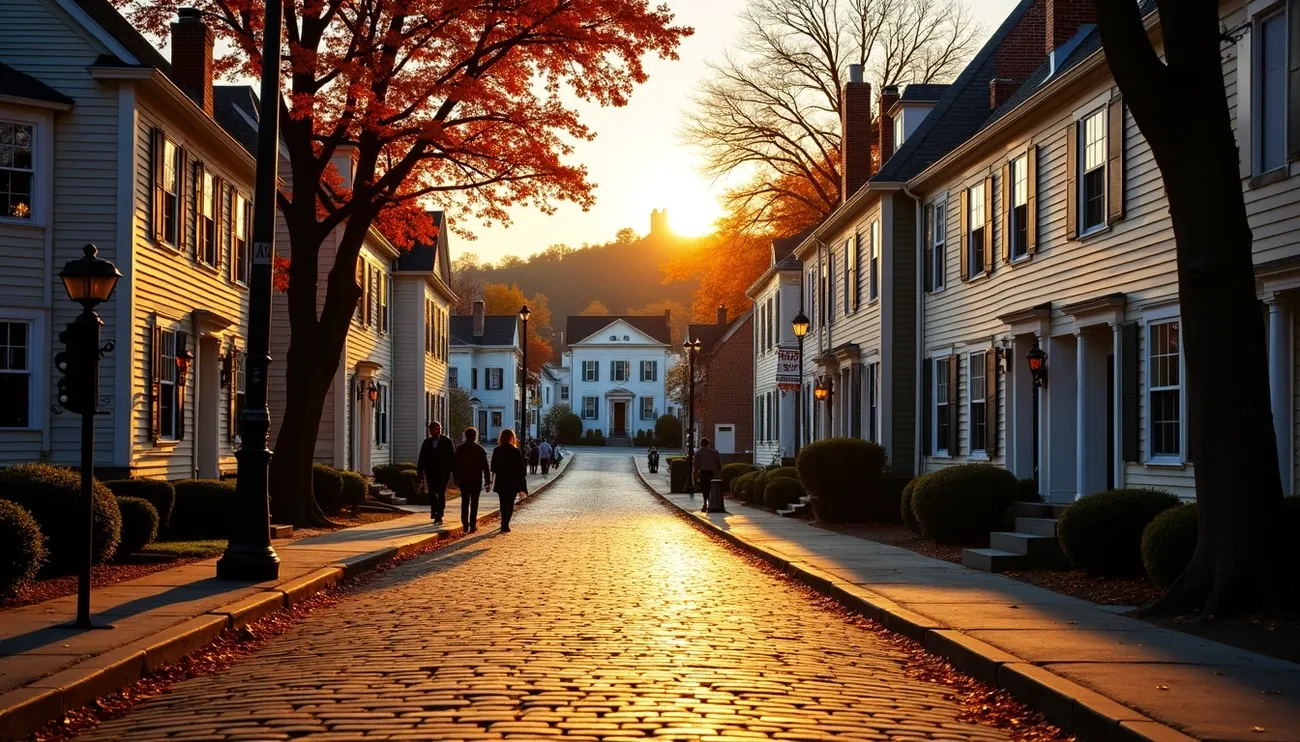
The oldest street in America, Leyden Street, has never stopped housing residents since the Pilgrims began building it before Christmas 1620 after stepping off the Mayflower. Plymouth, Massachusetts proudly showcases this historic road as America’s first example of planned urban development.
The street’s name changed from First Street to Leyden Street in 1823. This historic pathway stretches from Plymouth harbor’s eastern edge to Burial Hill on the west, passing through Town Square. The famous First Thanksgiving celebration of 1621 took place near this significant location. Modern visitors can still walk the street’s original layout despite the absence of 17th-century buildings. America’s oldest thoroughfare creates a physical link to the nation’s earliest European settlement through its collection of 18th and 19th-century homes.
The Origins of Leyden Street
America’s most historic thoroughfare started as a simple path that the newly arrived settlers needed. The Pilgrims called it “First Street,” and early colonial records also mention it as “Great Street” and “Broad Street”. This path became the foundation of American urban development as the first planned road in the New World.
From First Street to Leyden Street
The Pilgrims didn’t wait long to create this historic path after arriving in the New World. They started work right after stepping off the Mayflower to build what would become their settlement’s backbone. The street kept its original names for more than 200 years until 1823. That year, residents gave it a new name: “Leyden Street”. They picked this name to recognize Leiden, Holland’s vital role in their experience to America.
Why the Pilgrims Chose This Location
The Pilgrims had good reasons to build their settlement at Plymouth:
- Captain John Smith’s maps from 1614 already marked the area as “New Plymouth”
- Ships found natural protection in the harbor
- Native Americans had already cleared the land
- They wanted to stay away from Dutch influence near the Hudson River
- The area was safe because there wasn’t much Native American opposition
The Pilgrims’ street design showed great planning skills. The path ran from the harbor’s edge up to their fort on Burial Hill. This smart layout gave them easy access to the sea and kept them safe from threats.
Connection to Leiden, Netherlands
America’s oldest street’s name tells us about its deep European roots. Many Pilgrims lived in Leiden (also spelled “Leyden”), a busy Dutch industrial city, from 1608 until they left for America. The Pilgrims, who were Protestant dissenters, found safety in the Netherlands after facing religious persecution in England.
Life in Leiden had its ups and downs. The Pilgrims could worship freely, but city life was very different from their farming background. Their children started speaking Dutch and picking up local customs, moving away from their English roots. The final push to leave came in 1618 when English authorities tried to arrest William Brewster in Leiden for criticizing the Anglican Church.
The street’s new name in 1823 remembers this significant part of the Pilgrims’ story. Today, it stands as America’s oldest street that people have lived on continuously.
What’s the steepest street in America?
Leyden Street in the 1600s

America’s oldest continuously inhabited street started taking shape in the winter of 1620-21. The settlers built seven simple houses along Leyden Street quickly to shelter themselves from the harsh winter that claimed many lives.
The First Homes and Settlers
William Bradford’s early map shows the first homes only on the street’s south side. The street grew to have approximately 20 houses by 1623, with colony leaders and wealthy residents owning “4 or 5 fair and pleasant” homes. More settlers arrived on ships – the Fortune (1621), Anne and Little James (1623). This expansion led to 32 houses lining the street by 1624.
Several prominent Plymouth families made this historic street their home. Governor William Bradford, Dr. Samuel Fuller, Peter Browne and other leading settlers built their houses here. Each family received plots that measured 49½ feet deep.
Role in the Plymouth Colony
Leyden Street became the heart of the colony. It connected the shoreline to Burial Hill and served as the center of community life. The street linked homes, storehouses, and public spaces together. Two rows of houses along this street created America’s first planned urban design.
Town Brook and Burial Hill
Burial Hill marked the western end of America’s oldest street, rising 165 feet above sea level with sweeping views of the surroundings. The hill, first known as Fort Hill, supported the colony’s defensive structure that also served as their meetinghouse until 1677. Town Brook nearby was a vital source of fresh water for the settlement.
The First Thanksgiving Nearby
The famous First Thanksgiving celebration happened here in autumn 1621. Edward Winslow wrote that “our Governor sent four men on fowling” after a good harvest. They caught enough food to feed the colonists for almost a week. Wampanoag leader Massasoit joined the celebration with about 90 men and they brought five deer to add to the feast.
More on La Rambla street in Barcelona.
How Leyden Street Shaped Early America
Leyden Street’s impact goes way beyond its place in history. This street serves as a trailblazing model that influenced early American community design. The simple road means much more than a physical route—it represents the birth of American urban planning principles.
America’s First Planned Street
Leyden Street holds the unique position as America’s first hosted urban planning effort. The Pilgrims carefully planned this street before Christmas in 1620, instead of letting it develop naturally. Their forward-thinking approach to community building showed in the street’s exact placement. They strategically positioned it between Plymouth harbor and Burial Hill to link essential community resources and provide defensive benefits.
Urban Layout and Community Design
Leyden Street’s innovative design created the groundwork for colonial settlement patterns. Plymouth’s community organization stood out from other New England towns. Most towns featured a central green, but Plymouth built a market square at Leyden Street’s upper end. This market-focused design reflected both practical needs and European influences.
Plymouth’s growth made Leyden Street the central point for the town’s entire addressing system. Two vital cross streets grew from this central artery: Main Street went north while Market Street ran south toward Town Brook. This intersection created the foundation for a detailed house numbering system throughout the town. Even house numbers appeared on specific sides based on their direction from this central point.
Influence on Future Colonial Towns
Leyden Street’s design legacy lives on in many colonial settlements that followed. The street’s simple grid-like approach became a model for efficient town planning across New England and beyond. The original settlers showed remarkable vision despite their challenging circumstances.
Leyden Street’s layout highlights the Pilgrims’ steadfast dedication to building an orderly community around shared spaces. Their design of compact housing lots (approximately 49½ feet deep) that faced directly onto sidewalks created a distinctly American style of urban living that lasted for centuries.
Leyden Street Today: A Living Legacy

A walk down Leyden Street today connects visitors directly to the earliest days of American history. The street’s original path from Plymouth Harbor to Burial Hill remains unchanged after 400 years, though none of the 1620s buildings still stand.
What Visitors Can See Now
Leyden Street serves as a living piece of American history with its residential character. Town Square sits at the upper end of this historic path through the original Plymouth settlement. Visitors often say that “you are truly walking where the Pilgrims walked”. The street’s historical charm lives on despite centuries of changes. Many tourists prefer to walk instead of drive to better experience the street’s story through informational plaques.
Preserved 18th and 19th Century Homes
Beautiful 18th and 19th century houses line Leyden Street today, since the original 17th-century structures no longer exist. These homes showcase colonial American architecture. They sit close to the sidewalks and next to each other on small lots about 49½ feet deep—matching the same dimensions allotted in the first division of 1620. Each house proudly displays a plaque that tells visitors about its original owner and important historical events. This well-preserved streetscape helps people picture life in early America.
Nearby Landmarks and Museums
Several historical sites surround Leyden Street:
- The 1749 Court House Museum stands as America’s oldest wooden courthouse and longest-used municipal building. It displays artifacts like an 1828 fire engine and the town hearse
- Town Square features three notable buildings including the stone First Parish Church and a white wooden church
- Burial Hill rises 130 feet above sea level. The Pilgrims first used it as their defensive fort before it became a cemetery
Why it’s Still Called the Oldest Street in America
Leyden Street deserves its title as America’s oldest street because it has been “continuously inhabited since the original settlers built houses along it”. Other early settlements like Jamestown, Virginia saw only occasional use of their streets. Leyden Street has never stopped being home to residents since 1620. This continuous use and its original layout make it a living piece of America’s earliest history.
Enjoy Americas Oldest Street
Leyden Street today is much more than a simple thoroughfare – it stands as proof of America’s earliest European settlers. The street’s preserved layout connects visitors directly to those first Pilgrims who stepped off the Mayflower over four centuries ago, even though the original structures no longer exist. This historic pathway has seen American history unfold completely, from uncertain first days of settlement through revolution, civil war and into modern times.
The 1823 decision to rename First Street as Leyden Street definitely expresses the Netherlands’ profound influence on early American development. The first settlers showed remarkable foresight with their strategic urban planning that created a direct line from harbor to defensive position, despite their desperate circumstances. Their practical approach to community building shaped countless other American settlements later.
Modern visitors who walk Leyden Street follow the exact same path that William Bradford, Samuel Fuller and other founding families once tread. The preserved 18th and 19th-century homes, while not from the first settlement, notwithstanding that maintain the distinctive character and dimensions that are 400 years old. The surrounding landmarks like Burial Hill and Town Square complement the street and create an immersive historical experience.
Leyden Street reminds us that American history lives not just in textbooks but in physical places we can still experience today. The street’s continuous habitation since 1620 makes it uniquely valuable – a rare direct link between modern Americans and their earliest colonial roots. Four centuries after those first humble structures appeared, Leyden Street serves as both a practical thoroughfare and an enduring symbol of America’s beginnings.
FAQs
Q1. What makes Leyden Street the oldest street in America?
Leyden Street in Plymouth, Massachusetts, is considered the oldest street in America because it has been continuously inhabited since 1620 when the Pilgrims first established their settlement. Its original layout remains largely unchanged, providing a direct link to the earliest days of European colonization in America.
Q2. Why was Leyden Street renamed from First Street?
The street was renamed Leyden Street in 1823 to honor the city of Leiden, Netherlands, where many Pilgrims lived before embarking on their journey to America. This name change reflects the significant role Leiden played in the Pilgrims’ history and their journey to the New World.
Q3. What can visitors see on Leyden Street today?
Today, visitors can walk along Leyden Street’s original path from Plymouth Harbor to Burial Hill. While no 17th-century structures remain, the street features well-preserved 18th and 19th-century homes, informational plaques and nearby historical landmarks such as Town Square and the 1749 Court House Museum.
Q4. How did Leyden Street influence early American urban planning?
Leyden Street was America’s first planned street, establishing a model for efficient town planning across New England and beyond. Its layout, featuring compact housing lots fronting directly onto sidewalks, created a distinctly American approach to urban living that persisted for centuries and influenced the design of many colonial settlements.
Q5. What historical events are associated with Leyden Street?
Leyden Street was the site of many significant early American events. The first Thanksgiving likely took place nearby in 1621, and the street served as the center of community life for the Plymouth Colony. It was home to notable settlers like Governor William Bradford and connected important locations such as the harbor, Town Square and Burial Hill.


Leave A Comment