

I’ve stood beneath the Pyramid of the Sun many times. The volcanic stone feels warm even after dark. This UNESCO World Heritage Site, near Mexico City, is precious. We must protect it from climate change.
The same rocks that built this wonder now pose a threat. Thermal stress and salt invasion are serious issues. They could damage eight square miles of history.
When I learned about the Teotihuacan future 2050 plan, I was skeptical. Could modern tech save this site without losing its essence?
Then, I found out about the innovative solutions. Engineers are using breathable nano-coatings and underground water systems. These methods work with the ancient design, not against it.
This isn’t just about saving ancient Teotihuacan. It’s about showing that advanced science can respect the past and protect the future.
Key Takeaways
- Teotihuacan receives over 1.3 million visitors annually and faces unprecedented climate-driven deterioration by 2050
- Nano-sealant technology allows pyramids to breathe while blocking moisture and salt penetration
- Subterranean stormwater networks mimic ancient engineering to redirect extreme rainfall events
- Mexico’s National Climate Change Strategy mandates heritage sites adopt long-term adaptation frameworks
- Conservation teams blend civil engineering with archaeological expertise to maintain structural authenticity
- The project establishes a global blueprint for protecting high-altitude heritage in changing climates
When Ancient Stone Meets Modern Crisis: The Imperative to Reimagine Heritage Conservation
When ancient engineers built the Pyramid of the Sun around 100 CE, they aimed for eternity. Yet, they couldn’t foresee the climate crisis of 2050. Standing by this 200-foot-high monument, I marveled at the engineering genius. They crafted a 60,000 square yards structure without metal tools or animals.
The volcanic stone has endured nearly two millennia of weather, earthquakes, and human impact.
But survival and thriving are different. Teotihuacan’s structures face rapid deterioration, driven by unforeseen forces.
The Perfect Storm Threatening Mesoamerica’s Crown Jewel
The threats to these ancient structures are real and worsening. Site conservators face a perfect storm of destructive forces.
Thermal stress is a relentless attacker. The sun heats the stone dramatically, then it cools at night. This constant change creates microfractures.
Climate projections make this problem worse. By 2050, heat extremes will intensify these cycles beyond Teotihuacan’s history.
Salt crystallization is another threat. Moisture carries dissolved salts into the stone. When it evaporates, the salts expand, damaging the stone from within.
Teotihuacan’s climate is extremely volatile. It receives barely 600mm of rainfall annually. This scarcity stressed the ancient city’s residents, who developed irrigation systems.
Climate disruptions may have contributed to Teotihuacan’s decline around 550 CE. Weather events between 535-536 CE possibly played a role.
Today, the climate swings wildly. Drought and flash floods damage the pyramids in different ways. Drought speeds up salt crystallization. Flash floods erode foundations and introduce moisture.
Walking the Avenue of the Dead, I saw tourists seek shade after minutes in the sun. The pyramids can’t find shade.
Why Yesterday’s Solutions Fail Tomorrow’s Challenges
The failure of traditional conservation methods isn’t a criticism. Past conservators did heroic work with available tools and knowledge. But the climate emergency has changed everything.
Conventional methods involve surface sealants and cleaning. These worked in the 20th century. But they’re not enough for the future.
Here’s why traditional methods fail:
- Surface sealants trap moisture instead of allowing the stone to breathe, accelerating deterioration
- Periodic interventions can’t keep up with climate-driven damage
- Conventional materials aren’t designed for extreme thermal fluctuations
- Static protection can’t adapt to changing environmental conditions
I spoke with a senior conservator who’s worked here for over fifteen years. She said what once needed attention every five years now requires it every eighteen months. The damage is accelerating.
The volcanic stone faces conditions it was never meant to withstand. Traditional conservation assumed stable environments. That’s no longer true.
We need to reimagine heritage conservation. We can’t just do more of the same. New techniques are being developed.
The stakes are high. Teotihuacan is not just Mexico’s heritage but humanity’s shared cultural legacy. Losing these structures to climate change is a tragedy and a failure of imagination and will.
The Invisible Shield: How Biomimetic Nano-Coating Saves the Pyramids of the Sun and Moon
An invisible shield protects these 1,900-year-old pyramids. It’s a clever solution in heritage conservation. When I first saw it, I thought it would be obvious. But it’s not.
Conservators showed me treated and untreated sections. I couldn’t tell them apart. This is the beauty of volcanic stone masonry preservation.
The ancient Teotihuacanos built these pyramids without metal tools. They used volcanic stone from nearby places. Their pyramids still show dark red paint today.
Now, science keeps their legacy safe without changing how they look. The biomimetic nano-coating is so thin, you can’t see it. It’s like a shield for the pyramids.
Organic Barriers That Let Volcanic Masonry Breathe During Extreme Heatwaves
Stone needs to breathe, and it’s not just a figure of speech. The nano-coating works like high-tech outdoor clothes. It keeps water out but lets vapor escape.
This is key for volcanic stone masonry preservation. Moisture can harm the stone. When it gets hot, the moisture turns into salt that expands and cracks the stone.
The coating stops moisture from getting in. It keeps the stone safe during heatwaves. This way, the stone can release vapor without getting damaged.
I saw teams applying the coating, layer by layer. It’s so thin, it’s hard to believe it works. But it does, protecting the pyramids and showing off the ancient builders’ knowledge.
Thermal Stress Mitigation: Engineering for Mid-Century Temperature Extremes
The desert around Teotihuacan has huge temperature swings. I’ve felt it myself, changing clothes with the sun. The stone also expands and contracts with these changes.
Pyramid thermal stress mitigation deals with future heatwaves. The stone will get hotter and then cooler, causing it to expand and contract. This is more than the pyramids have faced before.
Old ways of preserving can’t handle this stress. But the new coating does. It moves with the stone and stays strong. It even heals itself if it gets damaged.
This technology is made for pyramid thermal stress mitigation. It doesn’t freeze the pyramids in time. Instead, it lets them keep weathering while protecting them from harsh climates.
This technology honors the ancient builders’ wisdom. They knew how to work with their materials and environment. Now, we use science to keep their pyramids alive for another two thousand years.
Beneath the Avenue of the Dead: The Subsurface Sponge-City Revolution
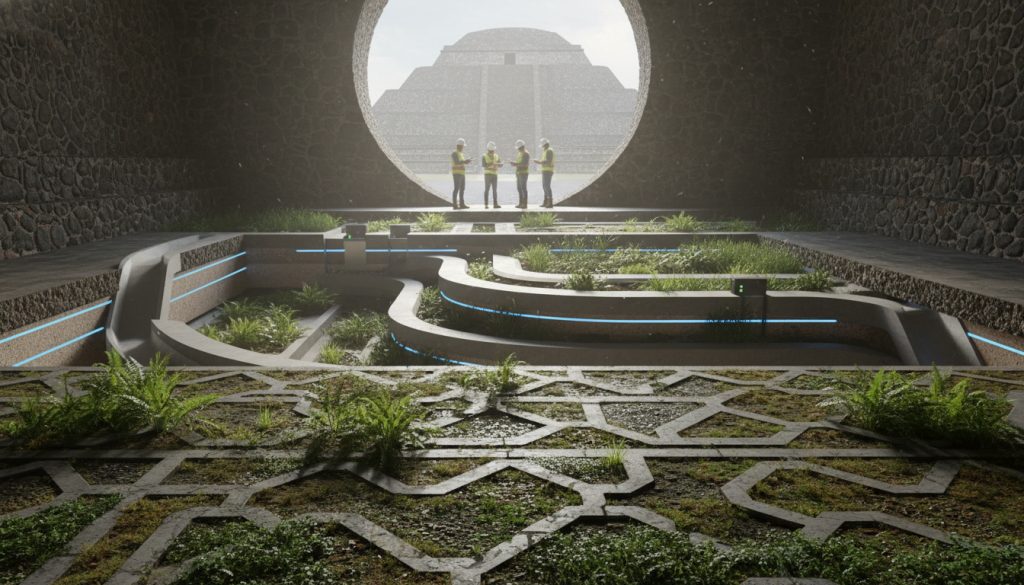
Under Teotihuacan’s famous Avenue of the Dead, a quiet change is happening. This change helps protect ancient sites from extreme weather. The Avenue of the Dead is nearly two miles long and still amazes people today. But, there’s a secret network of channels and chambers below.
I’ve walked the Avenue many times, always amazed by its design and power. But, my latest visit showed something amazing. Engineers have created a hidden shield against flash flooding.
The ancient Teotihuacanos were master water engineers. They knew their land well. In the second century CE, they changed the San Juan River’s path to fit their city’s layout. They built systems for water, including drainage, reservoirs, and canals.
This valley gets only 600mm of rain a year, but storms can be very strong. The Teotihuacanos solved this problem with their engineering skills.
Today, engineers are using modern materials to improve on the ancient wisdom. They’ve created a subsurface sponge-city system that would make the ancient builders proud.
Underground Siphon Grids Engineered to Tame Severe Flash Floods
The new avenue of the dead stormwater siphons are a big step forward in protecting sites. Instead of barriers that harm the site, engineers put in permeable points. These catch runoff before it damages the plazas and foundations.
High-capacity siphon channels move water underground. They follow natural drainage patterns. The ancient Teotihuacanos set their city grid diagonal to water flow, requiring smart engineering to manage runoff.
The siphon grid stops surface flooding while keeping the site intact. Sensors watch the water flow in real-time. This lets operators adjust the system as storms come.
This method fits with efforts for inclusive and resilient cities in Latin America. It shows how climate adaptation needs new infrastructure solutions.
Storage Vaults: Transforming Climate Threat into Resource
What really caught my attention was how the system turns danger into opportunity. The underground storage vaults hold water for the dry season. They’re not just temporary storage.
The ancient Teotihuacanos built reservoirs and canals for similar reasons. Their vision and today’s engineering are connected.
Modern storage chambers catch stormwater that would cause damage. During dry months, this water supports:
- Site maintenance and conservation work needing controlled water
- Dust suppression protecting murals and surfaces from wind
- Landscape stabilization through vegetation support
- Emergency fire suppression in a drier climate
The vaults keep water clean with filters. They also monitor storage levels. This is smart and cost-effective in a water-scarce region.
Walking above these systems, I see the Avenue of the Dead in a new light. The ancient builders and today’s team are working together. This thoughtful innovation gives me hope for protecting sites worldwide.
Teotihuacan Future 2050: The Premier Global Icon for High-Altitude Heritage Resilience
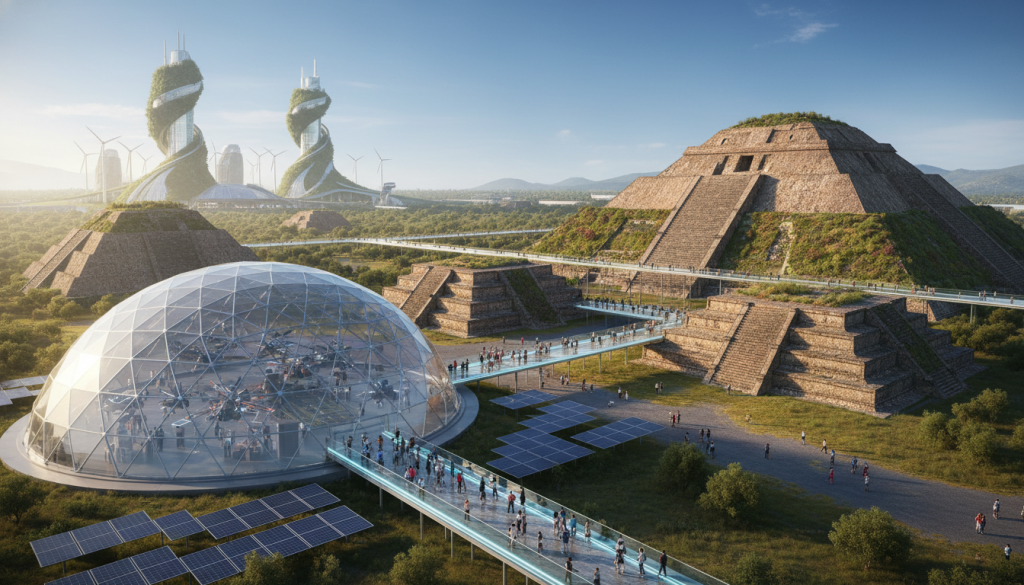
Thinking about the Teotihuacan future 2050 makes me envision more than just restored pyramids. It’s about a place that will show us how to save vulnerable heritage sites around the world. This ancient city, located at 19°41′33″N 98°50′38″W in the Valley of Mexico, is becoming a symbol of resilience.
Over 1.3 million visitors came to this UNESCO World Heritage Site in 2024. It’s Mexico’s second most-visited archaeological site. These visitors are part of an experiment in adapting to climate change.
The vision for Teotihuacan is ambitious. By mid-century, it will lead the way in protecting not just 3,381.71 hectares of Mesoamerican history. It will help safeguard human heritage across the world facing similar climate threats.
Scaling Conservation Frameworks to Mexico’s National Climate Change Strategy
Teotihuacan’s transformation is not alone. It’s deeply connected with the Mexico national climate change strategy. It serves as the main testing ground for climate adaptation in heritage sites.
This connection marks a shift in cultural preservation. The Mexico national climate change strategy now includes targets for reducing climate vulnerability in heritage zones. Teotihuacan is where these plans come to life.
The conservation efforts here tackle many challenges at once. They focus on preserving structures, managing water, and stabilizing microclimates. Each effort is designed to be scalable.
This approach is groundbreaking because it sees cultural preservation and climate adaptation as one. Saving ancient structures means addressing climate threats. The technologies being used, from nano-coatings to underground siphon grids, are being documented for national use.
Why Teotihuacan Sets the Blueprint for Vulnerable World Heritage Sites
Walking through the Avenue of the Dead, I see why Teotihuacan is key for vulnerable World Heritage Sites. Its unique combination of challenges makes it a model for others.
Teotihuacan’s high altitude poses specific climate challenges, similar to sites like Machu Picchu. Its volcanic geology requires special conservation methods. The large number of visitors tests resilience strategies in real conditions.
Teotihuacan’s past is inspiring. At its peak, it covered eight square miles and housed most of the valley’s population. Its influence spread across Mesoamerica, with its architecture appearing from Guatemala to Honduras.
Now, it’s leading again. The conservation methods tested here are being studied by teams managing sites like Angkor Wat and Petra.
| Resilience Factor | Teotihuacan Challenge | Global Application |
|---|---|---|
| High-Altitude Climate | 2,300m elevation with extreme temperature swings | Andean and Himalayan heritage sites |
| Volcanic Geology | Porous tezontle stone requiring breathable protection | Sites on volcanic formations worldwide |
| Mass Tourism Impact | 1.3 million annual visitors creating structural stress | High-traffic heritage destinations globally |
| Flash Flood Exposure | Seasonal monsoon patterns intensified by climate change | Archaeological sites in seasonal flood zones |
The beauty of this blueprint is its all-encompassing approach. It covers everything from managing visitor impact to long-term structural monitoring with solar-powered sensors.
I’m inspired by how the project honors Teotihuacan’s legacy as an innovator. This civilization influenced urban planning across ancient Mesoamerica. Its influence has been found as far as the Maya regions and Honduras.
By 2050, when travelers visit any major archaeological site that’s weathered climate change, they’ll see the impact of conservation frameworks first tested in Teotihuacan. This is a legacy worth fighting for—turning ancient wisdom into modern solutions that protect our shared human story for generations to come.
Solar-Powered Vigilance: Automated Climate Sensors Monitoring Structural Masonry Stability
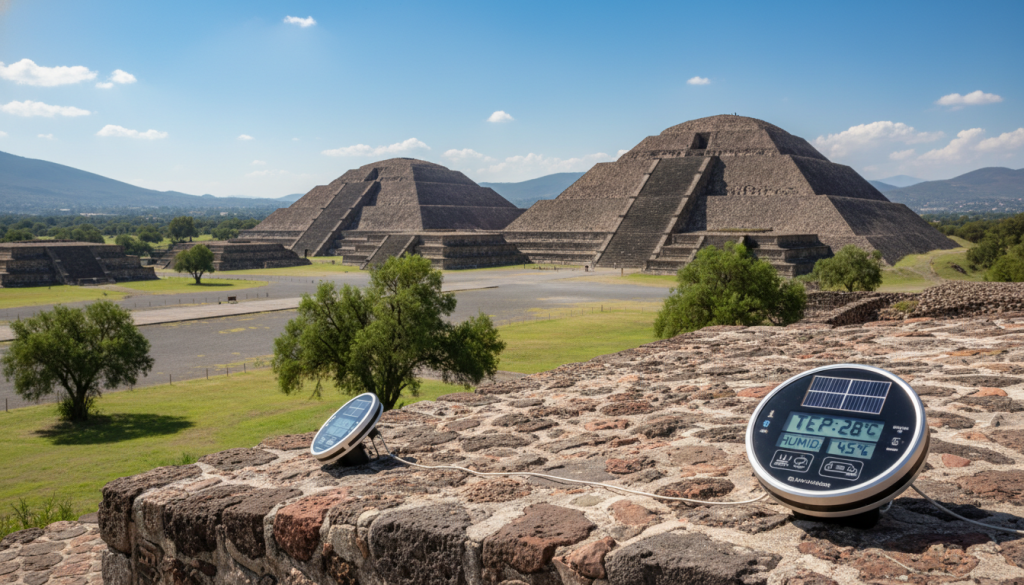
I never thought tiny sensors in ancient stone could tell us so much about pyramids built 1,900 years ago. But that’s what’s happening at Teotihuacan now. Modern tech quietly watches over these huge structures every minute of every day.
The monitoring system is a beautiful mix of respect and capability. Engineers put sensors all over the site to track things humans can’t see. These devices check temperature changes, moisture levels, and small structural shifts that might show trouble.
What amazes me most is how minimally invasive this system is. The ancient Teotihuacanos built the Pyramid of the Sun without metal tools or animals. They knew a lot about building and materials.
Today’s conservators use tech that doesn’t harm the original construction. Some sensors are hidden. Others use non-contact methods like infrared and radar to get data without touching the stone.
Off-Site Solar Arrays Enabling Continuous Real-Time Assessment
The first time I saw the solar monitoring station, I was on a ridge overlooking the site. The solar panels were there without ruining the view. This was done on purpose and was very important.
These solar arrays power a network of climate sensors that work all the time. No diesel generators or lines cutting across the site. This way, the site’s look and feel are kept intact.
The system checks data every few minutes. It sends this info to AI platforms for analysis. This way, conservators can spot problems early, not just during annual checks.
I’ve talked to techs who watch these data streams. They say it’s like having a constant chat with the pyramids. The stones tell us how they’re doing, if we just listen with the right tools.
The sensors track many things at once:
- Internal stone temperature changes that show stress
- Moisture levels and where they are
- Small shifts in the structure that might mean trouble
- Sound changes that show cracks inside before they’re seen
- How fast the surface is wearing away under different weather
This constant checking changes how we care for ancient sites. Instead of fixing damage after it happens, we can stop it before it starts. The Pyramid of the Sun is huge and hard to check by hand every day.
The solar arrays make this constant watch possible. They use renewable energy to keep the sensors going all the time. This is conservation technology that really cares about the planet.
The Beautiful Proof That Modern Science Can Preserve Ancient Sanctuaries
Being at the Pyramid of the Sun today feels different. I feel hopeful about its future. The tech protecting these sites shows what humans can do.
The city of Teotihuacan fell around 550 CE, maybe because of bad weather and climate changes. Modern archaeology shows how smart the ancient builders were. They used what they had to create amazing things.
Today’s conservators are just as smart. They use new tools to protect these sites. They’re working with what they have, just like the ancient builders.
Both groups want to protect something special. This shared goal across centuries touches my heart. The tech shows that modern science and ancient heritage can work together.
| Engineering Aspect | Ancient Teotihuacan (100-550 CE) | Modern Conservation (2025-2050) | Shared Principle |
|---|---|---|---|
| Structural Stability | Sophisticated pyramid engineering without metal tools, achieving 200-foot height | Automated sensors detecting micro-shifts and thermal stress in real-time | Deep understanding of material behavior under stress |
| Material Science | Volcanic stone selection and lime-based mortars optimized for durability | Biomimetic nano-coatings allowing masonry to breathe while protecting surfaces | Working with natural material properties rather than against them |
| Environmental Response | Construction techniques accounting for seismic activity and seasonal weather | Climate sensors monitoring moisture, temperature, and atmospheric conditions | Proactive adaptation to environmental challenges |
| Knowledge Transmission | Architectural expertise passed through generations of builders | AI-powered data analysis sharing insights across global conservation networks | Collective wisdom improving outcomes over time |
The data from Teotihuacan’s sensors helps protect ancient sites all over the world. It tells us how volcanic stone reacts to heat or moisture. This helps conservators in Peru, Egypt, and Cambodia.
This mix of ancient wisdom and modern tech gives me hope. The Teotihuacanos built monuments that lasted nearly two millennia. With solar power and constant monitoring, we can help these monuments last for two millennia more.
Using tech in this way is a sign of respect. The sensors don’t take away from the mystery of Teotihuacan. Instead, they make us appreciate the ancient builders and the modern conservators who protect their work for us.
The Moral Imperative: Why High-Tech Conservation Is Not Optional
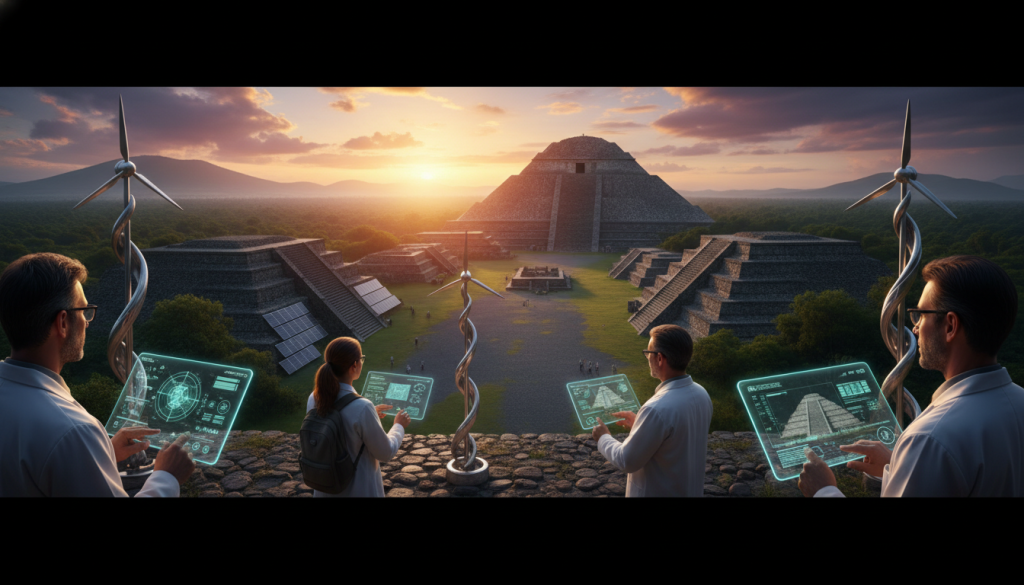
I used to think that spending on advanced conservation tech was too much for ancient ruins. But, learning more, I see it as a moral imperative.
The question isn’t about cost. It’s about whether we can afford not to use these technologies.
The Global Stakes of Heritage Loss in the Climate Crisis
Letting ancient sites like the Pyramids of the Sun and Moon crumble is a big deal. It’s not just about losing old buildings. It’s about cutting off a 2,000-year-old link to human achievement.
Every future generation will face a world with less. Teotihuacan would be nothing but memories and photos. That’s not a legacy I want to leave.
This UNESCO World Heritage Site is huge, covering 3,381.71 hectares. It’s a cultural treasure for Mesoamerica. At its peak, 100,000 people lived here, creating art and building a civilization.
Centuries later, the Aztecs revered these ruins. They saw a connection to the Teotihuacanos. Today, indigenous communities and Mexicans see Teotihuacan as part of their identity.
When we fail to conserve, we lose more than just structures. We break a chain of cultural memory that defines us.
Economic and Spiritual Returns on Conservation Investment
The economic benefits of conservation are clear. Teotihuacan got 1,313,321 visitors in 2024, making it Mexico’s second most-visited site. These visitors bring in a lot of money.
This money supports hotels, restaurants, and many small businesses. Local communities rely on tourism for their income. If visitors stop coming, these communities will suffer.
High-tech conservation is like an insurance policy. It protects a multi-generational revenue stream that supports entire regions. The tech used, like biomimetic coatings and solar power, is an investment in sustainable tourism.
The spiritual and cultural benefits are even more important. The mexico national climate change strategy shows that preserving heritage is key to climate resilience. Heritage sites are central to climate action.
Seeing the investment in advanced conservation, I see a society committed to preserving its heritage. The ancient Teotihuacanos built these monuments without modern tools. Today’s conservation efforts show the same dedication.
Both investments say the same thing across centuries:
- This place matters to our collective identity
- Cultural continuity deserves protection regardless of cost
- We preserve what we value most for those who come after us
- Heritage connects past to future in ways economics can’t measure
The mexico national climate change strategy knows that climate resilience includes cultural resilience. When heritage crumbles, communities lose more than just tourist income. They lose connection to their past and the stories that give life meaning.
I’ve talked to travelers who think conservation budgets are a waste. But, I’ve learned that what we choose to preserve shows our priorities. The ancient Teotihuacanos saw their monumental construction and water management as essential.
Today’s conservation efforts make the same statement. They say that preserving our cultural heritage is worth using our most advanced technologies. They say future generations deserve to experience the same awe as we do.
This isn’t optional. It’s who we are at our best—a species that honors its past while building resilience for the future.
Conclusion: When Cutting-Edge Innovation Becomes an Act of Reverence
Standing beneath the Pyramid of the Sun, I think about the hands that shaped each volcanic stone nearly two millennia ago. Those ancient builders were performing an act of reverence. Today’s engineers deploying nano-coatings and underground siphon grids are doing exactly the same thing.
The ancient Teotihuacan preservation technologies I’ve explored aren’t about replacing history with machinery. They’re about honoring what the Teotihuacanos created between 100 BCE and 250 CE. The biomimetic coatings respect the stone’s integrity. The subsurface water management continues the hydraulic genius of people who rerouted rivers to build their vision.
Every solar-powered sensor monitoring structural stability echoes the maintenance crews who kept this city thriving for six centuries. The Teotihuacan future 2050 depends on recognizing that each generation must use its best tools to protect what came before.
I’ve walked the Avenue of the Dead at sunrise dozens of times. The awe I felt on my first visit hasn’t faded. My hope is simple: visitors in 2050 should experience that same wonder. The pyramids should still rise majestically. The sacred geometry should still speak across time.
That future is achievable. It requires embracing our responsibility to deploy knowledge and resources for something beyond ourselves. This isn’t modern arrogance imposed on ancient wisdom. This is reverence in action, using 21st-century capabilities to honor timeless heritage.



Leave A Comment