
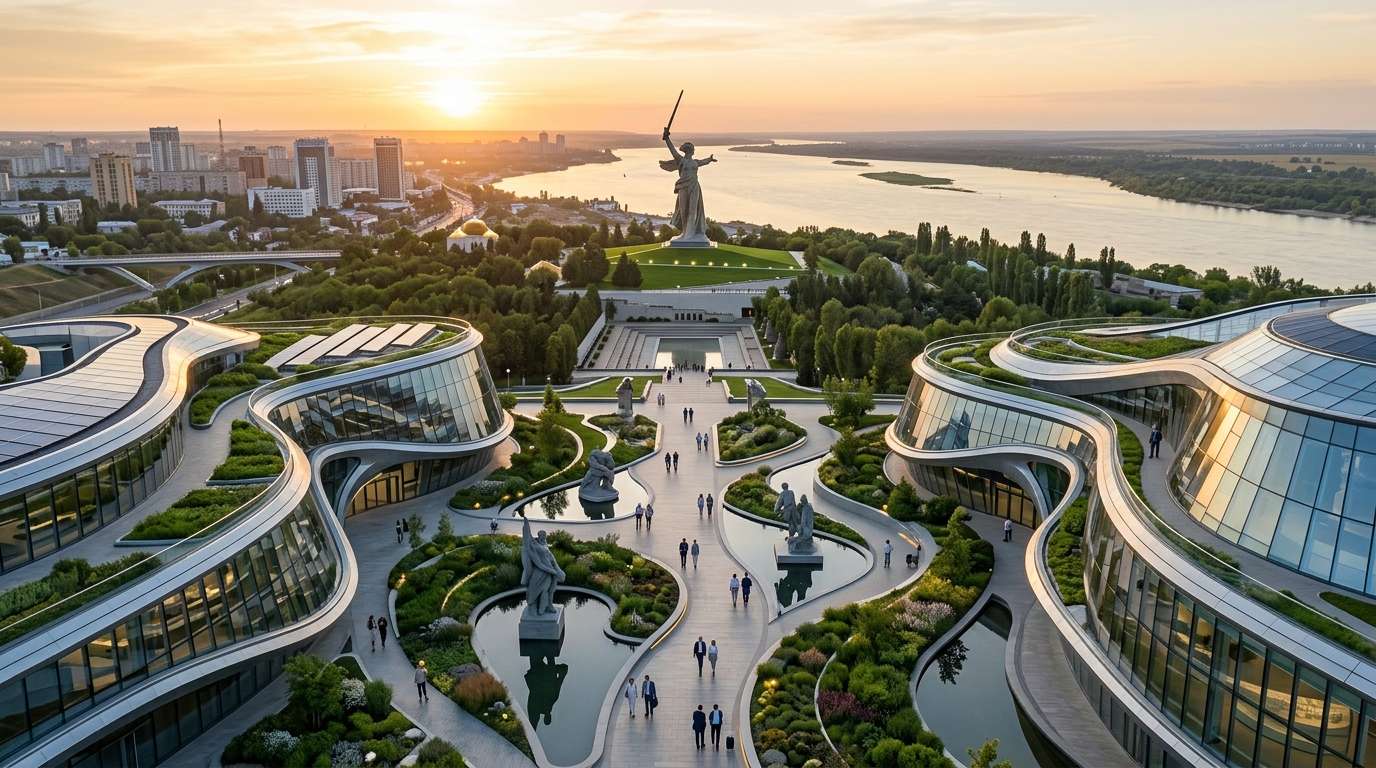
I stand at Mamayev Kurgan’s base, staring up at a hill that once swallowed an entire army. During the brutal Battle of Stalingrad, this slope changed hands dozens of times in close combat.
Down the road, the old Tractor Factory built unpainted T-34 tanks while shells fell. Workers sent them directly from the assembly line into battle. That history still hums beneath the soil.
Now I imagine walking this ridge decades later, through Volgograd’s famous memorial reborn. Concrete strengthened with nanotechnology covers the great statues.
Hidden drainage channels control steppe floods and harsh winter freezes. Footsteps from thousands of visitors power quiet systems buried beneath the ground.
This speculative Battle of Stalingrad Museum future 2050 journey imagines a living sanctuary built on memory. By mid-century, this hallowed ground could prove heritage sites can honor the past while engineering a carbon-neutral future.
Key Takeaways
- Mamayev Kurgan’s slopes saw repeated, brutal close combat during the historic defense of the city.
- The nearby Tractor Factory produced unpainted T-34 tanks under fire, sending them directly into battle.
- A speculative mid-century vision reimagines the memorial as a breathing, self-sustaining landscape.
- Nano-mineral coatings could protect the monument’s massive concrete structures from extreme steppe weather.
- Hidden hydrologic drainage systems may manage flooding and deep winter freezes beneath the hill.
- Visitor foot traffic could be harnessed as a quiet, renewable power source across the site.
- The ultimate goal frames heritage preservation and carbon-neutral engineering as complementary goals.
1. Battle of Stalingrad Museum Future 2050: Reimagining a Soviet Monument as a Living System
The numbers from Stalingrad still shock me. A German army fell, a city became rubble, and one hill changed the war. Mamayev Kurgan became victory’s symbolic heart, crowned with Soviet concrete never meant to last forever.
By 2050, this hill will show that heritage and sustainability can share the same soil. Research convinced me that Mamayev Kurgan deserves recognition as one of the planet’s boldest heritage experiments.
1.1 From Concrete Memorial to Carbon-Neutral Heritage Sanctuary
Walking through old photographs of the original memorial complex, you see thick concrete walls built for permanence, not efficiency. Soviet engineers in the 1960s designed for strength against time, not a changing climate.
The mamayev kurgan net zero memorial concept flips that old logic on its head. Instead of fighting decay with more concrete, the 2050 design generates its electricity, filters its water, and heals its cracks with mineral technology.
I love how practical this is — it’s not greenwashing for a museum brochure. Each system serves two purposes: honoring the dead and cutting carbon emissions close to zero.
| Feature | Soviet-Era Memorial (1960s) | Net-Zero Memorial (2050) |
|---|---|---|
| Energy Source | External power grid | Piezoelectric steps and solar microgrid |
| Water Management | No retention system | Closed-loop rainwater vaults |
| Surface Protection | Bare prestressed concrete | Breathable nano-mineral glaze |
| Carbon Footprint | High, unmonitored | Net-zero, continuously tracked |
1.2 Why Volgograd’s Historic Landscape Demanded a New Engineering Philosophy
Volgograd doesn’t do mild weather. Steppe winds howl across the slopes, and winter freeze-thaw cycles damage ordinary concrete year after year.
Add a landscape marked by one of history’s most brutal urban battles, and patch-and-repair maintenance makes little sense. Engineers realized the site needed a complete rethink, not another coat of sealant.
“The Battle of Stalingrad was one of the greatest battles of World War II, in which Soviet troops seized the strategic initiative and held it to the end of the war.”
That gravity shaped every engineering decision for the 2050 redesign. If the ground beneath Mamayev Kurgan once decided a war, it should now guide the memorial’s future. The mamayev kurgan net zero memorial will power, cool, and protect itself for the next century.
I kept returning to one idea while reading the engineering reports: this is not just about saving a monument. It’s also about proving a historic battlefield can become a working model for climate-resilient preservation everywhere.
2. Shielding “The Motherland Calls”: Nano-Mineral Armor for an 85-Meter Icon
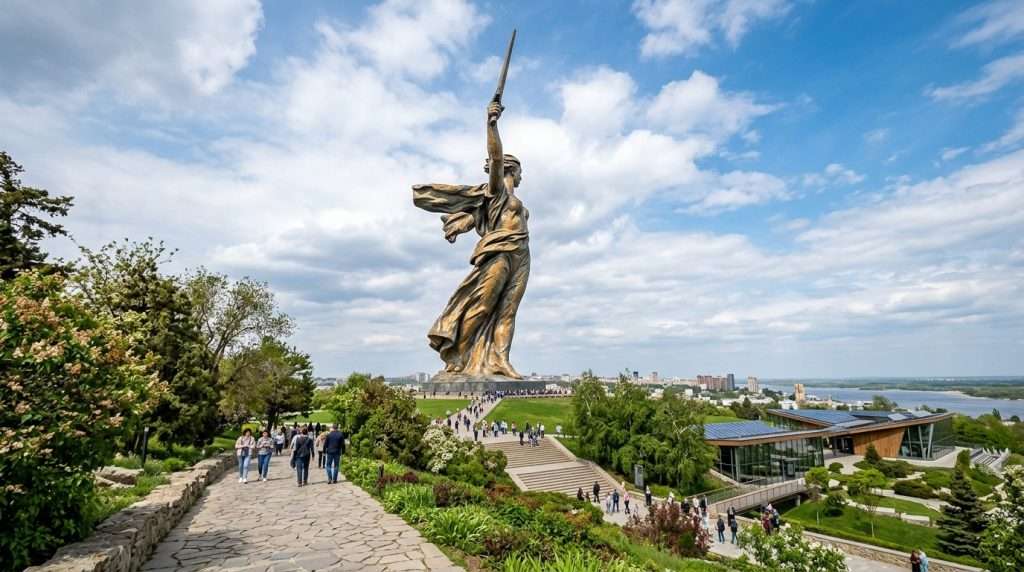
Nothing prepares you for standing beneath 85 meters of concrete and steel, her sword pointed at the clouds. I tilted my head back until my neck ached, trying to see the entire figure at once. You can’t. She’s too big, too close, and too much a part of the sky above Volgograd.
That same scale makes her fragile. Built from prestressed concrete in the 1960s, the statue faces decades of harsh steppe weather. Engineers restoring her in 2050 knew ice was the greatest enemy.
2.1 The Threat of Steppe Freeze-Thaw Cracking on Prestressed Concrete
Volgograd’s climate changes sharply. Summers bake the ground, while winters fall far below freezing. This constant change creates a slow threat called freeze-thaw cracking.
Water enters tiny pores and hairline cracks in the concrete. When temperatures fall, that water freezes and expands. Ice takes up about nine percent more volume than liquid water, forcing concrete outward.
After hundreds of yearly cycles across decades, the surface begins spalling. Chunks flake away, exposing the steel tendons inside. Exposed steel rusts, weakening the tension system that keeps her upright.
2.2 Non-Invasive Mineral Masonry Glazes That Breathe and Resist Spalling
The fix had to solve a difficult problem. Seal the surface too tightly, and trapped moisture cannot escape. Leave it unprotected, and water keeps entering.
The answer was non invasive mineral masonry glazes, a breathable coating applied over the original concrete without changing its texture. These glazes act like a one-way valve. Water vapor escapes, but rain and snowmelt cannot enter.
That breathability is the key. The glaze lets concrete release moisture while stopping water from collecting in its pores. Spalling stops before it starts, rather than after damage appears.
“The best conservation work is invisible work. You protect the structure so well that nobody notices anything was done at all.”
I think about that line when comparing photographs from the 1960s with the statue today. She has the same silhouette and raw concrete finish, but better protection underneath.
2.3 The Motherland Calls Preservation Without Altering Its Raw Silhouette
Here’s what struck me most at her base. None of this engineering was meant to change how she looks. The philosophy behind the motherland calls preservation effort rejects modernizing her appearance.
There are no smooth new coatings, visible patches, or color shifts. The mineral glaze dries clear and matte, blending with the concrete so closely that even conservators need close inspection.
That restraint matters because this statue carries meaning beyond its size. She represents the Battle of Stalingrad, a moment central to Russian memory and World War II history. Changing her appearance would feel like rewriting something meant to remain untouched.
The nano-mineral armor works quietly beneath the surface. She keeps standing as generations have seen her: raw, weathered, defiant, and ready for another hundred years of steppe winters.
3. Subsurface Hydrologic Heritage Engineering Beneath the Kurgan’s Slopes
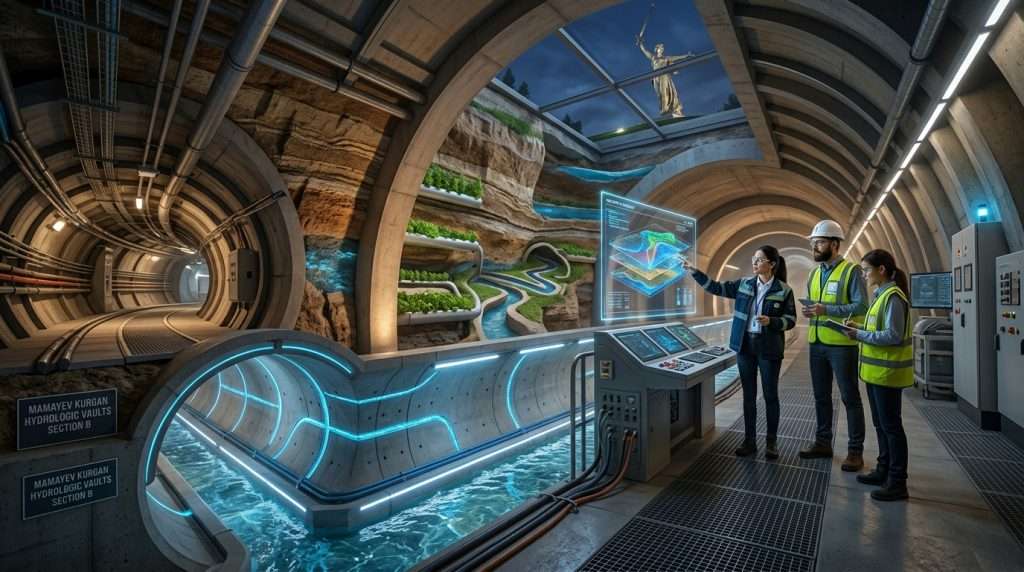
Water beneath Mamayev Kurgan may be the most overlooked part of this transformation. You cannot see it from the terraces or statue base, but hidden systems protect this sacred ground from water damage.
That is where subsurface hydrologic heritage engineering comes in. The name sounds complex, but the idea is simple. Hidden infrastructure manages water moving through the hillside, protecting the monument above.
3.1 Automated Retention Vaults Capturing Every Drop of Snowmelt and Storm Runoff
Volgograd winters bring heavy snow to this hillside each year. In spring, it melts quickly, and runoff once carved channels into the slopes. Over time, those channels became serious structural threats.
Automated retention vaults now lie buried beneath the terraces. They capture 100% of seasonal snowmelt and storm runoff before it reaches exposed soil. Sensors track rainfall and temperature, opening or closing intake valves automatically without human control.
These vaults perform three tasks at once:
- Stop erosion before it starts on the steep granite terraces
- Store filtered water for later reuse instead of letting it drain away
- Reduce pressure on aging drainage systems built decades ago
3.2 Closed-Loop Reservoir Stormwater Harvesting to Halt Hillside Slippage
Water moves through a closed loop reservoir stormwater harvesting system instead of sitting until the vault overflows. It cycles through filters and returns for reuse, rather than draining downhill.
Hillside slippage has threatened monuments like this one for years. When soil becomes saturated, it loses grip, slopes shift, and foundations crack. Closed-loop circulation keeps the ground stable by preventing excess water from building up.
Engineers describe it less like plumbing and more like a living circulatory system for the hill itself.
3.3 Volgograd Volga Hydrologic Cooling for the Panorama Museum
Volgograd has always been a river city. The Volga shaped Stalingrad’s defense, economy, and future engineering. That water-smart thinking now reaches the museum buildings.
With Volgograd Volga hydrologic cooling, filtered runoff from the slopes enters cooling loops for the Panorama Museum. The water once threatening the hillside now protects priceless artifacts from heat and humidity. The system uses no fossil fuels or carbon-based energy.
4. Mamayev Kurgan Net-Zero Memorial: A Microgrid Built on Footsteps
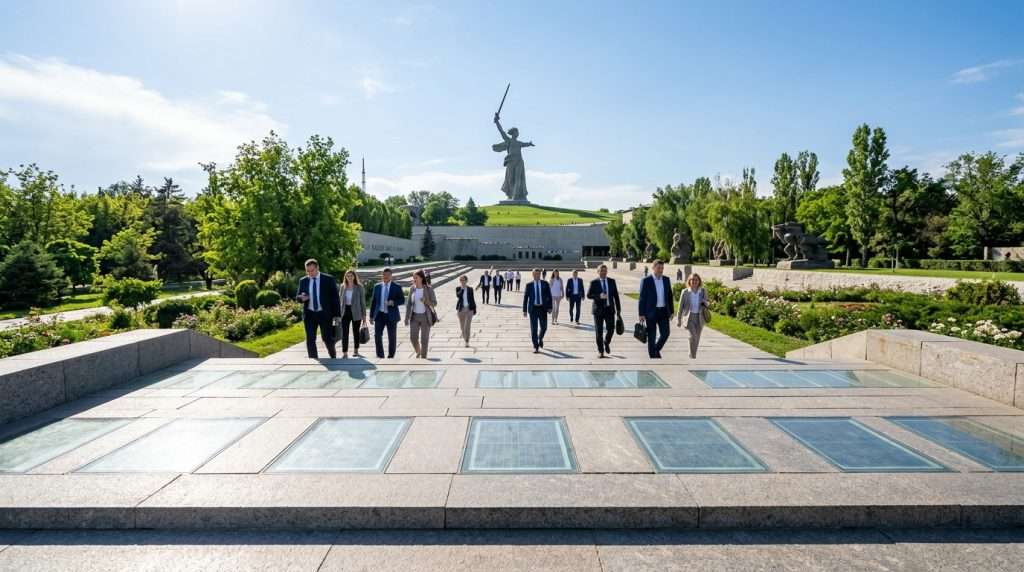
A quiet kind of magic happens beneath Mamayev Kurgan’s granite steps. I noticed it only after a guide explained what lay beneath my boots. The memorial preserves the past while creating power with every visit, helping keep the whole site running.
4.1 Piezoelectric Plates Beneath the 200 Granite Steps and Square of Heroes
Climbing the 200 granite steps toward the Square of Heroes feels important. Your legs and breath know it. Then I learned that each step presses on piezoelectric plates hidden beneath the stone.
These plates turn small mechanical pressure into usable electricity. The idea sounds simple, but engineers have used it in train stations and busy sidewalks for years. Mamayev Kurgan scaled it up for a site that receives thousands of footsteps daily.
This energy feeds directly into the site’s microgrid. It helps power lighting, climate systems, and visitor services without adding load to the regional grid. At the top, I wondered how many people had unknowingly helped supply that same power.
4.2 Lessons from Stadium Porous Asphalt Stormwater Drainage Applied to Sacred Ground
The most surprising detail is the system’s source. The engineering team borrowed ideas from stadium porous asphalt stormwater drainage. These systems serve massive sports venues, handling crowds and sudden downpours without flooding the grounds.
Engineers adapted the same porous asphalt, load-bearing logic for sacred, historic ground. The surface had to support constant foot traffic, drain rainwater, and protect the piezoelectric parts below. This clever design connects stadium drainage with memorial preservation.
| Feature | Stadium Porous Asphalt Drainage | Mamayev Kurgan Adaptation |
|---|---|---|
| Primary Purpose | Prevent flooding during games and events | Protect granite steps and power components |
| Load Handling | Thousands of fans, heavy equipment | Daily visitor foot traffic, ceremonial crowds |
| Water Management | Rapid drainage to avoid surface pooling | Controlled runoff protecting buried electronics |
| Energy Function | None, purely drainage-focused | Supports piezoelectric energy harvesting |
4.3 Turning Collective Remembrance Into Collective Power
Something stayed with me long after I left the Kurgan. Thousands of people walk these steps each year to remember, grieve, and honor what happened here. Now, their shared remembrance generates the electricity that keeps the memorial alive.
Memory itself has become a renewable resource. Few places connect history and sustainability so clearly, with honoring the past powering the present. Walking back down the steps, I moved more carefully, knowing my visit helped the site’s future.
5. Conclusion
I keep seeing myself atop the kurgan at sunset, looking down at the 200 steps and toward the Volga. That view has stayed unchanged for decades. In this imagined 2050, everything beneath it has changed.
A breathable mineral shield protects the concrete from steppe winters. Hidden vaults control every drop of rain and snowmelt. Footsteps on sacred ground create real power, yet the system stays quiet, as good engineering should.
This thought experiment shows preservation means more than sealing a place in amber and hoping it survives. It means giving a memorial tools to endure another century of harsh winters and shifting soil. Millions of footsteps come from people who still need somewhere to remember.
In this vision, Volgograd achieves something I have not seen attempted anywhere else. It turns a monument into a living system without touching its soul. The Motherland Calls still rises 85 meters above the plain, as raw and unflinching as ever.
Someday, I hope to stand on that hill, feel river wind, and know the ground protects this place. It works as hard as the people who built it did back in 1967. That hope closes this recap of the Battle of Stalingrad Museum’s future in 2050.




Leave A Comment