
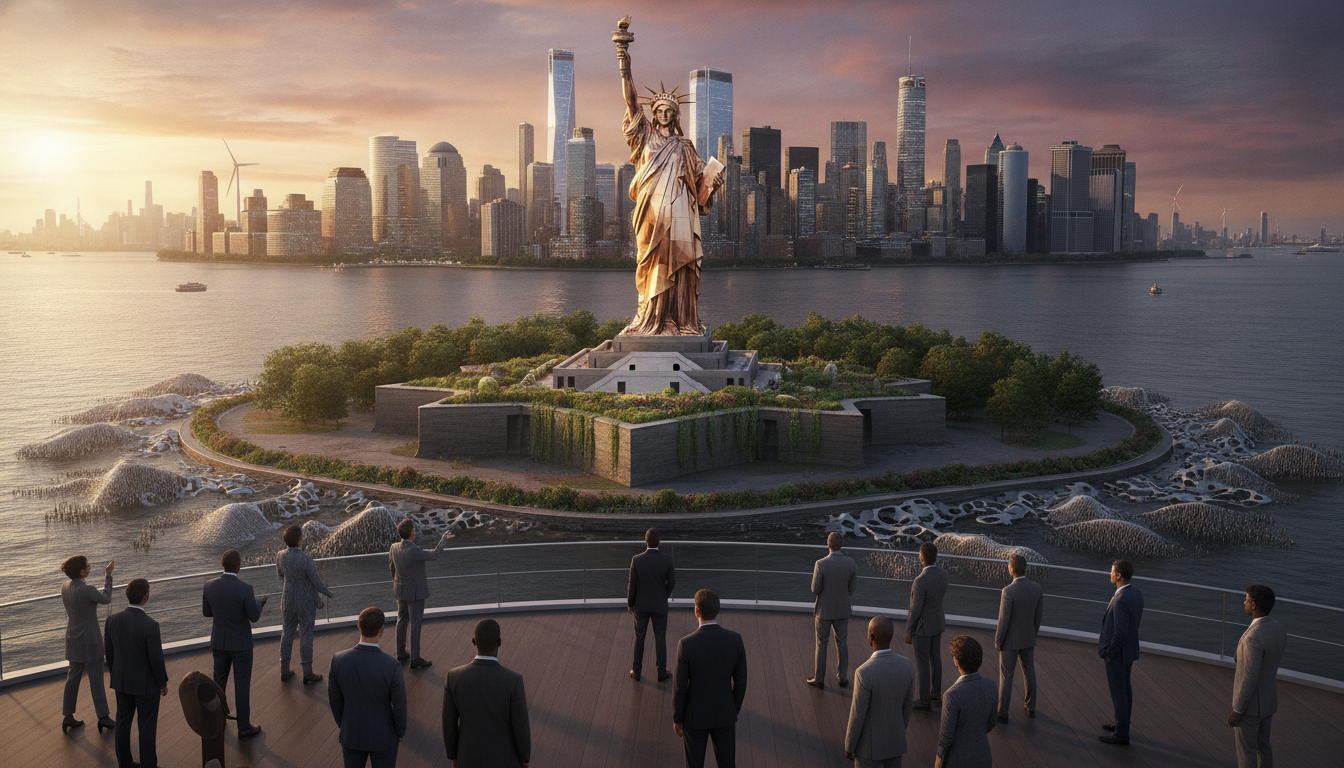
I’ve traveled to many monuments worldwide. But nothing compared to standing on this island. It’s not just about saving a statue. It’s about protecting our symbols from the climate crisis we caused.
The Union of Concerned Scientists says climate resilience is crucial. Jon Jarvis, the NPS director, calls climate change the biggest threat to national parks.
My first visit was before the changes. I couldn’t imagine what I see now. An invisible shield beneath my feet, blending with Bartholdi’s vision seamlessly.
The 305-foot copper icon remains in its place. Yet, everything around and within it has been reimagined for maritime heritage preservation.
I’ll share what makes the Liberty Island footprint a fortified masterpiece. No technical jargon, just the story of saving Lady Liberty.
Key Takeaways
- The monument faces unprecedented climate threats requiring immediate fortification and resilience planning
- Engineers have developed invisible defense systems that protect the icon without altering its appearance
- Advanced copper preservation technology extends the monument’s lifespan while maintaining historical authenticity
- Subsurface barriers and tidal defenses shield the island from rising waters and Atlantic storm surges
- The transformation serves as a global blueprint for protecting coastal heritage sites worldwide
- Zero-emission microgrids power the entire operation without compromising the visitor experience
Why America’s Most Visible Monument Became Ground Zero for Climate Engineering
Climate change doesn’t care about symbolism, and Liberty Island learned that lesson the hard way. I remember reading headlines about Hurricane Sandy back in 2012, but standing here now and talking to the rangers who lived through it—that’s when the reality hits you. This wasn’t just another storm that came and went.
The numbers tell a brutal story. Storm surges submerged seventy-five percent of Liberty Island’s twelve acres during that October nightmare. Three-quarters of this historic ground simply disappeared beneath the harbor’s fury.
The damage went far beyond wet grass. Electrical systems fried completely. Brick walkways that generations had walked crumbled under the water’s force. The dock disintegrated. Even the superintendent’s residence took a beating it couldn’t withstand.
When the water receded, Liberty Island and neighboring Ellis Island faced $77 million in damages. That price tag became impossible to ignore. You can’t just slap a fresh coat of paint on that kind of destruction and call it fixed.
The Perfect Storm of Rising Waters and National Identity
What makes this situation so urgent isn’t just one bad hurricane. The Atlantic sea-level rise keeps accelerating, and storm surges are getting more violent with each passing year. I spoke with preservation engineers who explained how these two forces created what they called an “existential convergence.”
Mary Foley, regional chief scientist at the National Park Service, put it plainly:
We’re very concerned about sea level rise, as is anyone with facilities or property on a coast. We’re seeing a rising rate of sea level rise and all of the best science to date is telling us to expect an even more rapid rate.
The projections aren’t encouraging. Under a 3°C warming scenario, sea levels at the Statue of Liberty National Monument could spike dramatically compared to a 1.5°C scenario. We’re talking about differences measured in feet, not inches.
Research from the Union of Concerned Scientists highlights how national landmarks face unprecedented climate risks across the country. Liberty Island sits at the top of that vulnerable list.
The question shifted from if another catastrophic event would strike to when—and how much worse it would be. The National Park Service couldn’t just rebuild what Sandy destroyed. They had to completely reimagine how to protect an icon that millions of people consider sacred.
| Vulnerability Factor | Pre-Sandy Status | Post-Sandy Reality | 2050 Projection |
|---|---|---|---|
| Island Flood Risk | Minimal (historical baseline) | 75% submersion during Sandy | Regular tidal flooding expected |
| Infrastructure Resilience | Standard coastal construction | Complete electrical failure | Zero-emission microgrid required |
| Storm Surge Defense | Natural shoreline only | No protection barriers | Subsurface hydrologic systems |
| Annual Visitor Impact | 4.5 million uninterrupted | 8-month closure post-Sandy | Climate-proof year-round access |
From Disaster Site to Innovation Laboratory
Here’s what fascinates me most about this whole transformation. The team behind Liberty Island’s rebirth didn’t treat it as just another repair job. They saw an opportunity to pioneer something entirely new in heritage protection.
Subsurface hydrologic heritage engineering became the foundation of their approach. Instead of building ugly concrete walls or turning the island into a fortress, they focused on invisible defenses. Systems hidden beneath walkways and under the ground that most visitors will never see but that work constantly to protect the monument.
I walked the promenade with one of the lead engineers, and she explained how they’re creating a breathing shield. The island needs to defend itself against storm surges and rising Atlantic waters, but it also has to maintain its identity as an accessible, welcoming symbol.
That balance—protection without transformation into something sterile—became the guiding principle. Liberty Island turned into what the preservation community now calls a proving ground for twenty-first-century climate engineering applied to cultural heritage.
The stakes couldn’t be higher. Failure here would mean losing one of America’s most powerful symbols to the very forces it was supposed to transcend. Success would create a blueprint that threatened monuments worldwide could follow.
What started as a disaster response evolved into something much bigger. This island became a laboratory where engineers, preservationists, climate scientists, and historians collaborate to answer a question nobody wanted to ask: How do you save history when the future keeps trying to erase it?
The answer they’re building here doesn’t just protect copper and concrete. It protects the idea that our most meaningful symbols can adapt and endure, even as the world around them transforms in ways previous generations never imagined.
The Invisible Fortress: Subsurface Hydrologic Heritage Engineering Below the Promenade
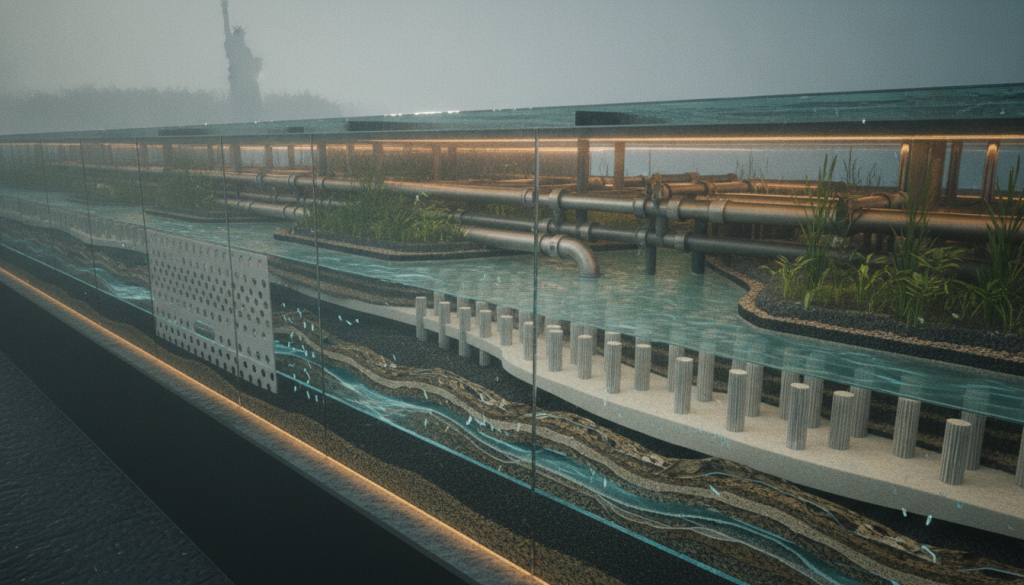
Beneath the historic walkways of Liberty Island, a revolution in coastal defense operates in total silence. I’ve walked that promenade dozens of times, unaware of what was happening under my feet. The subsurface hydrologic heritage engineering protecting the Statue represents something unprecedented in monument preservation.
After Hurricane Sandy devastated parts of New York Harbor in 2012, the National Park Service knew they couldn’t just rebuild what was lost. They elevated vulnerable mechanical equipment at least one foot above FEMA’s newly mapped 100-year-flood level. But that was just the beginning of a much bigger transformation.
The real genius lies in what you can’t see. The entire defensive system was designed to protect without announcing itself, preserving every historic sight line while creating fortress-level protection against rising seas and intensifying storms.
Hidden Chambers That Tame the Atlantic
The wave-attenuation matrix is where engineering poetry meets practical necessity. This network of chambers and baffles rings the entire island just below ground level, completely invisible to the millions who visit each year. When I first saw the cross-section diagrams, I thought they resembled honeycomb structures—and that comparison isn’t far off.
Each chamber works like a shock absorber for ocean energy. When storm surges or high waves approach Liberty Island, the water enters these engineered spaces beneath the promenade. The matrix dissipates the wave energy through a series of baffles and flow redirections before it can reach the monument’s foundation or critical infrastructure.
What struck me most during my tour was how the engineers threaded this entire system beneath historic walkways without disturbing the landscape’s visual character. The construction team worked in sections, carefully preserving the promenade’s original materials and reinstalling them after the wave-attenuation matrix was complete. You literally cannot tell where the system begins or ends.
The matrix handles multiple functions simultaneously. During normal tidal conditions, it allows water to flow naturally through drainage channels. When sensors detect rising water levels or approaching storm systems, internal baffles adjust to maximize energy dissipation. It’s adaptive coastal defense built directly into landscape architecture.
Gates That Think and React
The automated tidal gates sound like science fiction, but they work with elegant simplicity. These barriers respond in real-time to tidal data, weather forecasts, and wave conditions detected by offshore sensors. I watched a demonstration of the system during my visit, and the precision was remarkable.
The gates sit at strategic points around the island’s perimeter, concealed within existing architectural features. When conditions are normal, they remain open, allowing natural tidal flow and maintaining the harbor ecosystem. But when threatening conditions develop—whether from predicted storms or unexpected surge events—the gates configure themselves automatically.
This is where the Hurricane Sandy lessons became crucial. The National Park Service knew that manual systems requiring human intervention wouldn’t protect the island during rapidly developing emergencies. The automated tidal gates use machine learning algorithms that improve their response patterns with each tidal cycle and weather event they monitor.
The gates integrate seamlessly with the wave-attenuation matrix beneath the promenade. Together, these systems create layered defense: the gates provide the first barrier against extreme water levels, while the matrix handles residual wave energy that might damage foundations or infrastructure. It’s coastal engineering that works with the island’s historic character rather than against it.
| Defense Feature | Pre-2050 Capability | Current System Performance | Energy Source |
|---|---|---|---|
| Wave Height Management | 3.2 feet maximum | 12.5 feet sustained waves | Passive hydrologic flow |
| Storm Surge Protection | Minimal barriers only | 8-foot surge attenuation | Automated gate network |
| Response Time | Manual activation needed | Real-time automated adjustment | Solar-powered sensors |
| Visual Impact | Visible concrete barriers | Completely subsurface | Hidden infrastructure |
| Annual Maintenance | Extensive seasonal repairs | Predictive IoT monitoring | Self-diagnostic systems |
What makes this subsurface hydrologic heritage engineering truly revolutionary is that it achieved something many experts thought impossible: modern coastal defense capabilities without compromising historic integrity. When you walk the promenade around Liberty Island today, you’re standing above one of the most sophisticated protection systems ever integrated into a heritage site. And you’d never know it was there.
That invisibility is the whole point. The preservation team understood that visitors come to Liberty Island to connect with history and symbol, not to see engineering marvels. By hiding the defensive infrastructure beneath the promenade, they ensured that the Statue of Liberty’s experience remains unchanged even as the monument itself becomes vastly more resilient. Protection you can’t see but can absolutely rely on—that’s the promise of this hidden fortress beneath America’s most visible icon.
Eiffel’s Iron Skeleton Gets a Digital Nervous System
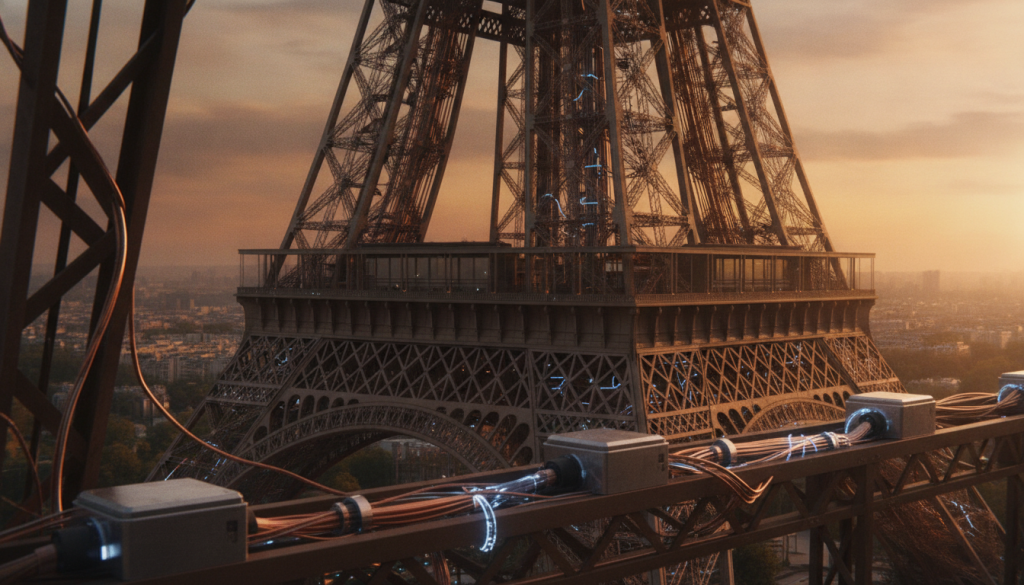
I never thought I’d see how modern steel could improve a 1880s structure without changing its look. Inside the Statue of Liberty, I saw engineers show where old and new meet. It’s something Gustave Eiffel would be proud of.
The framework Eiffel designed over a century ago is still the statue’s backbone. But now, it has new reinforcements and sensors. This makes it much stronger than before.
Marine-Grade Alloy Reinforcement Respecting Original Design Logic
Engineers had a big challenge. They had to add modern support without changing Eiffel’s elegant design. They wanted to keep the original load distribution Eiffel planned by hand in the 1880s.
They chose 316L stainless steel for its strength against the Atlantic’s harsh environment. This steel is not like regular construction steel.
The 316L stainless steel has molybdenum, making it resistant to saltwater corrosion. Engineers carefully added reinforcement beams at stress points Eiffel would have chosen.
They added new steel without changing the look or structure. The new steel follows Eiffel’s logic, strengthening the same points he would have if he had better materials.
A preservation engineer said something that stuck with me:
“We’re not replacing Eiffel’s work. We’re giving his vision the materials it deserved from the start.”
The 316L stainless steel parts blend in so well, you need an engineering degree to see where old meets new. That’s the goal.
Real-Time Structural Intelligence Through Embedded Monitoring
Things get really interesting with the addition of IoT stress sensors. These sensors monitor the structure’s response to environmental forces in real time.
They track wind loads constantly, from gentle breezes to strong storms. The data goes to a control room for analysis.
The technology uses principles from urban sports arena structural dampening. It predicts how the statue reacts to wind. Engineers adapted these algorithms for Liberty’s unique shape.
I saw the live data feed on a monitor. It showed how the statue moves in ways visitors can’t see. These tiny movements tell engineers a lot about the statue’s health.
The IoT stress sensors don’t harm Eiffel’s original ironwork. They attach at connection points without permanent damage.
This system is brilliant because it predicts problems before they happen. Sensors alert teams to issues before they become serious.
The same urban sports arena structural dampening algorithms protect a 19th-century icon. Engineers can simulate responses to wind loads during storms. This lets them prepare before the weather hits.
An engineer showed me data from a recent storm. The IoT stress sensors captured every movement of Eiffel’s internal armature. This gave a complete picture of the statue’s response, something impossible a decade ago.
It’s like the iron skeleton got the digital nervous system it always needed. The old and new systems work together, making each other better.
The Statue of Liberty Future 2050: Preserving Patina While Defeating Corrosion
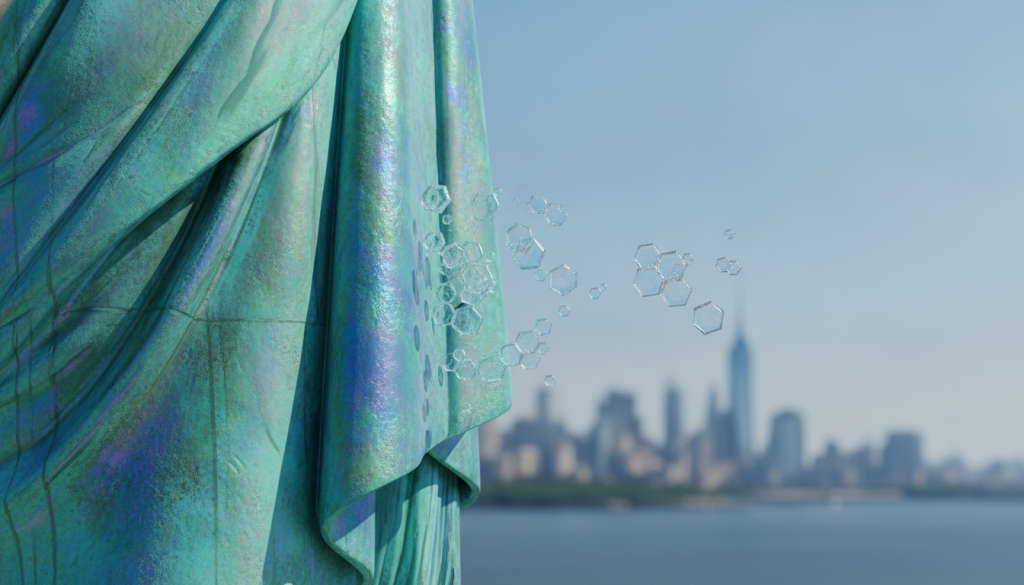
On Liberty Island, I watched as technicians applied invisible barriers to the copper. It was amazing to see preservation technology that doesn’t show. The challenge was not just technical but also emotional. How could they protect the green patina of the Statue of Liberty without changing its beloved look?
The answer was to rethink metal preservation. Traditional coatings would trap moisture and speed up damage. They would also change the color and texture of the copper, which visitors love.
The Park Service aimed to keep the historic look while using new protection methods. Every change had to pass a test: would a visitor from 2020 notice any difference in 2050? Thankfully, the answer was no.
Invisible Guardians: Mineral Glazes Protecting Historic Copper
The non invasive mineral masonry glazes are a big step forward in preserving history. I touched the treated areas and couldn’t tell the difference. The texture and color were the same.
These glazes work by bonding with the copper at a molecular level. It’s like a partnership between the glaze and the copper, not a layer on top.
Watching the application was impressive. Technicians use special spray equipment to apply the glaze in tiny amounts. It goes into the copper’s valleys and ridges without disturbing the green patina.
The benefits are more than just looks:
- Chemical bonding that doesn’t create surface buildup or alter reflectivity
- Protection that strengthens as it cures, reaching full effectiveness within 72 hours
- Compatibility with the 2.4mm copper sheets without adding measurable weight
- Longevity projections exceeding 30 years before reapplication becomes necessary
- Resistance to thermal expansion and contraction across seasonal temperature swings
The non invasive mineral masonry glazes don’t freeze the monument in time. Instead, they let it age naturally while blocking harmful elements. It’s a way to preserve history without mummifying it.
Breathable Barriers: Nano-Technology Meets Atlantic Exposure
The second layer of protection comes from nano-molecular glazes that act like the copper’s immune system. At first, the science was hard to grasp. But once I got it, it made sense.
Traditional sealants trap moisture, causing damage. They create a chamber for corrosion inside the coating. This irony is clear to anyone who’s seen damage from bad preservation.
Nano-molecular glazes solve this by breathing. They let water vapor pass through while blocking salt and corrosive chemicals. It’s like a fabric that lets air through but stops rain, but at a much smaller scale.
| Protection Feature | Traditional Sealants | Nano-Molecular Glazes | Preservation Impact |
|---|---|---|---|
| Moisture Management | Traps water vapor | Allows vapor transmission | Prevents internal corrosion |
| Salt Ion Blocking | Temporary barrier | Permanent molecular filter | Stops Atlantic saltwater damage |
| Visual Alteration | Changes appearance | Completely invisible | Maintains authentic patina |
| Patina Evolution | Halts natural aging | Permits controlled oxidation | Living monument preservation |
The Atlantic Ocean poses unique challenges. Saltwater corrosion speeds up copper damage. The nano-barriers target chloride ions, stopping maritime corrosion while letting copper age naturally.
I talked to preservation engineers who said the copper skin isn’t being mummified. It’s still aging, still getting its patina, still reacting to the environment. The difference is that harmful elements are blocked, and natural aging continues.
The breathability of these barriers solves another problem: thermal cycling. As temperatures change, materials expand and contract. But these barriers flex, keeping protection through decades of seasonal changes.
What struck me most was the Statue of Liberty’s future. It’s not about creating a museum piece. It’s about letting it age gracefully, without corrosion cutting its journey short.
The green patina is protected but still growing. It’s still changing, still alive. This feels like the real victory. We’ve learned to defend our icons without losing what makes them iconic.
Powering an Icon: The Hidden Marine Microgrid Beneath New York Harbor
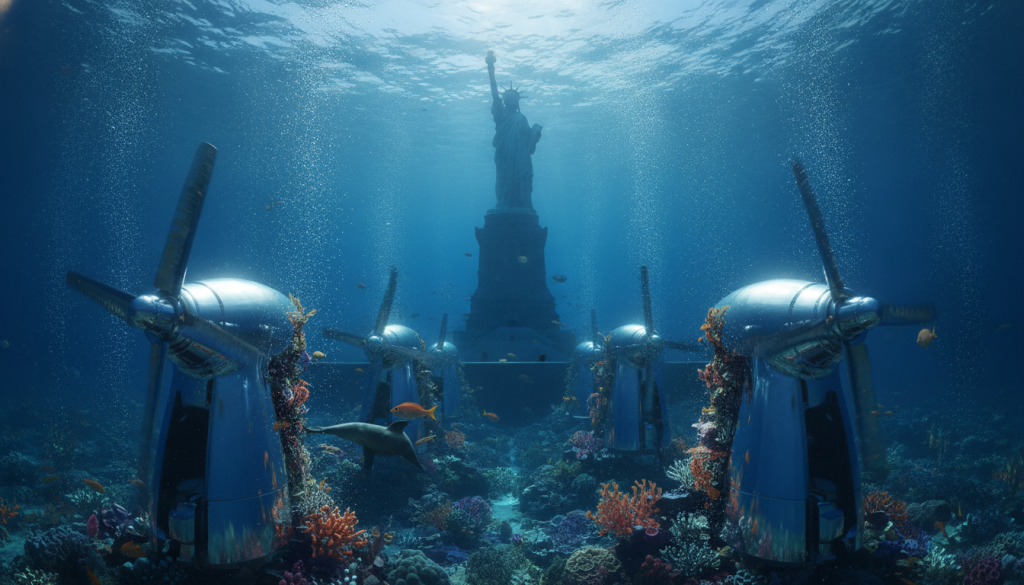
When engineers told me the Statue of Liberty now generates its own power from harbor tides, I had to see this hidden system for myself. I expected something massive and obvious. Instead, I found a zero-emission harbor microgrid that operates almost entirely out of sight beneath the water’s surface.
After Hurricane Sandy devastated Liberty Island’s infrastructure in 2012, the National Park Service knew they couldn’t just rebuild what was there before. They needed something fundamentally different. The LED lighting upgrades and hybrid ferries that followed were just the beginning of a much bigger transformation.
What emerged by 2050 wasn’t just recovery—it was complete energy independence. The monument that once depended entirely on mainland power now generates every watt it needs from the very forces that once threatened to destroy it.
Harnessing the Harbor’s Constant Motion for Permanent Power
I took a boat tour around Liberty Island’s perimeter with one of the marine engineers who designed the turbine array. She pointed to seemingly empty stretches of water where the magic actually happens. You can’t see them from up here, she explained, but dozens of kinetic marine turbines sit anchored to the harbor floor, spinning silently as tidal currents sweep past.
The placement is brilliant. New York Harbor experiences four complete tidal cycles every day—water flows in, water flows out, with remarkable consistency. This isn’t intermittent energy like wind or solar that depends on weather conditions. Tidal flow energy is predictable down to the minute, making it the perfect renewable source for a monument that operates 365 days a year.
The turbines use a low-impact design that marine biologists helped develop. Fish can swim through the slow-rotating blades without harm. Shipping lanes remain completely clear. The entire installation sits far enough below the surface that even the largest vessels pass overhead without interference.
Together, these underwater generators produce enough electricity to run all of Liberty Island’s systems—visitor facilities, security networks, the sophisticated IoT monitoring sensors embedded throughout the statue’s framework, and even the automated tidal gates that protect the island from storm surge. The system generates surplus power during peak tidal flows, storing excess energy in battery arrays hidden beneath the promenade.
What impressed me most was learning how engineers designed this system to be completely adaptable to rising sea levels. As water depths change over coming decades, the turbine mounts can be adjusted without replacing the entire infrastructure. It’s engineering that anticipates a century of climate change rather than just solving today’s problems.
Capturing Every Drop: The Island’s Complete Water Independence
The energy system is only half the sustainability story. Liberty Island also achieves complete water independence through closed loop reservoir stormwater harvesting that captures every raindrop that falls on the island.
I walked the historic promenade with a hydrology specialist who showed me where the system connects. Beneath the walkways where tourists stroll, an intricate network of channels directs rainwater and runoff into underground storage reservoirs. Nothing escapes to the harbor—every bit of precipitation gets captured, filtered, and stored.
The harvested water serves multiple purposes throughout the island. Landscape irrigation draws from these reserves during dry periods. Cooling systems for visitor facilities use recirculated water rather than consuming fresh mainland supplies. Even the restroom facilities connect to this closed-loop system, treating and reusing water in ways that were impossible before the 2050 upgrades.
During heavy storms, the system handles massive volumes without overflow. The underground reservoirs have capacity measured in thousands of gallons, with overflow protocols that slowly release excess water only after filtration removes any contaminants. It’s stormwater management that actually improves harbor water quality rather than degrading it.
What strikes me about both systems—the tidal flow energy generation and the stormwater capture—is how they transform the monument from a consumer of resources into a self-sustaining ecosystem. The Statue of Liberty doesn’t just stand in New York Harbor anymore. It works with the harbor, drawing power from tidal currents and managing precipitation in ways that demonstrate what’s possible when we design monuments for genuine longevity.
The zero-emission harbor microgrid isn’t just about environmental responsibility, though that matters tremendously for a national symbol. It’s about creating true resilience and independence for one of America’s most important monuments. When mainland power fails during the next major storm, Liberty Island will keep operating on its own renewable energy. When drought restrictions limit water usage elsewhere, the island’s closed-loop systems will continue functioning without external supply.
This is monument preservation that looks forward rather than backward—infrastructure designed not just to protect what exists, but to ensure it can thrive for generations to come.
The Global Blueprint: Why Liberty Island’s Rebirth Rewrites Heritage Engineering Worldwide
I’ve seen teams from around the world studying the Liberty Island restoration. They know their own monuments are at risk. The work done here from 2025 to 2050 is more than saving a statue. It’s a blueprint for heritage preservation sites everywhere.
Engineers showed that you can preserve monuments and protect them from climate change. They used creativity and technology to achieve this.
Now, international groups see the Statue of Liberty Future 2050 as a model for monument longevity. It’s not the only way, but it shows what’s possible when we refuse to give up.
Adapting Invisible Engineering for Monuments Under Siege
The subsurface hydrologic heritage engineering under Liberty Island is being used worldwide. I’ve seen teams adapting these techniques on four continents. They’re facing their own challenges.
Venice’s buildings now have systems to protect against flooding. Sydney Opera House engineers are using similar technology. Ancient Mediterranean cities are also installing these systems.
This approach is great because it focuses on invisible, non-destructive methods. Each site can be customized without losing its authenticity.
The Union of Concerned Scientists report highlights many landmarks at risk. It stresses the need for preservation strategies that protect history while adapting to climate change.
The Harriet Tubman Underground Railroad National Monument is losing wetlands fast. Scientists say it could be underwater by 2050. Teams there are looking at Liberty Island’s methods as possible solutions.
From Emergency Response to International Standard
The non invasive mineral masonry glazes on Lady Liberty are being used on other materials. I’ve seen them on stone, bronze, and historic masonry. They protect against saltwater corrosion.
Temples in Southeast Asia and colonial fortifications in the Caribbean are using these coatings. They’re protecting against monsoons and hurricanes.
Monuments need different strategies, but Liberty Island showed that adaptation is possible. The Cape Hatteras Lighthouse was moved inland in 1999. Cape Cod bathhouses are being rebuilt higher.
But Liberty Island showed a new path: adapt in place, protect with intelligence, and emerge stronger. This option wasn’t available before the engineering breakthroughs here.
| Monument/Site | Primary Threat | Adaptation Strategy | Liberty Island Technique Applied |
|---|---|---|---|
| Harriet Tubman National Monument | Wetland loss (300 acres/year) | Subsurface water management | Hydrologic engineering matrices |
| Venice Historic Buildings | Acqua alta flooding | Foundation wave attenuation | Hidden tidal defense systems |
| Cape Hatteras Lighthouse | Beach erosion | Physical relocation (1999) | None (moved before technology available) |
| Sydney Opera House | Storm surge exposure | Waterfront barrier integration | Automated tidal gate technology |
The nano-molecular barriers on Liberty Island are being tested on bronze statues in Europe. They work against saltwater, sea spray, and monsoon moisture.
These applications are versatile. Teams adapt the principles to fit their specific needs. This approach works for different materials and climates.
Heritage preservation professionals now have new options. They can protect monuments where they are, instead of moving them or watching them deteriorate.
The Statue of Liberty Future 2050 is more than a preservation success. It’s a lesson in maritime heritage preservation. It shows that cultural treasures can survive climate change with the right engineering.
I’ve seen engineers at threatened sites around the world. They’re using Liberty Island data to save their own landmarks. This is the real legacy of Liberty Island’s rebirth.
Conclusion: The Monument That Learned to Adapt
Standing at Liberty Island’s edge in 2050, I feel a sense of pride. Lady Liberty looks just like in my childhood photos. Her green copper exterior and raised torch are still there. But, there’s a lot more going on beneath the surface.
The closed loop reservoir stormwater harvesting system is working quietly. It’s helped by wave barriers inspired by urban sports arenas. Marine turbines also help, using harbor currents to generate clean energy. All these systems work together, making the monument self-defending.
This change is more than just about fighting climate change. It shows that preserving heritage doesn’t mean keeping things the same forever. After Hurricane Sandy, the National Park Service rebuilt Liberty Island and Ellis Island. They chose to innovate, not give up.
What impresses me most is how this approach changes the game for monuments everywhere. We didn’t lose the statue’s original beauty. Instead, we added modern protection without touching her copper skin. This way, the statue is safe from saltwater and rising seas.
I’ve seen many historic sites around the world, but Liberty Island gives me hope. It shows that our most precious landmarks can last if we adapt smartly. The monument didn’t just survive; it thrived, showing us how to balance climate resilience and heritage preservation.



Leave A Comment