
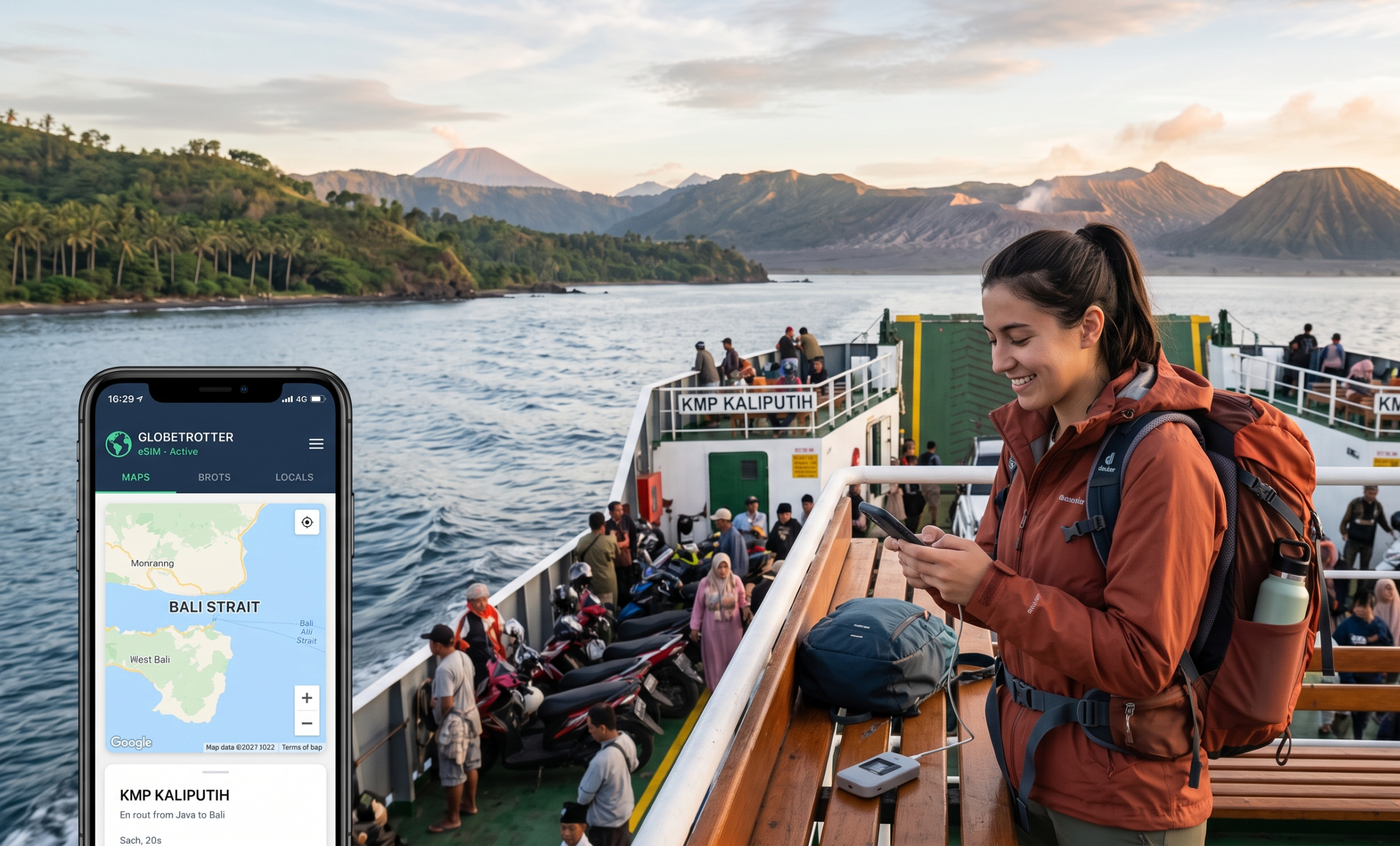
Indonesia looks very different when travelled at ground level. Instead of flying directly into Bali, an overland route across Java reveals the country through railway stations, roadside food stops, volcanic landscapes, port towns and the busy ferry crossing between Ketapang and Gilimanuk.
It is a rewarding journey, but it also places unusual demands on a phone. Train tickets may need to be shown at short notice, drivers often coordinate pick-ups through messaging apps, and accommodation details can change while you are already moving. The challenge is not simply getting online. It is keeping access to the information that holds the journey together while changing trains, buses, ferries and islands.
Treat Mobile Data as Part of the Route
On a straightforward city break, losing internet access for an hour is inconvenient. On an overland trip, it can affect the next stage of the route.
A typical Java-to-Bali itinerary may involve Jakarta, Yogyakarta, Surabaya or Malang, Banyuwangi, Ketapang, Gilimanuk and a final road transfer into Bali. Each transition creates a new set of practical questions: Which station entrance does the train leave from? Has the guesthouse confirmed an early arrival? Where does the bus stop in relation to the ferry terminal? Is the driver waiting at the port or farther along the road?
Sort out mobile access before the first long travel day rather than assuming it can be handled during a connection. Travellers who prefer not to compare physical SIM cards at an airport counter can arrange a reliable Indonesia travel eSIM before departure, leaving one less administrative task between immigration, baggage collection and the journey into the city.
That does not remove the need for offline preparation. It simply gives you a working connection sooner, while the route is still unfamiliar.
Build the Journey Around Transport Handoffs
The most difficult moments are rarely spent on the train itself. Problems tend to appear in the gap between one form of transport and the next.
Jakarta’s main stations are busy, and the name shown on a booking may not tell you which entrance or departure area is most convenient. In Yogyakarta, two places with similar names can be several kilometres apart. At the eastern end of Java, reaching Ketapang may involve a train, local taxi, minibus or a short walk, depending on where the previous service finishes.
Before each transfer, save four details:
- The exact name of the arrival point
- The next departure point
- The distance between them
- A screenshot of the route connecting the two
Do not rely only on a pin sent through a messaging app. Pins can be inaccurate, and drivers may describe locations using landmarks rather than formal addresses. Save the property name, street address and telephone number as text.
It is also worth asking accommodation hosts how travellers normally arrive. A guesthouse may be technically close to a station but separated from it by railway lines, one-way roads or an entrance on the opposite side.
Do Not Assume the Ferry Crossing Works Like an Airport
The Java-to-Bali ferry is a transport connection rather than a polished tourist arrival experience. That is part of its appeal, but it rewards preparation.
Ketapang and Gilimanuk are busy working ports. Passenger arrangements can vary depending on whether you arrive on foot, by bus, with a motorcycle or inside a private vehicle. Signs may be clear in one area and less obvious in another. Your onward driver may not be able to wait exactly where passengers leave the ferry.
Before boarding, confirm the next meeting point. Ask for a landmark, a written location and, ideally, a map pin. If the driver says “outside the port”, clarify which gate. Large transport areas often have several exits, parking zones and informal pick-up points.
Keep in mind that Java and Bali use different time zones. Bali is one hour ahead of Java, so check whether a quoted pick-up or check-in time refers to local time at the destination. Phones usually update automatically when connected, but a screenshot of an old ticket will not.
The crossing itself is a good moment to review the next stage rather than improvising after disembarkation. Open the map, check the expected driving distance and message the accommodation while the route is still easy to adjust.
Download Maps Before Leaving Major Cities
Mobile coverage can be strong in populated areas and less predictable on rural roads, around mountains or during long-distance transport. A navigation app that works perfectly in central Yogyakarta may struggle when you are approaching a remote homestay before sunrise.
Download offline maps for more than the cities on the itinerary. The connecting areas matter just as much. For a Java-to-Bali route, that may mean saving broad sections around:
- Jakarta and its main railway stations
- Yogyakarta, Borobudur and Prambanan
- Surabaya or Malang
- Mount Bromo access towns
- Banyuwangi, Ketapang and the ferry port
- Gilimanuk and the road towards your first Bali stop
Offline maps are particularly useful when checking whether a taxi is heading towards the correct station, identifying a nearby cash machine or finding the entrance to a hotel after reception has closed.
Mark important locations in advance. A saved list containing stations, ports, hotels and planned stops is faster to navigate than searching for each place again from a moving vehicle.
Keep Tickets and Addresses Outside Your Inbox
An email confirmation is only useful when the inbox loads. Save essential travel documents to the phone rather than leaving them scattered across several apps.
Take screenshots of train tickets, ferry information, accommodation bookings and any QR codes needed for entry. Add the travel date to each filename so you are not scrolling through dozens of images at a ticket barrier.
For longer journeys, create a single offline note with the day’s route:
Yogyakarta hotel → station → train number → arrival station → transfer contact → next hotel
Include booking references, departure times and contact numbers. This simple document becomes particularly valuable when a phone battery is low and you need the relevant information without opening several applications.
Travellers carrying two devices should store copies on both. A tablet or a companion’s phone can serve as a backup if the main handset is lost, damaged or left charging in a hotel room.
Plan for Early Starts and Late Arrivals
Overland itineraries often involve awkward hours. Sunrise trips, long railway journeys and ferry connections can place you outside a station before local businesses are fully open.
Do not assume there will be accessible Wi-Fi at every departure point. Even where a network exists, it may require a local number, a password from a café or a sign-in page that fails to load.
Message the next accommodation before setting off, especially when arriving late. Confirm whether reception operates through the night and whether the address shown on the booking matches the actual entrance. Small hotels and villas in Bali sometimes sit along narrow lanes where the vehicle stops a short walk from the door.
For early departures, book or discuss transport the evening before. Ride-hailing availability can vary by location, and some areas have local restrictions or designated pick-up points. A confirmed driver is more valuable than discovering at 4.30am that no nearby vehicle accepts the request.
Keep the Phone Working Through Long Travel Days
Connectivity is irrelevant once the battery is empty. Java’s long train journeys usually offer a chance to charge, but sockets may be occupied, awkwardly positioned or incompatible with a loose adaptor.
Carry a charged power bank in hand luggage and use it before the battery reaches a critical level. Charging early is better than saving it for an emergency, particularly when the final part of the journey involves navigation and driver communication.
Reduce background battery use by downloading music, podcasts and entertainment before departure. A phone constantly searching for a weak signal can drain faster than expected, so airplane mode can help during stretches when you do not need live updates.
Keep a charging cable in the small bag that stays with you. A cable packed beneath luggage on a bus is not much help when the phone is at five per cent.
Separate Essential Apps From Travel Clutter
Before crossing Java, arrange the home screen around the journey rather than everyday habits. Keep maps, messaging, transport bookings, translation, accommodation and banking apps together.
Log in before departure and confirm that each account works. Some services trigger verification when accessed from a new country, and receiving a security code becomes complicated if the registered number is unavailable.
It is also sensible to retain access to your usual number for banking messages and account verification. Travellers using dual-SIM phones should check which line handles mobile data and which remains active for calls or texts. Otherwise, the phone may continue using expensive roaming data without making the change obvious.
Let the Route Stay Flexible
The advantage of travelling overland through Indonesia is that the journey does not have to be reduced to a sequence of airports. You can stop longer in Yogyakarta, change plans around Mount Bromo, spend a night in Banyuwangi or arrive in Bali through its quieter western side.
That flexibility works best when the basic logistics are already under control. Save the documents, download the maps, confirm each handoff and keep enough battery for the final arrival. With those details covered, the phone returns to its proper role: a practical tool supporting the journey rather than a problem demanding attention at every station and port.








Leave A Comment