
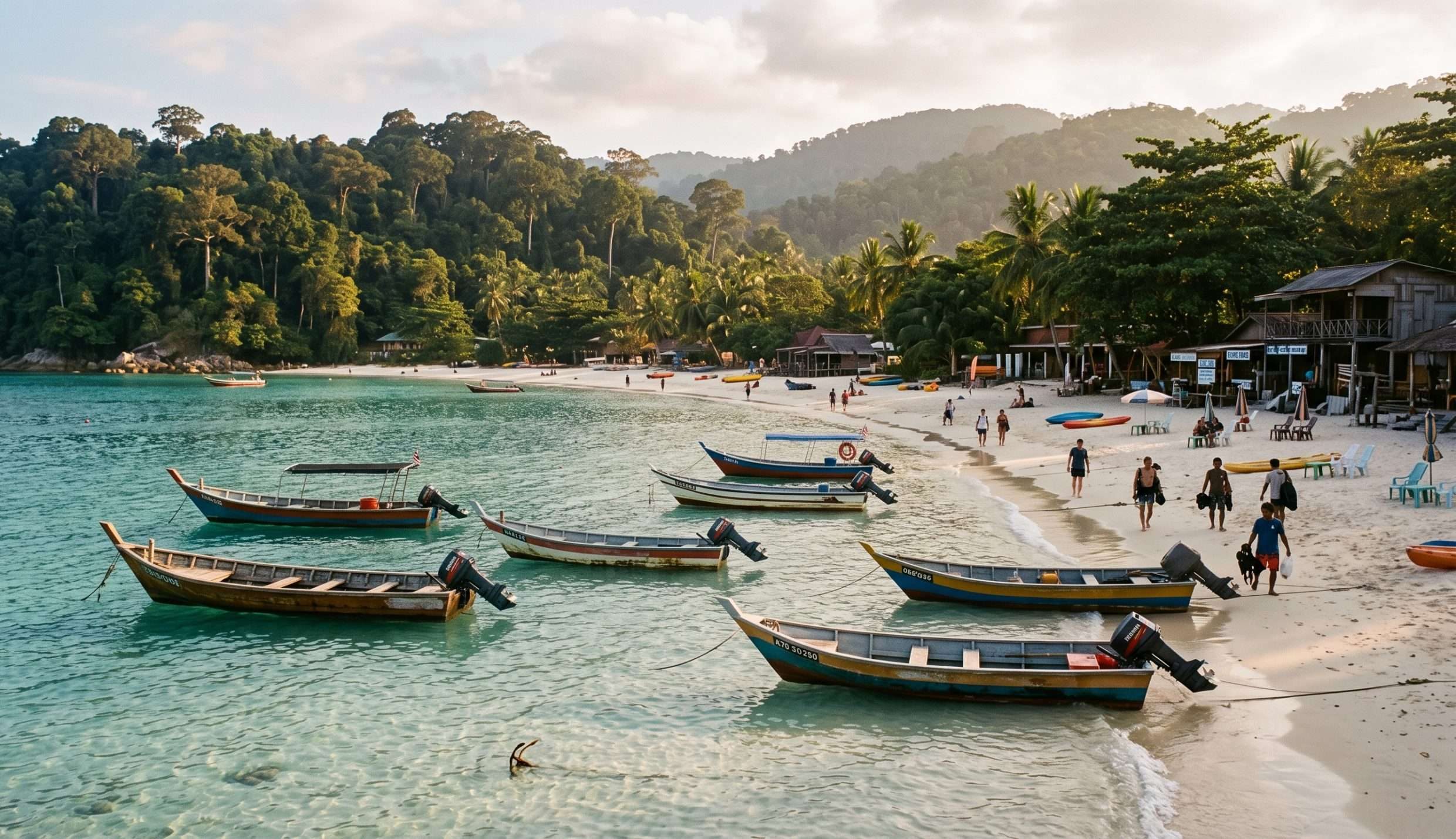
After surviving the hull-slapping transfer detailed in our East Coast Day 5 (Speedboat Arrival) breakdown, the biggest mistake travelers make on the Perhentian Islands is assuming these off-grid outposts operate with mainland infrastructure. With zero roads, no ATMs, and daily generator shutdowns across both Perhentian Kecil (the lively backpacker hub) and Perhentian Besar (the quieter flashpacker and resort island), thriving here requires strict cash management, tide-timed boat bookings, and smart battery rationing.
Destination Reality Check: Quick Summary Box
- Best Overall Booking Window: Book PADI dive slots and small-group snorkeling charters 48 to 72 hours ahead during the dry season (March–October) to lock in morning departures before local walk-up quotas fill.
- Peak Crowd Hours to Avoid: 11:00 AM to 2:30 PM at Shark Point and Turtle Sanctuary Beach, when large flotillas from Kuala Besut dump day-trippers onto the shallow reefs, churning up sand and dropping underwater visibility.
- Primary Transit Tip: A single 15-minute jungle footpath connects Long Beach and Coral Bay on Perhentian Kecil; for every other cove or island hop to Besar, you must flag a wooden water taxi from the beach huts before 7:00 PM, when daytime fares double.
Small-Group Snorkeling Safari (Shark Point & Turtle Beach): Beating the Midday Flotillas
The Breakdown
This half-day circuit runs on a shaded fiberglass speedboat, hitting five distinct marine ecosystems across both islands—typically Shark Point, Turtle Point, Turtle Beach, Fish Point, and Romantic Beach. Your captain provides masks, snorkels, and fins before dropping anchor over deep-water coral gardens where blacktip reef sharks patrol the drop-offs and green sea turtles graze on sea grass beds in four meters of water. Between reef drifts, the boat beaches on sheltered white-sand coves inaccessible by foot, giving you forty minutes to swim in calm, glass-clear shallows and inspect anemones packed with resident clownfish.
Why Book This Tour vs. Going Solo
While you can wade straight off Coral Bay or Tuna Bay for decent house-reef swimming, the largest pelagic life congregates over offshore shelves and current-swept points that are dangerous to swim to unassisted. Securing a vetted small-group boat ensures your captain times the anchor drops to slack tide and hits Shark Point at 9:30 AM, giving you thirty minutes of uncrowded water before twenty beach-shack boats arrive at once and kick up silt across the reef floor.
Logistics & Mobile Photo Pro-Tips
- Best Time & Lighting: Book the 9:00 AM departure. By 10:15 AM, the sun sits high enough to penetrate six meters down into the water column at Turtle Point without creating harsh surface glare, lighting up the green sea turtle shells naturally.
- The Money Shot: If using a waterproof mobile housing or a budget dome port, practice the over-under split shot in the calm, shallow waters of Turtle Beach. Switch to your 0.5x ultra-wide lens, submerge half the dome, and keep the waterline exactly in the middle of the lens to capture the branching staghorn coral below and the jungle-draped granite boulders above in a single frame.
- Mobile Pro-Tip: Before sealing your phone inside a waterproof pouch or housing, lock your screen orientation, disable auto-brightness, and crank display brightness to 100% so you can actually see your framing through wet polycarbonate under the equatorial sun. Use the physical volume buttons to fire bursts of 10 shots at a time while floating at the surface.
- Footwear & What to Wear: Pack a long-sleeved UV rashguard (reef-safe sunscreen washes off quickly and marine park rangers actively discourage heavy chemical lotions) and slip-on neoprene water shoes for stepping off the boat ladder onto coarse coral rubble.
Booking Details: Small-Group Snorkeling Safari (Shark Point & Turtle Beach) via GetYourGuide | Duration: 4 hours | Cancellation: Free up to 24 hours before | Small-Group Snorkeling Safari
Inter-Beach Water Taxis: Mastering the Roadless Transit Network
The Breakdown
Neither Perhentian Kecil nor Perhentian Besar has paved roads, cars, or motorbikes; a fleet of narrow fiberglass and wooden skiffs powered by 40-horsepower outboard engines acts as the archipelago's public bus system. Operating out of wooden dispatch tables on every major stretch of sand, drivers ferry passengers between Kecil's social hubs (Long Beach and Coral Bay), remote north-island coves (Mira Beach and D'Lagoon), and Besar's resort strips (Tuna Bay, PIR, and Abdul's Chalet). Trips take anywhere from five to twenty minutes depending on the swell wrapping around the headlands.
Why Book This Tour vs. Going Solo
You cannot navigate between the islands solo without a boat, unless you rent a sea kayak for a grueling two-hour open-ocean paddle across busy speedboat lanes. Understanding how the official beach dispatch boards work prevents rookie negotiation errors: fares are strictly regulated per person per route (ranging from 10 MYR to 30 MYR per leg), and coordinating shared departures at the dispatch hut cuts the single-passenger surcharge in half while guaranteeing a driver who knows the shallow coral heads at low tide.
Logistics & Mobile Photo Pro-Tips
- Best Time & Lighting: Schedule your transit hops before 6:45 PM. Not only do official water taxi prices double the moment the sun drops below the horizon at 7:00 PM, but the late afternoon window from 5:45 PM to 6:30 PM delivers warm side-lighting across the channel between Kecil and Besar.
- The Money Shot: Golden hour on Long Beach—and looking west from Coral Bay—produces the richest color gradients just before sunset. Stand knee-deep in the surf and use your 1x main lens to capture the sharp silhouettes of the anchored wooden water taxis bobbing in the foreground against the vibrant orange and purple sky.
- Mobile Pro-Tip: Tap and hold on the brightest band of the sunset sky to lock exposure, then slide the brightness finger-slider down slightly ($-0.7\text$). This preserves the deep magenta cloud textures and turns the hulls of the wooden boats into clean, noiseless black silhouettes without triggering grainy artificial night-mode processing.
- Footwear & What to Wear: Wear ankle-strapped sandals (like Tevas or Chacos) rather than loose flip-flops; there are no jetties on Long Beach and several smaller coves, meaning you must wade out to waist-deep surf and haul yourself over the high wooden gunwale as waves roll in. Keep your electronics inside a roll-top dry bag.
Booking Details: Inter-Beach Water Taxis & Island Transfers via GetYourGuide | Duration: 15–30 minutes | Cancellation: Free up to 24 hours before | Inter-Beach Water Taxis
PADI Discover Scuba Diving (DSD) or Fun Dives: Exploring the Sugar Wreck & Pinnacle Reefs
The Breakdown
The sheltered waters around the Perhentians feature gentle currents, $29^\circ\text$ water temperatures, and sandy bottoms that make this one of the highest-value training grounds in Southeast Asia. Uncertified beginners enroll in a half-day PADI Discover Scuba Diving (DSD) program, starting with shallow-water regulator drills in chest-deep water off Coral Bay or Tuna Bay before ascending onto a boat dive down to 12 meters at Tokong Laut (Temple of the Sea). Certified divers book two-tank morning fun dive packages targeting deeper topography like the Sugar Wreck—a 90-meter cargo ship lying on its side at 18 meters, surrounded by schools of yellowtail barracuda, bamboo sharks, and macro nudibranchs.
Why Book This Tour vs. Going Solo
While dozens of walk-up dive shacks line Long Beach, the price war on the sand often translates to worn O-rings, sun-rotted BCD inflator hoses, and overcrowded cattle boats with eight students per instructor. Pre-booking with an established, five-star PADI center locks in a strict 2:1 or 4:1 student-to-instructor ratio, freshly serviced regulators, and morning boat slots to Tokong Laut before visibility drops from afternoon plankton blooms.
Logistics & Mobile Photo Pro-Tips
- Best Time & Lighting: Lock in the 8:30 AM two-tank departure. Underwater ambient light peaks between 9:30 AM and 11:30 AM at the 15-meter mark, allowing mobile cameras in dive housings to capture reef colors without needing external video strobes.
- The Money Shot: During the surface interval between dives off the pinnacle rock of Tokong Laut, switch to your 3x optical telephoto lens from the boat deck. Frame the dramatic granite spire jutting out of the open South China Sea against the bow of the dive boat, compressing the distance so the rock face fills the upper two-thirds of the frame.
- Mobile Pro-Tip: Tropical humidity and cold air-conditioned guest rooms (when the power is actually on) cause severe internal condensation inside phone dive housings. Load your phone into the housing inside a dry, shaded room with a silica gel packet wedged near the hinge, and rub a thin drop of baby shampoo on the exterior glass port before rinsing in sea water to stop salt droplets from beading during surface shots.
- Footwear & What to Wear: Wear a snug two-piece swimsuit or boardshorts without bulky back-pocket zippers that chafe under a 3mm shorty wetsuit and weight belt. Bring a microfiber towel and a windbreaker for the twenty-minute speedboat run back to shore.
Booking Details: PADI Discover Scuba Diving (DSD) or Fun Dives via GetYourGuide | Duration: 4–5 hours | Cancellation: Free up to 24 hours before | PADI Scuba Diving Perhentian
On-the-Ground Flashpacker Survival Notes: Power Cuts & Protein Hunting
Living well between Kecil and Besar requires adapting to two operational realities that catch poorly prepared travelers off guard by day two:
- The Power and Connectivity Reality: Outside of three high-end resorts on Besar, the majority of budget and mid-range chalets across the islands run on diesel generators rather than a subsea municipal grid. Scheduled power cuts during the day—typically from 8:00 AM to 6:00 PM—are completely normal, meaning ceiling fans, room outlets, and Wi-Fi routers shut down entirely while you are ashore. Pack at least one airline-compliant $20,000\text$ power bank with fast-charging PD output, and plug a multi-port wall adapter into your room socket the moment the generators roar to life at dusk so your phone, dive computer, and camera batteries top up overnight.
- Finding High-Protein Meals on the Sand: Daytime beachfront cafes on both Long Beach and Coral Bay skew heavily toward cheap, carb-heavy backpacker staples—banana pancakes, Maggi goreng noodles, and frozen-dough pizzas that leave you sluggish after four hours of swimming against current. Skip the midday menus for your main meal and walk the tideline at 6:30 PM when local crews fire up the evening beach BBQs. For 30 to 45 MYR, you can select whole fresh-caught red snapper, giant squid tubes, or quarter chickens grilled over coconut husks, served with garlic butter and steamed rice to keep your protein intake solid.
Frequently Asked Questions
How much physical cash do I need to bring, and do dive shops take cards?
There are zero ATMs on either Perhentian Kecil or Perhentian Besar. While established PADI dive centers and top-tier resorts on Besar accept Visa and Mastercard with a $3\%$ to $5\%$ surcharge, you must bring at least 150–200 MYR per person per day in small physical banknotes (10s, 20s, and 50s) to cover water taxis, beach BBQs, and drinking water refills.
Should I base myself on Perhentian Kecil or Perhentian Besar?
Stay on Perhentian Kecil (specifically Coral Bay for sunset views and quieter chalets, or Long Beach for late-night fire shows and beach bars) if you want social backpacker energy and cheap food stalls. Base yourself on Perhentian Besar (around Tuna Bay or Teluk Dalam) if you prioritize calmer family-friendly beaches, deeper house reefs steps from your room, and mid-range chalets with more reliable daytime air-conditioning.
How difficult is the jungle trail between Long Beach and Coral Bay on Kecil?
The paved-and-dirt path takes 12 to 15 minutes at a normal pace and involves a mild 40-meter elevation gain under dense canopy with zero scrambling required. However, the path has broken solar streetlamps, so bring a headlamp or phone flashlight after 7:00 PM and apply DEET mosquito repellent before walking at dusk.
Can I fly a drone or use a tripod on the beaches?
Tripods and mobile gimbals require no permits on any beach, and small consumer drones under 250g are widely flown at sunrise on Long Beach and Romantic Beach. Avoid launching near the solar-wind hybrid turbines at the southern tip of Kecil due to unpredictable downdrafts, and never fly directly over nesting sea turtle enclosures on Turtle Sanctuary Beach.
Strategic Itinerary Sequencing
To maximize water clarity and minimize double-paying for water taxis, structure your full island day (and departure prep) in this exact loop:
- Day 1 Morning (08:30 AM – 12:30 PM): Board the Small-Group Snorkeling Safari straight from the Long Beach or Coral Bay jetty to hit Shark Point and Turtle Beach during peak morning visibility. Ask your captain to drop you off at Tuna Bay on Perhentian Besar on the return leg rather than going straight back to your hotel.
- Day 1 Afternoon (12:30 PM – 05:30 PM): Eat lunch on Besar, snorkel the calm house reef along the Tuna Bay drop-off, and flag an Inter-Beach Water Taxi (15 MYR per person) back to Coral Bay on Kecil by 5:00 PM. Walk the 15-minute jungle trail over to Long Beach to shoot golden hour water taxi silhouettes, then refuel on grilled snapper and squid at the evening beach BBQs while your room generator kicks back on to charge your power banks.
- Day 2 Morning (08:30 AM – 01:00 PM): Complete your PADI Discover Scuba Diving or Fun Dive double-tank session at the Sugar Wreck and Tokong Laut. Since scuba safety rules require a minimum 12-to-18-hour no-fly surface interval, diving here pairs seamlessly with overland travel—putting you in ideal position to catch the afternoon boat back to Kuala Besut and prepare for our East Coast Day 7 (Eastern Border Crossing) overland run into southern Thailand.





Leave A Comment