
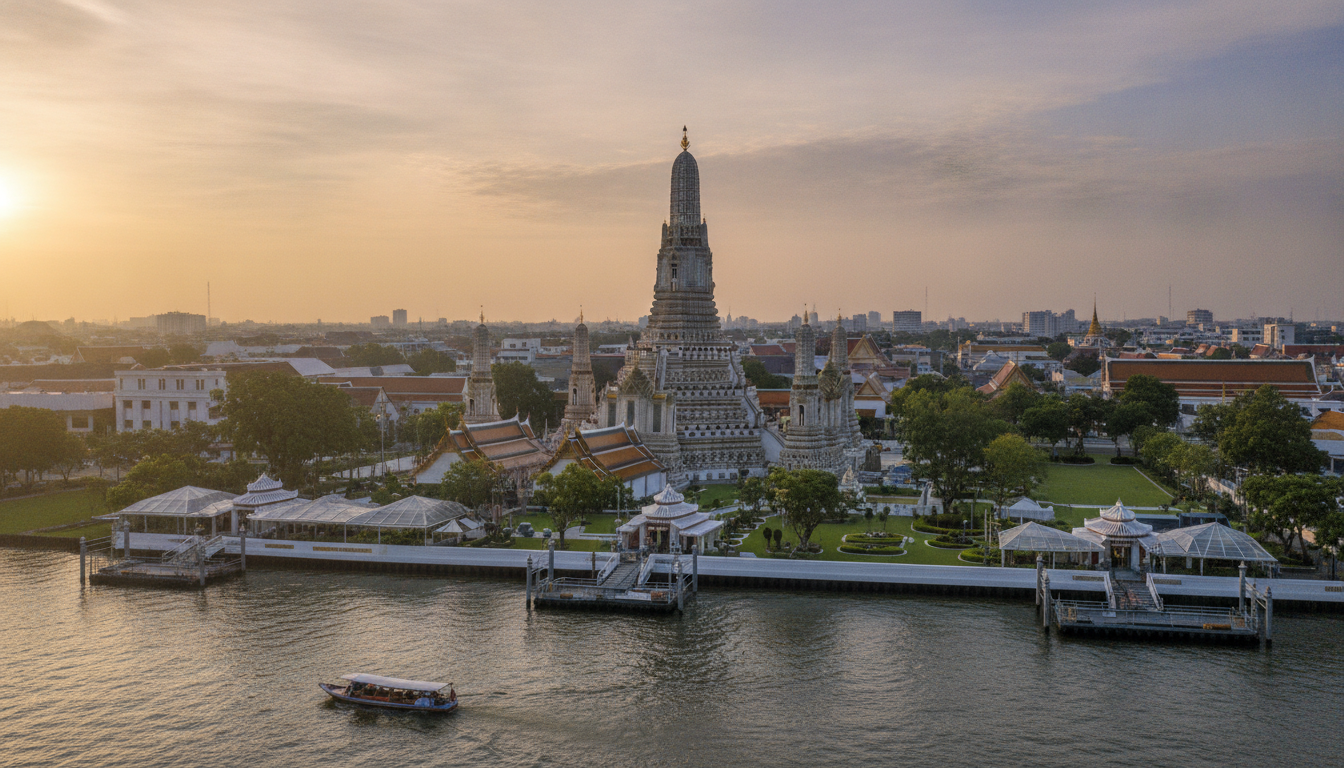
I stood on the Thonburi bank at sunrise, camera in hand, watching the first light climb across that famous porcelain spire. This is the Temple of Dawn, Bangkok’s most photographed shrine. It’s also one of my favorite spots to watch the sunrise along the Chao Phraya River.
But there’s more happening here than a pretty photo op.
Thailand has set a bold goal. The country aims for full carbon neutrality by mid-century. Prime Minister Prayut Chan-o-cha made this pledge at COP26. This goal now influences infrastructure plans across the nation, including a 300-year-old riverside icon like Wat Arun.
I often wonder on my trips. Can ancient heritage actually survive alongside real climate resilience? Wat Arun might just be the clearest answer I’ve found yet.
This piece explores how careful temple of dawn preservation work is turning a fragile ceramic monument into a blueprint. It’s a blueprint that sacred sites around the globe could borrow.
Key Takeaways
- Wat Arun serves as a living case study connecting 300-year-old sacred architecture with modern climate resilience goals.
- Thailand’s revised LT-LEDS, submitted at COP27 in November 2022, sets a national carbon neutrality target for 2050.
- Prime Minister Prayut Chan-o-cha reinforced this commitment at COP26, pledging net-zero emissions with international support.
- The temple’s porcelain-inlaid prang represents both a cultural treasure and a preservation engineering challenge.
- Riverbank heritage sites like this one offer practical lessons for sacred structures facing climate pressures worldwide.
- Heritage preservation and carbon-neutral infrastructure planning can genuinely work together, not against each other.
1. Wat Arun Future 2050: A Global Masterclass in Sacred Riverbank Preservation
Wat Arun, once just a photo spot, has become a model for others. It shows how to protect heritage while aiming for a green future. Engineers and architects now look to this temple as a guide.
In Southeast Asia, Wat Arun is often mentioned in talks about preserving sacred sites. It’s seen as a key example.
From Temple of Dawn to Carbon-Neutral Heritage Beacon
Thailand is serious about its climate goals. It has a plan to be carbon neutral by 2050. This plan also aims for net-zero emissions by 2065.
Wat Arun’s transformation into a green site is part of this bigger plan. It’s a test case for Thailand’s national policy, set against a famous backdrop.
Here’s a quick look at Thailand’s climate targets:
| Climate Target | Year | Governing Framework |
|---|---|---|
| Carbon Neutrality | 2050 | LT-LEDS, ONEP 2022 |
| Net-Zero GHG Emissions | 2065 | National Climate Strategy |
| Overall Plan Rating | Ongoing | Climate Action Tracker: “Average” |
Why This 82-Meter Prang Became the Benchmark for Sacred Monument Longevity
The 82-meter spire at Wat Arun is a big challenge. It sits on a tidal river, making it hard to protect for the next century.
Thailand’s climate plan is rated as “Average” by Climate Action Tracker. But Wat Arun’s success shows that with the right engineering, even a country’s slow policy pace can be overcome.
Architects from flood-prone cities often ask: if it works here, why not back home?
2. Guarding the Porcelain Skin: Nano-Molecular Glazes and Breathable Masonry
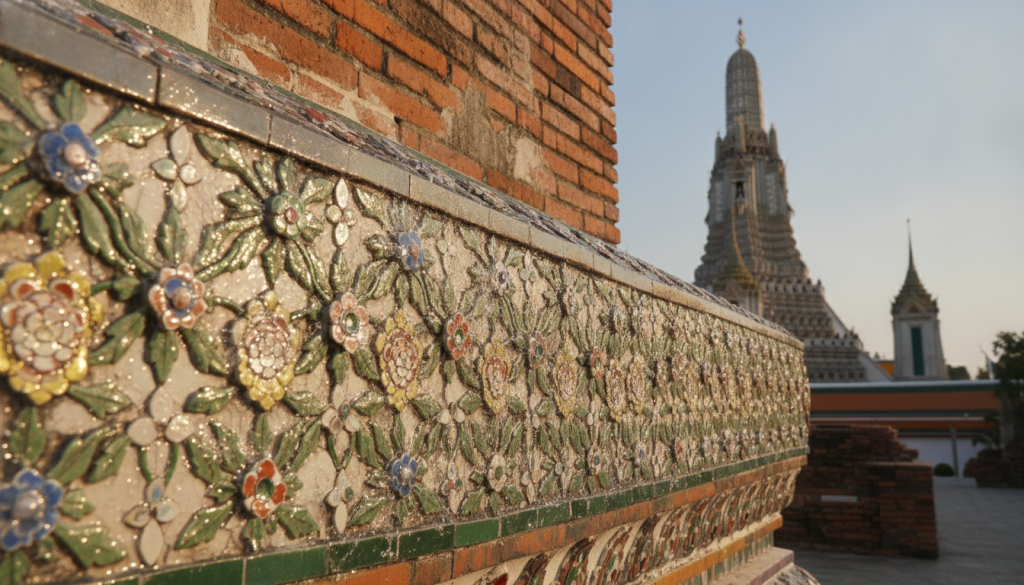
I still remember my first visit to Wat Arun at sunrise. The cool porcelain shards felt amazing against my palm. Thousands of tiny pieces cover every surface of the towering prang.
How did this delicate structure survive Bangkok’s harsh humidity for nearly two centuries? It’s not luck. It’s science and careful work.
Chinese Porcelain Shards and Seashell Mosaics Under Tropical Humidity Siege
Wat Arun’s surface is unique in Southeast Asia. Workers in the early 1800s mixed broken Chinese porcelain and seashells into wet plaster. This created mosaics that shimmer in the sun’s light.
But this beauty comes with a cost. Tropical humidity makes the lime mortar swell and shrink every day.
Monsoon rains and river moisture add to the problem. The porcelain itself doesn’t decay, but the mortar does, unless something changes.
Non-Invasive Mineral Masonry Glazes That Let Historic Lime Mortar Breathe
Modern materials science has found a solution. Engineers apply non-invasive mineral masonry glazes to the porcelain and mortar.
These glazes are like a quality rain jacket. They block water but let moisture out.
Older restoration methods often used waterproof coatings. This trapped moisture, causing damage. The new mineral glazes protect without smothering, helping the lime mortar last another hundred years.
Stucco Reliefs and the Quiet Chemistry of Modern Preservation
Wat Arun’s stucco reliefs face the same humidity challenges. This isn’t about flashy renovations. It’s about quiet chemistry happening slowly.
The glaze has self-healing compounds that seal small cracks. When tiny fissures form, the material closes the gap.
The best preservation is invisible. Nobody notices masonry that simply doesn’t fail.
This approach is part of Thailand’s sustainable materials push. It sees heritage conservation as innovation, not just maintenance. Protecting sacred art with breathable science and building a greener future are the same mission.
3. Chao Phraya Riverbank Hydro Armor: Engineering Beneath the Water Line
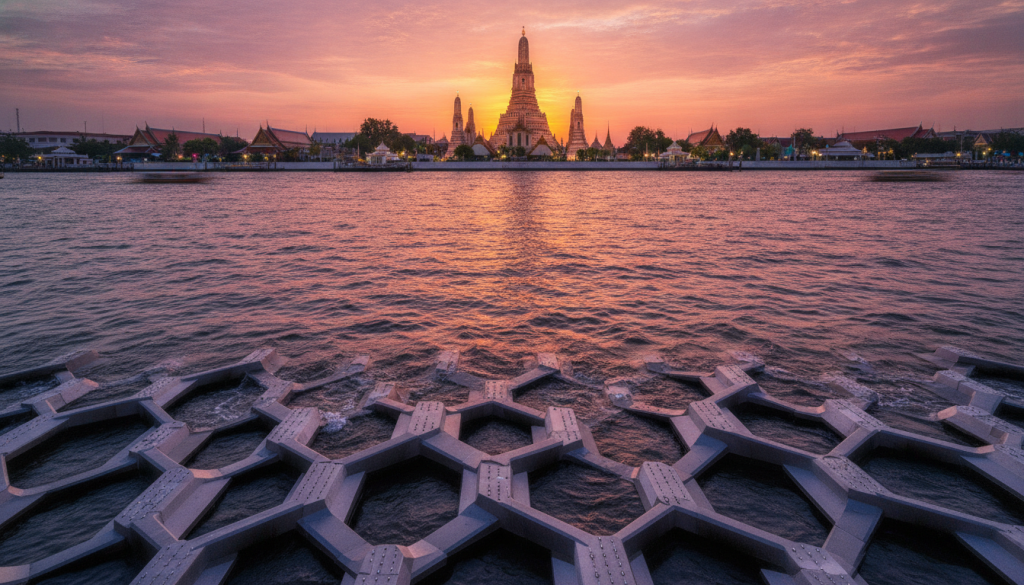
I’ve always been fascinated by what’s happening underwater just as much as what’s glowing above it. Wat Arun’s riverside defenses are proof that the best fixes are invisible ones. The Chao Phraya River never stops moving, pushing tidal surges against the temple’s base twice a day.
Engineers had to solve this without touching a single carved surface above the waterline. What they built down there genuinely impressed me once I understood how it worked.
Submerged Hydro-Kinetic Revetments Absorbing Tidal Surge
Picture underwater panels built along the riverbank slope, angled to catch the pull of every tide. These submerged structures don’t just block the water’s force. They absorb it, converting some of that raw energy into usable power instead.
It’s a clever twist: rather than fighting the river head-on, the design works with its natural rhythm. This chao phraya riverbank hydro armor cuts wave impact against the temple’s foundation by a meaningful margin. The panels flex slightly with each surge, dissipating pressure that would other wise chip away at centuries-old stonework over time.
Subsurface Hydrologic Heritage Engineering and Underground Retention Vaults
Beneath the temple courtyard sits another layer of protection most visitors will never notice. Underground retention vaults capture excess groundwater and river seepage before it can pool against the foundation. This subsurface hydrologic heritage engineering keeps water pressure balanced on both sides of the temple’s base.
Thailand’s broader net-zero infrastructure goals lean heavily on exactly this kind of domestic resilience work. Researchers studying soil behavior along tropical riverbanks have documented similar stabilization approaches. The engineering here lines up closely with published soil science research on riverbank stabilization. These vaults work around the clock, storing and releasing water in slow, controlled cycles instead of leaving it to chance.
| Protection Method | How It Works | Key Benefit |
|---|---|---|
| Traditional Stone Bulwarks | Solid barriers resisting wave impact directly | Basic protection, frequent upkeep required |
| Hydro-Kinetic Revetments | Underwater panels absorb and convert tidal energy | Reduces impact while generating clean power |
| Underground Retention Vaults | Store and release groundwater in controlled cycles | Balances pressure, prevents foundation settling |
Stopping River Scour Without Disturbing Sacred Ground
River scour, the slow erosion of riverbed material around a structure’s base, has toppled riverside monuments across Asia for generations. Wat Arun’s foundation sat exposed to exactly that risk for over a century. Modern engineers needed a fix that wouldn’t require digging up consecrated ground or shifting the temple’s footprint in any way.
Their answer involved anchoring flow deflectors well below the visible waterline, redirecting current away from vulnerable foundation points. Not one stone above the surface moved during installation. It’s a strong example of protecting something sacred by working entirely out of sight, letting the temple keep its exact silhouette while the ground beneath it quietly grows sturdier every single year.
4. Powering the Glow: Net-Zero Energy Behind Wat Arun’s Golden Illumination
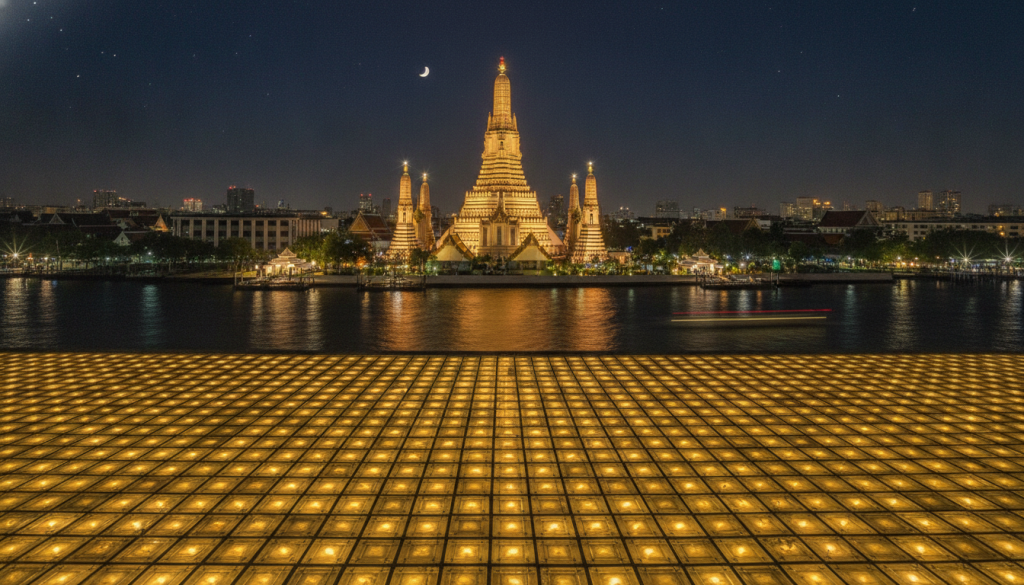
Standing on the riverbank at dusk, I’ve watched Wat Arun’s glow rise off the water like magic. It’s not magic, though. It’s smart energy engineering that makes it glow.
The system lighting up this 82-meter prang is a masterpiece of net-zero design. No diesel generators or cables cut into sacred ground. It’s clean, distributed power working quietly in the background.
Wireless Micro-Photonic Fixtures and the New Nighttime Ritual
Old temple lighting used to mean miles of wiring in ancient masonry. That’s all changed now.
Wat Arun 2050 uses wireless micro-photonic fixtures. These tiny lights power up without cables through the stucco and mosaics. They adjust brightness and color based on season and moon phase.
Seeing the temple light up is now a special nightly ritual. People gather to watch it, and it’s calming. Watching the stone glow gold without wires is magical.
Solar-Paver Courtyards as Silent Power Generators
The courtyard pavers at Wat Arun are more than just stone.
They’re solar-paver systems, catching sunlight all day. Every step and sun hour adds energy to the system.
No loud machinery or visible solar panels here. Just quiet power generation in the ground people walk on every day.
River-Current Microgrids Feeding the Bangkok UNESCO Heritage Grid
The Chao Phraya River is more than scenery. It’s a power source.
River-current microgrids near the temple capture energy from the river’s flow. This energy feeds into the Bangkok UNESCO heritage grid, a network for heritage sites along the river.
This isn’t just an experiment. It’s part of a bigger effort in Thailand.
| Milestone | Target Year | Goal |
|---|---|---|
| Renewable electricity share | 2040 | 68% |
| Renewable electricity share | 2050 | 74% |
| New power plant capacity from renewables | 2050 | 50% |
These numbers are from Thailand’s plan for renewable energy. Wat Arun is part of this national effort, not just for tourists.
So, when you take that photo of Wat Arun glowing, remember. There’s a whole renewable power story behind it, one step, one river current, one solar paver at a time.
5. Beyond One Temple: What Wat Arun 2050 Teaches Global Heritage Preservation
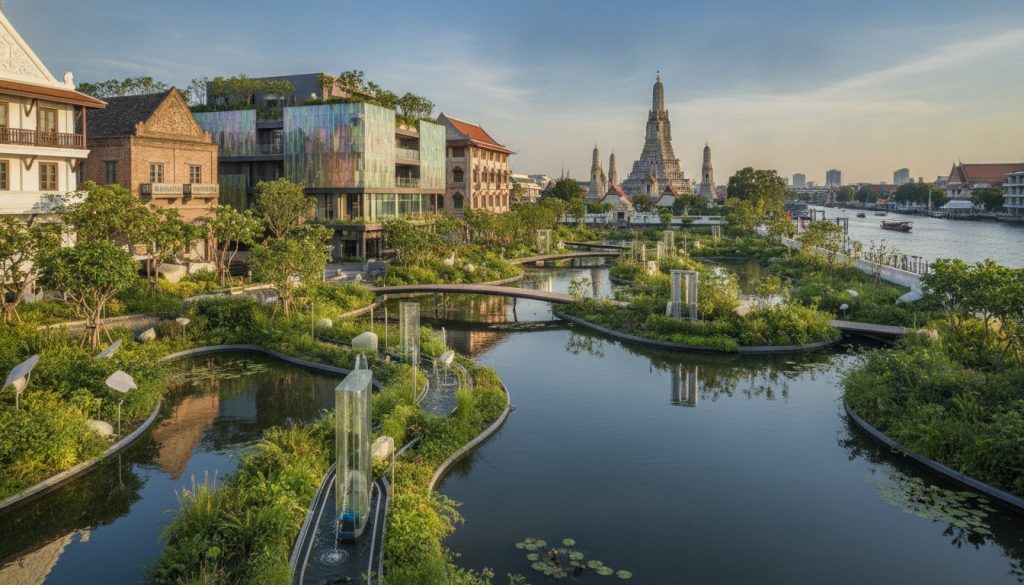
The magic of Wat Arun 2050 is not just for one temple. It shows how every historic city built on water can be saved. Engineers didn’t create new physics to protect this 300-year-old prang. They used ideas from other industries and made them work for the temple.
Thailand’s construction sector is already moving in this direction. The Thai Concrete and Cement Association’s “NEXT Chapter to Net Zero 2050” initiative aims to use low-carbon materials and circular-economy drainage solutions. These could be used in many places, not just one temple.
Stadium Porous Asphalt Stormwater Drainage as a Cross-Industry Inspiration
Sports venues faced this problem long before temples did. Stadium porous asphalt stormwater drainage was made to handle crowds and sudden rain without flooding. It lets rainwater drain through quickly.
Wat Arun’s courtyards use the same idea. Monsoon rains hit hard every year, threatening the mosaics and mortar. Engineers used permeable paving, first made for stadiums, to drain the temple grounds fast.
Closed-Loop Reservoir Stormwater Harvesting for Historic River Cities
Drainage alone isn’t enough. Closed loop reservoir stormwater harvesting captures runoff, stores it, and uses it for irrigation or cooling. This keeps water levels steady and protects the temple’s foundations during floods.
Cities like Venice and New Orleans face similar threats: rising water, old foundations, and materials not made for today’s floods. A closed loop system for one site could inspire similar solutions worldwide.
| Heritage City / Site | Primary Water Threat | Wat Arun-Inspired Solution | Potential Benefit |
|---|---|---|---|
| Venice, Italy | Rising tides and storm surge | Closed loop reservoir stormwater harvesting | Reduced pressure on ancient stone foundations |
| New Orleans, USA | Hurricane rainfall overload | Stadium-style porous drainage layers | Faster runoff, less pooling near historic districts |
| Kyoto, Japan | Seasonal river flooding | Subsurface retention vaults | Protects wooden temple foundations from scour |
| Bangkok, Thailand (Wat Arun) | Monsoon runoff and tidal surge | Combined porous paving and reservoir harvesting | Net-zero drainage protecting a 300-year-old prang |
Thonburi Craftsmanship Meets Space-Age Materials Science
None of this technology replaces the human hands that built Wat Arun. Local Thonburi artisans still use traditional techniques to set porcelain shards. This patient craft has been used for generations.
What’s changed is the materials and tools used. Nano-coatings protect the porcelain, sensors monitor mortar health, and new materials are tested. Old skill and new science work together, not against each other.
This combination shows why Wat Arun matters far beyond Thailand. It’s not just a museum piece. It’s a blueprint for other historic river cities to follow.
6. Conclusion
At first, hearing about nano-molecular glazes and hydro-kinetic revetments protecting a temple sounded like science fiction. But after digging deeper, my mind changed completely.
Thailand aims to be carbon neutral by 2050, and it’s not just talk. Cement producers are working hard to make this goal a reality. Wat Arun’s future is part of this bigger effort. It’s not just one temple; it’s a national shift towards cleaner infrastructure.
The preservation of the Temple of Dawn is remarkable. It doesn’t shout about its advanced technology. The porcelain still shines at sunrise, and the prang stands tall over the Chao Phraya. Behind this beauty, ancient craftsmanship meets modern science, protecting the temple from rising waters and climate changes.
I hope you get to see Wat Arun one day. Watch how the light hits the porcelain. Feel the calm. In that quiet, innovation is working hard to keep something beautiful safe, without seeking praise.



Leave A Comment