
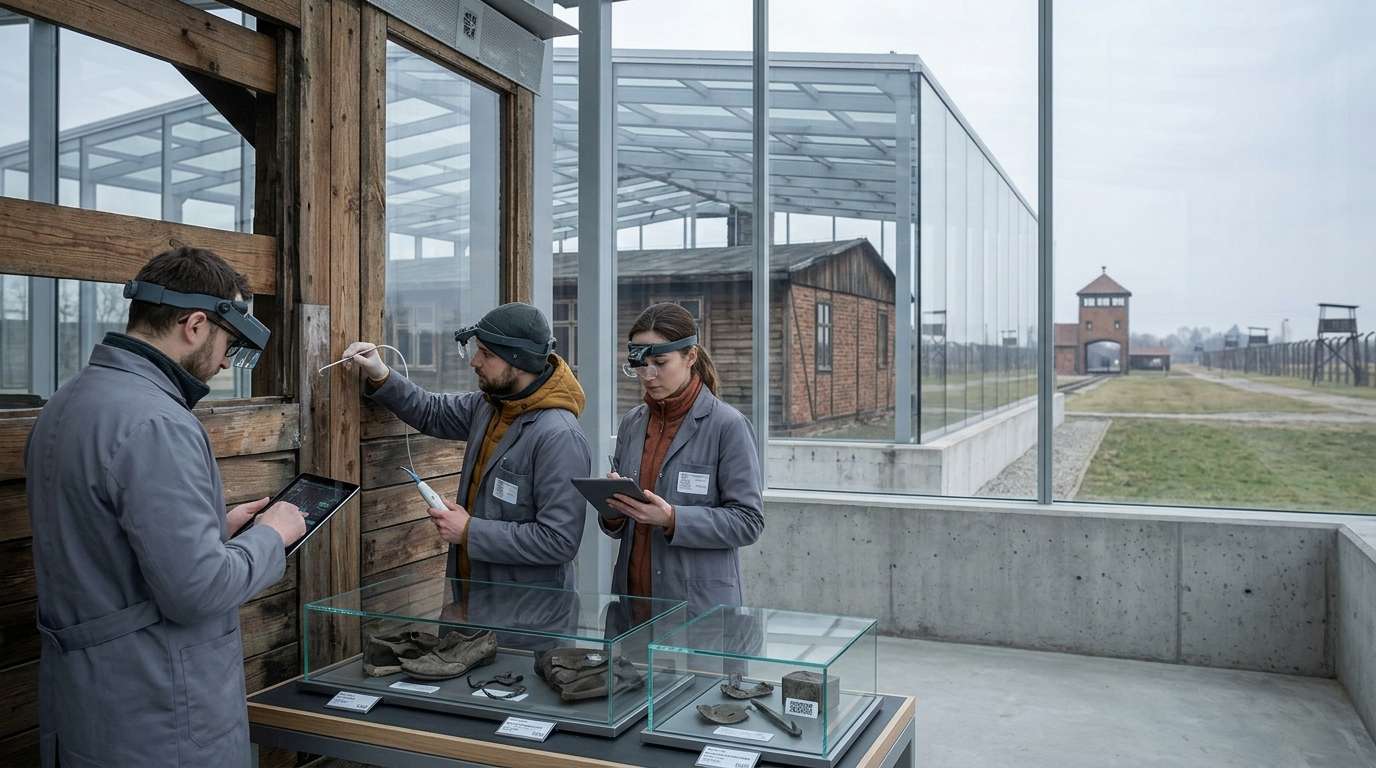
I never planned to spend a weekend reading engineering reports about brick decay. Yet I kept tracing how this fragile place could survive another hundred years.
You cannot visit this site once and simply store it in memory. It covers 190 hectares of brittle brick, waterlogged ground, and physical evidence that cannot crumble.
I kept asking what happens when the last survivor’s voice grows quiet. Who will keep the barracks standing? Who will stop the marshland from swallowing the truth?
The answer uses nano-mineral coatings, hydrologic drainage systems, and a steady move toward full energy independence. This holocaust memorial preservation work rarely makes headlines. Yet it is some of the most careful engineering I have seen.
I wanted to understand it like a mountain pass or border crossing: piece by piece, honestly, without skipping hard parts.
What I found changed how I view preservation. This holocaust memorial preservation is not routine upkeep. It is a promise built into stone, timber, and code, meant to outlast everyone standing here today.
Key Takeaways
- By mid-century, the site functions as a fully autonomous, carbon-neutral sanctuary built to last generations.
- Low-fired brick barracks are stabilized using breathable nano-mineral consolidants that resist freeze-thaw damage.
- Vistula hydrologic drainage vaults protect waterlogged marshland from swallowing fragile physical evidence.
- Visitor pathways double as kinetic energy harvesters, quietly powering on-site systems.
- Preservation efforts balance material science with deep respect for historical truth.
- The 190-hectare landscape represents one of the most advanced heritage engineering projects in the world.
1. A Moral Mandate: Why Protecting Auschwitz-Birkenau Is a Test of Our Humanity
My boots crunched on gravel when I first walked through that gate years ago. I still remember the sound.
Why does this matter so much? I asked myself while standing beneath the iron sign. Something shifts in you then. It is not exactly fear, but a weight that settles in your chest and never fully leaves.
I’ve traveled to dozens of historic sites since that day. None have asked as much of me as this one did.
This is not about nostalgia or checking a box on a travel itinerary. Protecting Auschwitz-Birkenau means doing the hard, unglamorous work of remembering. The work is uncomfortable, and looking away would be easier.
“For the dead and the living, we must bear witness.”
I think about that line whenever I read about new conservation work here. Letting brick crumble or timber rot is more than a maintenance failure. It is a moral one.
If the physical evidence disappears, we lose something no textbook or documentary can replace. That loss is the real stake behind every effort you will read about in the sections ahead.
Keeping this place standing is, at its core, a test. It is not a test of engineering, but of humanity.
2. Auschwitz-Birkenau Memorial Future 2050: A Blueprint for Sacred Sustainability
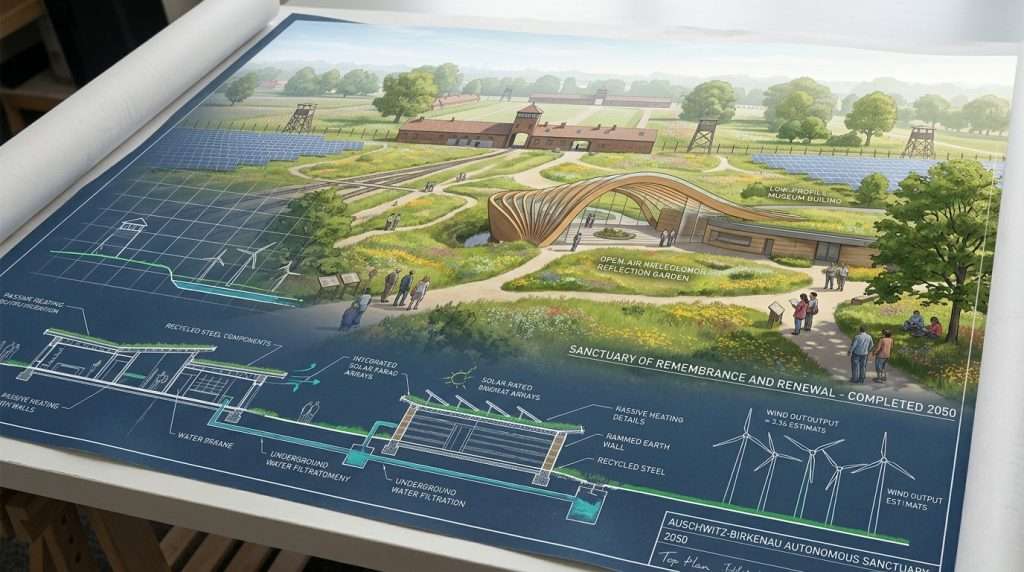
I keep returning to one number: 190 hectares. That equals roughly 270 football fields, filled with brick barracks, railway tracks, and fragile wooden structures. They have survived nearly a century of Polish winters.
By 2050, this landscape becomes a carbon-neutral, self-sustaining sanctuary. Every system, from power generation to moisture control, works together without heavy daily upkeep.
This section presents the blueprint before examining the specific technologies that do the heavy lifting.
Scaling 190 Hectares Into an Autonomous Sanctuary
An “autonomous sanctuary” sounds abstract until you break it down. Solar arrays and geothermal loops supply all on-site electricity without drawing from outside power grids.
Ground sensors track moisture around brick foundations. They trigger drainage when water threatens to rise. Conservators step in only when something truly needs human care.
I find this balance remarkable. The grounds nearly watch over themselves, freeing staff to focus on research, education, and yearly visitors.
Why Authenticity Must Never Be Sacrificed for Innovation
Here is my concern. Whenever I read about new sensors or coatings on historic sites, I worry that we may polish away the evidence we protect.
Auschwitz-Birkenau isn’t a theme park, and it should not look like one. Every rusted nail and crumbling brick tells part of the story, so no upgrade should erase that truth.
One simple rule guides every decision: technology stays invisible, reversible, and secondary to the original materials. If a system fails that test, it does not belong here.
“It is our duty to hand them on in the full richness of their authenticity.”
That sentence came decades before nano-coatings or geothermal archives. It still sets the standard for every plan through 2050.
3. Guarding Fragile Brick and Timber: The Nano-Mineral Shield
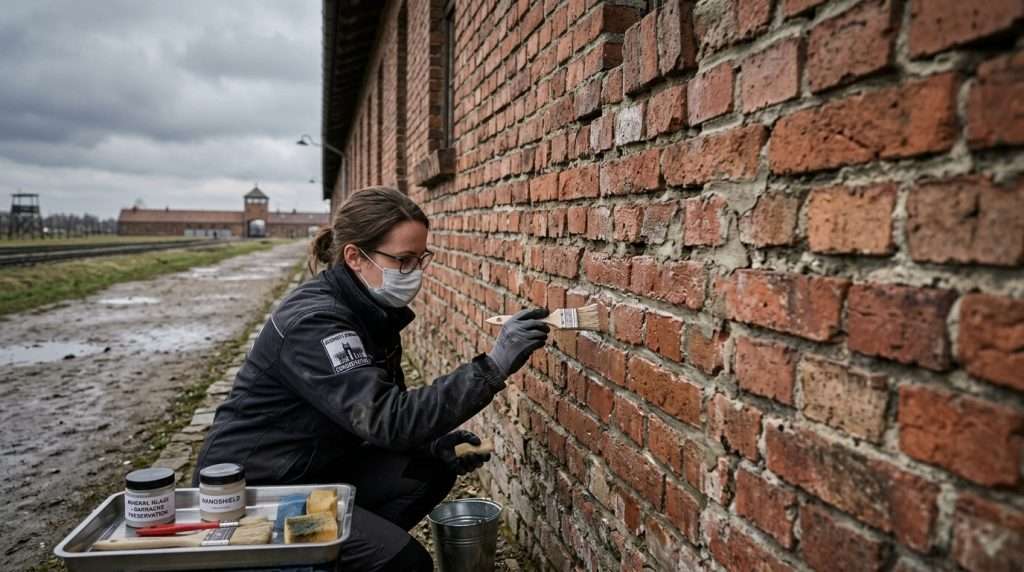
I think of the brick barracks at Birkenau each winter. Poland’s freeze-thaw cycles quietly damage this history each season. The structures were never built to endure eighty-plus winters.
Yet they still stand watch over one of humanity’s darkest chapters. The solution is a nearly invisible mineral layer that works around the clock.
Non-Invasive Mineral Masonry Glazes Explained
Non invasive mineral masonry glazes sound technical, but the idea is simple. Think of them as breathable sunscreen for old brick. Unlike old synthetic coatings, they let water vapor escape while blocking rain and snowmelt.
The glaze bonds with the original brick surface at a nano level. It doesn’t add a visible coating or change the brick’s color or texture. Conservators chose this method because it protects without hiding history’s authentic scars.
Birkenau Brick Barracks Conservation Against Freeze-Thaw Cycles
Birkenau brick barracks conservation faces a brutal enemy: water that seeps into brick pores, freezes, expands, and cracks brick surfaces from within. This happens each winter, and the damage quickly adds up.
I’ve seen photos of bricks with crumbled corners and edges rounded by decades of spalling. Most visitors walk past this damage without noticing. It’s a slow, silent kind of loss. The mineral glaze keeps water from penetrating deeply enough to freeze and expand, breaking that destructive cycle before it starts.
Saving Timber Stables and Crematoria Ruins From Decay
Wood presents a different challenge. The timber stables and crematoria ruins are among the grounds’ most fragile structures, weakened by rot, insects, and decades of weather.
Conservators adapted this nano-mineral approach for wood, using breathable formulas that strengthen fibers from inside. The goal was never to make these structures look new. Instead, it was to halt decay where it stands, preserving the damage in the historical record visitors come to witness.
4. Beneath the Memorial: Subsurface Hydrologic Heritage Engineering
Walking across Birkenau’s marshy fields, you would not notice the work beneath your feet. The entire memorial stands on the Vistula–Soła river plain, which looks calm but constantly struggles with water. Rising damp has slowly damaged brick and timber from below for decades.
That is where subsurface hydrologic heritage engineering helps. It forms a hidden support system that protects the site without changing anything above ground. I find this preservation work almost poetic because visitors never see the most important work.
Vistula Basin Hydrologic Drainage and the Fight Against Rising Damp
The Vistula basin hydrologic drainage network moves water away before it reaches historic structures. Pipes and channels beneath the soil draw out moisture and guide it to controlled outflow points. It adjusts to seasonal rainfall and river levels.
Staff do not need to monitor it each day. Sensors track soil moisture around the clock. When levels rise, drainage responds automatically and keeps water away from brick barracks and timber stables.
Automated Vaults Regulating Groundwater Beneath the Marshy Plain
Below the grounds, automated vaults regulate groundwater across the entire site. They act like quiet guardians, adjusting water tables to protect fragile foundations from shifts and cracks.
This work is essential on Birkenau’s marshy plain. Without it, seasonal flooding could undermine everything above, including the railway ramp and crematoria ruins. Real-time data lets the vaults respond before damage occurs.
Closed-Loop Reservoir Stormwater Harvesting for Archival Vaults
Captured rainwater does not go to waste. Closed loop reservoir stormwater harvesting collects and filters runoff, then sends it into geothermal loops. These loops cool climate-controlled archival vaults and keep document storage stable year-round without fossil fuels.
It is a simple idea carried out with great precision. Water that once threatened the site now helps preserve it. That kind of transformation feels like the quiet heart of this entire project.
5. Power Drawn From Memory: Clean Energy Across the Grounds
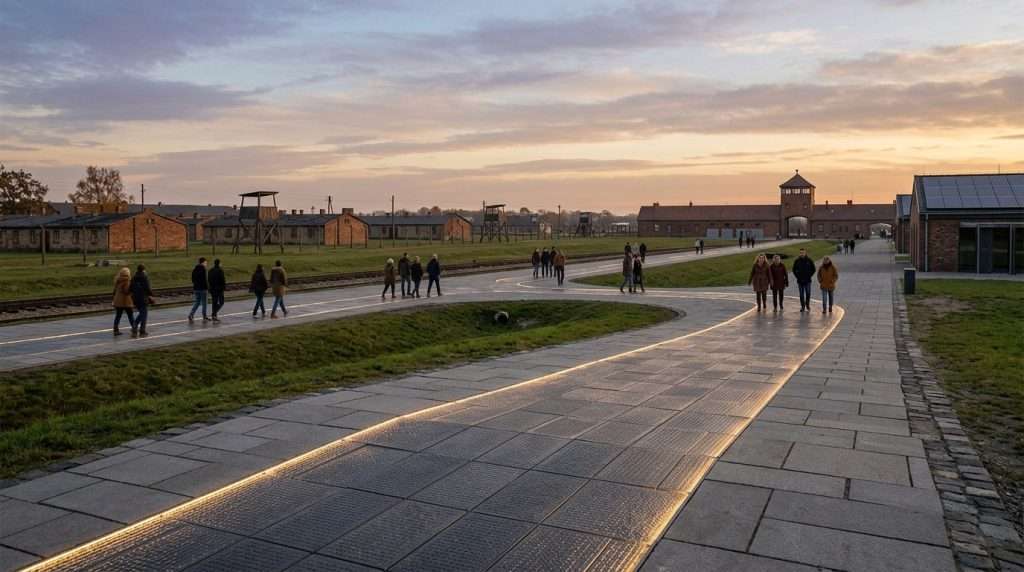
By 2050, this memorial’s energy will not come from fossil fuels or distant power plants. It will come from us. Each visitor becomes part of a quiet, clean energy system that honors the past and protects its future.
Piezoelectric Pavers on the Railway Ramp and Walking Corridors
Engineers embedded piezoelectric pavers beneath the historic surface along the central railway ramp and main walking corridors. These pavers capture the weight and motion of footsteps. That energy powers lighting, sensors, and climate controls across the site through a clean microgrid.
This detail moves me. Thousands of people walk this same path each day, following routes once walked by prisoners. Now, their footsteps create the power that keeps the memorial standing, making It’s a small but powerful symbol of memory turned into stewardship.
Zero-Emission Geothermal Loops Cooling the Archives
That commitment to clean power also extends underground. Zero-emission geothermal loops draw steady temperatures from deep below the marshy plain. They cool the archives, where fragile documents and artifacts rest.
These loops use no diesel generators and create no emissions. Instead, they quietly exchange heat to protect irreplaceable records from humidity and decay.
Borrowing From Stadium Porous Asphalt Stormwater Drainage Design
Here is something I did not expect at a memorial: ideas borrowed from sports architecture. Engineers studied stadium porous asphalt stormwater drainage systems used outside modern arenas. They adapted this permeable paving for the pathways here.
The porous surface lets rainwater soak through instead of pooling or eroding historic ground. It protects fragile foundations without changing what visitors see or feel underfoot. Sometimes, respectful solutions come from unexpected places.
6. Oświęcim’s Living Promise: Preserving Historic Truth for Future Generations
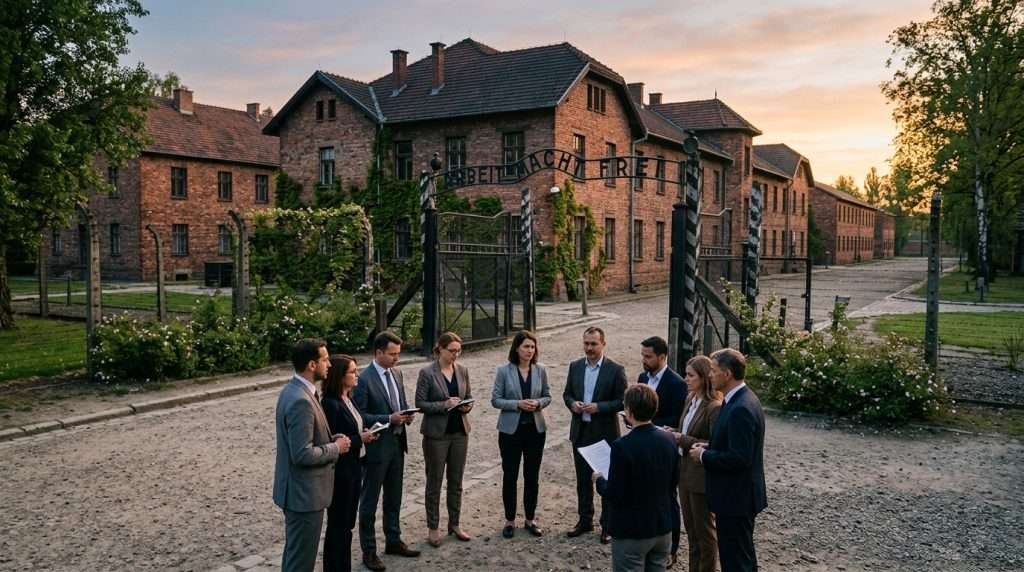
Between the nano-mineral glazes and geothermal loops, I nearly forgot the people who live here. Oświęcim is more than a memorial backdrop; it is a real town with families, schools, and daily routines. Those routines quietly carry its history forward.
After visiting the camp, I walked through its streets. The weight felt different beyond the gates. It is less about machinery and more about choice. Every resident inherits a duty no algorithm can replace.
The Town’s Stewardship Beyond the Memorial Gates
Local schools teach this history each year as a neighborhood story, not a distant lesson. Oświęcim preserves historic truth through its own museums, archives, and community programs that extend far past the memorial’s fence line.
Shopkeepers, teachers, and town officials each play a part. Their steady work matters as much as the conservation technology described earlier.
The town takes its role as keeper of context seriously. Street names, local signage, and civic memory projects add meaning that the physical site cannot provide alone.
Technology as Servant, Not Substitute, for Human Memory
By 2050, no survivors will remain to share their stories firsthand. This reality changes how I view every engineering project described throughout this article.
Nano-mineral shields and automated groundwater vaults protect only brick and timber. They cannot protect meaning. That work falls to teachers, guides, and families who keep speaking honestly about what happened here.
“For the dead and the living, we must bear witness.”
I keep returning to that idea while writing this piece. Every sensor, every climate-controlled archive, every solar panel exists only to buy time for human memory to keep working.
Technology can slow decay, but it cannot replace a grandparent’s voice or a teacher’s lesson. Oświęcim’s quiet daily commitment keeps historic truth alive. It will endure long after engineering fades into the background.
7. Conclusion
I won’t pretend that imagining Auschwitz-Birkenau in 2050 feels comfortable. It doesn’t. But sitting with that discomfort matters more than looking away.
As I walked through these 190 hectares, I kept thinking about every solution I had learned about. Nano-mineral shields protect brick barracks, hidden vaults manage groundwater beneath the marsh, and pavers turn footsteps into power. None of these systems exists to impress visitors with clever engineering; they help physical evidence survive and tell its story.
The people of Oświęcim understand this better than anyone. Their quiet stewardship, passed down through generations, shows that preservation is not only a technology problem. It’s a promise kept by human hands, even when they use solar panels and geothermal loops, not mortar and paint.
I hope one thing stays true decades from now. At the 2050 railway ramp, someone should feel exactly what I felt today: 1945’s weight pressing into the present. They should not feel awe at sustainable infrastructure; progress should stay invisible here, but memory should not.



Leave A Comment