
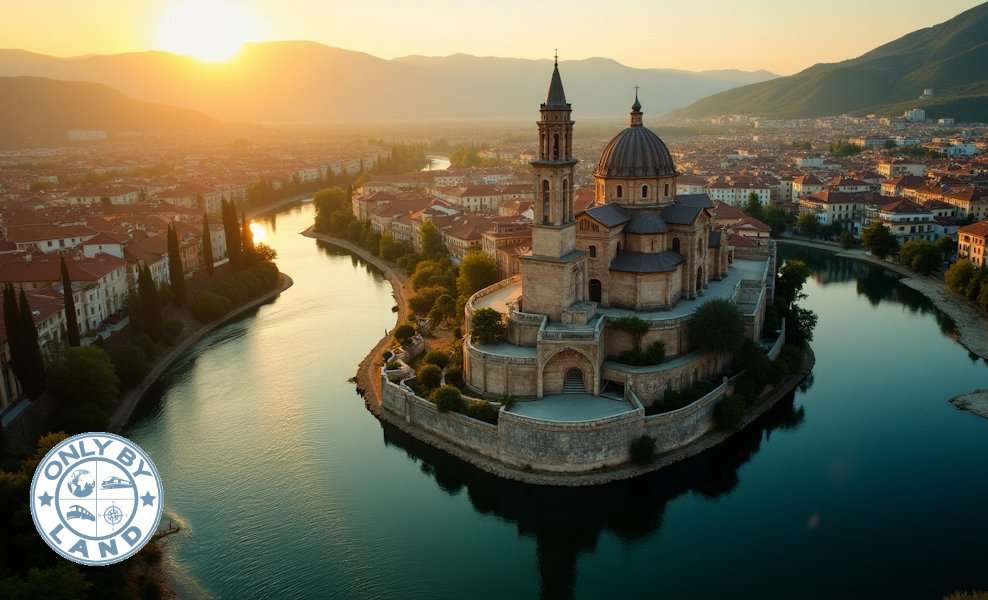
The ancient city of Mtskheta, Georgia ranks among the oldest continuously inhabited places on Earth. People have called this remarkable place home since the 2nd millennium BC. The city flourished as the vibrant capital of the Kingdom of Iberia from the 3rd century BC until the 5th century AD.
This historic gem sits 20 kilometers north of Tbilisi, where the Kura and Aragvi rivers meet. Mtskheta’s significance runs deep in Georgia’s spiritual heritage. The city witnessed a pivotal moment when Christianity was proclaimed as Georgia’s official religion in 337 AD. The Georgian Orthodox Church recognized Mtskheta as the “Holy City” in 2014 and its UNESCO World Heritage status covers remarkable monuments. These treasures include the Jvari Monastery from the 6th century, the majestic Svetitskhoveli Cathedral built in the 11th century and the ancient Samtavro Monastery dating back to the 4th century.
The Birth of Mtskheta: Georgia’s First Capital
The ancient city of Mtskheta became Georgia’s first capital, but its story begins much earlier. Archeological findings paint a picture of its evolution from a prehistoric settlement to a royal capital. The city’s unique geography and cultural influences shaped its remarkable growth.
Origins in the 5th Century BC
The story of Mtskheta blends history with legend. The Georgian Chronicles credit Mtskhetos, son of Kartlos and ancestor of the Georgians, as the city’s founder. Historical records show ancient Meschian tribes built the settlement in the 5th century BC. The city later became the capital of the early Georgian Kingdom of Iberia from the 3rd century BC to the 5th century AD.
The first Georgian king, Parnavaz, built new defensive walls around Mtskheta in the early 3rd century BC. His son Saurmag strengthened these walls between the late 3rd and early 2nd century BC. King Parnajom built mutually beneficial alliances with Persians in the late 2nd to early 1st century BC. He invited Zoroastrian priests to live in the city, which led to the construction of Zoroastrian temples.
Strategic Location at Two Rivers
The city’s location played a vital role in its growth. Mtskheta sits where two major rivers meet—the Mtkvari (Kura) and Aragvi—about 20 kilometers north of modern-day Tbilisi. This prime spot revolutionized Mtskheta into a bustling trading center. The city connected major trade routes between Byzantium, Syria, the Roman Empire, and the Silk Road.
This perfect location encouraged trade and brought together people from different cultures. The city’s defenses were impressive, with walls running along both sides of the Mtkvari River and three protective forts. The city’s atmosphere reflected a unique mix of values from the Bronze Age through its prosperous Christian era.
Early Archeological Evidence
Archeologists have found traces of human life in the Mtskheta area dating back to the 3rd and 2nd millennium BCE. Many Bronze Age burial sites from the early 1st millennium BC show that Mtskheta had grown into a thriving settlement.
The Armaziskhevi Archeological Site, on the right bank of the Mtkvari River, is a vital archeological treasure for Georgia and the entire Caucasus region. This site holds a rich mixture of history from the 1st century through the Middle Ages. Researchers have uncovered a grand palace, bathhouse, wine cellar, plumbing system, ceramics workshop and a necropolis with 144 graves from the 2nd to 9th centuries.
The site has also yielded two globally important stelae: a bilingual Greek-Aramaic epitaph (known as the Sarmazian bilingual) and a monolingual stela with Aramaic inscriptions. These artifacts tell the story of Georgian victory in Armenia during the mid-1st century AD.
Read about the oldest Christian churches in the world.
Rise to Power: Mtskheta as the Heart of Ancient Iberia
Mtskheta grew from a thriving settlement into the political heart of the newly formed Kingdom of Iberia at the end of the 4th century BC. This ancient town’s remarkable growth made it Georgia’s most important early capital. Its influence lasted nearly a millennium.
Center of the Kingdom of Iberia
By the 3rd century BC, Mtskheta became the Iberian kingdom’s political center and remained its capital until the 5th century AD. The city gained prominence under King Parnavaz I, who built new defensive walls. His successor King Saurmag continued to strengthen the city’s defenses in the late 3rd to early 2nd century BC. The large fortified city served as Iberia’s economic and political core for about 800 years.
Royal Dynasties and Their Legacy
Mtskheta’s time as capital saw several royal dynasties shape Georgia’s future. The Pharnavazid, Artaxiad, Arsacid and Chosroid royal families ruled the kingdom successively. King Mirian III made a historic choice in 326 AD that changed the city forever – he adopted Christianity as Georgia’s state religion.
Iberia experienced new growth under King Vakhtang I Gorgasali (447-502 AD). Though he answered to Persia, he secured the northern borders by subduing Caucasian mountaineers. He expanded control over nearby western and southern Georgian territories. He created an autocephalic patriarchate at Mtskheta but ended up moving his capital to Tbilisi.
Cultural Exchanges with Rome, Persia and Byzantium
The city’s strategic location encouraged rich interactions with powerful neighboring civilizations. A stone inscription found in the city shows the 1st-century ruler Mihdrat I (58-106 AD) as “the friend of the Caesars” and king “of the Roman-loving Iberians”. Emperor Vespasian strengthened the Arzami site in Mtskheta for Iberian kings in 75 AD.
Persian influence ran deep in Iberian elite customs. The Armazian script, based on Aramaic, became their official writing system. Zoroastrianism and Mithras’s cult flourished with local beliefs and gradually merged with ancient Georgian religious traditions. Byzantine architecture later shaped Georgian building methods, especially through Armenian influences.
Mtskheta’s position as a cultural crossroads helped it combine various influences with local traditions. This created a unique Georgian identity that continued long after the capital moved to Tbilisi in the 6th century.
Try these delicious Georgian dishes.
Sacred Transformation: How Christianity Changed Mtskheta
The ancient Iberian kingdom’s religious landscape went through a dramatic change in the 4th century. This change altered the map of Mtskheta, the oldest town in Georgia. Christianity turned this political center into the spiritual heart of the Georgian nation.
St. Nino and the Conversion of Georgia in 337 AD
Christianity came to Iberia around 320 AD with the arrival of St. Nino, a Cappadocian woman, in Mtskheta. She established herself in the royal capital and performed a miracle by healing Queen Nana from a severe illness. The queen converted to Christianity right after this extraordinary event.
King Mirian III opposed his wife’s new faith at first. The legend tells us that during a hunting trip, darkness suddenly surrounded him. He could only see again after he prayed to “Nino’s God”. This experience led King Mirian III to make Christianity the official state religion of Iberia in 337 AD. Georgia became the second nation after Armenia to embrace Christianity as its state religion.
Building of the First Wooden Churches
King Mirian built the first wooden church in Mtskheta’s center after accepting the new faith. Scientists found remains of this original wooden structure under today’s Svetitskhoveli Cathedral. St. Nino guided the construction of this first church in the royal garden, starting Georgia’s religious architectural legacy.
King Vakhtang Gorgasali replaced the wooden church with a larger basilica on the same site in the 5th century (420s). Catholicos Melchisedec I later built the current cross-domed Svetitskhoveli Cathedral between 1010 and 1029.
The Holy Tunic and Sacred Relics
Christ’s Robe (also called the Tunic) lies without doubt within Svetitskhoveli Cathedral as Mtskheta’s most sacred treasure. Georgian tradition tells of Elias (or Elioz), a Jewish man from Mtskheta, who saw Christ’s crucifixion in Jerusalem and brought the robe to Georgia. His sister Sidonia died instantly from overwhelming emotion when she touched the holy garment. She was buried with the robe still in her hands.
A cedar tree grew from Sidonia’s grave. St. Nino later asked for seven columns to be made from this tree to build the first church. One column rose into the air miraculously and came down only after St. Nino prayed all night. This “life-giving pillar” (Svetitskhoveli) became famous for its healing myrrh and gave the cathedral its name.
Architectural Treasures of the Oldest Town in Georgia

Mtskheta’s skyline features magnificent cathedrals and ancient monasteries that showcase Georgia’s rich architectural heritage. This UNESCO World Heritage site is Georgia’s oldest town, and its religious structures have survived invasions, earthquakes and centuries of history.
Svetitskhoveli Cathedral: Georgia’s Spiritual Center
Svetitskhoveli Cathedral, Georgia’s second-largest church building, stands as a masterpiece of medieval Georgian architecture. The cathedral, 54 meters tall, was built between 1010 and 1029 by architect Arsukisdze. Its name means “life-giving pillar” and refers to a cedar tree column that legend says rose into the air mysteriously.
The cathedral houses what many believe to be Christ’s robe, which Elioz, a Jewish witness to the crucifixion, brought to Georgia. Georgian monarchs chose this sacred place for their coronations and burials, including King Erekle II. The cathedral’s western façade still displays its original 11th-century ornate decorations.
Jvari Monastery: Guardian on the Hilltop
The 6th-century old Jvari Monastery sits atop Jvari Mount (656m) and seems to emerge from the mountain rock itself. This pristine example of Early Medieval Georgian architecture created the “Jvari type” church design that later spread throughout Georgia and Armenia.
The monastery features a cruciform structure with semicircular apses and an eight-faceted dome. Three-quarter cylindrical niches connect the four apses to the central space – a remarkable architectural innovation at the time. The eastern and southern façades showcase stunning bas-relief sculptures with Hellenistic and Sassanian influences and some carry explanatory inscriptions in Georgian Asomtavruli script.
Samtavro Monastery: Royal Burial Ground
King Mirian III built Samtavro Monastery in the 4th century, and builders reconstructed it in the 11th century. This complex includes the Transfiguration Church and St. Nino’s Nunnery. The cross-in-square temple displays characteristic 11th-century Georgian architectural decorations.
Samtavro’s significance lies in being the burial site of Georgia’s first Christian rulers, King Mirian III and Queen Nana. The monastery’s treasures include a piece of the life-giving pillar, a stone from Saint Nino’s grave and Saint Gabriel’s remains.
Hidden Archeological Sites Most Visitors Miss
Mtskheta holds archeological treasures that many tourists often overlook. The Armaziskhevi site reveals ruins from Hellenistic and Roman times, with artifacts spanning ancient history through the early Middle Ages. The area also features the Armaztsikhe fortress (3rd century BC), the Armaztsikhe acropolis (late 1st century BC) and a royal palace’s remains from the 1st-3rd centuries AD.
Enjoy Atskheta Georgia
Mtskheta shows evidence of Georgia’s rich cultural heritage that blends ancient history with spiritual significance. This UNESCO World Heritage site may no longer be the capital, but it remains Georgia’s spiritual heart through its remarkable religious monuments and archeological treasures.
Two rivers meet at this historic city that grew from a strategic settlement into ancient Iberia’s center. Svetitskhoveli Cathedral, Jvari Monastery and Samtavro Monastery showcase Georgia’s Christian heritage. The archeological sites reveal civilizations that stretch back to the Bronze Age.
The sort of thing I love about Mtskheta is its role as a cultural meeting point. Roman, Persian and Byzantine influences merged with local traditions to create something distinctly Georgian. This ancient capital’s architectural masterpieces and sacred relics give visitors a genuine window into Georgian civilization’s soul.
FAQs
Q1. When did Mtskheta serve as the capital of Georgia?
Mtskheta was the capital of the ancient Kingdom of Iberia (early Georgia) from the 3rd century BC to the 5th century AD. It served as the political and economic center of the kingdom for about 800 years before the capital was moved to Tbilisi.
Q2. What is the historical significance of Mtskheta?
Mtskheta is one of the oldest continuously inhabited cities in Georgia, with settlements dating back to the 2nd millennium BC. It became Georgia’s spiritual center after the country’s conversion to Christianity in 337 AD and is home to several important UNESCO World Heritage sites.
Q3. What are the main architectural attractions in Mtskheta?
The key architectural treasures in Mtskheta include the 11th-century Svetitskhoveli Cathedral, the 6th-century Jvari Monastery and the 4th-century Samtavro Monastery. These structures showcase medieval Georgian architecture and hold great religious importance.
Q4. How did Christianity transform Mtskheta?
Christianity dramatically changed Mtskheta when it became Georgia’s state religion in 337 AD. This led to the construction of the first wooden churches, later replaced by grand stone cathedrals. The city became a spiritual center, housing important religious relics like the supposed burial site of Christ’s robe.
Q5. What cultural influences shaped ancient Mtskheta?
Mtskheta’s strategic location facilitated cultural exchanges with Rome, Persia, and Byzantium. This resulted in a unique blend of architectural styles, religious practices, and artistic traditions, combining foreign influences with local Georgian elements to create a distinct cultural identity.


Leave A Comment