
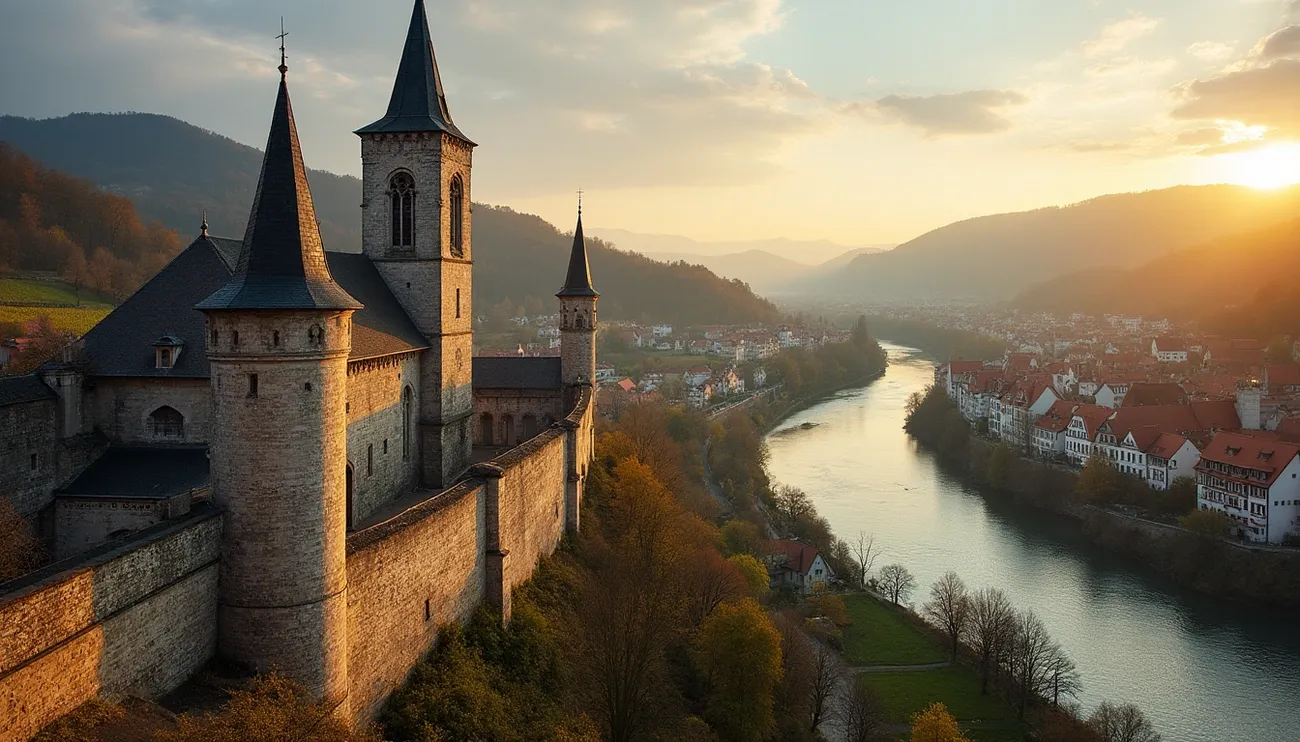
Oberwesel is a medieval gem tucked away in Germany’s Upper Middle Rhine Valley World Heritage Site. The town’s original defense system included 21 towers and all but one of these towers still stand guard after 800 years. People know it as the “Town of Towers and Wine.” The impressive town walls took about 200 years to build, starting in 1220 and finishing in the 15th century. The town’s history goes back to pre-Roman times, but it really flourished after becoming a free imperial city.
Two remarkable Gothic churches dominate Oberwesel’s skyline. The Liebfrauenkirche Oberwesel stands out as the Rhine Valley World Heritage Site’s most spectacular church, with its majestic spire defining the town’s silhouette. On top of that, the Martinskirche showcases Gothic architecture that draws history buffs from around the world. The Burghotel auf Schoenburg Oberwesel, set in a 10th-century castle, gives guests an unmatched experience. This carefully restored 19th-century structure provides breathtaking views of the Rhine. The town’s charming Marktplatz features a massive wine glass that symbolizes the region’s rich wine heritage. The high-quality Riesling vineyards have helped the town prosper for hundreds of years.
A Town of Towers and Time: Why Oberwesel is Worth Discovering

Oberwesel stands out as one of the most fascinating places along the Rhine Valley that truly captures medieval Germany’s spirit. This historic treasure lies in the UNESCO-protected Upper Middle Rhine Valley, right on the river’s left bank between Sankt Goar and Bacharach. People know it as the “town of many towers and wines”—a nickname that perfectly describes its character.
The moment you step into Oberwesel, you’ll feel transported back in time. The town shows off its medieval character through its defensive wall system, which ranks among the most complete ones you’ll find in the Middle Rhine region. These impressive fortifications run for three kilometers and feature towers with unique designs. The town started building these walls in the early 13th century as it grew wealthy and important. Construction continued until the 15th century.
What makes Oberwesel special is that you can climb parts of these ancient walls—something rare among Rhine towns. The Zehnerturm (Tenth Tower), the newest defensive structure, now houses an interesting exhibition. You’ll also find other remarkable towers like the Hospitalgassenturm (Hospital Lane Tower), Steingassenturm (Stone Lane Tower), Katzenturm (Cats’ Tower) and the Ochsenturm (Ox’s Tower) with its distinctive octagonal top.
The town’s roots go much deeper than what meets the eye. Celts first settled here, naming it Vosavia or Volsolvia. Later, Romans turned it into a military service point and horse-changing station. After the Romans left, the Franks built a royal estate here. The town changed hands several times—it became a free Imperial city in 1220 before becoming part of the Electorate of Trier in 1309, staying there until 1802.
French troops nearly destroyed the town during the Nine Years’ War in 1689. Yet Oberwesel bounced back. Most buildings you see today came up after this destruction, but they kept the town’s medieval charm intact.
Medieval Oberwesel
The magnificent Schönburg Castle watches over Oberwesel from above. Historical records first mentioned it in 1149. This thousand-year-old fortress made its owners some of the region’s richest and most powerful families, thanks to the custom duties collected in town. The castle shared the town’s fate in 1689 during Louis XIV’s campaign. T.J. Oakley Rhinelander, a German-American, funded its partial rebuild in 1885 using original plans. Now you can visit the Tower Museum to learn about the castle’s 700-year history or take in amazing views from its observation deck.
Medieval Oberwesel thrived on winegrowing, handicrafts, fishing, and trade. Nine monasteries once operated here, showing how prosperous the town was. The Minorite monastery, built in 1242, lasted until Napoleon dissolved it in 1802. A great fire in 1836 left it in ruins, which still stand today.
The town boasts remarkable cultural landmarks. The gothic Liebfrauenkirche (Church of Our Lady) from 1375 stands as one of the Rhineland’s most significant Gothic churches, featuring a golden altar, rood screen and wall paintings. Saint Martin’s Church, built in 1350, shows clever medieval engineering—its tower doubles as part of the town wall for defense.
Today’s visitors can check out unique spots like the Günderode House, a half-timbered building that appeared in the German series Heimat 3, offering spectacular views. The Kulturhaus Oberwesel teaches visitors about local history and life along the Rhine.
Wine lovers will appreciate that Oberwesel still produces excellent Rieslings. The town celebrates its wine heritage with a festival in early September each year.
More castles in Germany.
The Story Behind the Stones: A Brief History of Oberwesel

The ancient lands around Oberwesel tell a story that goes back centuries, a tale of changing powers and cultural shifts. The town’s medieval facade hides layers of history that stretch back thousands of years.
From Roman Outpost to Medieval Stronghold
A Celtic village called Vosavia or Volsolvia marked the earliest known settlement in what we now call Oberwesel. These first inhabitants built their community long before written records captured their daily lives. The Romans saw this Rhine location’s strategic value and built a military post here. They added a horse-changing station and a hostel that served official couriers and merchants.
The area went through big changes after Roman rule ended around 450 AD. The Frankish Merovingian tribe took control of the Middle Rhine region by the late 5th century and brought Christianity with them. Oberwesel became crown land under Frankish law. The entire region, including Bacharach and St. Goar, belonged to the royal property.
Records become clearer during the Saxon Ottonian dynasty. Emperor Otto I gave Oberwesel to the Mauritius Monastery in Magdeburg in 966. Later, Emperor Barbarossa took back the town and castle in 1166, putting them under imperial control again. This started Oberwesel’s change from a simple outpost to a strong medieval fortress.
The Rise of Trade and Wine in the Middle Ages
The year 1220 brought dramatic changes to Oberwesel. Emperor Frederick II lifted the pledge and made it a free imperial city. This freedom sparked remarkable growth. Construction of the impressive town walls started that same year. The walls grew bigger in three phases until the mid-14th century.
Oberwesel joined the powerful Rhenish League of Towns by 1255, linking its future with other major Rhine settlements. This golden age brought wealth from several sources:
- Wine growing brought riches between the 13th-15th centuries
- Rhine waters provided excellent fishing
- River access helped trade flourish
- Local craftsmen made popular goods
Religious life boomed at the same time. Two great churches—Liebfrauenkirche Oberwesel and Saint Martin’s Church—stood alongside two monasteries and a Beginenhof. The Franciscan monastery, built in 1242, later joined the Minorites around 1500. Nine monasteries owned major commercial properties in town, showing its religious and economic strength.
This wealth couldn’t stop political changes. Emperor Henry VII pledged the city to his brother Balduin, Archbishop and Elector of Trier, in 1309. The citizens protested, but Trier kept control. Oberwesel lost a key battle called the Wesel War in 1390/91. Still, Balduin helped develop the town by funding the Church of Our Lady (Liebfrauenkirche Oberwesel) at his domain’s southern edge.
Destruction and Rebirth: The 1689 War and Beyond
The Nine Years’ War (called the Palatinate War of Succession in Germany) ended Oberwesel’s medieval golden age in 1689. French troops under Louis XIV burned both the town and Schönburg Castle, wiping out centuries of growth. Oberwesel lay in ruins for the first time in its long history.
People started rebuilding almost right away. They restored only the Holy Spirit Hospital church’s choir as a chapel with a unique baroque roof dome around 1700. The town slowly rebuilt its buildings throughout the 18th century. Political challenges under Trier’s rule kept Oberwesel and nearby areas somewhat quiet.
The French came back in 1794 during the Revolutionary Wars. They took over Oberwesel and officially annexed it by 1802, ending the Archbishops of Trier’s centuries-long rule through secularization. French control didn’t last long. After Napoleon’s defeat and the 1815 Congress of Vienna, Oberwesel—with the Rhine’s left bank—became Prussian territory. Prussia ruled until German unification in 1871.
Modern visitors to Oberwesel Germany find a town that faced many challenges but kept its medieval character through sheer determination. The Burghotel auf Schoenburg Oberwesel stands as a perfect example of this comeback—a castle destroyed in war, left empty for two hundred years, then carefully restored to become one of the region’s most striking landmarks.
What are the largest castles in the world?
Walking Through Time: Exploring the Old Town and City Walls
A walk through Oberwesel’s medieval streets feels like stepping into a living history book. The centuries-old fortifications tell stories of times long past. This town lets you get close to history, especially when you walk along its remarkable city walls.
Highlights of the Altstadt
The old town’s heart is the charming Marktplatz, where you’ll find the tourist information office with maps and guidance for your visit. While the half-timbered area is smaller than Bacharach’s, Oberwesel’s Altstadt has its own special charm.
Convenient stairs from Marktplatz lead straight to the town wall walkways, making it a perfect starting point. Narrow streets wind between historic buildings that take you back centuries. The town kept its medieval character even though many buildings were rebuilt after 1689.
The Kulturhaus Oberwesel (City Museum) is worth a visit in the old town. You can find everything from ice age mammal skeletons to Rhine boat models and 19th-century carvings. The museum shows photos of the yearly crowned Weinkönigin (wine queen) and Weinhexe (wine witch)—a friendly guardian who makes sure the vineyards produce quality wine.
The Begehbare Stadtmauer Eexperience
Oberwesel’s crown jewel is the “Begehbare Stadtmauer” (walkable city wall)—a monument that’s truly special. The original medieval fortification stretched more than 2.5 kilometers and remains one of Germany’s best-preserved city fortifications.
The wall reaches between 8 and 16 meters high depending on the ground. Sixteen of the original 22 defensive towers still stand, each with its own unique design. Tourism development over the years means you can now climb the wall in many spots and walk the ancient battlements.
The Zehnerturm (Tenth Tower), the newest defensive structure, has an interesting exhibition. You can also go inside several other towers along the way and see medieval defensive architecture from the inside.
Victor Hugo, the French Romantic writer, wrote in his travel diary: “Oberwesel is particularly marked by the wars of the Middle Ages. The old town wall is riddled with cannon and rifle bullets… But today Oberwesel resembles an old soldier who became a vintner. Its red wine is excellent”.
Best viewpoints Along the Wall
The wall circuit gives you amazing views from different spots. Rhine River lovers will enjoy the wall section next to the river. You can climb an open tower here to see the water from above.
The northern section of the wall shows stunning views both inside and outside the town. Many people say this northern part is the most beautiful piece of the fortifications.
The terrace at Günderodehaus offers the best panoramic views. Vineyards surround this spot that looks out over the Rhine River, mixing history with natural beauty. Some wall sections frame the white tower of Martinskirche perfectly against the town.
Walking the wall is an adventure with its uneven ground and old stairs. The walls aren’t very high compared to others, but they make up for it with their authentic feel and atmosphere. On quiet, gray days when few people are around, you might feel like you’ve traveled back in time.
Visit the Berlin Wall.
Sacred Spaces: Oberwesel’s Two Iconic Churches

Oberwesel’s skyline rises above its medieval walls and historic marketplace, crowned by two magnificent churches that have stood guard for over 600 years. These sacred monuments tell stories of both spiritual devotion and the wealth and artistic achievements of medieval Oberwesel.
Liebfrauenkirche Oberwesel: Gothic Grandeur
The Liebfrauenkirche (Church of Our Lady) stands at the town’s southern edge. Many call it the most stunning Gothic church in the Rhine Valley UNESCO World Heritage site. Construction began in 1308 under Archbishop Baldwin of Trier and lasted until 1375. The result was a masterpiece of German Late Gothic architecture.
The church’s elegant 60-meter spire shapes Oberwesel’s silhouette and catches the eye from miles along the Rhine. The interior holds original medieval treasures. A magnificent golden altar from 1331 ranks among the most valuable pieces of that era. The limestone rood screen between the nave and choir stands as one of just three remaining in the Rhineland.
The church’s medieval wall paintings make it truly special. Nearly 40 scenes spread across 1,500 square meters offer a window into 14th-century religious art. Visitors can step back in time as vibrant colors and detailed imagery surround them.
Martinskirche: The White Church on the Hill
St. Martin’s Church (Martinskirche) creates a striking contrast to the Liebfrauenkirche’s central location. People know it as “The White Church” because of its bright exterior. This Gothic structure sits on a slight hill at the town’s northern end, built between 1350 and 1400.
Martinskirche’s defensive tower makes it unique. The tower connects directly to Oberwesel’s city fortifications. This practical design shows how medieval builders combined sacred and defensive needs.
The church never reached completion. Money ran short before the choir could match Liebfrauenkirche’s grandeur. All the same, this “unfinished” state adds to the church’s charm and historical appeal. The simple hall design with three equal-height naves reflects the mendicant orders’ style choices.
Hidden Details and Art Inside the Churches
Both churches hold amazing artistic treasures. Liebfrauenkirche houses the famous “Oberwesel Altar” from 1506. This masterpiece shows Mary’s life through exquisite craftsmanship, making it a jewel of late Gothic art.
Martinskirche features the “Mittelrheinischer Schmerzenmann” (Middle Rhine Man of Sorrows). This moving statue from 1380 captures Christ’s suffering with late medieval art’s emotional power.
Medieval choir stalls in both churches have misericords – small ledges under folding seats with detailed carvings. These often show funny or everyday scenes, mixing daily medieval life with sacred art.
Liebfrauenkirche’s stained glass windows deserve a closer look. Original medieval panels showcase 14th-century glassmakers’ skill and rich colors. Martinskirche’s baptismal font stands out as beautiful Romanesque work from before the church’s time.
These twin churches help visitors grasp Oberwesel’s medieval spirit. They add rich spiritual and artistic context to the town’s defensive walls and historic buildings covered earlier.
Schönburg Castle and the Tower Museum

Schönburg Castle stands tall on a hilltop above Oberwesel. This majestic fortress overlooks the Rhine Valley and brings together rich history with luxury hotel accommodations.
History of the Burghotel Auf Schoenburg Oberwesel
Records first mention Schönburg Castle between 911 and 1166 AD. The castle started as a defensive stronghold and its owners collected profitable customs from Rhine traders. The castle’s unique status as one of Germany’s “co-inheritance castles” meant it housed 24 different families with about 250 residents during its peak in the 14th century. Friedrich von Schönburg (known as “Marshall Schomberg”) became the castle’s most famous resident. He served as a lieutenant general throughout Europe until his death at the Battle of the Boyne in 1690.
French troops burned the castle to ruins in 1689 during the War of the Palatinate Succession. The ruins lay abandoned for two centuries. German-American T.J. Oakley Rhinelander bought and restored the castle in 1885. He invested over 2 million gold marks by 1914. The town of Oberwesel has owned Schönburg since 1950. The Hüttl family now runs it as a distinguished hotel in their third generation.
What to See at the Tower Museum
The Tower Museum sits behind an imposing double-grate gate tower and showcases 700 years of castle history through interactive exhibits. Visitors can practice at the crossbow shooting range or try the stone-throwing simulation that shows medieval siege tactics. A narrow winding staircase leads to the observation deck after 122 steps, revealing stunning Rhine Valley views.
Tips for Visiting or Staying Overnight
The castle hotel’s 27 rooms range from cozy singles to luxurious suites and many rooms have balconies with Rhine views. Each room has a free minibar, TV, and seating area, plus special touches like fresh fruit and sherry.
Hotel guests get exclusive access to the restaurant. Other visitors can enjoy the Bistro from 12:00-4:30 pm. Evening meals on the castle walls create magical moments when weather permits.
Museum tickets cost €3 for adults and €7 for families, while hotel guests enter free. The museum welcomes visitors Tuesday through Sunday (closed Mondays) from 10:00 am in high season, with limited weekend hours during winter.
Local Secrets: Wine, Food and Unexpected Finds
Oberwesel shows its true character beyond the ancient walls and sacred spaces. The town’s vibrant present blends perfectly with its medieval past through amazing food experiences and surprising attractions.
Weingut Lanius-Knab and Other Vineyards
Weingut Lanius-Knab stands proudly as the cornerstone of Oberwesel’s wine tradition. This family estate on the Rhine’s banks dates back 250 years. Riesling makes up 85% of their production. Guests can check out the historic vaulted cellars from 1897 or taste wines right in the vineyard. They’ll also learn about the challenges of growing grapes on steep slopes. The winery welcomes visitors with several options:
- Regular tastings at €25 per person daily
- Cellar tours with tastings (€27.50) on Mondays and Fridays
- Vineyard tours with on-site tastings (€40) on Thursdays
Weingut Weiler-fendel, Goswin Lambrich and Albert Lambrich are other notable vineyards. These wineries help build the town’s reputation for exceptional Rieslings.
The Giant Wine Glass in Marktplatz
A massive wine glass stands out in Oberwesel’s lively Marktplatz. This eye-catching landmark has become everyone’s favorite photo spot. The glass represents how wine-making shaped Oberwesel’s growth from a Roman outpost into a wealthy medieval town. The soil on Oelsberg hill just north of town creates perfect conditions for vineyards. This natural advantage brought great wealth to the town through history.
Günderodehaus: Film, Food and Views
The charming Günderodehaus sits near Oelsberg hill’s peak with one of the Rhine Valley’s most stunning views. This 200-year-old farmhouse with partial timber framing came from Seibersbach. It moved here to be part of Edgar Reitz’s “Heimat 3” TV series. Now it serves as a restaurant, wine bar and small film museum. Visitors can enjoy local food and wines while taking in amazing views of vineyards and the river below.
The Meteorite Museum Surprise
The Meteorite Museum might be the last thing you’d expect in this medieval wine town. It houses an amazing collection of space rocks. A huge 43kg Campo del Cielo iron meteorite from Argentina (found in 1576) steals the show. The museum displays various meteorites, tektites and impact rocks in artistic galleries with pastel walls.
Try German tea.
Enjoy the Hidden Gems of Oberwesel
Oberwesel is proof of resilience, history, and cultural preservation along the Rhine. This medieval gem has survived wars, destruction and political upheavals through the centuries while keeping its unique character. The town walls with their 16 surviving towers give visitors a rare chance to walk through history. You can experience medieval defensive architecture up close instead of just looking at it from far away.
The twin Gothic churches shape the town’s spiritual core. Liebfrauenkirche shows off its magnificent spire while Martinskirche stands guard with its defensive tower. Both buildings display extraordinary medieval artistry. Schönburg Castle’s amazing change from ruins to luxury hotel shows how historical preservation naturally fits with modern hospitality.
Wine has been at Oberwesel’s heart since Roman times. Local vineyards keep centuries-old traditions alive on the steep slopes around the town. They produce exceptional Rieslings that people celebrate at yearly festivals. The giant wine glass in Marktplatz shows the deep connection between the town and its wine-making heritage.
The town refuses to stay stuck in the past. You’ll find unexpected things like the Meteorite Museum and film connections at Günderodehaus. These spots show how Oberwesel honors its history while building new identities. This balance sets it apart from other Rhine destinations. Medieval walls house modern lives here and ancient traditions grow instead of staying frozen in time.
Travelers who step away from the usual Rhine Valley spots will find Oberwesel rewards exploration with real experiences. The town blends easy access with discovery. It’s organized enough for comfortable tourism yet untouched enough to feel like a genuine find. Though smaller than its famous neighbors, Oberwesel without doubt gives visitors a deeper, more personal look at the Middle Rhine’s true character.
FAQs
Q1. What makes Oberwesel unique among Rhine Valley towns?
Oberwesel stands out for its remarkably preserved medieval walls and towers, two iconic Gothic churches and a thriving wine culture. The town offers visitors a chance to walk along ancient fortifications, explore sacred spaces with centuries-old art and enjoy locally produced Riesling wines.
Q2. Can visitors actually walk on Oberwesel’s medieval walls?
Yes, Oberwesel’s “Begehbare Stadtmauer” (walkable city wall) allows visitors to climb and walk along large sections of the ancient fortifications. This unique experience offers stunning views of the town and Rhine Valley from various vantage points.
Q3. What is the significance of Schönburg Castle in Oberwesel?
Schönburg Castle, dating back over 1000 years, played a crucial role in Oberwesel’s history. Today, it houses a museum showcasing 700 years of castle history and functions as a luxury hotel, offering visitors a chance to stay in a restored medieval fortress.
Q4. Are there any unexpected attractions in Oberwesel?
Surprisingly, Oberwesel is home to a Meteorite Museum, featuring an extensive collection of extraterrestrial specimens. Additionally, the Günderodehaus, a relocated farmhouse used as a filming location, now serves as a restaurant and small film museum with panoramic views.
Q5. How important is wine to Oberwesel’s culture and economy?
Wine has been central to Oberwesel’s identity since Roman times. The town is renowned for its Riesling production, with several local vineyards offering tours and tastings. The giant wine glass in the Marktplatz symbolizes the enduring importance of viticulture to the town’s heritage and economy.


Leave A Comment