
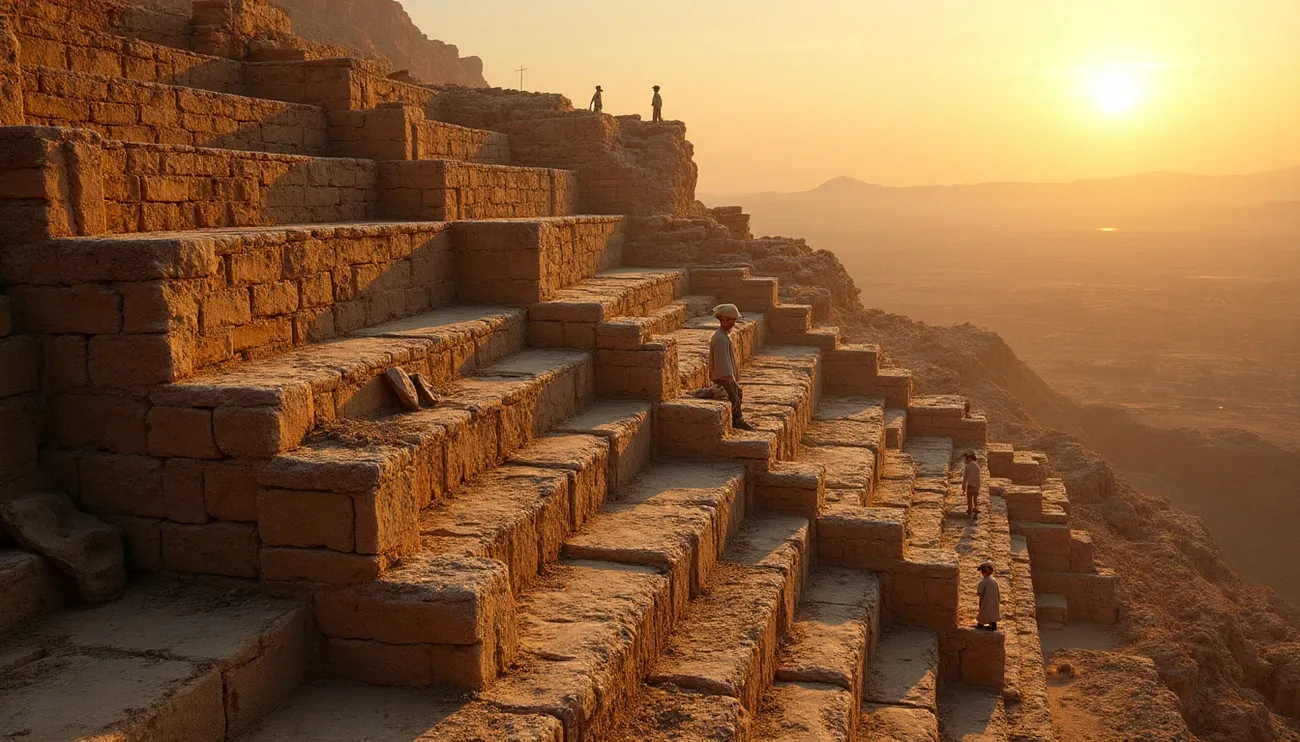
The Hanging Gardens of Babylon stand as the most mysterious of the Seven Wonders of the Ancient World. People know about them worldwide, yet nobody can find their exact location. These legendary gardens remain the only Wonder that researchers haven’t pinpointed precisely, even after centuries of fascination.
Neo-Babylonian King Nebuchadnezzar II supposedly built these gardens between 605 and 562 BC. Legend says he created them to comfort his Median wife, Queen Amytis, who felt homesick. The gardens’ location still baffles researchers today, well into the 21st century. Three compelling theories try to explain what happened to these magnificent gardens. Some believe they were just myths. Others think they existed in Babylon but disappeared around the first century AD. The most surprising theory suggests the legend actually describes gardens built by Assyrian King Sennacherib in Nineveh. This mystery leads to a crucial question: Did the Hanging Gardens of Babylon really exist, or have historians been looking in the wrong place?
Classical Descriptions of the Hanging Gardens

Ancient writers gave us captivating descriptions of the hanging gardens of Babylon. These accounts surfaced centuries after the gardens were built. Five major classical writers documented the most detailed accounts. Each writer brought their own viewpoint while sharing certain common elements.
Accounts from Berossus and Josephus
Berossus, a Babylonian priest of Marduk, made the earliest known mention of the hanging gardens around 290 BC. His original work no longer exists. The Jewish historian Josephus (c. 37-100 AD) preserved his description. Berossus stands out as the only source that directly credits Nebuchadnezzar II with constructing the gardens.
Josephus retells Berossus’s account of Nebuchadnezzar’s palace. The palace had “very high walls, supported by stone pillars. The king created what people called a pensile paradise. He filled it with trees of all kinds to make it look exactly like a mountainous country”. The king built this marvel to please his Median wife who missed the mountains of her homeland.
Josephus’s account stands alone in naming Nebuchadnezzar’s wife as Amytis, daughter of Astyages, King of the Medes. Nabopolassar arranged their marriage to strengthen the alliance between these peoples.
Descriptions by Diodorus and Strabo
Diodorus Siculus (active c. 60-30 BC) wrote one of the most detailed descriptions. He drew from earlier sources including Cleitarchus and Ctesias of Cnidus. Unlike Berossus, he credited the gardens to a “Syrian king” who built them for a Persian concubine longing for her mountainous homeland.
Diodorus describes a square garden with each side measuring four plethra (about 400 feet or 122 meters). The garden rose in tiered terraces like a theater. The uppermost gallery reached 50 cubits (about 75 feet) high. The complex construction included walls 22 feet thick and stone beams 16 feet long. Builders layered reeds in bitumen, added baked brick bonded by cement and covered it with lead to keep moisture out.
Strabo (c. 64 BC – 21 AD) likely drew from Onesicritus and told a slightly different story. He described the gardens as four-sided with each side four plethra long. The structure had “arched vaults, one after another, on checkered, cube-like foundations”. These foundations were “hollowed out” and “covered deep with earth to support the largest of trees”.
Both writers emphasized advanced irrigation systems. Strabo mentioned water lifted from the Euphrates through “screws” next to stairs. Diodorus wrote about “machines raising water abundantly from the river, hidden from outside view”.
Common Themes in Ancient Texts
The classical accounts share several key elements despite differences in attribution and details:
- Mountainous appearance – Most writers emphasized the garden’s mountain-like landscape
- Tiered construction – Multiple levels rose in terraces throughout the gardens
- Sophisticated engineering – Every account mentioned complex structures supporting massive weight of soil and trees
- Advanced irrigation – Various mechanical devices raised water from the Euphrates
- Royal motivation – A king built the gardens to please a homesick queen or concubine
These descriptions reveal an extraordinary achievement in engineering and horticulture. In spite of that, the accounts raise questions about the gardens’ existence. Writers documented these stories centuries after the supposed construction and disagreed about who built them and why.
The Babylon Theory: Traditional Beliefs and Challenges

The traditional story of the hanging gardens of Babylon has captivated people for centuries. The story revolves around the city of Babylon and its most famous ruler. Classical accounts support this popular theory, but archeological evidence and historical records present major challenges to this belief.
Nebuchadnezzar II and Queen Amytis
King Nebuchadnezzar II ruled Babylon from 605 to 562 BCE. The legend tells us he constructed this magnificent wonder to please his Median wife, Queen Amytis. She missed the green landscapes of her mountainous homeland. Their marriage took place around 605 BCE when Princess Amytis made her journey from Ecbatana to Babylon.
The king’s deep love for his wife drove him to create an artificial paradise that reminded her of the lush hills of her homeland. This romantic gesture stands as maybe even history’s grandest gift from a husband to his wife.
Queen Amytis’s historical record remains surprisingly sparse. Her story has largely disappeared from history except for her connection to the legendary gardens. Historians can’t even confirm if she had children with Nebuchadnezzar or held any political power. On top of that, no Babylonian texts from that time mention a marriage between Nebuchadnezzar and a Median princess named Amytis.
Architectural Features and Irrigation Systems
Classical accounts describe the hanging gardens as an engineering marvel with unique features. The structure looked like a mountain landscape with tiered terraces that rose about 75 feet high. Ancient writers tell us about a square garden that measured roughly 400 feet on each side.
Builders used mud bricks, stone and bitumen (an ancient form of asphalt). The walls measured 22 feet thick and supported the massive weight of soil, plants and trees. The name “hanging” came from the way vegetation seemed to float in air as it flowed down multiple levels.
The gardens needed an advanced irrigation system to survive Babylon’s dry climate. Engineers created a clever mechanism that moved water from the Euphrates River to the highest terraces. One theory suggests they used a chain pump with buckets attached to a continuous chain that slaves powered. Water-filled buckets would empty at the top and let water flow down through channels to feed all plants.
Lack of Babylonian Records or Remains
The biggest challenge to the Babylon theory comes from the total lack of archeological and textual evidence. Archeologists have not found any clear remains of the gardens in Babylon despite extensive digging. German archeologist Robert Koldewey thought he had found the gardens’ foundation during his work between 1899 and 1917. Most scholars now believe this structure was just a warehouse.
Babylonian sources from that time make no mention of the gardens. We have hundreds of documents from Nebuchadnezzar’s reign that detail his building projects, but none talk about any hanging gardens. This silence stands out because Nebuchadnezzar loved to document his achievements.
Many scholars now question whether the hanging gardens of Babylon existed as described in their traditional location. Some think they might be purely mythical or were destroyed before anyone could document them. An interesting alternative suggests the legendary gardens might have stood in Nineveh, the Assyrian Empire’s capital, rather than Babylon.
Beautiful places to visit in Iraq.
The Nineveh Hypothesis: Sennacherib’s Garden
A new theory challenges everything we thought we knew about the hanging gardens. These legendary gardens might not have been in Babylon at all. Evidence points to Nineveh, the Assyrian Empire’s capital, where King Sennacherib built them almost 100 years before Nebuchadnezzar.
Stephanie Dalley’s Research and Claims
Oxford University’s Stephanie Dalley started questioning the traditional story in the early 1990s. She noticed things didn’t add up with the Babylon version. Her complete findings came out in 2013, and they tell a different story. The gardens stood in Nineveh (today’s Mosul, Iraq), built by the Assyrian King Sennacherib around 700 BCE.
Dalley’s theory tackles several issues with the Babylon story. Ancient writers mixed up Babylon and Nineveh sometimes. They used “Babylon” as a catch-all term for cities in Mesopotamia. The classical descriptions match Nineveh’s landscape better than Babylon’s flat ground. The sort of thing I love is that Sennacherib wrote about building these amazing gardens, while Nebuchadnezzar never mentioned them.
Evidence from Assyrian Inscriptions
Babylon left no written proof, but Assyrian inscriptions tell a different story. Sennacherib’s records describe amazing palace gardens with trees, sweet-smelling plants and fruits “from all over.” His words paint a vivid picture: “I raised the height of the surroundings of the palace to be a wonder for all peoples… I had a swamp and reed-bed made along its terrace, I planted a botanical garden.”
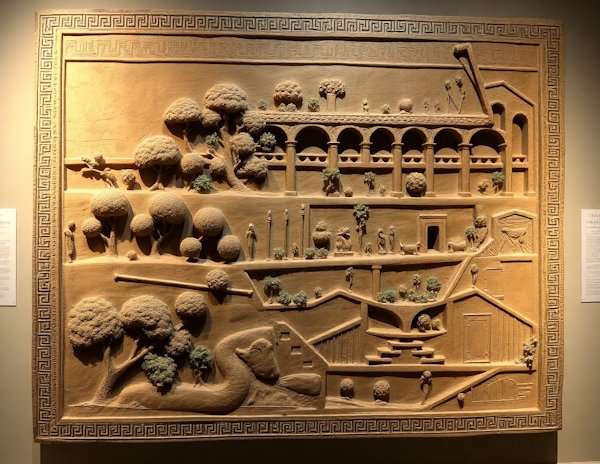
The king built these gardens to make his queen happy – just like the old stories said about Nebuchadnezzar. On top of that, a relief from Nineveh shows trees and plants growing on a hillside held up by stone arches. This matches what classical writers said about the hanging gardens perfectly.
Aqueducts and Water-raising Technology
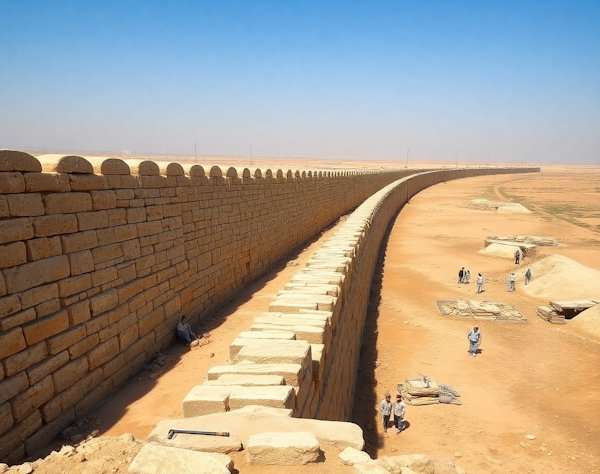
Sennacherib’s water engineering projects make this theory really shine. Assyrian texts show he built a massive irrigation system with a 50-mile aqueduct bringing water from the mountains to Nineveh. The king proudly declared: “I made water flow over steep limestone terrain… for irrigation… I made fields for Nineveh.”
The king created new ways to lift water, including something that looks like an Archimedes screw – long before Archimedes was born. Archeological discoveries back this up. They found parts of an aqueduct at Jerwan with a million stone blocks and waterproof bitumen.
The evidence keeps stacking up. Text records, archeological finds and logical connections make the Nineveh story more believable. This could explain why nobody can find the hanging gardens of Babylon in Babylon itself.
Archeological Evidence and Excavation Findings
Archeological digs over many decades have left experts puzzled about where the hanging gardens of Babylon really stood. The evidence they found points in different directions.
Findings at Babylon: vaults and wells
German archeologist Robert Koldewey led the first big dig at Babylon from 1899 to 1917. His team found something promising in the northeastern corner of Babylon’s Southern Palace. They unearthed an unusual arched structure with thick walls and several wells. The strong stone vaults looked perfect for holding up something heavy above them. This made Koldewey believe he had found the legendary hanging gardens’ base.
Time proved this idea wrong. Most experts now reject this theory. They found storage jars and a cuneiform tablet that listed grain, dates and other goods. These items showed the structure was more likely a warehouse than the base of grand gardens. A century of digging at Babylon has not revealed any buildings or written records that prove the gardens existed there.
Excavations at Nineveh and Jerwan
The work at Nineveh tells a different story that matches what ancient writers said about the hanging gardens. Researchers found a huge aqueduct system there. From above, it “looked like a stretch of motorway”. This amazing piece of engineering carries Sennacherib’s words: “Over a great distance I had a watercourse directed to the environs of Nineveh”.
The Jerwan aqueduct stands as another remarkable find. Built between 700-690 BC about 30 miles from Nineveh, it uses more than two million stones and waterproof cement. The royal palace at Nineveh held relief panels showing a beautiful garden fed by an aqueduct. People used to think these panels were just decorative, but they match the ancient descriptions of the hanging gardens surprisingly well.
Limitations of Current Archeological Methods
Several things make it hard to reach firm conclusions about the gardens. The Euphrates River has moved since Nebuchadnezzar’s time and some key evidence might lie under its waters. Safety issues near Mosul, Iraq have made it tough to dig at Nineveh.
Not knowing exactly where to look creates another problem. Without confirmed locations, experts can’t protect what might be left. Money problems keep getting in the way of new digs that could finally solve this ancient puzzle.
Were the Hanging Gardens of Babylon Real?
The mystery of Babylon’s hanging gardens has puzzled historians for over a century. A fundamental question remains unanswered – did this ancient wonder actually exist?
Arguments for a Mythical Creation
Archeological evidence at Babylon simply doesn’t exist. German archeologists dedicated two decades to excavating the site during the early 1900s but found “not a single clue”. The situation becomes more puzzling since Babylonian texts never mention these gardens. Even Nebuchadnezzar’s detailed construction records show “no mention of such gardens”. Herodotus visited Babylon during the gardens’ supposed existence yet never wrote about them.
Possibility of Misattribution Over Time
These facts point to a different explanation. The Assyrians conquered Babylon in 689 BCE and Nineveh became known as “New Babylon”. King Sennacherib renamed his city gates to match Babylon’s entrances. This merging of identities confused Greek historians about locations. Diodorus exemplifies this confusion by placing Nineveh “next to the Euphrates, although in fact the city stood on the banks of the Tigris”.
Symbolic Value in Ancient and Modern Culture
The gardens transcend physical existence and represent humanity’s endless quest to merge nature with built environments. Gardens symbolized fertility, abundance, and divine favor in Mesopotamian culture. The hanging gardens of Babylon continue to engage our imagination as a powerful symbol of human ingenuity whatever their historical truth.
Appreciate Hanging Gardens of Babylon
Historians and archeologists remain fascinated by the mystery of the hanging gardens of Babylon. Most people believe Nebuchadnezzar II built them in Babylon, but new evidence suggests Nineveh as their true home. Stephanie Dalley’s groundbreaking research has definitely challenged old beliefs and explains why we haven’t found any proof in Babylon.
The evidence at Nineveh lines up perfectly with classical descriptions. The site reveals extensive aqueducts, sophisticated irrigation systems and relief panels showing lush gardens. Sennacherib’s inscriptions talk about creating magnificent gardens “to be a wonder for all peoples” – exactly what made these gardens legendary.
The confusion started because people sometimes called Nineveh “New Babylon” after Assyrian conquests. This naming mix-up, combined with classical writers being far from the original events, created a mystery that puzzles us today.
These hanging gardens showcase human achievement, whether they stood in Babylon, Nineveh, or existed only in ancient stories. Their impact goes nowhere near physical existence – they show humanity’s endless desire to blend architectural brilliance with nature’s beauty.
Finding solid proof remains challenging because of unstable politics, changing landscapes and limited access to dig sites. In spite of that, new theories and discoveries help us understand this ancient wonder better.
The hanging gardens’ story lives on as a powerful cultural symbol, whatever their historical truth might be. They remind us that history’s greatest mysteries don’t always need exact details to inspire wonder through the ages.
FAQs
Q1. Where were the Hanging Gardens of Babylon actually located?
Recent research suggests that the Hanging Gardens may have been located in Nineveh, the capital of the Assyrian Empire, rather than in Babylon. This theory is based on archeological evidence and ancient Assyrian inscriptions that align more closely with classical descriptions of the gardens.
Q2. Who is believed to have built the Hanging Gardens?
While traditionally attributed to Nebuchadnezzar II of Babylon, new evidence points to Assyrian King Sennacherib as the possible creator of the gardens. Sennacherib’s own records describe the construction of magnificent palace gardens in Nineveh around 700 BCE.
Q3. Why haven’t archeologists found evidence of the Hanging Gardens in Babylon?
Despite extensive excavations in Babylon, no conclusive evidence of the Hanging Gardens has been found. This lack of evidence, combined with the absence of mentions in Babylonian texts, has led scholars to question the traditional narrative and explore alternative theories.
Q4. What made the Hanging Gardens so remarkable?
The Hanging Gardens were considered extraordinary due to their tiered construction, sophisticated irrigation systems and ability to sustain lush vegetation in an arid climate. They were described as resembling a green mountain, with multiple levels of plants and trees seemingly suspended in air.
Q5. Is it possible that the Hanging Gardens never actually existed?
While the lack of archeological evidence has led some to suggest the gardens might be mythical, they continue to captivate imaginations as a symbol of human ingenuity. Whether they existed physically or not, the concept of the Hanging Gardens represents humanity’s enduring desire to create beauty by blending architecture with nature.





Leave A Comment