

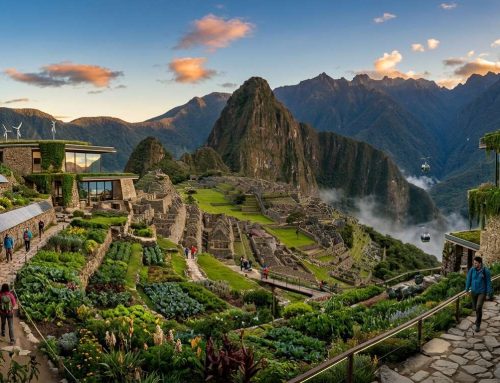
I still remember my first ride into these misty highlands. The cable car rose through thick clouds as I held my camera ready. Then the mist cleared, revealing two giant stone hands cradling a golden bridge from a fairy tale.
Back then, the bridge felt fragile. It seemed like a beautiful postcard scene that harsh typhoon seasons could slowly damage year after year.
But what if extreme mountain weather became this resort’s greatest strength, rather than its weakness?
That question guides my view of the Ba Na Hills future 2050. This is my own curious, cinematic look at what’s being tested now in Da Nang’s highlands. It is a mountain resort engineered to survive monsoon seasons and altitude stress, not merely endure them.
The Golden Bridge and the French Village remain the heritage anchors. Everything else gets built to protect them.
Key Takeaways
- The resort aims to become a net-zero, climate-resilient mountain destination by 2050.
- The Golden Bridge and French Village remain protected heritage anchors throughout the transformation.
- Engineering solutions target monsoon rainfall, altitude stress, and typhoon exposure.
- Weather vulnerability is being reimagined as a competitive design advantage.
- Architecture blends cliffside structures with breathable, sustainable building materials.
- The vision signals a broader shift toward resilient, high-altitude tourism destinations.
Ba Na Hills Future 2050: A New Benchmark for High-Altitude Resort Resilience
I once thought nobody built a theme park to survive climate change. Then I spent a week studying Ba Na Hills in 2050.
I grew up seeing this place as a cable-car ride, a giant golden bridge, and a fake French village. But Ba Na Hills became much more: a working proof that mountain resorts can survive climate stress worldwide.
Researchers studying sustainable cities often highlight the same few places. The UN-Habitat “A Better World” volume on SDG 11 tracks resilient, low-carbon city infrastructure. It highlights Sino-Singapore’s Tianjin Eco-City and Smart Dubai’s climate-ready grid systems, much like Ba Na Hills on one mountain.
“Resilient infrastructure isn’t a luxury for mega-cities anymore. It’s becoming the baseline expectation for any built environment facing climate stress, from Dubai’s skyline to a mountaintop resort in Vietnam.”
That comparison changed how I view Ba Na Hills future 2050. This is not a resort with solar panels added for good public relations. It is an autonomous, carbon-neutral mountain biome that runs independently from Da Nang’s city grid and emergency repair budgets.
Three systems make this possible, and I explain each one below:
- Self-generated clean power drawn from kinetic energy created by thousands of footsteps crossing the Golden Bridge every day
- Independent floodwater management built to handle the brutal downpours rolling off the Trường Sơn mountains
- Heritage protection systems that shield titanium ribs, Gothic facades, and stone masonry without leaning on outside repair crews
I did not expect a theme park to achieve this. At the plaza’s edge, stone facades stood firm in monsoon mist. I understood why engineers from other climate-resilience projects now pay attention.
Ba Na Hills by 2050 is no longer chasing tourist numbers. It seeks something harder to measure and far more valuable: proof. That proof shows one resort can survive what entire cities struggle to withstand.
That’s the real story behind Ba Na Hills future 2050. It is not a bigger bridge or a flashier village, but a mountain that learned to care for itself.
Guarding Cầu Vàng’s Giant Hands: Non-Invasive Mineral Masonry Glazes in Action
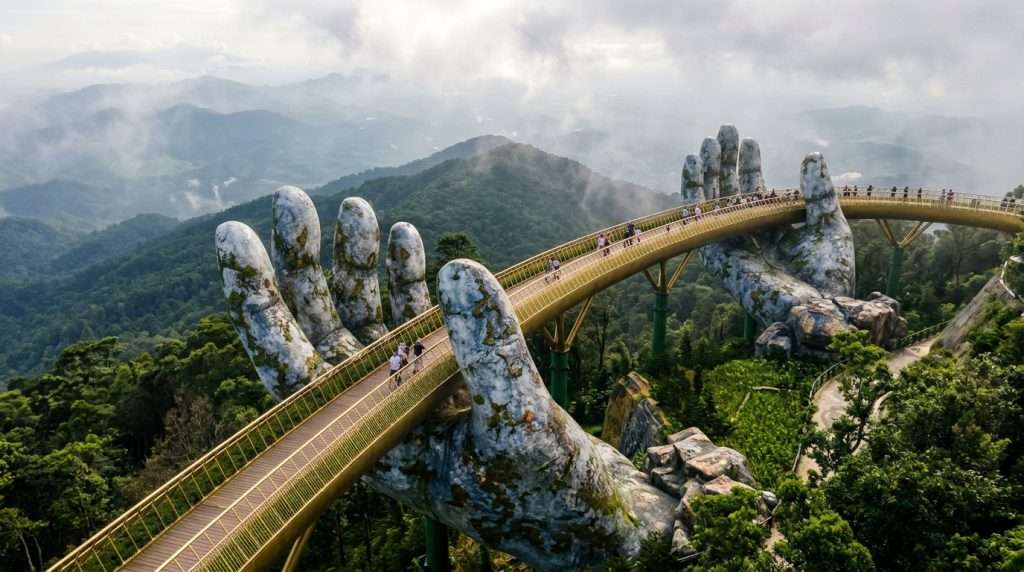
The giant hands make every photo look ancient and unchanged. Up close, I learned they are part of a delicate preservation project. Visitors stop first, raising phones or cameras to frame the weathered knuckles against the misty valley.
Under the mossy, aged surface, an engineered structure fights slow moisture damage.
That’s where cau vang preservation becomes fascinating. Engineers wanted to keep the character that makes the bridge feel real, so they protected it from inside out.
Breathable Nano-Mineral Glazes and the Science of Arresting Fiber Fatigue
The stone hands are not solid rock. They are layered composites built around structural fiber cores that give the sculptures shape and strength.
Constant exposure to Da Nang’s humidity stresses the fiber layer. Engineers call this slow process fiber fatigue.
Without treatment, fatigue weakens the structure from within, long before cracks appear. The solution borrows from an older Vietnamese tradition.
Restoration teams coat the fiber core with breathable nano-mineral glazes. The technique comes from ironwood pillar restoration work I saw elsewhere in Vietnam’s historic sites. These glazes work like skin, not paint.
- They let trapped moisture escape outward, preventing pressure buildup inside the fiber layer.
- They block driving rain and monsoon spray from penetrating the surface.
- They bond at a microscopic level, so no visible film or sheen ever forms.
That balance is the whole trick — keeping the structure dry inside while letting it breathe outside.
Preserving Titanium Ribs and Gothic Facades Without Sacrificing Patina
Farther along the bridge deck, titanium ribs support its graceful curves. In the French Village, Gothic-style facades display decades of weathered color that nobody wants to lose.
Both surfaces receive non invasive mineral masonry glazes in thin layers bonded directly to existing material. Workers do not repaint, resurface, or correct the color.
I asked one conservation engineer how they keep the look consistent. The answer stayed with me.
“We’re not restoring how it looked on day one. We’re protecting how it looks right now, because that’s the version travelers actually came to see.”
That philosophy explains the titanium ribs’ soft gunmetal sheen and the Gothic facades’ sun-bleached, storm-worn look. That look remains exactly as intended.
Da Nang’s Climate Test: Fighting Bio-Rot in Perpetual Monsoon Mist
Da Nang’s weather does not do the structure any favors. Monsoon mist rolls through the mountains for months, helping mold, moss, and bio-rot spread across stone and metal.
This is the real stress test for every glaze applied across the site. Engineers needed a glaze that resists biological growth without stripping the bridge’s authentic, aged patina.
| Surface Type | Main Threat | Protective Approach |
|---|---|---|
| Stone fiber core (hands) | Fiber fatigue from humidity | Breathable nano-mineral glaze |
| Titanium ribs | Surface oxidation | Microscopic mineral bonding |
| Gothic facades | Mold and moss growth | Bio-resistant mineral coating |
These mineral compounds make the surface hostile to spores and algae. They avoid harsh chemicals that could fade or flatten the stone’s natural color.
For photographers, this detail matters more than it first seems. It helps the bridge look timeless in every shot, during peak monsoon season or the driest summer stretch.
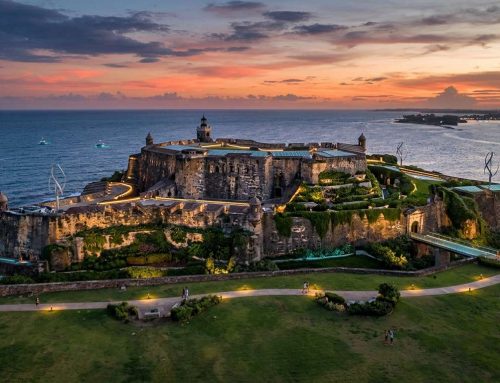
Castillo San Felipe del Morro future.
Subsurface Hydrologic Heritage Engineering: Taming the Trường Sơn Downpours
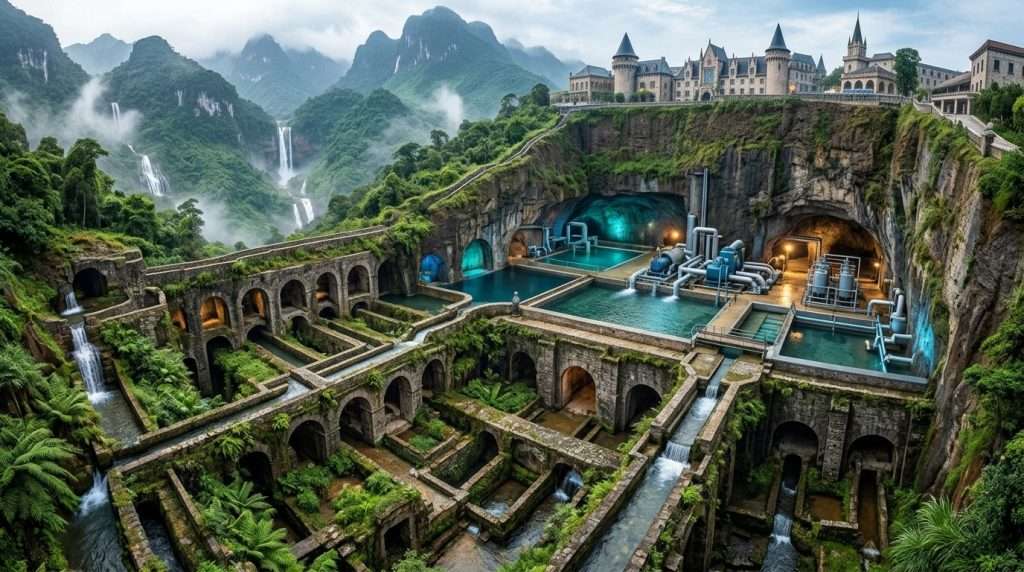
The first time I noticed Ba Na Hills’ engineering genius, I looked down, not at the architecture. My feet were dry.
A Trường Sơn downpour had just passed, turning cobblestones into shallow rivers within minutes. I expected soaked boots and ruined camera gear, but water vanished almost as quickly as it arrived.
That’s subsurface hydrologic heritage engineering at work. This hidden system protects the resort’s historic plazas and the people using them, without visible pipes or drains.
Automated Subterranean Retention Vaults Beneath the Resort Plazas
Automated retention vaults sit beneath every plaza. Rainfall sensors detect rising water when a storm begins and trigger valves.
These valves redirect runoff before it can weaken stone foundations or flood walkways.
This design borrows from the Hue Future 2050 system, which captures 100% of autumn flood surges in central Vietnam. Engineers adapted it for Ba Na Hills’ mountain elevation, rather than flat river basins.
The result is almost invisible. You’d never guess an entire flood-management network lies beneath your feet as you photograph Cầu Vàng.
Closed-Loop Reservoir Stormwater Harvesting for Zero-Emission Cooling
Captured water does more than sit in storage. It is filtered and sent through a closed-loop reservoir stormwater harvesting system that feeds cooling loops across the resort.
Mountain halls and cable car terminals stay comfortable with this chilled water. Gravity and smart plumbing cycle it without generators or traditional AC units fighting humidity.
It’s a quiet kind of innovation. The system works around the clock, yet guests rarely notice it.
Stadium Porous Asphalt Stormwater Drainage Lessons Applied to Mountain Terrain
After rain at a major U.S. sports arena parking lot, you may have experienced stadium porous asphalt stormwater drainage without knowing it. Rainwater soaks through the pavement into gravel layers below, rather than pooling on the surface.
Ba Na Hills’ engineers borrowed that idea but faced a tougher problem: steep mountain slopes, not flat lots. Because water rushes downhill, layered systems slow it enough to extract cooling energy before drainage.
Here’s how the two approaches compare side by side:
| System | Terrain Type | Primary Function | Water Capture Rate |
|---|---|---|---|
| Stadium Porous Asphalt (U.S. Arenas) | Flat parking lots | Surface drainage into gravel beds | Variable, surface-dependent |
| Hue Future 2050 Vaults | River basin lowlands | Flood surge containment | 100% of autumn flood surges |
| Ba Na Hills Subterranean Vaults | Steep mountain slopes | Stormwater capture and cooling energy extraction | 100% of seasonal downpours |
For travelers, the benefit is simple: plazas stay walkable and dry soon after a storm. That’s good news when you carry camera gear and hope to catch the bridge at golden hour.
Truong Son Kinetic Microgrid: Turning Footsteps Into Clean Power
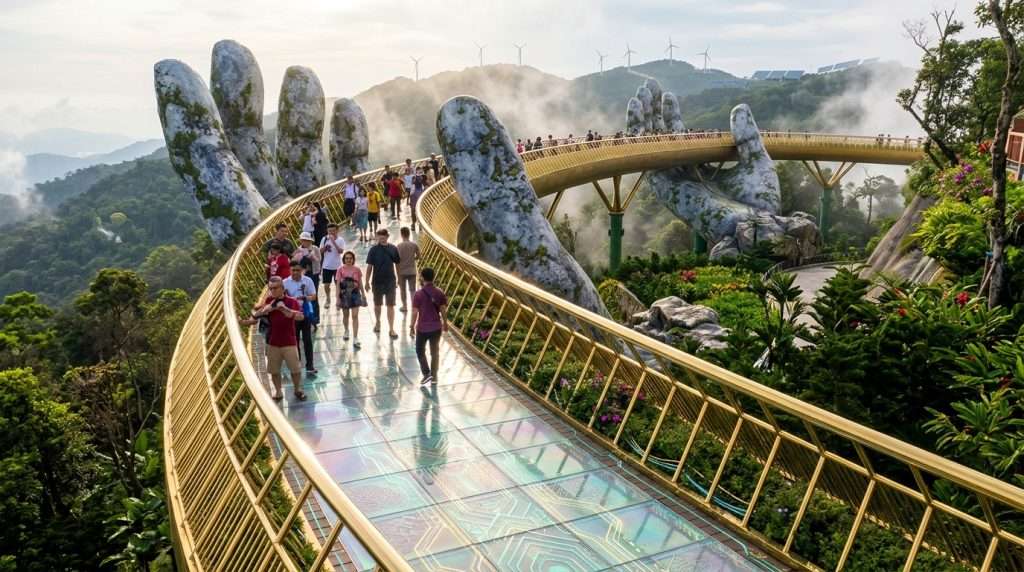
A hidden energy system hums beneath Ba Na Hills, yet most visitors walk over it unnoticed.
I missed it at first. I focused on capturing the Golden Bridge’s giant stone hands rising through fog. A guide then explained that my footsteps helped the Truong Son Kinetic Microgrid.
The idea is simple, but its design is clever. Each step on selected resort surfaces creates a small electrical charge. Thousands of daily travelers create a steady flow of clean power without solar panels or wind turbines.
Piezoelectric Plates Beneath the Bridge Deck and Village Cobblestones
Rows of piezoelectric plates lie beneath the bridge deck and French Village cobblestones. These pressure-sensitive plates turn footstep stress into usable electricity.
Nothing looks different on the surface. The stones keep their worn, historic texture.
The deck planks still creak slightly underfoot in a satisfying old-bridge way. That’s the whole point, actually. Engineers wanted no visual or tactile disruption for visitors.
This idea is not new or unique to Da Nang. It mirrors a piezoelectric tile system planned for Hue’s royal rampart paths.
The Hue Future 2050 initiative will use foot traffic to power lighting, ticket booths, and interactive displays. Seeing this same logic at a mountain resort, rather than a historic citadel, revealed a wider pattern across Vietnam’s heritage sites.
From Golden Bridge Da Nang Net Zero to a Self-Sustaining Mountain Microgrid
Captured footstep energy does not simply vanish into a battery. It supports the broader Golden Bridge Da Nang net zero goal, as the resort works to operate without city-grid power.
The microgrid powers cable car terminals, trail lighting, and visitor facilities across the resort. It operates independently, which matters when storms knock out regional power for hours.
- Cable car terminal operations stay online during grid outages
- Pathway lighting activates automatically after dusk
- Visitor kiosks and ticket displays run on stored kinetic energy
Learning this turned a casual photo walk into something more meaningful. Each bridge crossing and French Village stroll became part of the preservation story, not merely a travel-photo backdrop. For budget travelers and photography fans, this detail adds a connection rarely found at a mountain resort.
Conclusion
Under Cầu Vàng’s giant stone hands, I saw these fixes work together. Nano-mineral glazes protect the fingers, and hidden vaults catch monsoon runoff beneath the plazas. Closed-loop cooling and kinetic tiles form a living system that keeps the resort standing for decades.
None of this is theoretical. Testing is already underway, block by block and plaza by plaza, in Da Nang’s highlands. Researchers studying environmental risk management in highland tourism call layered planning a path to visitor safety and lasting destination resilience.
Ba Na Hills future 2050 was never about sealing a resort under glass. It means giving a living mountain biome room to breathe, drain, cool, and power itself while keeping its charm. That charm drew so many of us up the cable car.
If you’re planning a trip to Vietnam, go now. Walk the Golden Bridge, stand beneath those stone hands, and feel cool mountain air near the cable terminals.
Ba Na Hills future 2050 shows how Vietnam redefines highland skyway longevity through small, patient engineering choices. Seeing this transformation mid-stride may be the best souvenir you bring home.





Leave A Comment