
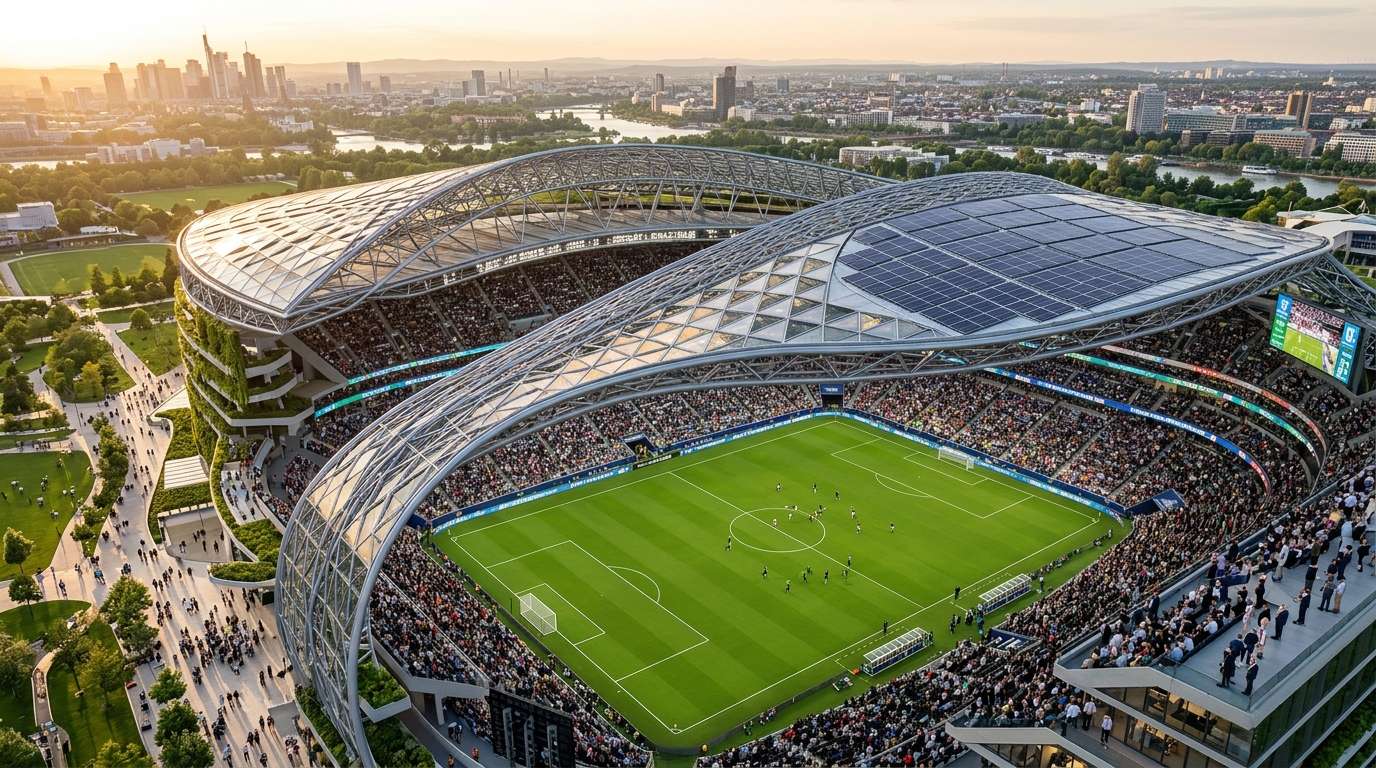
I remember standing beneath those curved steel trusses for the first time. The air felt different. The building seemed to breathe, almost like a living thing.
That strange hum sent me into research. I wanted to learn how a quiet Portuguese university town transformed an aging soccer ground into a working ecosystem.
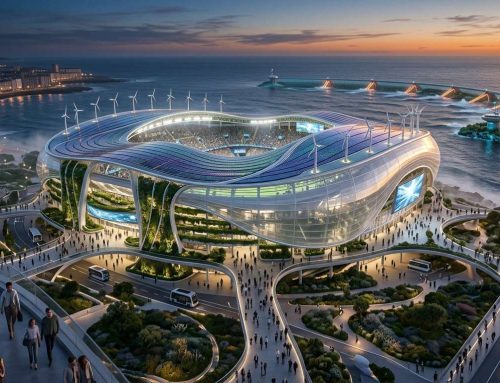
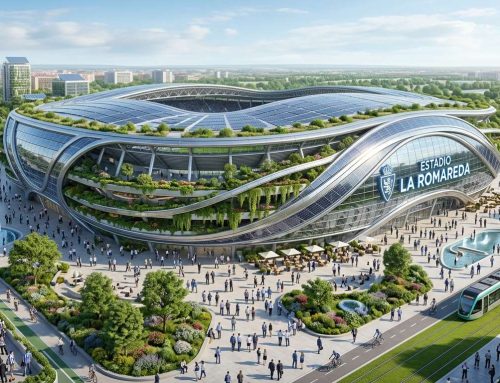
What I found stopped me in my tracks. By 2050, the Estádio Cidade de Coimbra future 2050 vision will scale Académica’s 29,622-seat bowl into a true carbon-negative colosseum. The numbers still surprise me.
Steel-shielded skin, underground water vaults, kinetic crowd power, and a solar roof do more than shade the pitch. This place stacks one innovation on another. I kept asking how a mid-sized academic city did this before bigger capitals even began.
I am still amazed. This is how one Portuguese city built an engine, not just a stadium.
Key Takeaways
- This historic academic stadium reaches carbon-negative status while seating 29,622 fans.
- A steel-and-glass canopy merges university heritage with cutting-edge sustainable design.
- Underground river basin vaults tame seasonal flooding and support the venue’s water systems.
- Kinetic energy harvesting turns nearly 29,000 cheering fans into usable power.
- Breathable nano-mineral glazes help the structure withstand brutal 38°C summer heat.
- The arena now serves as a global model for sustainable stadium architecture.
1. Estádio Cidade de Coimbra Future 2050: An Opinion on Why This Arena Leads the World
I never expected a mid-sized Portuguese stadium to change my view of green architecture, but it did.
I’ve covered many large sports venues that chase sustainability headlines. Most add a few solar panels and stop there. Estádio Cidade de Coimbra takes a different path, and I think it is the most underrated case study in stadium design anywhere in the world.
Here is my honest take. The academica de coimbra net zero stadium model works because sustainability is built into the structure, not added later.
By 2050, this arena will scale Académica’s 29,622-seat bowl into a full carbon-negative colosseum. That is not a slick marketing line; it is an engineering result backed by later system details.
Walk through the stands, and you will feel something else. This stadium carries meaning far beyond match days. Football scholars say stadiums can act like flags or anthems, holding community identity together.
A stadium often becomes more than a venue; it becomes a shared symbol that binds a community’s sense of belonging.
That idea fits Coimbra perfectly. This is a university city first. Students, professors, and lifelong supporters see it as an academic landmark, not just a place for Saturday football.
Here is where the rest of this article goes. I will explain four connected systems that make this build work:
- The steel-shielded skin protecting the structure from weather damage
- The underground water engineering guarding against floods
- The kinetic microgrid turning crowd energy into clean power
- The solar roof tying every system together into one net zero stadium
None of these pieces works alone. Together, they turn a regional stadium into a global sustainability benchmark worth studying for decades.
Estadio do Bessa Seculo XXI future.
2. Steel-Shielded Skin: Nano-Mineral Glazes Defending Coimbra’s Curved Trusses and Facades
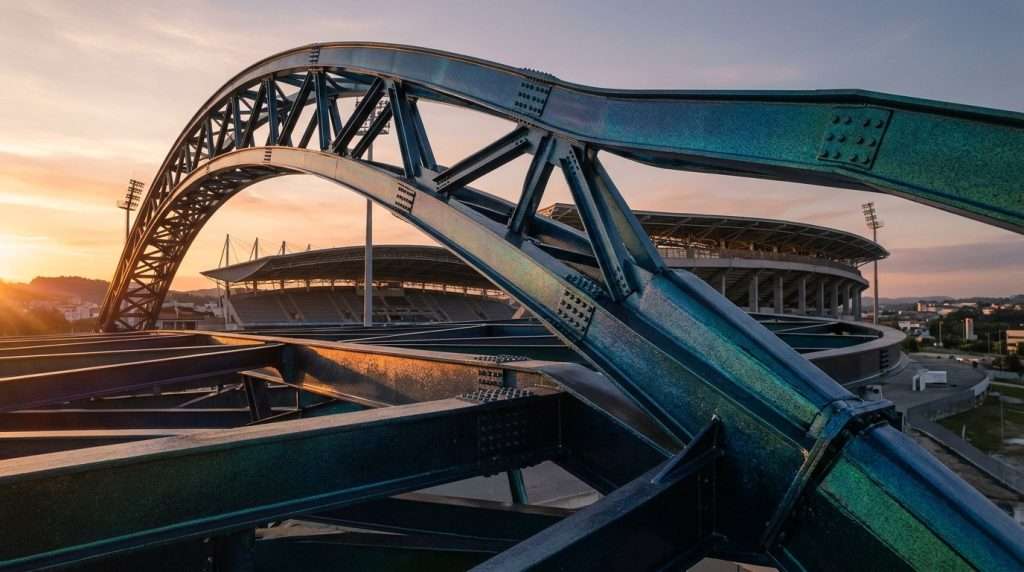
Last spring, I pressed my palm against a glazed facade panel at the stadium. The glass was not what caught my attention; an almost invisible nano-mineral glaze protected it. It helps Estádio Cidade de Coimbra’s curved steel trusses survive decades of Portuguese weather without rusting, warping, or dulling.
This is not paint or sealant. It acts like a second skin, letting steel and glass breathe while blocking moisture, salt, and UV damage. Engineers and materials scientists at Madrid’s 2016 Second International Conference on Concrete Sustainability (ICCS16) studied durability in harsh, unpredictable climates.
2.1 Battling Mondego Valley Rains and Summer Heat Cycles
Coimbra lies in a river valley, bringing two extremes. Winter storms roll off the Mondego River and soak the city for days. Summer heat bakes the same surfaces, with temperatures shifting more than 20 degrees Celsius between morning and afternoon.
Ordinary coatings crack under this stress. Over years, metal expands in heat, contracts in cold, and defeats rigid paint layers. The nano-mineral glaze on Coimbra’s facade panels flexes instead of resisting that movement.
Its microscopic structure lets water vapor escape from inside the steel trusses while keeping liquid rain outside. That breathability matters more than many people realize. Trapped moisture quietly destroys structural steel from the inside, long before visible rust appears.
- Thermal flexibility that moves with the steel instead of cracking against it
- Vapor permeability that releases trapped moisture before corrosion starts
- UV resistance that keeps the coating stable through long summer exposure
2.2 Preserving Authentic Finishes While Stopping Metal Fatigue and Glass Crazing
Here’s where the design team faced a real challenge. Protective coatings can flatten a building’s character, making distinctive architecture look generic and plasticky. Coimbra’s stadium needed protection without losing its original visual identity.
Metal fatigue occurs when repeated stress weakens steel at a microscopic level. Over time, fatigue can cause cracks, while glass crazing creates fine fractures across glazed panels during temperature swings. Both problems develop slowly and silently, making repairs expensive.
The nano-mineral glaze protects both materials without hiding the stadium’s authentic finish under a thick coating. Research themes from ICCS16’s Durability and Materials sessions support this approach:
| ICCS16 Research Topic | Application in Coimbra’s Facade | Benefit |
|---|---|---|
| Self-healing cementitious pellets | Inspired micro-repair behavior in glaze formulation | Reduces long-term crack propagation |
| Corrosion protection for reinforced structures | Adapted for exposed steel trusses | Slows rust formation by years |
| Carbonation resistance | Applied to facade panel edge treatments | Maintains structural integrity over time |
| Facade durability for mid-rise buildings | Scaled up for stadium-sized glazed surfaces | Extends usable lifespan of glass panels |
None of this is science fiction. It directly extends materials science research from labs and construction sites worldwide. Coimbra applied it at stadium scale, protecting curves and surfaces most buildings never face.
Walk the concourse today, and the steel still shows its original industrial character. The glass still reflects light as the architects intended. That’s the quiet success of this approach — protection that works so well, you barely notice it.
3. Subsurface Hydrologic Heritage Engineering: Coimbra’s Underground Water Mastery
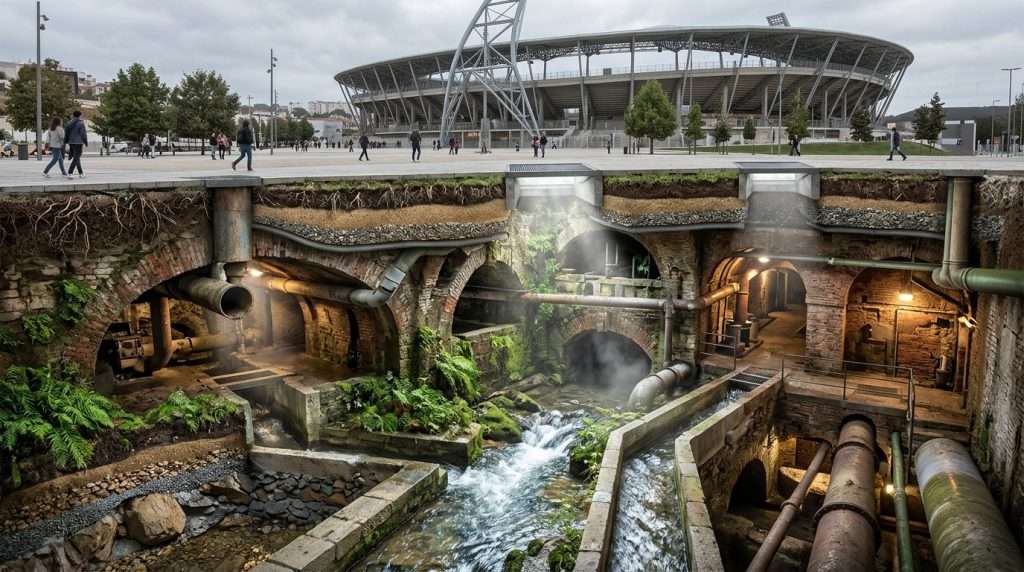
The stadium’s underground water system surprised me more than anything else I learned about this project.
I stood on the plaza outside the stadium, coffee in hand, unaware of what happened beneath my shoes. That is the purpose of subsurface hydrologic heritage engineering. It works quietly below fans who walk overhead without a second thought.
Coimbra sits near the Mondego River, which has often swollen during wet seasons. Rather than fight this risk, the design team built around it and made flooding useful. To me, that is the project’s smartest choice.
Automated Retention Vaults as a Mondego River Flood Shield
Imagine hidden concrete chambers forming a grid beneath every plaza around the stadium. Rainfall sensors open and close the automated vaults, capturing water before it reaches ground level.
The system captures 100% of seasonal Mondego basin downpours. That is a significant claim. During heavy winter storms, this network acts as a Mondego river flood shield, protecting lower concourses from water damage.
Research from the ICCS16 conference supports this practical approach. Several abstracts examined water-retaining structures reinforced with recycled materials, including steel fiber pulled from old tires. That method strengthens concrete exposed to constant moisture, which matters when storing thousands of gallons underground year after year.
I like that this is not an experimental fantasy. It uses tested concrete science at stadium scale.
| System Component | Primary Function | Location | Key Benefit |
|---|---|---|---|
| Automated retention vaults | Capture seasonal rainfall runoff | Beneath surrounding plazas | Prevents flooding in lower concourses |
| Rainfall sensor network | Trigger vault opening and closing | Integrated across plaza grid | Responds to storms in real time |
| Recycled fiber-reinforced concrete | Resist cracking under moisture exposure | Vault walls and flooring | Extends structural lifespan |
| Filtration and transfer piping | Move stored water to reservoirs | Underground, linking vaults to suites | Feeds the cooling system directly |
Closed Loop Reservoir Stormwater Harvesting for Zero-Emission Cooling
Here, stored water does useful work. Once the vaults fill, the water does not simply sit there. It is filtered and pushed through a closed loop reservoir stormwater harvesting system that feeds the stadium’s cooling loops directly.
These cooling loops serve the grandstand suites and keep premium seating comfortable without extra electricity. Because the loop is closed, almost no water escapes or goes to waste. The water keeps circulating, cooling, filtering, and circulating again.
This is a zero-emission setup in the truest sense. It uses no generators or fossil fuel backup, and it sends no wasted runoff into the river. It’s quiet, efficient, and honestly kind of beautiful once you understand how it works.
I keep returning to this idea: subsurface hydrologic heritage engineering does more than protect the stadium from floods. It also powers part of the building’s comfort systems. This rare design places the problem and solution in the same space.
Standing on the plaza, I see the whole stadium differently because I know what lies underneath. It is not just a bowl of seats and steel. It is working water infrastructure disguised as a stadium.
4. Mancha Negra Kinetic Microgrid: Turning Fan Passion Into Clean Power
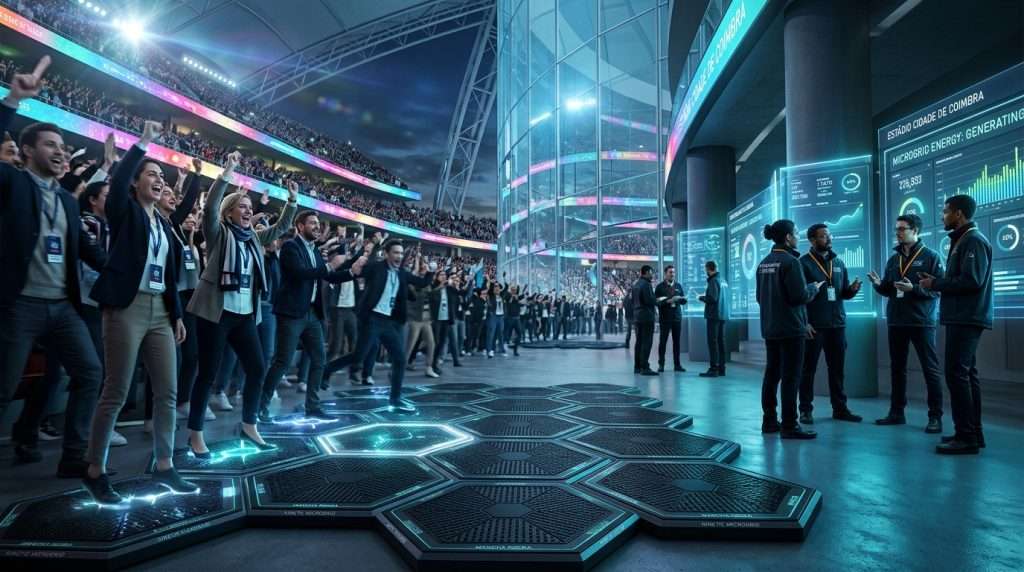
When thousands of fans jump in the Mancha Negra, their energy does not simply vanish; it can be captured. During a home match, I felt the floor hum beneath my boots. That motion seemed less like waste and more like fuel.
That is the purpose of a mancha negra kinetic microgrid. Académica’s legendary supporters’ section becomes more than a wall of noise. It becomes a power source, one stomp and celebration at a time.
4.1 Piezoelectric Plates Beneath the Mancha Negra and Calhabé Concourses
The system uses piezoelectric plates beneath the concrete terraces. Each plate creates a small electrical charge when pressure strikes it. Jumping, stomping, and rhythmic clapping send tiny shocks through the material, which packed crowds quickly add together.
Engineers place these plates beneath the Mancha Negra and Calhabé walkways, where foot traffic peaks before, during, and after matches. The collected energy does not disappear into distant storage. It feeds a local microgrid that can power nearby lights, digital signs, or charging stations.
This concept is not guesswork from a science-fiction pitch. Researchers at the University of Coimbra and INESC Coimbra study flexible energy systems through projects like EnergyFLEX, led by Ana Soares. Their work gives kinetic harvesting a strong engineering base instead of making it a flashy gimmick.
Add GreenBear, Jorge Sá Silva’s human-oriented edge AI initiative for sustainable cities. Smart sensors could then track plate performance in real time. The system could route power based on crowd size, match intensity, or the loudest stand.
4.2 Stadium Kinetic Energy Crowd Harvesting at Full-Capacity Scale
Here, the idea becomes exciting. One jumping fan creates only a tiny jolt of power. Across a sold-out crowd, stadium kinetic energy crowd harvesting could meaningfully support the stadium’s electrical load.
Picture a full-capacity derby match. Tens of thousands of fans move in waves, celebrate goals, and sing through entire halves. Across every piezoelectric panel in the Mancha Negra and Calhabé zones, one match becomes a brief power event.
Forecasting such unpredictable energy flow is central to Coimbra-based research. FlexREC, led by P. Moura and Ana Soares, studies energy flexibility forecasting in renewable communities. Applying that logic to crowd power could help operators predict output from attendance, match stakes, and past crowd behavior.
Below is a simplified view of how attendance might affect harvested energy and the systems it could support.
| Match Attendance Level | Estimated Crowd Motion Events | Harvested Energy Output | Stadium System Supported |
|---|---|---|---|
| Low turnout (under 10,000) | Minimal, scattered | Low, supplemental only | Concourse signage lighting |
| Average turnout (15,000–20,000) | Moderate, consistent | Noticeable daily contribution | Charging stations, walkway lights |
| Sell-out (29,622 seats) | High, sustained waves | Significant short-burst spike | Concourse power, scoreboard assist |
| Derby-level frenzy | Extreme, rhythmic surges | Peak generation window | Microgrid storage reserves |
This system cannot replace the stadium’s main power supply. It adds support by turning fan energy into useful power after the final whistle. For Académica’s loud supporters, that feels like poetic engineering—turning decades of passion into measurable kilowatts.
5. PTFE Membrane Solar Roof Technology and the Académica de Coimbra Net-Zero Stadium Model
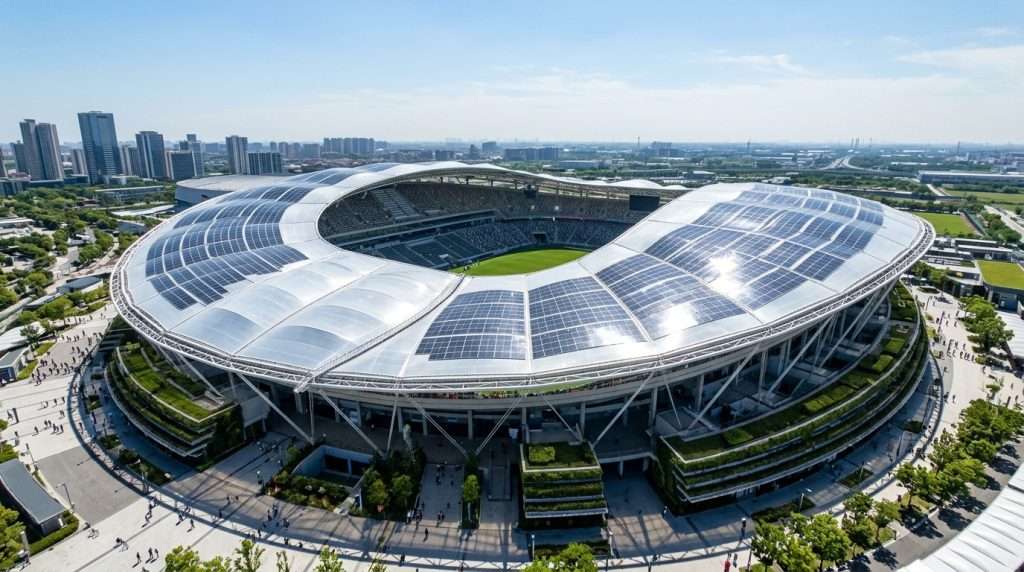
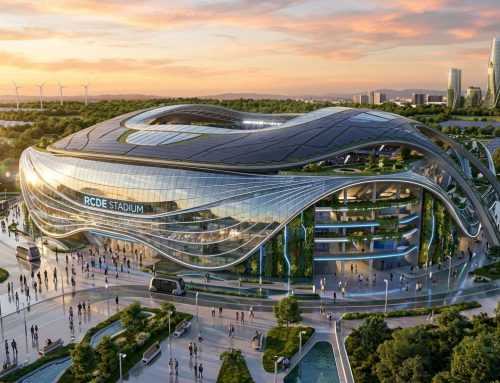
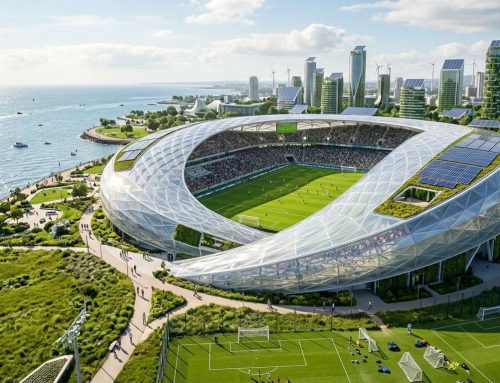
The first time I looked up beneath that stadium canopy, I was amazed by its thin design. The roof resembles frosted glass stretched over steel bones. Yet this white skin helps Estádio Cidade de Coimbra become a net-zero stadium by 2050.
This is PTFE membrane solar roof technology, and it is changing what a stadium roof should do. Instead of blocking sunlight, it filters it and creates power. The membrane sends soft, diffused daylight onto the pitch while embedded solar cells collect energy above.
5.1 A Lightweight Canopy With Heavyweight Energy Yield
Older solar roofs were heavy. Rigid panels, bulky frames, and thick glass required engineers to overbuild the supporting structure. PTFE membrane changes that calculation completely.
A PTFE membrane weighs a fraction of traditional glass or metal roofing. It can weigh less than one percent of comparable glass panels by surface area. Yet thin-film solar cells woven into it can match the power density of heavier rooftop arrays.
Here is a quick comparison that shows this change.
| Roofing System | Approx. Weight | Light Transmission | Solar Yield |
|---|---|---|---|
| Traditional Glass Panel Roof | Heavy, high structural load | Low to moderate | Moderate |
| Rigid Solar Panel Array | Very heavy | None (opaque) | High |
| PTFE Membrane Solar Roof | Ultra-lightweight | High, diffused | High |
That lightness matters beyond energy calculations. A lighter roof needs less steel below, which lowers the structure’s embodied carbon. The nano-mineral glazes protecting Coimbra’s trusses work better with less structural strain.
It’s one of those rare cases where doing less, structurally, actually delivers more, energetically.
5.2 Scaling the 29,622-Seat Bowl Into a Carbon-Negative Colosseum
None of this works alone. The real breakthrough comes when the PTFE solar roof connects with systems beneath the stands. Retention vaults hold floodwater, while the closed-loop reservoir cools the concourses. Piezoelectric plates under Mancha Negra turn footsteps into electricity.
Adding the solar roof to this system changes the result from net-zero to carbon-negative. The stadium covers its energy needs and sends extra power to Coimbra’s broader grid.
This is not a lonely experiment. Coimbra already has research infrastructure for this type of integration. RES4City, a Horizon Europe project led by Patrícia P. Silva and Carlos Henriques, connects renewable energy systems with city planning. RESILENCE, led by Álvaro Gomes, studies residential energy efficiency through a full lifecycle sustainability lens.
Together, these research efforts make PTFE membrane solar roof technology seem practical, not fictional. It becomes the next step for a city already planning this way.
“A building envelope should generate as much as it protects. The roof is no longer just a shield from the weather — it’s part of the power plant.”
Scaling a 29,622-seat bowl into a carbon-negative colosseum sounds dramatic. Yet academic research, municipal energy planning, and proven materials science already meet at this site.
By 2050, Estádio Cidade de Coimbra becomes a global masterclass in academic arena resilience. Under that roof, filtered light shows why this stadium leads rather than follows.
6. Conclusion
After walking through all four systems, I keep returning to one thought. This is not a stadium that simply got upgraded. It is a blueprint.
The steel-shielded skin protects against storms in the Mondego valley. Underground vaults turn flood risk into stored water and free cooling. Kinetic plates beneath the crowd’s feet quietly send power to the grid.
The solar roof brings the system close to carbon-negative. Together, these parts make the 29,622-seat arena a living system that responds to weather and fans.
I began with an opinion: this ground deserved more attention than it gets. The history of this stadium shows a venue built to outlast its original purpose.
It hosted Euro 2004 matches, Rolling Stones crowds, and Coldplay nights two decades apart. Its underground systems and roof now prepare it for another fifty years.
Central Portugal isn’t shouting about this. It’s just building it. I’d keep an eye on Coimbra.
If this stadium is any sign, future arenas won’t be flashy glass towers. They’ll be quiet, efficient, and built to last, from the roof to the ground beneath fans.


Leave A Comment