
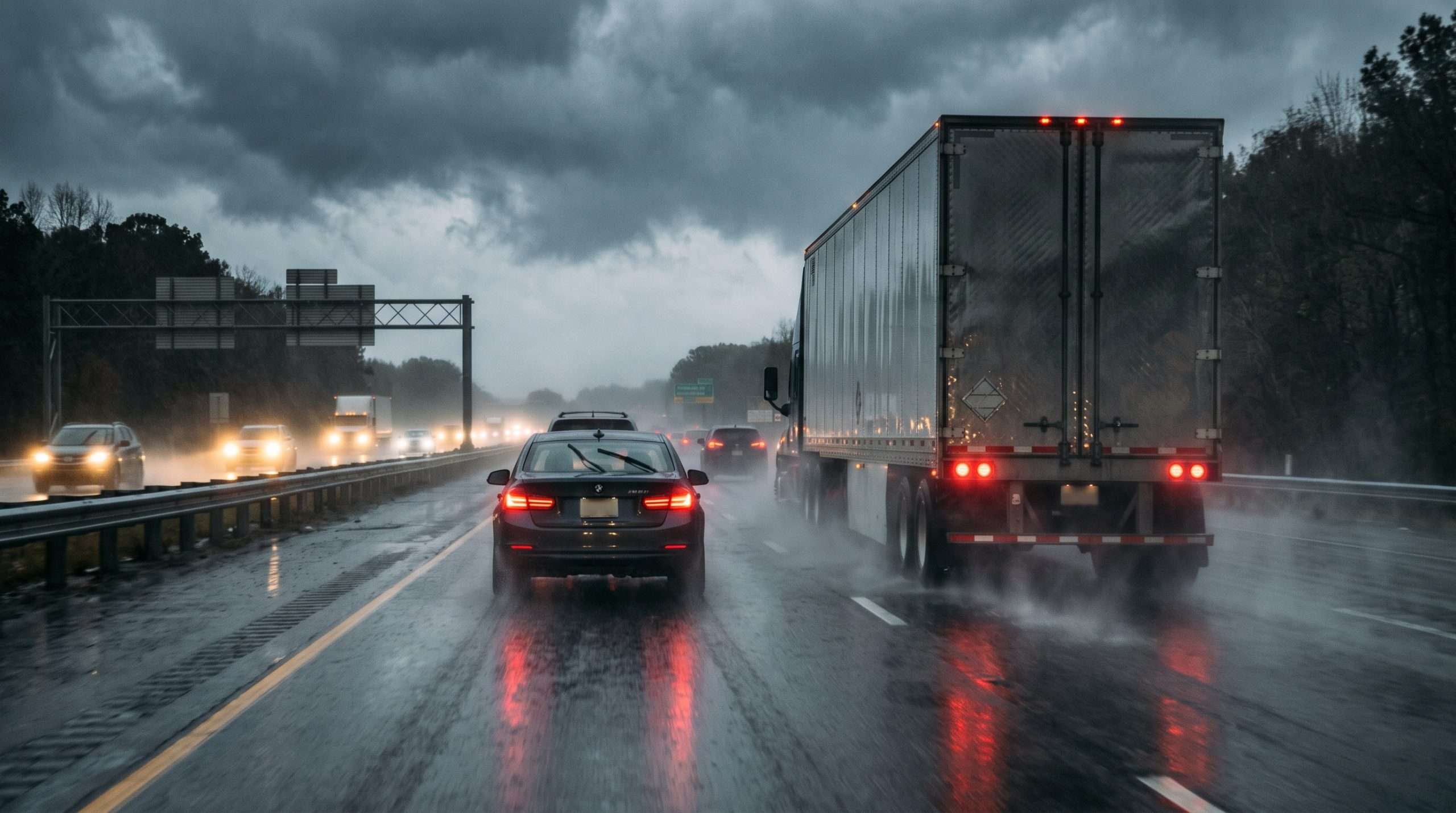
The rain starts somewhere past the Pearl River as you head west on I-20 toward Jackson, Mississippi, and within five minutes it’s the kind that turns the windshield into a sheet. Brake lights ahead smear into red streaks. In the right lane, an 18-wheeler is throwing up a wall of spray so dense that the car in front of you simply disappears into it for a few seconds. You ease off the gas, tighten your hands on the wheel, and find yourself boxed in: a truck ahead, a truck behind, and a concrete barrier on the left. There’s nowhere to go except forward, carefully, and hope everyone around you is being careful too.
Bad weather is when the size difference between a passenger car and a commercial truck stops being abstract. Trucks take far longer to stop, lose visibility in spray and fog, and are vulnerable to crosswinds and hydroplaning in ways that drivers of smaller vehicles don’t always understand. Here’s how to share the road with big rigs when the weather turns, and what to do if, despite everything, you end up in a crash.
Weather Is Behind Hundreds of Thousands of Crashes
Rain, fog, and ice are not minor contributors. According to the Federal Highway Administration’s Road Weather Management Program, an average of about 744,911 crashes a year between 2019 and 2023 were weather-related, killing 3,807 people and injuring more than 268,000 annually, and over 77 percent of those crashes happened during rain or mist.
Rain, the most ordinary weather there is, does the most damage, and it’s exactly the condition in which a passenger car and a loaded truck are most likely to misjudge each other.
Why Trucks Behave Differently in Bad Weather
A fully loaded tractor-trailer can weigh 80,000 pounds, and physics changes everything about how it handles when the road is wet:
- Stopping distance: a truck already needs far more room than a car to stop; on wet pavement that distance grows sharply
- Spray and visibility: the truck’s own tires throw water that can blind drivers alongside and behind it
- Hydroplaning: an empty or lightly loaded trailer can lose traction and swing
- Crosswinds: a high trailer acts like a sail in storms, pushing the truck sideways
- Blind spots: already large, they get bigger when mirrors are streaked with rain
- Jackknifing: hard braking on a slick surface can cause the trailer to swing around the cab
A driver who understands these limits gives trucks the room they need rather than the room that feels polite.
Give Trucks Space, Then Give Them More
The single most effective safety habit in bad weather is distance:
- Extend following distance behind a truck to at least six to eight seconds in rain, more in fog or ice
- Stay out of the “no zones”: directly behind, directly in front, and alongside the cab on the right
- Don’t linger beside a truck; pass decisively when it’s safe or drop well back
- Leave room ahead of a truck when merging, since it can’t slow quickly for you
- Expect wide turns, and don’t squeeze into the gap on the right
If you can’t see the truck’s mirrors, the driver can’t see you, and in rain that zone is larger than usual.
Adjust Your Own Driving
Trucks aren’t the only vehicles that behave differently in weather. Protect yourself by:
- Slowing well below the posted limit; speed limits assume dry roads
- Turning on headlights, not just running lights, so trucks can see you in spray
- Avoiding cruise control on wet roads, which can worsen hydroplaning
- Braking early and gently, and steering smoothly
- Keeping tires properly inflated with adequate tread, which matters most on wet pavement
- Pulling off at a safe exit if visibility drops too far, rather than stopping on the shoulder
The goal is to be predictable to the professional drivers around you.
Watch for the Warning Signs of Trouble
A truck in difficulty often gives a few seconds’ notice:
- A trailer drifting or swinging in its lane
- Brake lights flickering repeatedly on a downgrade
- The truck moving significantly slower or faster than traffic
- Spray patterns changing suddenly, suggesting standing water ahead
- A truck straddling lanes in fog or heavy rain
When you see any of these, create distance immediately rather than waiting to see what happens.
If a Crash Happens
Even careful drivers get caught in weather crashes involving trucks, and those crashes are different from car-on-car collisions in important ways:
- Call 911 and get medical care the same day; the forces involved cause injuries that surface later
- Photograph the vehicles, the road surface, the weather, and any skid or hydroplane marks
- Get the truck’s company name, DOT number, and the driver’s details, along with witness contacts
- Say nothing about fault to the driver, the company, or their insurer
- Note the weather and visibility at the time, since “the rain caused it” is a defense trucking insurers use
Trucking companies and their insurers often have investigators on the way within hours. Evidence such as electronic logs, black box data, and dashcam footage can be overwritten or lost quickly, which is why people hurt in these crashes frequently contact a truck accident lawyer in Jackson before the company’s team has finished its own review.
Maggio Law, which works these cases from its office in the city on a no-recovery, no-fee basis, moves early to preserve exactly that evidence: black box and ELD data, driver qualification files, maintenance records, cargo manifests, and dispatch records, and then identifies every responsible party, from the driver and trucking company to the cargo loader or trailer owner. Whichever firm you call, ask how fast they send preservation letters, because in a weather case the data showing speed and braking before impact is often the whole argument.
Mississippi Law for Truck Crashes
A few rules shape how these cases play out in the state:
- Comparative negligence: Mississippi reduces an injured person’s recovery by their share of fault but does not bar recovery, so a trucking insurer arguing that you “should have slowed down too” affects the amount, not the right to a claim
- Statute of limitations: most personal injury claims, including truck crashes, must be filed within three years of the collision
- Federal rules apply alongside state law: FMCSA regulations on hours of service, driver qualifications, maintenance, and cargo securement set the standard a trucking company must meet, and a violation strengthens a claim
- Weather is not an excuse: commercial drivers are required to use extreme caution in hazardous conditions and to reduce speed or stop when conditions demand it, so bad weather can increase a trucker’s responsibility rather than reduce it
- Minimum insurance: interstate carriers must carry far higher liability limits than private drivers, which matters when injuries are serious
Knowing these rules helps injured drivers understand why a weather crash with a truck is rarely “just an accident.”
Plan for the Weather Before You Leave
Most weather crashes are avoidable with a few habits:
- Check the forecast along the route, not just at the destination
- Delay departure or stop early when storms are forecast
- Keep the windshield, wipers, and washer fluid in good shape
- Carry a flashlight, reflective triangles, and a phone charger
- Know where the safe exits are on long stretches of highway
The extra hour spent waiting out a storm is cheaper than any alternative.
Conclusion
Driving through bad weather around commercial trucks comes down to respecting what the weather does to an 80,000-pound vehicle: giving trucks more space than feels necessary, staying out of their blind spots, slowing down and staying visible, watching for the signs of a truck in trouble, and pulling off when visibility fails.
If a crash happens anyway, acting quickly to document the scene, get medical care, and preserve the truck’s electronic evidence before it disappears is what protects an injured driver, and Mississippi’s comparative fault rules and the federal regulations on commercial drivers make bad weather a reason for more accountability, not less. With rain alone behind more than three-quarters of the roughly 745,000 weather-related crashes each year, the wall of spray on I-20 is a familiar hazard. Treat it with the caution it deserves, and most storms end with nothing worse than a slower trip.











Leave A Comment