
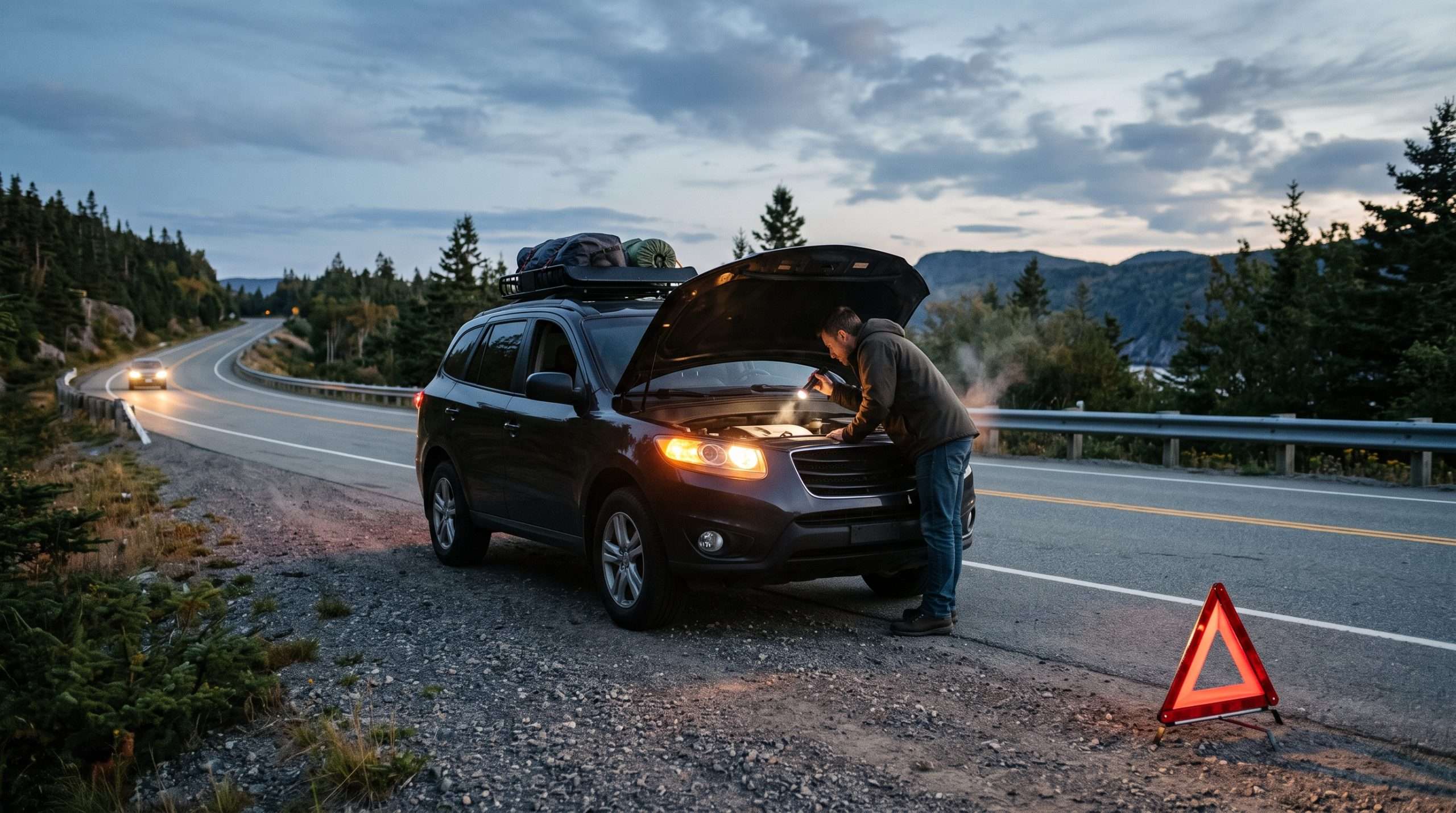
Two hours outside Dublin, on the way to a long weekend by the lake, the dashboard lights up, and the car begins to shudder. You pull onto a shoulder that’s narrower than you’d like, with trucks passing close enough to rock the car, and realize that the emergency kit you meant to pack is still in the garage. The kids are asking what’s wrong. Your phone has one bar. And the only thing you know for certain is that the trip you planned for months is now a problem to solve on the side of the road.
Roadside emergencies are a feature of road trips, not a rare interruption. Flat tires, dead batteries, overheating engines, lockouts, and, more seriously, collisions all happen far from home, often in places without a tow truck nearby or a mechanic who’s open on Sunday. The difference between a story you’ll laugh about later and a trip that goes badly wrong comes down to a few decisions made calmly in the first minutes. Here’s how to handle each kind of emergency, from a flat to a crash.
Breakdowns Are Routine, and Numerous
The scale of roadside trouble is easy to underestimate. According to AAA’s Auto Club Group, the club responded to more than 700,000 roadside emergencies in a single year across its territory, with flat tires, dead batteries, and lockouts the most common calls, at a time when nearly 61.6 million Americans were planning Independence Day road trips alone.
That’s one regional club, in one year. Multiply it across the country, and the lesson is plain: being prepared isn’t paranoia.
First Priority: Get Safe
Whatever has gone wrong, the first job is to make the car and the people in it safe:
- Signal early, slow gradually, and pull as far right as possible, ideally off the pavement or onto an exit
- Turn on hazard lights immediately
- On a highway, stay in the car with seat belts on unless it’s unsafe to do so; the shoulder is more dangerous than it looks
- If you must get out, exit on the side away from traffic and stand well back, behind a barrier if there is one
- Set out reflective triangles or flares behind the vehicle if you can do it safely
- At night or in bad weather, keep the interior light on so you’re visible
Nothing about a flat tire is worth being hit on the shoulder.
Flat Tires, Dead Batteries, and Lockouts
The three most common emergencies have straightforward responses:
- Flat tire: if you’re on a safe, flat shoulder and know how, change it; if traffic is heavy or the shoulder is narrow, call for help instead
- Dead battery: jumper cables or a portable jump pack solve most cases; if the car dies again quickly, the alternator may be the problem
- Lockout: call roadside assistance or a locksmith rather than trying to force a door, and keep a spare key with a traveling companion
A basic kit, listed below, handles all three.
Overheating and Warning Lights
An overheating engine needs to be shut off, not pushed to the next exit. Pull over safely, turn off the engine, and wait at least 30 minutes before opening the hood; never open a hot radiator cap.
Check coolant once it’s cool, and if the level is low or there’s a leak, call for a tow rather than risk the engine. For other warning lights, a quick check of the owner’s manual on your phone tells you whether it’s safe to continue slowly or not at all.
If the Emergency Is a Collision
A crash on a road trip adds the stress of being far from home to an already difficult situation. Steps that protect everyone:
- Check for injuries and call 911; ask for police even in a minor crash
- Move vehicles out of traffic only if they’re drivable and no one is seriously hurt
- Photograph everything: vehicles, damage, plates, the road, signs, and injuries
- Exchange insurance and contact details; get witness names
- Say nothing about fault to the other driver or their insurer
- Get medical care the same day, even for soreness, and keep the records
- Note the exact location, since the state where the crash happened sets the rules for any claim
If the crash occurred on your way out of Ohio or on the return leg, the sensible next call, after the doctor, is to a car accident lawyer in Dublin, OH who can preserve evidence and deal with insurers while you deal with getting home. The Stuckey Firm’s four-step approach starts with a free case review and early guidance on documentation, medical follow-up, and insurer communication, then moves through evidence gathering, a demand package covering medical costs, lost income, and future treatment, and negotiation or litigation if the insurer won’t be fair. Any attorney you call should be able to explain how shared fault and filing deadlines apply to your crash before you decide anything.
Ohio Law When a Road Trip Goes Wrong
For crashes on Ohio roads, a few rules shape what happens next:
- Duty to stop and exchange information: drivers involved in a crash must stop, provide their name, address, and vehicle registration, and render reasonable aid; leaving the scene is a criminal offense
- Reporting: crashes involving injury, death, or significant property damage must be reported to law enforcement
- Move Over law: drivers must move over or slow down for stopped emergency, roadside assistance, and maintenance vehicles with flashing lights, which also protects you when you’re the one stranded
- Modified comparative negligence: an injured person can recover damages if they were 50 percent or less at fault, with the award reduced by their share of responsibility
- Statute of limitations: personal injury and property damage claims generally must be filed within two years of the crash
- Minimum insurance: Ohio drivers must carry liability coverage, but the minimums are modest, which makes uninsured and underinsured motorist coverage on your own policy valuable on a long trip
Knowing these before you leave means fewer surprises on the shoulder.
Pack the Kit You Keep Meaning to Pack
A road-trip emergency kit fits in a small bin and covers most of what goes wrong:
- Jumper cables or a portable jump pack
- A properly inflated spare, jack, and lug wrench, and the knowledge to use them
- Tire sealant and a small compressor
- Reflective triangles or flares, and a flashlight with spare batteries
- Basic first aid supplies
- Water, non-perishable snacks, and blankets
- A phone charger and a backup battery
- Printed copies of insurance and registration, in case the phone dies
- Gloves, a rain poncho, and a basic tool set
Add a paper map for stretches without signal.
Before You Leave
Most roadside emergencies are preventable:
- Check tires, including the spare, oil, coolant, and battery a week before departure
- Confirm roadside assistance coverage, whether through an auto club, insurer, or credit card
- Save the assistance number in your phone and write it on a card in the glovebox
- Share your route and schedule with someone at home
- Fill up before long empty stretches
Twenty minutes of preparation saves hours on a shoulder.
Conclusion
Handling unexpected roadside emergencies during a road trip comes down to getting the car and the family safe first, knowing the simple fixes for flats, batteries, and lockouts, shutting down an overheating engine rather than pushing it, treating a collision with the same care you would at home, including same-day medical care and a call to a lawyer where the crash happened, and understanding the basics of the state’s rules on stopping, reporting, and fault.
With one regional auto club alone answering more than 700,000 calls in a year, trouble on the road is normal; being unprepared for it is optional. Pack the kit, check the car, and the shudder two hours out of town becomes a delay, not a disaster.







Leave A Comment