
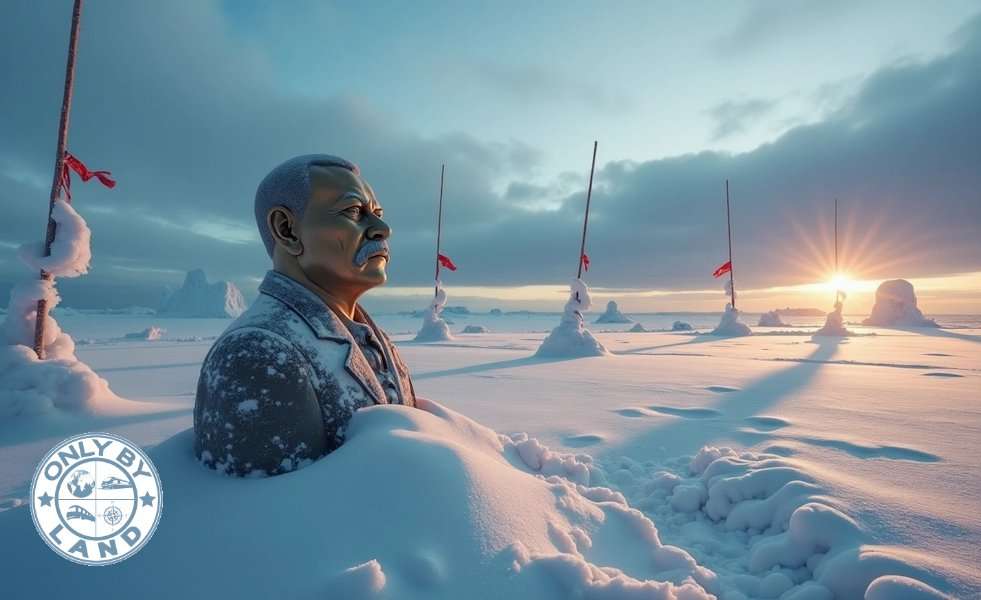
Statues exist in Antarctica under some of Earth’s most extreme conditions. The continent’s hostile environment hasn’t stopped a yellowing Lenin bust from facing Moscow at the Southern Pole of Inaccessibility. This remote monument has stood its ground since 1958 when a Soviet team placed it during their brief 12-day stay. A 2007 expedition found the statue still visible through layers of ice and snow.
The frozen continent houses almost 100 officially designated Historic Sites and Monuments that showcase human exploration and scientific breakthroughs. Antarctica’s landmarks include the Monument to the Antarctic Treaty, revealed in 1999 to mark 40 years of international collaboration. The Observation Hill Cross stands as a memorial to Robert Falcon Scott’s team who lost their lives in 1912. Visitors to Grytviken can see Ernest Shackleton’s grave, marked by its distinctive nine-pointed star – a fitting tribute to one of polar exploration’s greatest pioneers.
These Antarctic monuments, from Roald Amundsen’s Ceremonial South Pole of 1911 to the historic remains at Whalers Bay, tell the story of humanity’s endless fascination with Earth’s most remote continent. This piece examines Antarctica’s remarkable statues and their compelling backstories.
The Most Iconic Statues Found in Antarctica
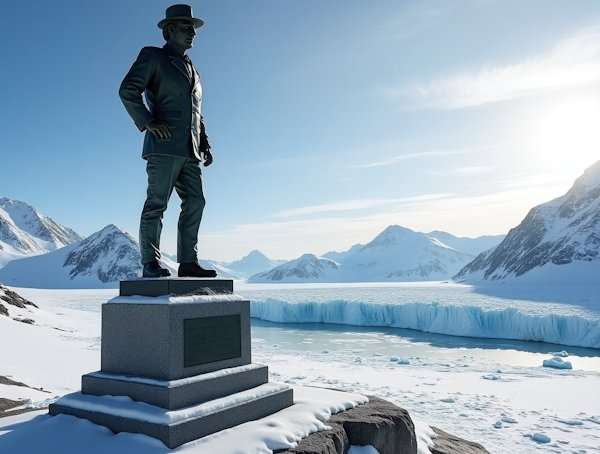
Antarctica’s frozen landscape holds remarkable monuments that stand strong against Earth’s harshest weather. These quiet guardians share powerful stories of exploration, science, and human determination at the world’s end.
The Lenin Bust stands as one of Antarctica’s most unique statues at the Pole of Inaccessibility. A plastic bust sits on a wooden platform on top of a station building that snow has slowly buried. The bust stood approximately 1.5 meters above the snow surface in 2007, while snow completely covered the station below. The monument looks toward Moscow across thousands of empty kilometers, showing Soviet achievement’s symbolic reach.
Ross Island’s Observation Hill Cross serves as a touching tribute to Captain Robert F. Scott and his team. British Antarctic Expedition members built this nine-foot wooden cross from Australian jarrah in January 1913. The cross bears the fallen men’s names and Tennyson’s famous words: “To strive, to seek, to find, and not to yield”. This memorial stands strong on a 754-foot-tall lava dome despite heavy wind erosion and UV damage.
Near McMurdo Station, “Our Lady of the Snows” shrine honors Richard T. Williams, a U.S. Navy SeaBee who lost his life in 1956. His tractor broke through sea ice during the station’s construction. Built in 1957, the shrine underwent major restoration in 1995-96 by Christchurch’s Carmelite nuns. The restored Mary statue now faces north over McMurdo Sound, toward Williams’s final resting place beneath the ice.
The Antarctic Treaty Monument, made of copper, displays twelve panels that represent the original signatory states. The monument’s four plaques show the Antarctic Treaty’s official languages – English, French, Russian and Spanish. These plaques highlight the international teamwork that shapes Antarctic research and exploration.
Lesser-Known Monuments in Antarctica
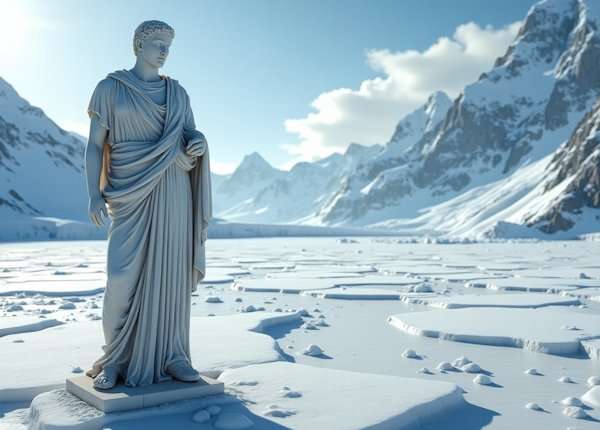
Antarctica has its famous landmarks, but the continent also holds many hidden monuments that paint fascinating stories of human exploration on this icy land. These historical treasures rarely get public attention, yet they play a crucial role in the polar story.
The Amundsen-Scott South Pole Station carries on a special tradition. Scientists gather every January 1st to place a new ceremonial pole marker. This custom hasn’t missed a beat every New Year’s Day since 1959. The “winterovers” – staff who brave the harsh Antarctic winter – design and craft these markers with impressive skill. The old markers don’t go to waste. They find their home in a glass display case at the station’s entrance, creating a growing collection of Antarctic art and history.
A remarkable stone building called Omond House sits in the South Orkney Islands. The Scottish National Antarctic Expedition built it in 1903 and it earned its place in history as Antarctica’s first meteorological station. Argentina took over the building the next year, and it became the Orcadas Base – now Antarctica’s longest-running research station. The stone walls might be crumbling, but this site remains precious as the birthplace of permanent scientific research on the continent.
Whalers Bay on Deception Island holds one of Antarctica’s most mysterious historic sites. The black volcanic beach shows scattered pieces of the Norwegian Aktieselskabet Hektor whaling station that ran from 1912 to 1931. Massive rusted oil tanks and empty buildings slowly sink into volcanic ash. The site has old pressure cookers that processed whale meat, a mill that ground whale bones, and the old dormitories where whalers once slept.
A small cemetery at Scotia Bay tells its own quiet story with twelve graves of early explorers. The oldest grave dates back to 1903, reminding us of the brave souls who risked everything to explore this frozen continent.
Why These Landmarks of Antarctica Matter
Antarctica’s historic sites and monuments mean nowhere near just sentimental value. This continent stands unique with no native population and a short human history. Its cultural heritage offers exceptional insights into humanity’s relationship with Earth’s harshest environment.
The Antarctic Treaty System protects approximately 90 Historic Sites and Monuments (HSMs). These landmarks must remain untouched and protected according to the Environmental Protocol. Sites earn this special status only when they showcase genuine historic value. They must connect to key events, remarkable achievements or pioneering individuals in Antarctic exploration and research.
Climate change poses serious threats to these irreplaceable structures. The Antarctic Peninsula warmed faster than any other land area in the Southern Hemisphere during the late 20th century. This warming brings increased snowfall and rain that demands constant maintenance. Meltwater now erodes building foundations, causing structural damage.
Antarctica’s landmarks tell powerful stories that data alone cannot convey. These historic sites create emotional bonds that can “galvanize public opinion” and “touch people’s hearts”. They turn complex scientific facts into compelling human narratives.
These monuments showcase the power of international cooperation. Twelve nations signed the Antarctic Treaty in 1959 and today it has 54 signatories. The treaty makes Antarctica the only continent that “does not belong to anyone”. This groundbreaking agreement dedicates the entire continent to peaceful scientific work. It stands as proof that nations can work together instead of fighting over territory.
Visitors must follow strict rules to protect these treasures. The guidelines require tourists to “respect protected areas” and “not damage, destroy or remove artifacts from Historic sites or monuments”. So future generations can experience these physical connections to Antarctic exploration. This preserves what the UK Antarctic Heritage Trust calls “the cumulative memory of humankind”.
Appreciate Hidden Statues in Antarctica
These remarkable statues and monuments stand as silent witnesses to human courage, scientific progress and international collaboration across Earth’s southernmost frozen wilderness. Without doubt, the Lenin Bust, Observation Hill Cross and many more historical landmarks survive against impossible odds. They battle temperatures that drop below -70°C and winds that reach 200 km/h. These lasting structures tell stories that numbers and scientific papers cannot capture alone.
Climate change threatens Antarctica’s historical heritage. Rising temperatures affect sites along the Antarctic Peninsula. More precipitation and meltwater weaken foundations and speed up decay. Preservation work must adapt to these new conditions. This needs to happen while protecting the continent’s pristine environment.
These monuments serve as powerful symbols of human achievement through cooperation instead of conflict. The Antarctic Treaty remains one of diplomacy’s greatest successes. It created a continent focused only on peaceful scientific research. Each protected site strengthens this dedication to shared knowledge and international partnership. This includes everything from the grand Antarctic Treaty Monument to the simple grave markers at Scotia Bay.
People who travel to this remote landscape come back with more than photos. They bring stories of human determination carved in wood, stone and metal against Earth’s harshest backdrop. These statues and monuments stand isolated and rarely seen, yet they form an essential part of our global heritage. They remind us that human curiosity, courage, and cooperation can create lasting marks that exceed national boundaries and endure time’s test, even in extreme environments.
When you return from your Antarctic adventure, laden with icy wonders and memories of your adventure, you’ll want a portable memento of these landmarks that stood tall in such an extreme environment. Perhaps a custom keyring is the perfect way to capture this unique journey.
Keyrings come in a variety of materials and can be customized quickly. You can replicate the majestic lines of the Lookout Mountain Cross. The main body of the keyring is pure white, symbolizing the Antarctic ice and snow, with touches of blue embellishing the depths of the frozen sea.
These compact and exquisite custom keyrings embody the grandeur and legend of Antarctica. Every time you touch it, you’ll vividly recall your unforgettable journey exploring the southernmost tip of the Earth.

FAQs
Q1. Are there any mysterious structures hidden in Antarctica?
While there are no confirmed mysterious structures, Antarctica is home to several remarkable monuments and statues. These include the Lenin Bust at the Pole of Inaccessibility, the Observation Hill Cross on Ross Island and the Antarctic Treaty Monument on King George Island. These structures tell stories of exploration, scientific achievement and international cooperation in Earth’s most extreme environment.
Q2. What lies beneath Antarctica’s ice sheet?
Beneath Antarctica’s thick ice sheet lie unseen mountains, valleys, lakes, and rivers. While these hidden features are not directly related to the statues and monuments discussed, they contribute to the continent’s mystique and scientific importance. The ice sheet’s changes could have significant global consequences, making Antarctica a crucial area for climate research.
Q3. What is the oldest human-made structure in Antarctica?
One of the oldest human-made structures in Antarctica is Omond House, built in 1903 by the Scottish National Antarctic Expedition. Located in the South Orkney Islands, it became Antarctica’s first meteorological station and later evolved into the Orcadas Base, which is now the oldest continuously operating research station on the continent.
Q4. Are there any unusual wildlife species found in Antarctica?
While not directly related to the statues, Antarctica is home to unique wildlife. Some fascinating creatures include sea pigs (unusual sea cucumbers), Antarctic sea spiders and icefish known for their colorless blood. These species have adapted to the extreme Antarctic environment, much like the monuments that withstand harsh conditions.
Q5. How are historical sites in Antarctica protected?
Under the Antarctic Treaty System, approximately 90 Historic Sites and Monuments receive special protection. These sites cannot be damaged, removed, or destroyed according to the Environmental Protocol. Strict guidelines ensure that tourists respect protected areas and do not interfere with artifacts. This protection helps preserve Antarctica’s brief but significant human history for future generations.












Leave A Comment