
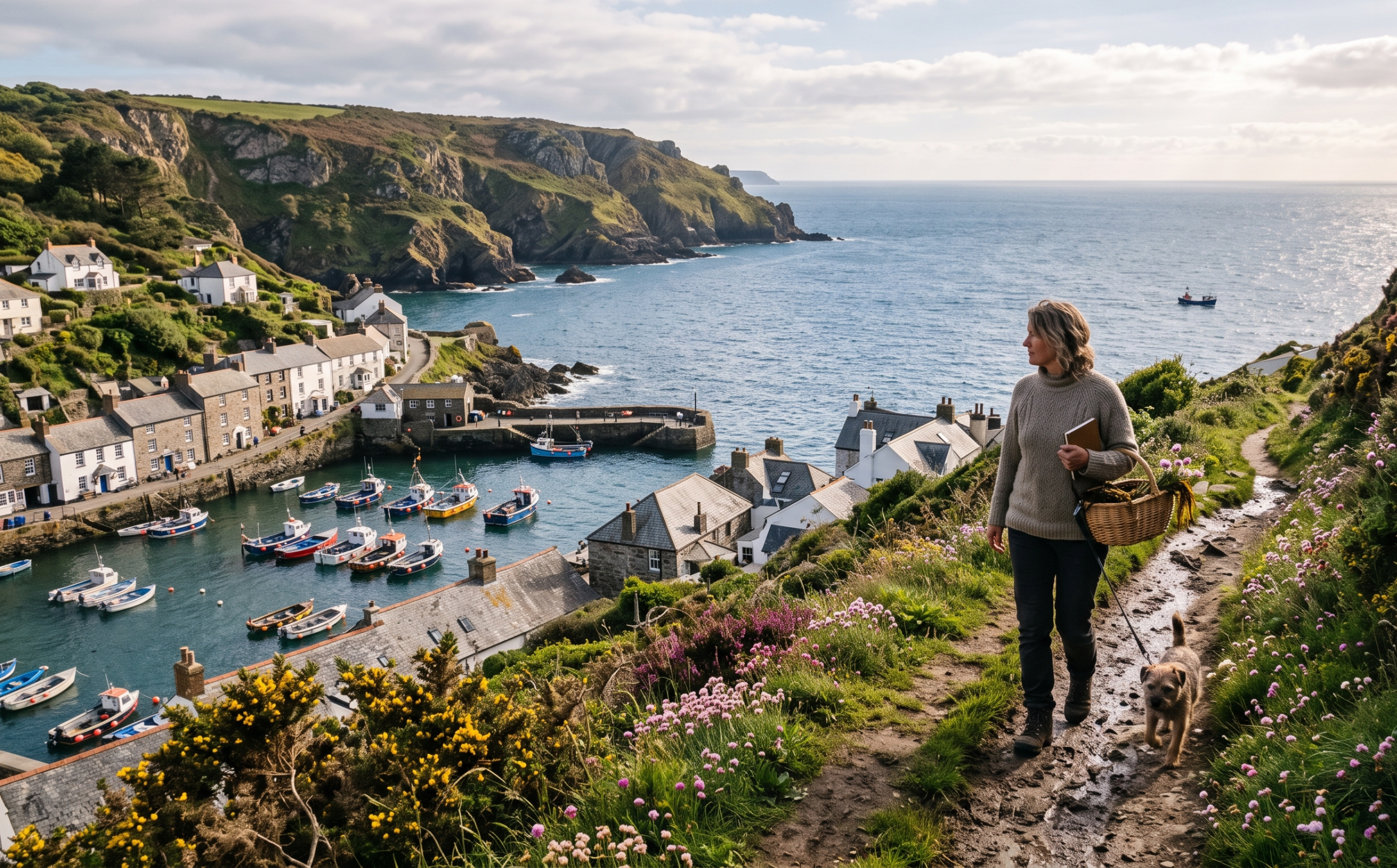
Most people arrive in Cornwall with a list. Land’s End by Tuesday, Eden Project Wednesday, St Ives Thursday, done. They drive 300 miles in four days and leave wondering why it felt like a theme park. The ones who come back year after year do the opposite – they pick one corner and stay there.
This is what we call slow travel. It doesn’t mean they lack ambition; it’s just a different kind of ambition.
What Slow Travel Actually Means Here
Slow travel is not about being as slow as a snail. It is about opting for a more in-depth experience rather than a broad one. In Cornwall, this difference counts more than almost anywhere in the UK, because the identity of the county is genuinely distinct – Celtic origins, its own unique language (Kernewek, which is regularly spoken and taught), a way of life shaped by tin mining and deep-sea fishing rather than anything particularly English.
When you rush through, you miss all of that. You see the postcard version. The cream tea, the harbour wall selfie, the obligatory photo at the sign. When you stay long enough to become a temporary local – to walk to the same bakery twice, to nod at the same faces on the coastal path – the place begins to give you something back.
Slow travel also does less harm. Cornwall deals with real pressure from overtourism, particularly through July and August when coastal villages become gridlocked and car parks overflow onto verges. A different approach – quieter timing, lower-impact transport, spending money locally – is better for the place and, not coincidentally, better for the trip.
Choosing the Right Base
It all starts with where you stay. A hotel in a busy resort positions you in the heart of the tourist supply chain – the queues, the chain restaurants, the gift shops. A self-catering cottage in a quieter village works the other way around.
With a kitchen, you shop locally. With a garden, you have somewhere to sit without booking it. With walls around you that are not those of a hotel corridor, you begin to feel like you live somewhere rather than visiting it. That shift in feeling completely alters how you spend your time.
Location in this regard matters a lot. The Helford River, the Lizard Peninsula, the villages tucked into the Fal estuary – these are not places that shout in the manner of St Ives or Padstow. They’re quieter, more self-contained, and will give you access to coastal walks and creeks and farm shops without the car park anxiety.
When booking, use a regional expert, not a global player. Book through Cornish Holiday Cottages and you are pushing your accommodation spend directly into the local economy, not into a platform’s offshore revenue stream, and you are dealing with people who know the properties and the places in which they stand.
The local multiplier effect is real. A study from the New Economics Foundation discovered that money spent at independent local businesses circulates in the local economy up to three times longer than money spent at national chains. Your choice of accommodation is the biggest spend you’ll make on any trip. Make it count.
Go in Autumn or Spring
The argument for the shoulder season has been repeated so often that it has become a cliché. However, in Cornwall, it really changes everything. If you go between October and April, you will be able to enjoy the beaches almost all for yourself. You will see dog walkers instead of people sunbathing. Surf schools will be closed, but you will see real local surfers who are in the sea all year round.
In winter, pubs have a different atmosphere. There is a sea shanty revival all over Cornwall. Local singers gather in pubs during the week, not to attract tourists but because this is part of the local culture. The Minack Theatre, located on the cliff above Porthcurno, offers winter shows. Local galleries and studios are open and relaxed. And at the Tate St Ives, you’ll only have to wait in line for half the time.
The light in October along the Lizard is unique and completely different from what you experience in summer. The skies are clearer, the shadows are longer, and the sea is a deep and true blue. In spring, wildflowers bloom along the cliffs, such as thrift and sea campion, before the rush of the high season begins and the roads become crowded again.
Leave the Car at the Cottage
Better yet, if possible, avoid using a car altogether. Cornwall does not have a good rail network but the existing rail lines are definitely worth taking advantage of. The Falmouth to Truro line offers stunning views of Cornwall’s picturesque countryside. The St Ives line is equally beautiful, running right along the coast of the stunning St Ives Bay.
Once you’re in one area, the South West Coast Path does most of the work. This 630-mile trail is usually discussed in terms of end-to-end challenges, but for slow travel you just want sections – a morning walk from Coverack towards Kennack Sands, say, or the path from Helford Passage down to the coast. These sections reveal coves that have no road access, which means in practice that no one else is there.
Sea kayaking on the Helford River, cycling on the Camel Trail, walking the creekside paths around Mylor and Restronguet – none of these require a car. The local bus network is imperfect but usable, and there’s something about the occasional inconvenience of a bus that slows your pace in exactly the right way.
Build a Local Food Strategy
The idea is very straightforward: whenever possible, avoid supermarkets and make your purchase as direct as possible.
Cadgwith, the tiny cove village on the Lizard, still has a few working crab and lobster boats. On the right morning, you can buy from the fishermen right there. Newlyn, not far down the coast, is one of Britain’s largest fishing ports, and fishmongers by the harbour will cheerfully sell you whatever came in that morning. Trevaskis Farm, outside Hayle, does a decent line in overflow produce from its farm shop and operates an honesty system for the box in which you leave your money. Roadside veg stalls, most notably unattended and with an ancient biscuit tin in which to leave payment, pop up all over the county.
For a pasty, always go to an independent local bakery and always ask what’s in it. The old recipe is a proper one: steak, swede, potato and onion crimped on the side. The crimp was a functional business, as miners would hold that edge with their dirty hands and then leave it. Once you know that, eating one is a different experience.
It all comes in at about the same price as supermarket shopping. Some of it comes in at less. The difference is that the money sticks in Cornwall.
Engage With the Culture Beyond the Surface
Cornwall’s heritage isn’t quaint. The engine houses you find dotted along the north coast – iron-rusted, granite walls, sentinel-like in fields above the sea – are the residue of an industry that sent Cornish miners round the world to South Africa, Australia, and South America when the tin trade died. That story of resourceful diaspora is told with subdued, worthy intent at the Geevor Tin Mine heritage site, just outside St Just.
The language is still alive, not just a museum piece. Kernewek classes exist here and there. Place names all over the county refer to the Cornish not the English (Penzance = holy headland, Marazion = little market, Bodmin = the dwelling of the monks, in a Cornish derivation). Reading a map here can be a kind of interpretation.
Village-run ventures, village halls with film nights, the cooperative shops in the tiniest villages, local art galleries operated by the artists themselves, these are where the living culture is. They are not always easily found and they don’t advertise in the tourist brochures. You have to come across them.
Slow travel in the countryside.
Treat the Coast with Some Care
Cornwall’s marine ecosystems are fragile in ways that aren’t always visible. Grey seals haul out on the Lizard and along the north coast – they look docile and can appear unbothered, but disturbance during pupping season causes real harm. Keep your distance, keep dogs back, and if you’re kayaking, give them a wide berth.
The dune systems at beaches like Holywell Bay and Perranporth are slow to recover from foot traffic. Stick to marked paths across them. The rock pools at low tide are extraordinary – blennies, anemones, the occasional cuttlefish – and they stay that way when people look without taking.
Spontaneous beach cleans happen all over Cornwall, often organised through local social media groups. If you’re there on a quiet morning with an hour to spare, it’s worth searching for one. The regulars are some of the most useful people to talk to – they know the coast better than any guidebook and they’re almost always happy to share it.
The Discipline of Doing Nothing
Slow travel has one final requirement: you have to actually stop.
Not sit at a café with your phone. Sit on a harbour wall and watch the boats. Watch the tide come in at a creek-side pub on the Helford and notice how the light on the water changes as the afternoon goes. Let an afternoon just be an afternoon.
Jubilee Pool in Penzance – a restored Art Deco tidal lido from the 1930s – is one of the best places in Cornwall to do this. You swim, you get out, you sit in the sun if there is any, and there’s nothing on the agenda after that.
That permission to stop is what most people find hardest and what they remember longest. Cornwall is built for it. You just have to let it work.












Leave A Comment