

The Danakil Depression in Ethiopia records temperatures of 115°F (46.1°C), making it Earth’s most inhospitable place. This geological wonder in Ethiopia’s northeastern region sits 410 feet below sea level and ranks among the planet’s lowest-lying areas.
Life persists in the Danakil Depression despite its extreme temperatures that challenge human survival. The remarkable landscape showcases acid pools, lava lakes and salt plains that create surreal colors across the terrain. Scientists value this harsh environment because it mirrors conditions on Mars and helps them understand how life might exist on other planets.
The Geological Marvel of Three Tectonic Plates
The Danakil Depression lies at a remarkable geological crossroads where three massive tectonic plates meet. This unique spot, known as the Afar Triple Junction, marks where the Arabian, Nubian and Somali plates come together.
Formation of the Afar Triangle
This geological wonder’s story started about 30 million years ago as the Somali plate pulled away from the rest of the African continent. This split created the foundations for what would become the Afar Triangle. The Arabian plate’s movement away from Africa led to the Red Sea Rift’s formation, which moves forward about one centimeter each year.
Ongoing Continental Drift
The region’s current geological activity is truly extraordinary. These three tectonic plates steadily drift apart at a rate of 1-2 centimeters per year. This continuous separation shows up in several ways:
- Recurring earthquakes and deep surface fissures
- The valley floor gradually sinks
- Vast salt deposits form from periodic Red Sea flooding
This dynamic activity peaked in 2005 with 163 major earthquakes and volcanic eruptions at the Dabbahu and Erta Ale volcanoes. About 2.5 cubic kilometers of molten rock surged upward and created an impressive 8-meter-wide gap on the surface.
Future Ocean Basin Predictions
Geologists expect dramatic changes to reshape the scene ahead. The next 10 million years will likely see the whole 6,000-kilometer length of the East African Rift submerge. This change will create a new ocean basin that matches today’s Red Sea in size. This future waterway will split the Horn of Africa from the mainland and alter the continent’s geography fundamentally.
Earth’s Most Extreme Environmental Conditions
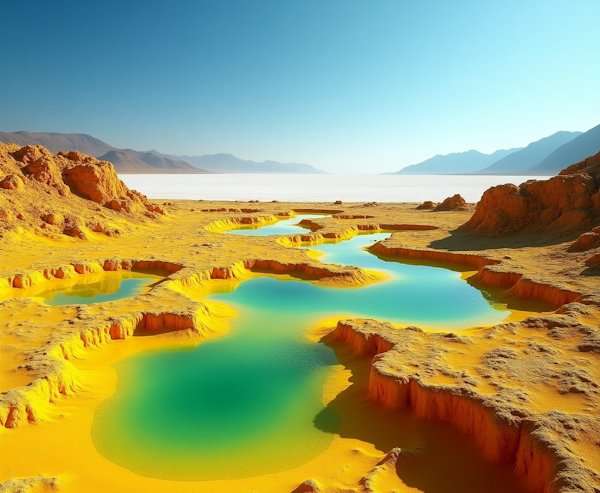
The Danakil Depression houses one of Earth’s most hostile environments deep within its geological wonder. This remarkable place challenges what life can endure through a perfect combination of extreme conditions.
Record-Breaking Temperatures
The scorching landscape reaches temperatures of 45°C (113°F) regularly and sometimes climbs to an astounding 55°C (131°F). The Dallol region’s geothermal activity drives temperatures even higher and surface water approaches 100°C (212°F).
Hyperacid Springs and Salt Formations
Nature’s extremes are evident in the region’s hyperacid springs. These pools maintain an average pH of 0.2, making them the most acidic natural waters that scientists have recorded. Scientists found life in pools with zero pH, setting a new record for acidic environments where organisms can survive.
The springs display a mesmerizing array of colors because of their unique chemical makeup. The mineral-rich waters contain:
- Iron concentrations of 35.6 g/L
- Copper levels reaching 93 mg/L
Atmospheric and Chemical Extremes
The air itself creates major challenges with its dangerous mixture of elements including:
- Toxic hydrogen sulfide gas
- Chlorine vapor
- Sulfurous fumes
Scientists call this blend of extreme conditions a “multi-extreme environment”. Volcanic activity interacts with evaporite deposits to create supersaturated waters that form colorful, highly acidic pools throughout the region. This extreme environment helps scientists study potential Martian hydrothermal environments.
In contrast, visit Fjallsarlon Glacier Lagoon.
Volcanic Activity and Lava Lakes
The Erta Ale volcano stands as evidence of Earth’s raw power and ranks as one of the Danakil Depression’s most striking features. This active basaltic shield volcano contains one of only eight permanent lava lakes worldwide and has stayed active since 1967.
Erta Ale’s Permanent Lava Lake
The volcano’s lava lake shows remarkable features and has lasted longer than most:
- Molten activity continues unbroken since the early 20th century
- Lava fountains reach heights of 10-15 meters
- Surface temperatures range between 700–1100°C
Hydrothermal Systems at Dallol
The Dallol hydrothermal field offers a completely different view. This unique system creates extreme conditions where water temperatures climb to 108°C and pH levels fall below zero. You’ll find a complex network of:
- Supersaturated hydrothermal waters
- Active and inactive fumaroles
- Geysers and hot springs
Active Geological Processes
Dallol’s geological activity never stops changing. New springs appear while others become inactive within days. The main gasses these springs release include carbon dioxide, hydrogen sulfide and sulfur dioxide.
The Gaet’ale Pond stands out as Earth’s saltiest water body with 43% salinity. The area’s hydrothermal features reshape the scene constantly, though these changes come from inorganic processes rather than biological activity.
Erta Ale’s volcanic activity took a dramatic turn in January 2017. A new fissure eruption emerged about 4 km from the caldera. This event triggered major changes as lava flows stretched several kilometers and created a large new lava field that holds at least one new lava lake.
Learn about Ethiopian culture.
Scientific Significance and Research

The Danakil Depression draws scientists from around the world with its potential for groundbreaking research in many fields. This harsh landscape serves as a natural laboratory that helps us learn about life’s limits.
Extremophile Studies
Scientists found remarkable evidence of life in areas once considered uninhabitable. They discovered ultra-small microorganisms that thrive in environments with pH levels as low as 0.25 and temperatures reaching 90°C. These bacteria, among the most resilient organisms that ever spread, have pushed our understanding of life’s boundaries further.
Mars Analog Research
The Danakil Depression’s unique features are a great way to get insights for Mars research. The region’s mineral deposits and sulfate formations mirror those found on the Red Planet. Several research initiatives have focused on the site:
- DNA evidence of microbial life in extreme salty environments
- Studies of bacterial relationships with the atmosphere
- Investigation of preservation patterns for organic matter
Paleontological Discoveries
The Danakil Depression holds remarkable evidence of ancient life despite its current inhospitable state. The region’s paleontological findings have contributed significantly to our understanding of human evolution. Lucy’s discovery, dating back 3.2 million years, remains one of the most important findings in the area.
The Buia Basin’s sedimentary succession, stretching 1,000 meters thick, contains over 200 fossil sites. These sites feature well-preserved early human fossils alongside stone tools that give an explanation of human evolution between 1.4 million and 650,000 years ago.
Did you know Antarctica is a desert?
Enjoy the Danakil Depression
The Danakil Depression is Earth’s most remarkable natural laboratory. This unique place shows us what happens when extreme geology meets groundbreaking science. The harsh landscape, created by the joining of three tectonic plates, changes how we think about where life can exist.
Scientists who study the region’s hyperacid springs and scorching temperatures have found that there was life in conditions nobody thought possible. These tough microorganisms challenge our understanding of biological adaptation and are a great way to get information about possible life forms on other planets.
This place matters for more than just what we see today. The famous “Lucy” fossil and other archeological finds show how the depression played a key role in human evolution. The active volcanic features, like Erta Ale’s permanent lava lake, show Earth’s geological processes in action.
The future of this extraordinary place looks just as fascinating. Tectonic forces will slowly turn the depression into an ocean basin millions of years from now. The Danakil Depression remains the best place on Earth to study extreme environments, early human history and possible life on Mars.
FAQs
Q1. What makes the Danakil Depression so unique?
The Danakil Depression is one of Earth’s most extreme environments, featuring record-breaking temperatures, hyperacid springs, and active volcanoes. It’s home to colorful mineral formations, salt flats, and lava lakes, making it a geological wonder and a valuable site for scientific research.
Q2. How hot does it get in the Danakil Depression?
Temperatures in the Danakil Depression regularly reach 45°C (113°F), with some areas recording temperatures as high as 55°C (131°F). In the Dallol region, geothermal activity can push surface water temperatures close to 100°C (212°F).
Q3. Is it possible to visit the Danakil Depression?
Yes, it is possible to visit the Danakil Depression, but due to its extreme conditions, tours are carefully managed. Visitors can observe the colorful acid pools, salt formations, and even the Erta Ale volcano’s lava lake. However, it’s crucial to go with experienced guides and take necessary precautions.
Q4. Why is the Danakil Depression important for scientific research?
The Danakil Depression is significant for scientific research because it serves as an analog for potential Martian environments. It’s also valuable for studying extremophiles – organisms that thrive in extreme conditions – and for understanding the limits of life on Earth. Additionally, the area has yielded important paleontological discoveries related to human evolution.
Q5. What is the future of the Danakil Depression?
Geologists predict that over the next 10 million years, the entire East African Rift, including the Danakil Depression, will eventually submerge and form a new ocean basin. This process is driven by the ongoing separation of tectonic plates in the region, which continues at a rate of 1-2 centimeters per year.


Leave A Comment