

Baldwin Street in Dunedin, New Zealand stands as the world’s steepest road with a mind-bending 35% gradient. Drivers must park their cars sideways to keep them from rolling downhill. The street’s average gradient of 1:3.41 (29.3%) tests every driver and walker who dares to tackle it.
Most people look for scenic drives, but these super-steep roads deliver pure adrenaline. The title of world’s steepest street has sparked some heated competition. A street in Wales, Ffordd Pen Llech, claimed the top spot with a 37.45% gradient, but experts later adjusted it to 28.6%. Pittsburgh’s Canton Avenue reaches an impressive 37% grade but hasn’t secured official recognition. Waipio Valley Road in Hawaii takes things even further – parts of this rural road hit a 45% gradient, making it America’s steepest.
These extreme roads have become local attractions that bring communities together. The Baldwin Street Gutbuster race draws brave runners who sprint up the incline – the fastest time stands at 1 minute and 56 seconds. The street’s Cadbury Jaffa Race sends 75,000 candies tumbling down for charity. This piece takes you through the world’s most challenging roads and shows how they’ve shaped their communities’ culture, history and daily life.
Baldwin Street, Dunedin, New Zealand

Image Source: Guinness World Records
Baldwin Street sits in Dunedin’s residential suburb of North East Valley, New Zealand. This remarkable 350-meter stretch of road shows what ambitious urban planning looks like. The street climbs from 30 meters above sea level where it meets North Road to 100 meters at its peak. Its extraordinary incline makes it famous, with an average slope that’s more than 1:5 throughout its length.
Baldwin Street Gradient and Location
The street’s gradient gets steeper as you go up. The lower part has a moderate slope with asphalt covering. The real challenge lies in the upper 161.2-meter section. This part rises 47.2 meters vertically, creating an average gradient of 1:3.41. The steepest point sits about 70 meters from the top, reaching 1:2.86 (35% or 19 degrees). The extreme steepness meant builders had to use concrete instead of asphalt for the upper section. Asphalt could melt and flow downhill during hot weather.
The street got its unusual gradient from 19th-century urban planning during Dunedin’s rapid growth after the Otago Gold Rush. Charles Kettle, Dunedin’s surveyor, based the city’s design on Edinburgh’s New Town layout. He made sure to include roads that went up Signal Hill’s rugged slopes.
Baldwin Street Guinness World Record History
The street’s path to fame started in 1987. After a two-year campaign led by broadcaster Jim Mora, it earned its spot in the Guinness Book of Records. The street kept this prestigious title until June 2019. Ffordd Pen Llech in Harlech, Wales, briefly took the crown with a reported 37.45% gradient.
Dunedin locals wouldn’t give up. Surveyor Toby Stoff led a team that surveyed both streets and filed an appeal. Guinness World Records gave Baldwin Street back its title on April 8, 2020. They changed their measurement rules to calculate steepness along the road’s centerline. Under these new standards, Baldwin Street’s 34.8% gradient beat Ffordd Pen Llech’s recalculated 28.6%.
Baldwin Street Tourist Events and Challenges
Tourists flock to Baldwin Street, which hosts several yearly events drawing people from around the world. The Baldwin Street Gutbuster has tested athletes since 1988. They race up and down the steep incline, with the record time of 1 minute and 56 seconds set in 1998.
The street’s Jaffa Race adds to its fame. Thousands of round candy-coated chocolate balls roll down the slope for charity. This tradition started after a 1998 event where 2,000 tennis balls raised funds for Habitat for Humanity. The Jaffa Race grew bigger, with up to 30,000 Jaffas rolling down annually.
People love creating their own challenges too. A walk to the top usually takes about 10 minutes, though locals can do it in seven. Social media fans have turned the street into a popular spot. They take photos that make the houses look dramatically tilted.
Ffordd Pen Llech, Harlech, Wales

Image Source: Manchester Evening News
Ffordd Pen Llech ([fɔrð pʰɛn ɬeːχ]) sits in the historic town of Harlech in North Wales. This ancient road curves down from the town center past the medieval Harlech Castle. The street stands as one of two roads around the Harlech Castle World Heritage Site. It links the town center up high with the railway station and coastal areas below.
Ffordd Pen Llech Steepness and Layout
The street drops down a rocky spur north of the castle at an amazing angle. Scientists measured its steepest point at 37.45%. Houses that are 300 years old line this winding Welsh street. Both visitors and locals can’t help but notice the street’s dramatic slope. Local resident Gwyn Headley puts it well: “I first realized this street was a contender for the steepest street in the world when my car slid straight down with all four tires locked”.
This public road dates back about 1,000 years. Modern warning signs at the bottom show a 40% slope, though official measurements later changed this number.
Ffordd Pen Llech Record Controversy
The street grabbed the title of “World’s Steepest Street” from Baldwin Street in Dunedin, New Zealand in July 2019. Harlech locals ran a big campaign and brought in surveyor Myrddyn Phillips. He measured the street using satellite technology and old-school methods.
The celebration didn’t last long. Guinness World Records gave the title back to Baldwin Street in April 2020. This happened after an appeal and a fresh look at how they measured steepness. The records team decided they should measure steepness along the road’s middle line instead of its steepest part. So Ffordd Pen Llech’s gradient dropped from 37.45% to 28.6%, while Baldwin Street came in at 34.8%.
Ffordd Pen Llech Driving Restrictions
The street’s extreme slope shapes how traffic moves through it. Cars might not start again if they stop on the steepest parts. That’s why Ffordd Pen Llech runs one-way, letting vehicles travel only downhill.
Cycling fans love the street’s steep slope as it offers quite a challenge. UK law makes cyclists follow all traffic signs, which means no uphill rides. Cyclists who want to go up must use the nearby road called Twtil. It has a gentler slope of 25%.
The street may have lost its world record, but it still holds the title of steepest street in the Northern Hemisphere. People still come from far and wide to see this gravity-defying road.
Canton Avenue, Pittsburgh, USA

Image Source: en.wikipedia.org
Canton Avenue, America’s champion of steep streets, lies hidden in Pittsburgh’s Beechview neighborhood. This challenging road spans just 630 feet but delivers an incredible uphill challenge.
Canton Avenue Steepest Road Grade in the World
The road’s average grade of 30% runs through its short length, and a 21-foot section reaches a mind-boggling 37% gradient. This means the road climbs 37 feet for every 100 feet of horizontal distance. The street’s extreme steepness has sparked debates about its place among the world’s steepest roads. Baldwin Street in New Zealand holds the official Guinness World Record at 34.8% grade, but Pittsburgh’s locals and media outlets believe Canton Avenue deserves the top spot. The competition extends beyond international borders. Bradford Street in San Francisco boasts a 39% grade for nine meters and Hawaii’s Waipio Valley Road has sections that reach 45%.
Canton Avenue Cycling Events
Pittsburgh’s annual Dirty Dozen bicycle race brought Canton Avenue into the spotlight. This 50-mile test of endurance challenges riders with 13 of the city’s toughest hills. Danny Chew and two friends started the race 1983 old. The event grew from five participants to hundreds of cycling enthusiasts. Canton Avenue stands out as the course’s steepest climb, and it often beats cyclists on their first try. The race’s founder said: “That hill gets about half the people the first time up… Once they crash or don’t make it once or twice, then they take it more seriously”. Riders cruise between hills at a relaxed pace and race only on the uphill sections to earn points as the fastest climbers.
Canton Avenue One-way Traffic System
The street’s extreme grade led to a one-way traffic system that allows vehicles to move only uphill from Coast Avenue. This smart traffic solution helps prevent dangerous situations where vehicles might lose control on the steep descent. An Audi Quattro advertisement in 2016 featured professional athletes conquering the street’s dramatic slope. Pittsburgh City Councilman Anthony Coghill wants to add signs marking Canton as America’s steepest street to draw tourists to Beechview’s business district.
Waipio Valley Road, Hawaii, USA

Image Source: Condé Nast Traveler
Waipio Valley Road on Hawaii’s Big Island stands as one of the world’s toughest drives. This remarkable road connects the Waipio Overlook to the sacred valley floor. Drivers face a true test of their vehicles and courage here.
Waipio Valley Road Terrain and Gradient
The road drops 800 feet in just 0.6 miles, with a steep 25% average grade from start to finish. Some sections reach an incredible 45% grade, making them steeper than both Baldwin Street’s 35% and Canton Avenue’s 37%. These numbers make Waipio the steepest road of its length in the United States. Narrow lanes wind through the terrain and the surface becomes unpaved once you reach the valley floor. Drivers must carefully navigate tight hairpin turns. The elevation changes dramatically from 279 meters at the overlook to just 7 meters at the bottom.
Waipio Valley Road Accessibility and Safety
Safety concerns led authorities to limit road access strictly since February 2022. Only Hawaii residents, authorized tour operators and Native Hawaiians practicing traditional rights can use the road now. The rules require vehicles to be low-range four-wheel drive and weigh less than 10,000 pounds. A full picture revealed dangerous rockfall hazards—the county deals with at least three rockfalls each year. The extreme grade has caused many accidents when brakes fail during descent. Risk calculations show that falling rocks pose a 1 in 18,000 risk of death to pedestrians, while vehicle occupants face a 1 in 170,000 risk.
Waipio Valley Road Scenic Value
The road offers a unique view of what locals call “The Valley of Kings”—where King Kamehameha I spent his childhood. Dramatic 2,000-foot cliffs surround the area, featuring a black sand beach and Hawaii’s tallest waterfall. Hi’ilawe Falls drops an impressive 1,450 feet. The valley holds deep cultural importance, and fewer than 100 people live among its taro fields and rivers today. Visitors at the overlook can see massive cliff faces where parts of the island have broken away. Powerful ocean waves create perfect photo opportunities against this backdrop.
Bradford Street, San Francisco, USA

Image Source: Data Pointed
Bradford Street stands out as San Francisco’s most dramatically steep roadway among its famous hills. This unassuming street in the Bernal Heights neighborhood has become known as the city’s steepest route that vehicles can travel on. It challenges both cars and people who dare to take it on.
Bradford Street Steepest Section
The street’s steepest point hits an incredible 41% grade, making it the champion of San Francisco’s tough climbs. Most of the street runs at a 24% grade, but a 30-foot section takes the challenge to another level. The physics at play here are remarkable – a one-ton car rolls downhill with 800 pounds of force just from gravity, and it can go from zero to sixty in 7.2 seconds. The street starts at Tompkins Avenue with a 20% grade. After about 150 feet, the slope becomes twice as steep. A recent unofficial survey showed this 30-foot section, paved in 2010, hits a 40% grade.
Bradford Street Urban Planning
The street’s extreme slope shows how San Francisco’s city planners chose to work with the natural landscape rather than fight it. The northern half of the block went through major improvements in 2009-2010. Planners added two separate stairways next to the road up to Jarboe. These stairs show how they adapted to the tough terrain while keeping the area accessible. The 2010 improvement project included fully paving the street, which gave drivers a better surface to handle this intense climb.
Bradford Street Local Experiences
People seeing Bradford Street for the first time often can’t believe their eyes. The top offers amazing views of the Alemany Farmers’ Market, John McClaren Park, and the southern side of San Francisco. Anyone walking up this steep climb should bring water and a hat. Bradford Street leads the pack of San Francisco’s steepest streets. Romolo between Vallejo and Fresno comes second with a 37.5% grade, while Prentiss between Chapman and Powhattan takes third place at 37% grade. The street gives both locals and tourists a perfect example of why San Francisco is famous for its gravity-defying hills.
Laugh at these San Francisco puns.
Vale Street, Bristol, UK

Image Source: Atlas Obscura
Bristol’s Totterdown neighborhood proudly claims England’s steepest street. Vale Street earned this title in 2019, and its dramatic slope creates quite a spectacle that challenges everyone who encounters it.
Vale Street gradient and layout
The street might be just 0.2 kilometers long, but it packs a serious climb with a 17-meter elevation gain. The road boasts an average gradient of 22 degrees, while some parts reach a whopping 25.6 degrees. Picture an advanced intermediate ski run – that’s exactly how steep this street is. Designers added staircases on both sides of the road because they knew people would need help walking up and down. The street connects Park Street to Balmain Street over 427 feet. The bottom section looks almost vertical to anyone standing there.
Vale Street Easter Egg Roll Tradition
This challenging hill transforms into a festive gathering spot during Easter, thanks to a tradition that started over 30 years ago. Mat Goren, who moved here from Holland, kicked off this unique competition in 1995. The rules are simple – people decorate hard-boiled eggs and let them roll from the top. Kids and adults compete separately and victory goes to whoever’s egg travels the farthest without cracking. Martin Tillett, a 63-year-old local, says with a smile: “They don’t win anything – just the glory”.
Vale Street Parking Challenges
The street’s extreme slope forces residents to get creative with parking. Cars must sit at right angles to the road instead of parallel to prevent them from rolling downhill. Winter brings extra challenges – some people actually tie their cars to lampposts when ice covers the street. Most drivers steer clear of the street completely, which works out well for residents who rarely struggle to find parking spots. Delivery drivers often give up on the climb and ask residents to meet them at the bottom instead.
Filbert Street, San Francisco, USA

Image Source: Secret San Francisco
Filbert Street winds through San Francisco’s iconic Telegraph Hill, combining extreme gradient challenges with some of the city’s most scenic views. This east-west thoroughfare runs from The Presidio to The Embarcadero, featuring both drivable sections and pedestrian-only pathways.
Filbert Street Maximum Gradient
The steepest part of Filbert Street sits between Hyde and Leavenworth Streets, where the gradient hits an impressive 31.5% (17.5°). This one-way downhill stretch drops 65 feet over a half-block span of 206.25 horizontal feet. The street shares this exact gradient with 22nd Street (between Vicksburg and Church), but Filbert gets more attention because it’s a major thoroughfare. Several San Francisco roads are steeper than Filbert, including a sidewalk-only section of Broderick Street that reaches about 35%. Notwithstanding that, locals still consider Filbert one of the city’s steepest streets and many used to think it had the steepest slope in San Francisco.
Filbert Street Tourist Appeal
The street’s eastern section draws crowds with its remarkable pedestrian pathways. The Filbert Street Steps cascade down Telegraph Hill’s eastern slope with about 400 wooden and concrete steps surrounded by beautiful gardens. These steps now run through the Grace Marchant Garden, a 73-year-old garden that Gary Kray managed to keep alive from 1979 until 2012. Climbers get amazing views of the Bay Bridge, waterfront, Treasure Island and San Francisco Bay. The journey from the bottom of the steps to Coit Tower covers roughly 445 steps and takes 30-60 minutes depending on how fast you walk.
Filbert Street Historical Events
Filbert Street’s character comes from its rich history. Many cottages along the steps date back to the 1850s and survived the big 1906 earthquake. The sort of thing I love about this area’s history is how residents saved their homes during the fires – they used wine-soaked burlap sacks to stop their houses from burning. The area became famous for its feral parrots, which caught global attention in the 2003 documentary “The Wild Parrots of Telegraph Hill”. These colorful birds still hang out along the Filbert Street steps, adding more charm to this unique San Francisco landmark.
Baxter Street, Los Angeles, USA

Image Source: Los Angeles Times
A simple thoroughfare marked on an 1853 surveyor’s map, Baxter Street in Los Angeles transformed into a notorious challenge for drivers. This relaxed street gained its reputation not just from its steep slope, but as a technological trap when navigation apps started sending unsuspecting drivers up its daunting incline.
Baxter Street Steepest Section
The street’s 32% grade makes it the third steepest street in Los Angeles and places it among America’s top 10 steepest roads. The slope is a big deal as it means that it’s steeper than many of San Francisco’s famous hills. Drivers face a unique experience through the most challenging section between Allesandro and Alvarado. The summit creates serious visibility issues—drivers can only see sky through their windshields, with no view of oncoming traffic from the other side. City planners embedded a concrete grid pattern just past Lemoyne to help drivers maintain better traction.
Baxter Street Vehicle Accidents
The extreme slope led to many accidents and property damage. Resident Robbie Adams shared his experience: “We had our garden wall knocked down twice, and my wife’s car got hit in our own driveway. I’ve seen five or six cars smash into other cars, and it’s getting worse”. Rain makes everything worse as cars spin out, creating “absolute chaos”. Some vehicles needed airlifting after getting stuck on the hill. Cars have crashed through gardens, broken fences and even flipped over in people’s front yards.
Baxter Street One-way Conversion
The Los Angeles Department of Transportation made major changes in 2018 after years of accidents and community pressure. The section between Allesandro Street and North Alvarado Street became one-way westbound, while the stretch from North Alvarado Street to Lake Shore Avenue turned one-way eastbound. Right turns from Alvarado Street onto Baxter Street were also restricted during rush hours (4-7 p.m., Monday through Friday). These changes aimed to stop navigation apps like Waze from directing unfamiliar drivers onto what locals called a street too dangerous for regular traffic.
Eldred Street, Los Angeles, USA

Image Source: YouTube
Eldred Street stands as one of America’s steepest residential roads in Los Angeles’ Mount Washington neighborhood. This remarkable street challenges modern engineering standards with its extreme slope and ranks among the world’s top 10 steepest roads due to its historical origins and exceptional gradient.
Eldred Street Gradient and History
The street’s story began in 1912, named after property owner Delos W. Eldred. The road features a heart-stopping 33% grade and climbs an impressive 219 feet in elevation. It holds the title of California’s steepest street and ranks third steepest in the United States. The road’s construction happened before modern city rules limited street grades to 15%, which means it will always remain Los Angeles’ steepest street. A 196-step wooden stairway awaits visitors at the dead-end summit – the city’s oldest – leading up to Cross Avenue.
Eldred Street Garbage Truck Adaptations
The street’s steep grade demands special city services. The sanitation department sends smaller, custom garbage trucks every Tuesday morning. These trucks must reverse up the incline and slowly move down to collect trash because standard trucks would topple while turning around. The street’s challenges became clear during one incident where a trash truck got stuck at the top. It took crews 12 hours to free the vehicle safely.
Eldred Street Resident Challenges
Life on Eldred Street comes with unique daily hurdles. The mail carrier won’t tackle the slope, so residents collect their mail from community boxes at the street’s base. Parking creates constant headaches – a resident once had to use “an 8-foot 2-by-4 to pry a police car off the wall” after it slid down. Cars have been known to slide and zigzag before flipping over. A longtime resident’s warning rings true: “One thing you cannot do is get off the paved road if it’s raining or wet. You’ll slide sideways down the hill”.
Laugh at these Los Angeles puns.
Malga Palazzo, Trentino, Italy

Image Source: ITALIAN CYCLING JOURNAL
The Scanuppia-Malga Palazzo road lies tucked away in northern Italy’s Dolomite mountain range. Many cyclists call it Europe’s most daunting paved climb. This mountain path dates back to the 16th century and still tests the limits of seasoned riders with its remarkable steepness.
Malga Palazzo Steepest Road Grade in Europe
This daunting route sits in Trentino’s Besenello municipality and features an average gradient of 17.9-18.1% throughout its length. Some sources claim the steepest sections hit a mind-boggling 45%, though verified measurements show maximum slopes closer to 35-37%. The concrete path runs between 7.1-9.76 kilometers based on measurement methods. Starting at 230 meters elevation, it climbs to over 1,500 meters at its peak. The total elevation gain ranges from 1,300-1,385 meters, making it the steepest sustained climb on paved roads across Europe.
Malga Palazzo Cycling Difficulty
Most cyclists can’t complete this climb without stopping. ClimbFinder rates Scanuppia/Malga Palazzo as “Super Hors Catégorie” – their toughest possible rating. The climb forces even fit riders to get off their bikes. Riders need the lightest possible gearing – a 34-tooth or smaller chainring paired with a 34-tooth rear cog. The first three kilometers prove brutal, leaving riders “incredulous” at the punishing gradient. The gradient eases slightly after that, making 20% slopes feel like “false flats”.
Malga Palazzo Surface and Traction
The road’s surface shows unique features that boost traction. Most of the concrete displays a distinctive wavy pattern with wide ripples. These intentional bumps provide better grip in snowy or icy conditions. The surface pattern creates extra challenges as cyclists must maintain momentum through the dips between “waves”. The road stays restricted – only residents, landowners, or accompanied guests can access this extreme route. This policy helps protect both safety and the pristine mountain setting.
Stalheimskleiva, Norway
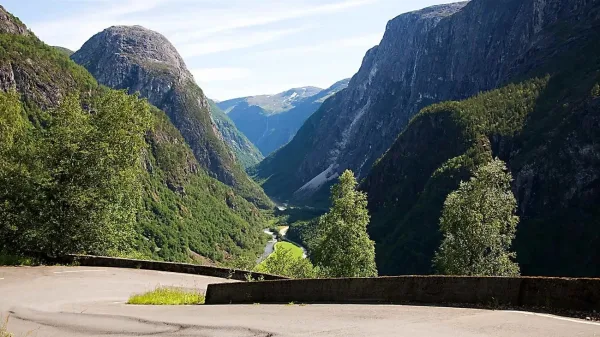
Image Source: Norway – Nordic Visitor
Stalheimskleiva stands as one of Europe’s most challenging drives. Norwegian engineers built this remarkable serpentine route during their country’s ambitious 19th-century infrastructure push. What started as a vital transportation link has now become a protected cultural landmark that shows off historic engineering excellence.
Stalheimskleiva Historical Construction
The construction of Stalheimskleiva took place between 1842 and 1846, with about 1,000 men working with their hands. This massive project aimed to create a better postal route between Oslo and Bergen, showing Norway’s commitment to connect its major cities despite tough terrain. The road’s simple purpose was to link the inner Nærøydalen valley to farms at Brekke and Stalheim. Workers carved the steep mountainside using just hand tools and simple equipment. Their effort stands as proof of 19th-century Norwegian engineering skills.
Stalheimskleiva Gradient and Hairpin Turns
Stalheimskleiva ranks among Northern Europe’s steepest roads. Several sections reach a maximum gradient of 20%. The road winds up 1.75 kilometers (1.1 miles) from Nærøy Valley to Stalheim village through 13 hairpin bends. These tight switchbacks have made Stalheimskleiva one of the world’s most famous hairpinned roads. Without doubt, its most unique feature lies between two spectacular waterfalls—Stalheimsfossen (125 meters) and Sivlefossen (140 meters). This placement earned it the nickname “the road between the waterfalls”.
Stalheimskleiva Current Usage
Stalheimskleiva no longer allows vehicle traffic. Since October 2023, visitors can explore this path on foot or bicycle. The Norwegian National Agency for Cultural Heritage protected Stalheimskleiva in 2009 as part of the National Protection Plan for Roads. This road’s importance goes beyond its engineering marvel. It sits in the Nærøyfjorden landscape conservation area, which became part of the West Norwegian Fjord Landscape—a UNESCO World Heritage Site in 2005. Visitors can reach this historic route by walking about one kilometer from Stalheim Hotel at the top.
Gold Hill, Shaftesbury, UK

Image Source: en.wikipedia.org
Gold Hill’s cobbled pathway in Dorset stands as one of Britain’s most photographed streets. The street charms visitors with its steep gradient and quintessentially English appeal. People describe its ancient cobblestones and distinctive thatched cottages as “one of the most romantic sights in England”.
Gold Hill Cultural Significance
Traditional cottages line one side of this important historical landmark. The 14th-century buttressed precinct wall of Shaftesbury Abbey stands on the other. The ancient street runs next to the Abbey’s Grade I listed walls built by King Alfred the Great. Gold Hill became famous for its traditional fairs where market stalls filled the street and cheese races entertained people. The town continues this centuries-old community tradition by hosting the annual Gold Hill Fair to support local charities.
Gold Hill Media Appearances
The street first caught nationwide attention when it appeared in the 1967 film adaptation of Thomas Hardy’s “Far from the Madding Crowd”. Real fame came with the 1973 “Boy on Bike” Hovis bread TV ad, directed by Ridley Scott before his Hollywood career. This iconic commercial showed a delivery boy pushing his bicycle up the steep hill while Dvořák’s New World Symphony played. British people voted it their favorite advertisement ever. The ad’s cultural effect was so strong that The Two Ronnies created a detailed spoof in 1978, showing the now middle-aged delivery boy still climbing the hill.
Gold Hill Tourist Appeal
Gold Hill Museum sits at the top, housed in two historic buildings. One building was once a priest’s house and still has a “squint” through the wall to St. Peter’s Church. The museum displays fascinating artifacts, especially from Dorset’s button-making industry of the early 19th century. Visitors can enjoy amazing panoramic views that stretch northwest to Glastonbury Tor and south to Melbury Hill. Many walking routes wind through Shaftesbury’s mix of thatched and stone properties, making Gold Hill central to Dorset’s tourism scene.
Visit the steepest roads in Europe.
Blake Street, Sheffield, UK

Image Source: Sheffield Star
Blake Street in Upperthorpe stands as Sheffield’s steepest street and Yorkshire’s pride in the world of challenging inclines. This gravity-defying road boasts a staggering gradient of 16.6 degrees and stretches 186 meters. First-time visitors can’t help but be amazed by its dramatic slope.
Blake Street Gradient and Location
The street’s physical features make it one of Britain’s toughest climbs. The road climbs from 91 meters at the bottom to 118 meters at the top, with a total elevation gain of 27 meters. The average grade hits 14.2% and reaches a maximum of 17.4%. These numbers put it ahead of Sheffield’s famous Jenkin Road by more than five degrees. The city has added practical features to help pedestrians tackle this climb. A handrail runs the full length of the street and special grips are built into the concrete paving stones. The Blake pub and Ruskin Park entrance mark the top of the street, where you’ll find stunning views of Sheffield’s cityscape.
Blake Street Film Appearances
The street’s fame goes beyond its steep slope. It caught the public’s eye in the 1997 hit movie “The Full Monty”. This British comedy-drama used Blake Street and other iconic Sheffield locations to capture the city’s authentic northern spirit.
Blake Street Seasonal Events
The street’s challenging slope brings the community together for various activities year-round. Winter turns it into a natural sledding paradise. Local resident Morgan Pearce shares, “People sledge down here in the winter and I’ve done that myself”. The yearly Santa Dash has become a favorite tradition as participants race up the slope in festive outfits. Cyclists love to test their skills on Blake Street during hill climb competitions. One reviewer describes it as “a sprint though, not a marathon” and advises riders to “get in the right gear from the off”.
Comparison Table
| Road Name | Location | Maximum Gradient (%) | Length | Notable Features | Current Status/Usage |
|---|---|---|---|---|---|
| Baldwin Street | Dunedin, New Zealand | 35% | 350 meters | Concrete paving covers steepest section; Hosts annual Gutbuster race and Jaffa Race | Active public road |
| Ffordd Pen Llech | Harlech, Wales | 28.6% | – | Links town center to railway station; 300-year-old houses line the route | One-way downhill only |
| Canton Avenue | Pittsburgh, USA | 37% | 630 feet | Highlights annual Dirty Dozen bicycle race | One-way uphill only |
| Waipio Valley Road | Hawaii, USA | 45% | 0.6 miles | Drops 800 feet to sacred valley floor | Restricted access (residents/authorized only) |
| Bradford Street | San Francisco, USA | 41% | – | San Francisco’s steepest vehicular route with 30-foot steepest section | Active public road |
| Vale Street | Bristol, UK | 22 degrees | 0.2 kilometers | Known for Easter egg rolling tradition; Cars park perpendicular | Active public road |
| Filbert Street | San Francisco, USA | 31.5% | – | Showcases wooden Filbert Steps and Grace Marchant Garden | Active public road |
| Baxter Street | Los Angeles, USA | 32% | – | Concrete grid pattern provides traction | One-way sections |
| Eldred Street | Los Angeles, USA | 33% | – | 196-step wooden stairway crowns summit; Requires special garbage trucks | Active public road |
| Malga Palazzo | Trentino, Italy | 35-37% | 7.1-9.76 km | Wavy concrete pattern surface enhances traction | Restricted access (residents/authorized only) |
| Stalheimskleiva | Norway | 20% | 1.75 kilometers | Features 13 hairpin turns between two waterfalls | Pedestrian/bicycle path only |
| Gold Hill | Shaftesbury, UK | Not mentioned | – | Historic cobbled street featured in Hovis bread commercial | Active public road |
| Blake Street | Sheffield, UK | 17.4% | 186 meters | Full-length handrail; Featured in “The Full Monty” | Active public road |
Appreciate the Steepest Roads in the World
These gravity-defying roads are proof of human engineering, community adaptation and sometimes questionable urban planning. Baldwin Street’s official 35% gradient and Waipio Valley Road’s stunning 45% sections create unique challenges that shape local culture and daily life. Local residents have shown remarkable creativity. They park cars perpendicular to roads, tie vehicles to lampposts during winter, and create special garbage collection systems.
These extreme inclines have become cultural landmarks over time. Dunedin’s Jaffa Race, Vale Street’s Easter egg roll, and Pittsburgh’s Dirty Dozen bicycle race turn these tough slopes into celebration spots. Many streets have gained worldwide fame through media coverage. Gold Hill appeared in the iconic Hovis bread commercial, while Bradford Street featured in “The Full Monty.”
Safety remains the biggest concern on these challenging roads. Some streets now operate with restricted access or one-way traffic patterns to avoid accidents. Waipio Valley Road allows only residents and authorized visitors. Streets like Baxter and Eldred have changed their traffic rules after multiple incidents. In spite of that, adventurous tourists and determined cyclists still want to conquer these slopes.
People debate which road deserves the “world’s steepest” title, but these extraordinary streets mean way more than just numbers. Each one shows how geography, history and human determination come together. Some roads have concrete ripples for better grip, others have staircases for walking safely. Communities worldwide have turned extreme landscape challenges into unique local identities through annual competitions and celebrations.
Visitors should come prepared to these remarkable streets. Bring water for the climb, check access restrictions and make sure your vehicle’s brakes work well.
FAQs
Q1. What is currently recognized as the world’s steepest street?
Baldwin Street in Dunedin, New Zealand, holds the Guinness World Record for the steepest street, with a gradient of 34.8% measured along its centerline.
Q2. Which road in the United States has the steepest grade?
Canton Avenue in Pittsburgh, Pennsylvania, is considered the steepest street in the US, featuring a 37% grade for a 21-foot section of its 630-foot length.
Q3. How do residents cope with living on extremely steep streets?
Residents employ various strategies, such as parking cars perpendicular to the road, using special garbage trucks and in some cases, tying vehicles to lampposts during icy conditions.
Q4. Are there any unique events associated with these steep streets?
Yes, many steep streets host annual events. For example, Baldwin Street in New Zealand has the Jaffa Race where candies roll down for charity and Vale Street in Bristol, UK, holds an Easter egg rolling tradition.
Q5. How do cities manage safety on these extremely steep roads?
Cities often implement safety measures such as converting streets to one-way traffic, restricting access to residents and authorized vehicles only, adding handrails for pedestrians and using specially textured road surfaces for better traction.












Leave A Comment