
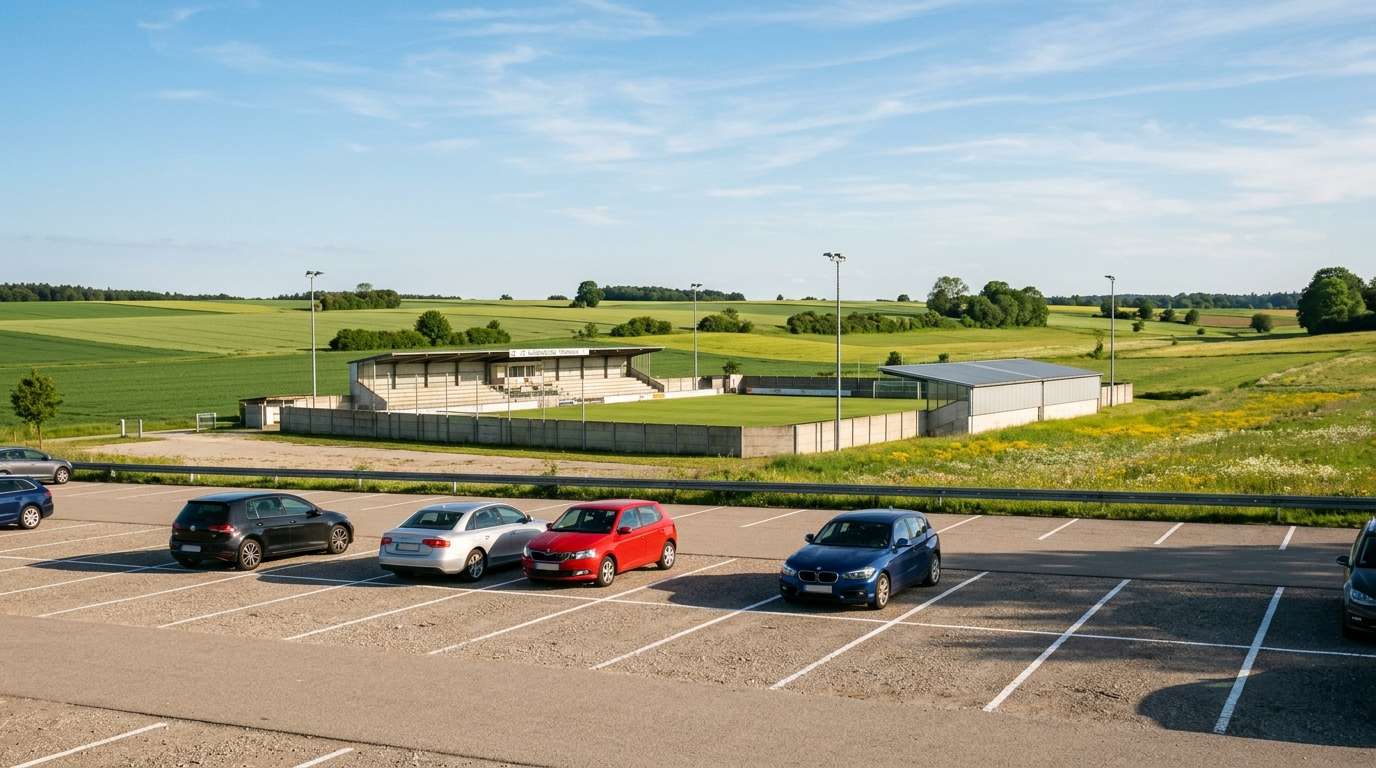
I stood in a car park outside the WWK Arena Augsburg future 2050 idea’s starting point, a plain building ringed by fields, and wondered what it could become. The ground sits in Bavaria, Germany, and opened on 26 July 2009. My first impression was modest: gray walls, flat land, rows of parked cars.
I still found it worth a stop. The stadium holds 30,660 fans, and it was called the first climate-neutral football stadium in the world. That green record is real.
The 2050 pieces in this story are my own vision, not an announced club plan. I keep real facts and imagination clearly apart. I start with what the arena is today.
Key Takeaways
- The stadium is the home of FC Augsburg in Bavaria, Germany.
- It opened in 2009 and holds 30,660 people for league games.
- Geothermal heat pumps have heated and cooled it since the start.
- No official 2050 plan exists; the carbon-negative version is imagined.
- Tram 8 from the main station is free with a match ticket.
- The outside looks plain, so photographers should come for the crowd.
What the WWK Arena in Augsburg Is Today
The WWK Arena is the home of FC Augsburg, a football stadium with a capacity of 30,660 on the south edge of Augsburg, Bavaria. The club owns it through FC Augsburg 1907 e.V. Architects Bernhard & Kögl designed it, and builders worked from November 2007 to July 2009 for €45 million.
Of the total, 19,556 are home seats and 8,000 are home standing places. Away fans get 800 seats and 2,200 standing places. There are also 46 wheelchair spaces and 99 media seats. Do not quote 30,660 for international games, because the figure drops to 28,367.
The 30,660 figure is for league matches only. For international games, the stadium holds 28,367.
The pitch measures 105 x 68 meters. The stands slope between 26 and 36 degrees, so fans sit close and the noise stays in. The roof is steel, and the stands are reinforced concrete.
The ground replaced the Rosenaustadion, built in 1951. It opened with a friendly that FC Augsburg won 2-0. Names changed over time: Augsburg Arena, Impuls Arena, SGL Arena, then WWK Arena since 1 July 2015. Locals also say Schwabenstadion.
It hosted matches of the 2011 FIFA Women’s World Cup. The club first reached the Bundesliga that same year. After the February 2016 Europa League tie against Liverpool, people nicknamed it the “Anfield of the B17.” A second building phase could lift capacity to around 49,000.
Its best-known first is how it is heated.
The Real Green Record: Climate Neutral Since Opening
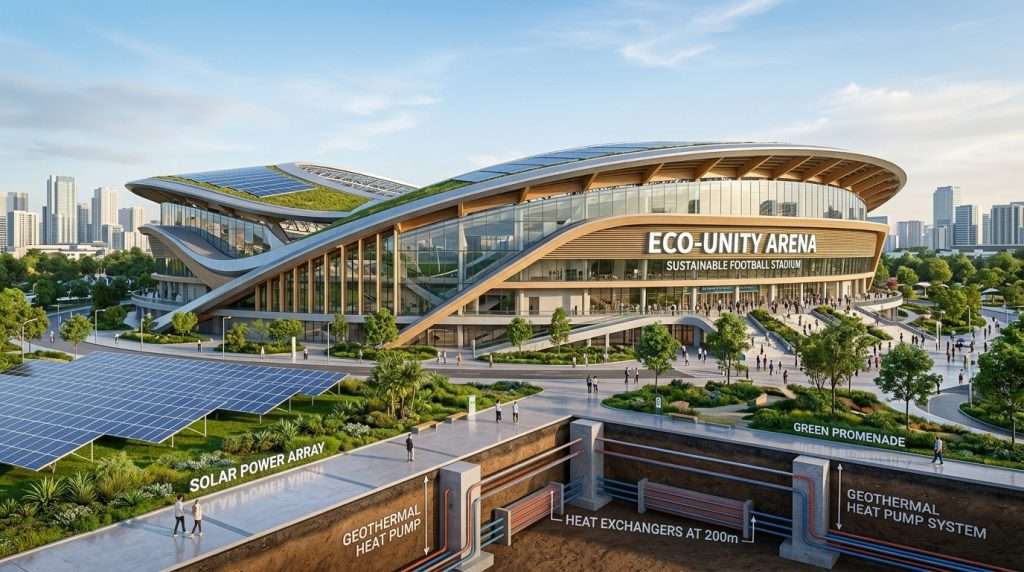
Six heat pumps, each 40 meters deep, sit under this stadium. They make the WWK Arena a working example of treating heat as a resource. Builders called it the first climate-neutral football stadium in the world.
The idea matches how WorldGBC explains net-zero carbon buildings: cut energy demand first, then handle what is left. Even so, peak match days still need a boiler.
| Piece | What it does | Today or 2050 vision |
|---|---|---|
| Deep heat pumps | Heat and cool the stadium | Real today |
| Bio natural gas boiler | Covers peak load in a game | Real today |
| Tube facade | Wraps the building (new one planned for 2017) | Real today |
| Training center | Two natural pitches, one artificial | Real today |
Deep Heat Pumps and the Peak-Load Boiler
The six geothermal heat pumps work through heat exchangers. They pull steady warmth from the ground and can send heat back in, so one system serves both jobs.
A bio natural gas boiler joins in when a game peaks. A full house needs more than the ground alone gives. I like that the design admits this limit.
The Facade, the Offices and the Training Center
The main building holds the club’s offices and a business club. A new facade was planned for 2017. The look from outside is plain, but a lot happens inside the walls.
To the west, a training center was built for €1.5 million. It has two natural pitches and one artificial pitch. These real pieces give any vision a base, and the next section lifts them to 2050.
WWK Arena Augsburg Future 2050: A Carbon-Negative Vision
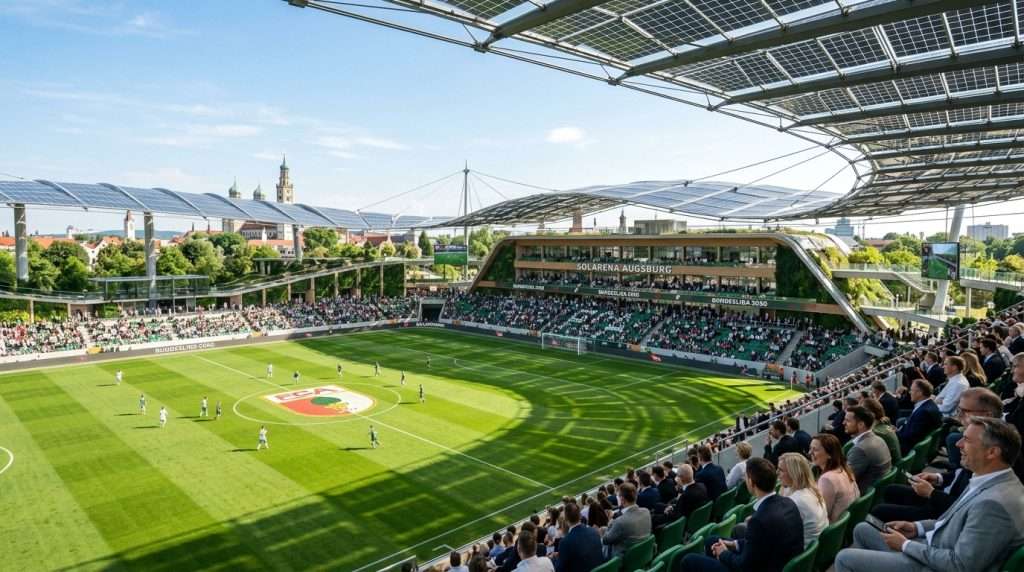
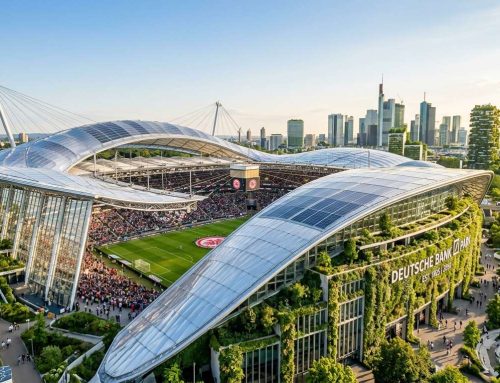
Nobody has announced a 2050 plan, so this is my picture, an imagined stadium. Carbon-negative means removing more carbon dioxide from the air than the building gives off. In my vision, the arena keeps its 30,660 seats and becomes a carbon-negative colosseum.
No official 2050 plan exists. Online videos of a giant new stadium are made-up fiction. Only the heat pumps and the room to grow are real, since the ground was designed to reach about 49,000 seats if the club ever needs it.
Here are the five pieces I picture, all imagined:
- Breathable nano-mineral glazes and low-carbon sealants protect the concrete bowl and steel cantilevers.
- Translucent bio-photovoltaic membranes cover the roof and aluminum tube facade, letting filtered light reach the turf.
- Underground vaults catch all Lech River storm runoff and cycle filtered water through deep closed-loop geothermal cooling.
- Piezoelectric plates under the Ulrich-Biesinger-Tribüne turn fan jumping into microgrid power.
- Longevity: the stadium stands on the Lech gravel plain and lasts for decades.
I picture standing in that stand on a match day, feeling the floor hum.
Visiting the WWK Arena as a Budget Traveler

Tram 8 from Augsburg Hauptbahnhof is free with a match ticket, so the trip costs nothing extra. The stadium sits at Bürgermeister-Ulrich-Straße 90, 86199 Augsburg. Here is how I would plan a visit:
- Buy your ticket on the club’s official website, then print it or collect it at the ticket office.
- Take tram 8 from the main station straight to the stadium.
- Driving? Augsburg lies on the A8 between Stuttgart and Munich. Take junction Augsburg-West, then the B17.
- Check the parking: 3,500 spaces, 1,140 for day tickets only, and 80 for buses.
- Visit the Helmut Haller statue near the block J entrance and the LEW Sports Bar.
The sports bar holds 120 guests and has history cabinets. Haller took the ball home from the 1966 World Cup final, which makes the statue fun to see.
Is Augsburg a big club? No, it is a mid-sized club with a loyal base. It rose from the lower tiers, has played in the Bundesliga since 2011, and finished fifth in 2015.
Pair your trip with the old Rosenaustadion in the city center. It is protected, and the reserve team still plays there in the fourth tier. The outside of the new ground looks plain, so photographers should come for the crowd. That crowd keeps pulling me back to what I hope the stadium becomes.
Conclusion
What stays with me is the contrast: a plain gray ground that hums with ideas. The real stadium is already a green pioneer, with heat pumps working under the pitch since day one.
The 2050 version is a vision worth imagining. It is only my picture, but it shows how far a modest building could go.
Your next step is simple. Plan one match day, bring a camera, and watch the stands move. Go see it before it changes.



Leave A Comment