
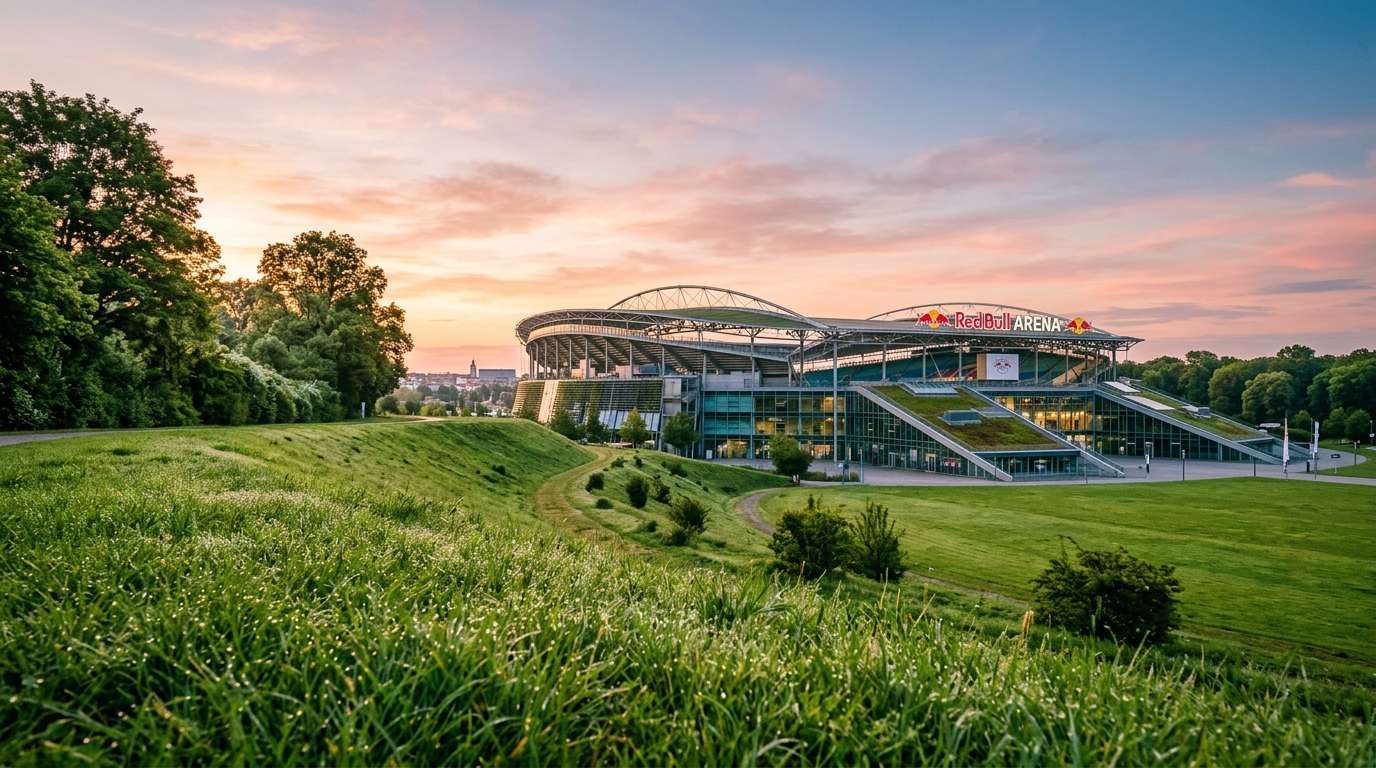
I stood at the foot of the grassy embankment in central Leipzig, boots wet from the morning dew, and looked up at a green wall that curved away on both sides. Behind that wall sits Red Bull Arena, a 2004 stadium tucked inside a ring of earth from 1956. It felt like finding a modern spaceship parked inside an old crater.
That sight made me ask a simple question. What could this place look like in 2050? I am a traveler, not an engineer, so I walked the grounds, read the history, and let my imagination run.
Here is my promise. Every 2050 idea in this story is a vision, built on real history and real ground. I also think a stadium can be a destination for overland travelers, not only a place for match days. To see why, you first need the story of how the place got here.
Key Takeaways
- The arena sits inside an earth ring that dates from 1956, not from the 2004 rebuild.
- Today’s arena holds 47,069 people, including 10,500 standing fans.
- The 2050 net-zero plan is a vision, not a built project.
- The vision pairs a solar roof, underground water tanks and fan-powered floors.
- Flood and storm risks explain why those systems make sense.
- Travelers can walk the ring, take a tour or catch a match.
How the Zentralstadion Became Red Bull Arena
On 9 September 1956, 100,000 people watched SC Rotation Leipzig play Lokomotive Leipzig, and that league crowd remains a German record. The Zentralstadion had been built between 1954 and 1956 and held about 100,000 people. Another 110,000 came on 27 October 1957 to watch East Germany play Czechoslovakia.
Here are the five milestones I keep in my notebook:
- 1956: the old stadium opens.
- 1994: the old stadium closes because of its poor condition.
- 2004: the new Zentralstadion reopens on 16 and 17 July.
- 2006: the FIFA World Cup comes to town.
- 2010: the stadium becomes Red Bull Arena.
Foundations for the new arena were laid in 2000. Builders kept the old wall and put the new bowl in the middle, where the pitch and running track used to be. The earth ring is not new: it dates from the 1950s. Many visitors assume it came with the new stadium, and I did too.
The earth ring belongs to the 1950s. The new stadium was built inside it, not the other way around.
The ring grew from wartime rubble, so every step of the walk crosses a piece of the city’s past. The stadium also hosted the 2005 Confederations Cup and the 2006 FIFA World Cup. Leipzig, a city of over 600,000 people, hosted matches at Euro 2024 too. The arena took its current name in 2010 and opened under it on 24 July 2010 with a friendly against FC Schalke 04. So what does the arena look like and hold now?
Red Bull Arena Leipzig Future 2050: From 47,069 Seats to a Net-Zero Vision
The arena holds 47,069 people today, including space for 10,500 standing fans. That is the base for the Red Bull Arena Leipzig future 2050 story. Seats and standing room together make the capacity.
What the Arena Holds Today
The Red Bull Arena Leipzig capacity changes with the match type. Here is how the numbers line up.
| Event | Figure | Note |
|---|---|---|
| League games | 47,069 | Full capacity |
| European games | 45,228 | Lower for seating rules |
| Standing space | 10,500 | Included in the total |
| Record crowd | 47,069 | DFB-Pokal semi-final, 20 April 2022 |
The club agreed to buy the stadium in December 2016. Planning permission came on 28 April 2017, and rebuilding began on 5 September 2019, with completion planned by 2024. The work added easier access routes, new signs, more kiosks, a merchandise store, digital tickets and cashless payment. Blue seats became red and white in 2022.
The Seating Plan and Where to Watch From
The Red Bull Arena Leipzig seating plan has one spot I would pick for noise: Sektor B, the vocal home end. If you want a calmer view from my seat at Red Bull Arena Leipzig, try the sides. The stadium has also hosted concerts by Coldplay, Elton John, Rammstein and others.
How the Arena Could Grow by 2050
Earlier Red Bull Arena Leipzig expansion plans called for 57,000 seats in 2015 and 53,840 seats in 2016. Both came and went. The vision I imagine keeps the 47,069-seat home and scales it into a carbon-negative sports colosseum, with no seat count promised. To make that work, the old stone and earth would need careful protection.
Protecting the 1956 Embankment and Its Stone Stairs
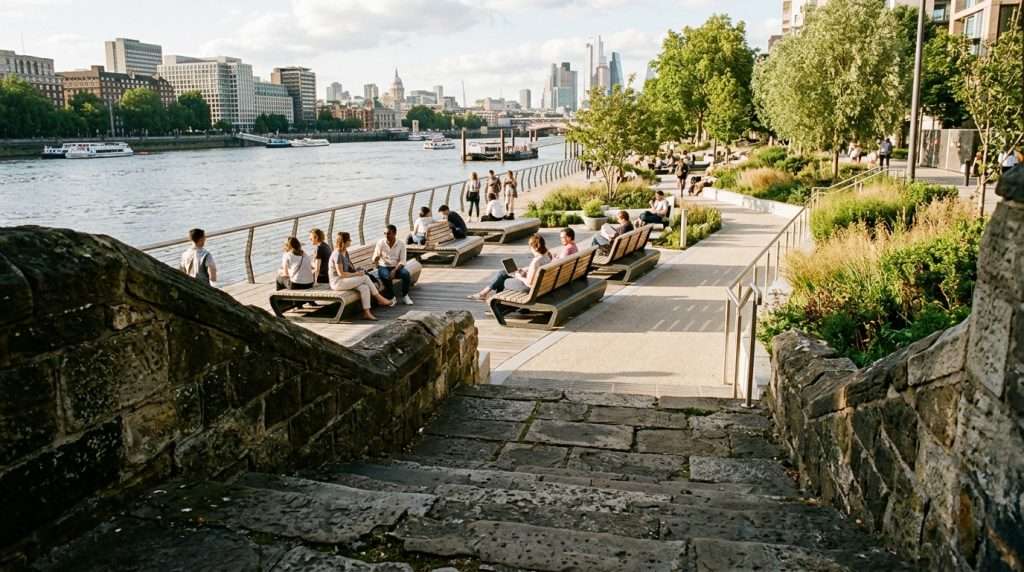
I sat on the old stone stairs one afternoon and ran my hand over a step worn smooth by decades of boots. The 1956 embankment was raised from wartime rubble, and its steps now sit beside the new seating. By 2050 the stone could be kept alive with breathable nano-mineral glazes, which belong to the vision and are not installed today.
Breathable matters because sealing old stone airtight traps moisture inside. Trapped water freezes, swells and cracks the stone from within. The vision uses masonry sealants that resist weathering and still let the stone breathe, so the historic patina stays.
The earth ring is also green parkland. It supports plants, handles stormwater and cools the city. Walking around it, I saw old steps next to new seats, and that mix is the best part of the place for me.
Touching that worn stone, I felt a small community of people reaching back decades. Protecting it keeps the foundations of the infrastructure honest. Above all of it, the roof is where the vision gets bold.
The Suspended Roof, Energy and Water Systems
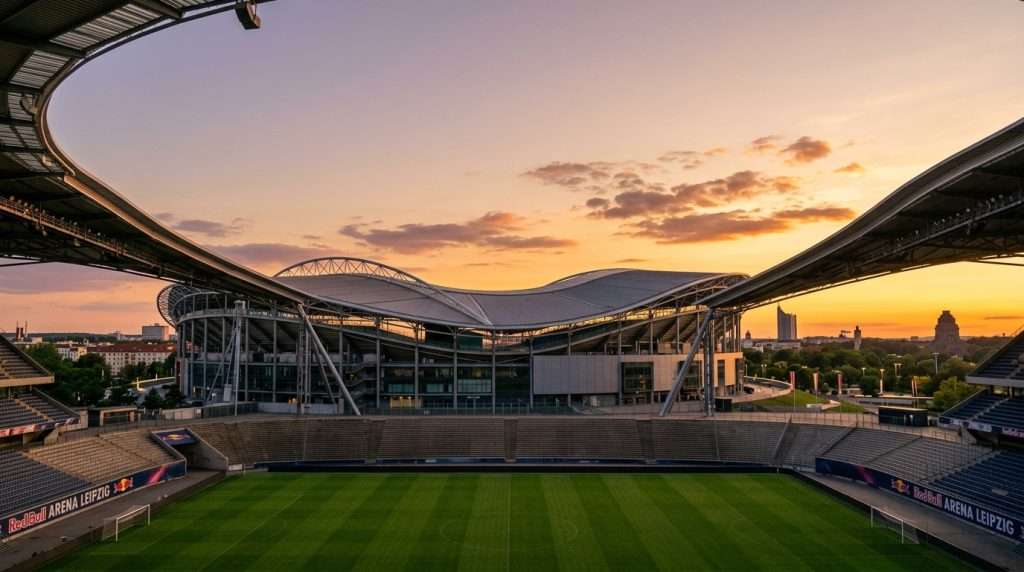
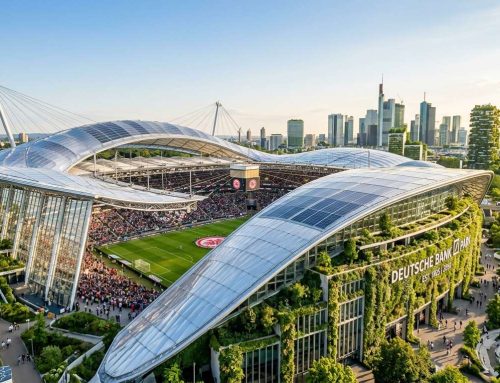
I looked up at the curved roof and tried to picture it glowing. In the vision, the curved-truss roof carries translucent membranes that make solar power. All three systems below are a 2050 vision, not features running today.
Together the system does these jobs:
- Makes solar power for the arena.
- Passes light to the turf.
- Reuses stormwater for cooling.
- Turns fan jumping into energy.
Bio-Photovoltaic Roof Membranes
The roof membrane is a bio-photovoltaic membrane. It makes solar power and passes photosynthetic wavelengths to the turf. That means the pitch gets the light that grass needs, even under a roof.
For Red Bull Arena Leipzig photos, I would shoot the roof lines and the green bowl at golden hour. Go for a few days if you can, since light changes fast.
Hydrologic Vaults Beneath the Pitch
The hydrologic vaults are underground water tanks. They would capture 100% of Elster river basin storm surges. Filtered water then flows into zero-emission closed-loop cooling for club facilities. Flood-prone Elster ground makes storing water below the pitch sensible.
Piezoelectric Plates in Sektor B
A piezoelectric plate is a floor panel that produces a small electric charge when people press on it. Under the floor of Sektor B, these plates would turn fan jumping into clean microgrid power. I like picturing a loud chorus lighting up the lamps. First, though, the stadium must face real risks.
Climate Risks This Stadium Must Plan For
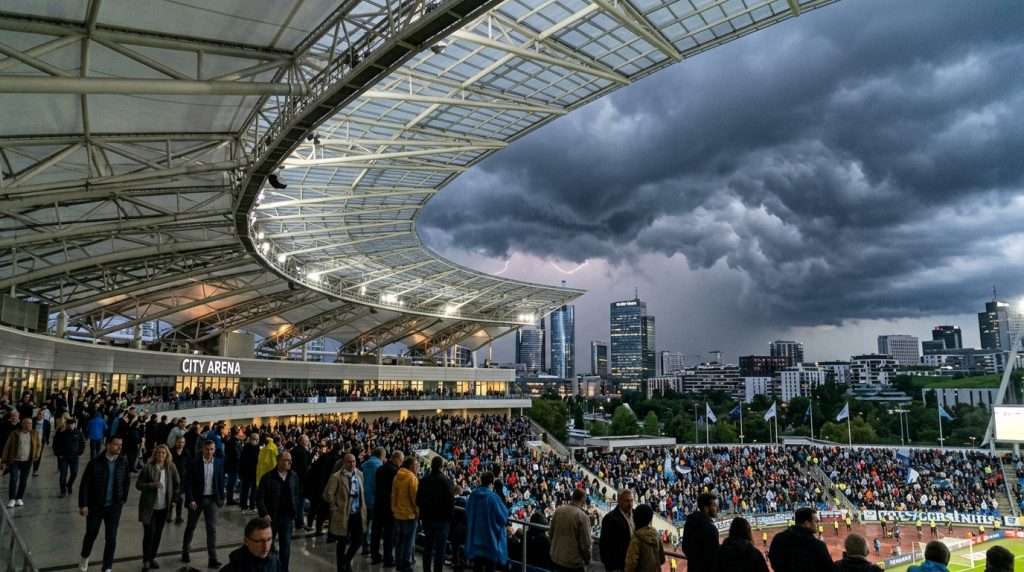
Water is the biggest threat to this sports venue. Under a high-emissions scenario, the arena faces a medium river-flood risk because of the Elster basin. These figures are projections, and they depend on emissions.
| Hazard | Projected level | Design answer |
|---|---|---|
| River flooding | Medium risk | Hydrologic vaults |
| Surface flooding | Projected | Green earth ring |
| Storm winds | Up to about 145 km/h | Curved-truss roof |
| Yearly losses | About 4.2 million euros by the 2050s | Smart controls |
The wind figure comes from strong North Atlantic storms. Today’s upgrades include connected LED floodlights and smart arena controls, which help a project like this watch its own infrastructure. Each hazard links to an answer in the vision. Vaults take on floods, and the green ring soaks up surface water.
Many events happen over a stadium’s life, and every one could meet bad weather on some days. Planning for it is cheaper than repairing it. Reading these numbers made me want to see the place for real.
Visiting Red Bull Arena Leipzig as an Overland Traveler
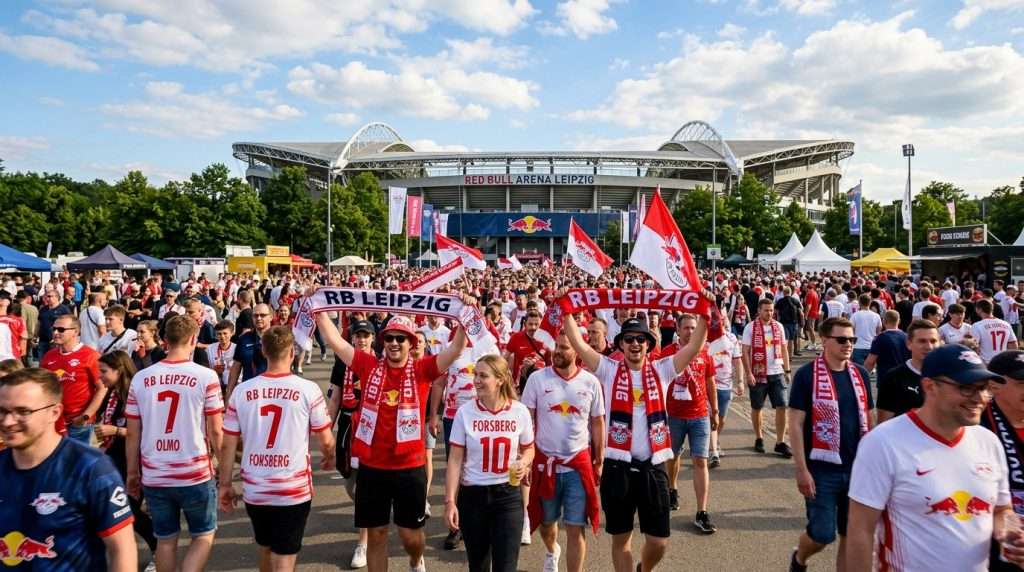
Start by walking the full embankment loop. The arena sits in central Leipzig beside the Festwiese, which the club owns. Walking the ring first shows you how the old and new fit together.
Here are four tips from my own visit:
- Walk the full embankment loop.
- Take a stadium tour.
- Catch a match.
- Visit outside event days for photos.
The club sells stadium tours and match tickets, so check its site for tour times. Match days mean crowds and fewer quiet photo chances. If you want parking, know that the Sportforum area around the stadium is planned to grow with offices and parking. Fans fill the paths, but the atmosphere is worth it. Those experiences bring me to my final thoughts.
Conclusion
What stuck with me was how calm the old earth ring felt, even with a modern stadium inside. Old foundations can drive new design, and Leipzig shows it better than any place I have walked. The 2050 ideas are only a vision, but they are one worth watching.
If you travel through Germany, plan a Leipzig stop and walk the green bowl yourself. Bring good shoes and a camera. Come see it.



Leave A Comment