
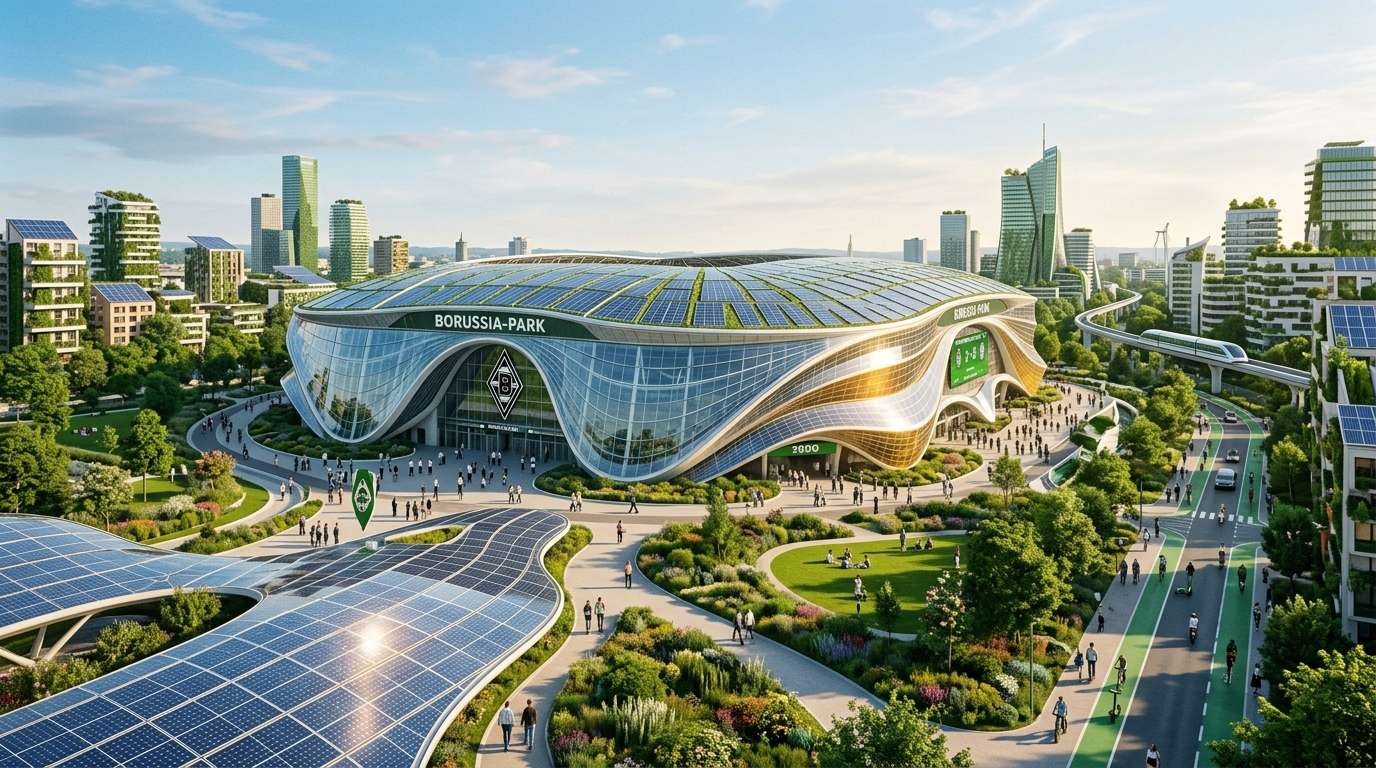
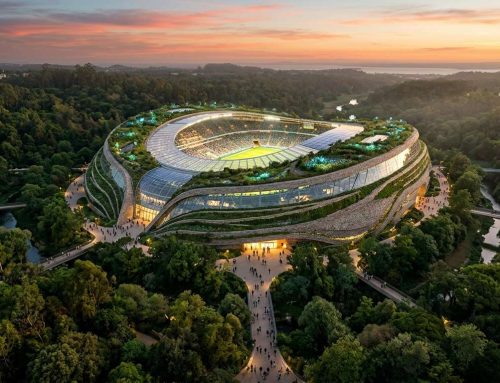
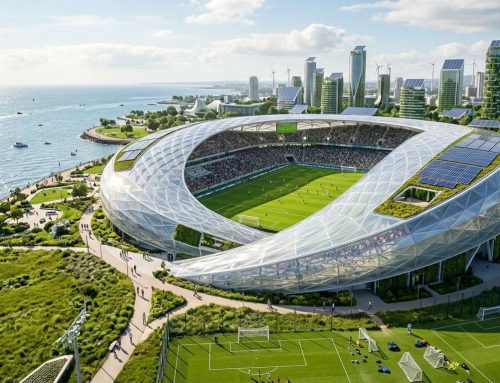
I walk up the gravel path toward the stadium, and something feels different. The building no longer sits apart from the landscape. It seems to breathe with its surroundings, like a living thing.
Thin solar panels ripple across the roofline, catching the day’s last light. The whole structure seems to glow from within, soft and steady. This is not the stadium I remember from grainy old match broadcasts.
By 2050, the 54,057-seat home of Borussia Mönchengladbach becomes a rare, carbon-negative sports colosseum. It grows from Rhineland football tradition and supports the Borussia-Park future 2050 vision. The project shows how aging stadiums can become living landmarks.
I am here to explore how this transformation happened. The roof uses bio-photovoltaic cells woven into its structure, rather than simple steel. Beneath the pitch, the ground quietly manages floodwater from the Niers basin.
Fans also play a role now. Every stomp from the terraces feeds energy into something larger than the game.
This blueprint is worth exploring piece by piece.
Key Takeaways
- Borussia-Park aims to become a carbon-negative stadium by 2050, setting a new global standard for sports venues.
- Bio-photovoltaic roof panels generate clean energy while covering the stadium’s steep two-tier stands.
- Underground retention vaults manage stormwater from the Niers basin, reducing flood risk around the grounds.
- Kinetic energy from roughly 16,000 fans in the Nordkurve helps power the stadium’s systems.
- The design blends Rhineland football tradition with advanced civil engineering and renewable technology.
- This transformation offers a practical blueprint for aging stadiums worldwide seeking sustainable upgrades.
1. Borussia-Park Future 2050: A Global Stadium Blueprint
I’ve toured many stadiums for photos and football, but Borussia-Park surprised me. At first, it seems like a beloved home ground, but a larger future appears on closer inspection.
The Borussia-Park future 2050 vision is not a distant fantasy hidden in a planning document. It already guides engineers, architects, and club leaders as they plan for aging stadiums. By 2050, Borussia-Park stands as a global masterclass in campus stadium resilience, scaling Borussia Mönchengladbach’s 54,057-seat home into a carbon-negative sports colosseum.
1.1 From Bundesliga Icon to Net-Zero Icon
Borussia-Park opened as a modern Bundesliga ground built for noise, color, and matchday energy. That identity remains, but everything beneath and around it has changed.
Rather than removing the foal-crest soul, engineers worked with the stadium’s bones. They added protection to concrete stands and turned roof structures into energy generators. The result feels like evolution, not demolition.
That is what I find most compelling. A stadium can remain familiar to fans while becoming technically unrecognizable to engineers. Borussia-Park proves both changes can happen together.
1.2 Why This Transformation Matters Beyond Germany
Here’s the bigger question I asked: why should anyone outside Mönchengladbach care about one club’s stadium plan?
The answer is scale. Thousands of aging stadiums worldwide face aging concrete, higher energy costs, and climate pressure. Few have a documented path forward.
This project joins a wider shift across German football, including the league-wide sustainability benchmarking tracked in Bundesliga’s sustainability rankings. Borussia-Park takes that momentum further, turning policy goals into physical infrastructure.
- Municipal arenas with tight budgets gain a tested retrofit model instead of starting from scratch.
- Larger colosseums get proof that heritage structures can hit net-zero targets without full rebuilds.
- Cities gain a case study linking stadium design to local water and energy systems.
That is why I return to this stadium when discussing the future of sports venues. It is not the biggest or flashiest project. The Borussia-Park future 2050 plan is simply one of the clearest blueprints built so far.
2. Guarding 54,057 Seats of Concrete Heritage
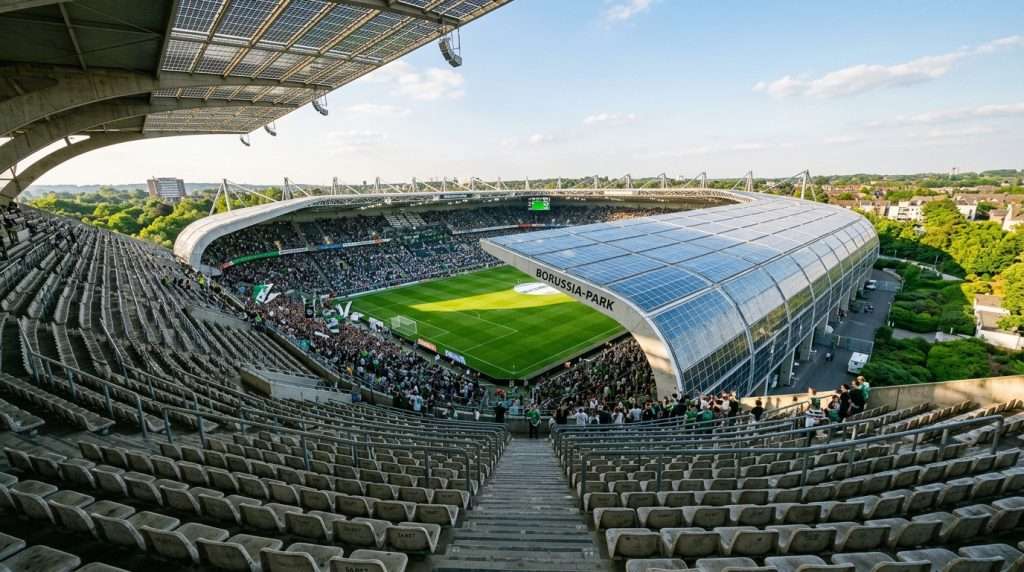
I have climbed many aging stadiums while traveling, always asking how to save their bones without losing their soul. Borussia-Park offers an unexpected answer: its original 54,057-seat concrete stands still hold crowds today. Nobody tore them down to build something shiny and forgettable.
Instead, the team behind the Borussia Monchengladbach net zero stadium project found a way to protect the concrete and honor its history. The goal was not to make the stadium look new, but to help it last another fifty years with its original character intact.
This balance between preservation and performance shapes every part of this build.
2.1 Nano-Mineral Glazes: Breathable Armor for Aging Stands
Old concrete has a problem. It absorbs water, freezes in winter, and slowly cracks from the inside out. Thick coatings can trap moisture and speed up the damage.
Borussia-Park chose a different solution with nano-mineral glazes. Think of them as breathable skin for concrete. The glaze lets trapped moisture escape as vapor, preventing water from pooling inside.
At the same time, it blocks rain, salt, and pollution from soaking in. It works like a good rain jacket: weather stays out while the structure can breathe.
The result is concrete that resists decay without heavy renovation. This careful engineering helps the Borussia Monchengladbach net zero stadium model stand apart from typical arena upgrades.
2.2 Low-Carbon Sealants Replacing Traditional Weatherproofing
Traditional stadium sealants use heavy petrochemical compounds. They work, but they create high carbon costs and may yellow or crack within a decade.
Engineers replaced them with low-carbon sealants made from bio-based resins and mineral fillers. These sealants handle decades of rain, frost, and German winter changes with a smaller environmental footprint.
The original finish still looks authentic. There is no plastic sheen or over-renovated appearance to strip away the building’s personality. It feels like a restoration worth admiring on a road trip through an old European town.
| Feature | Traditional Method | New Approach | Key Benefit |
|---|---|---|---|
| Surface Coating | Non-breathable acrylic paint | Nano-mineral glaze | Prevents moisture trapping and frost cracks |
| Weatherproofing | Petrochemical sealant | Low-carbon bio-based sealant | Lower embodied carbon footprint |
| Visual Finish | Glossy, synthetic look | Natural, matte concrete texture | Preserves original stadium character |
| Maintenance Cycle | Every 5-7 years | Every 15-20 years | Reduced long-term resource use |
3. PTFE Membrane Solar Roof Technology Over the Pitch
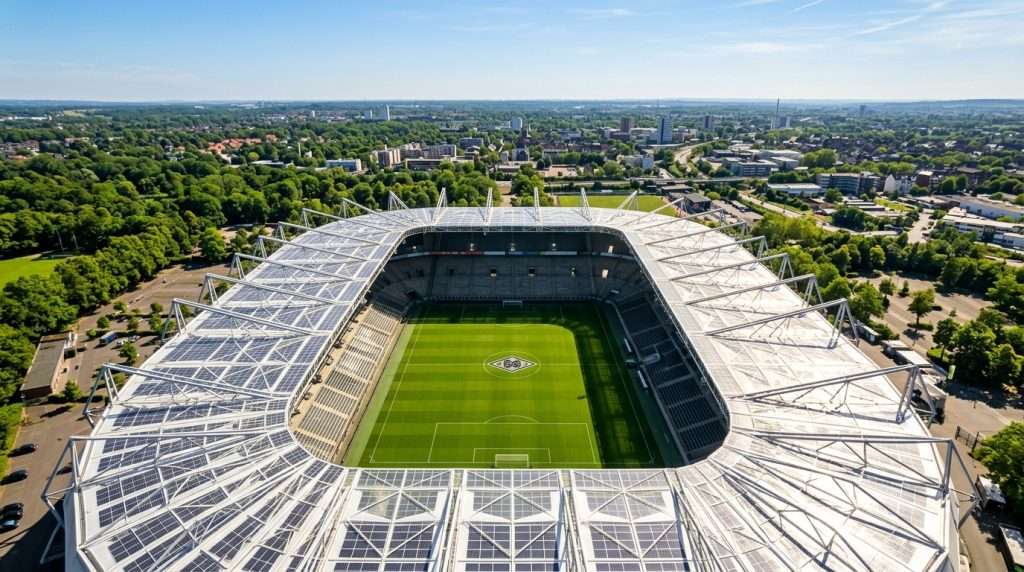
I nearly missed the cleverest part of this stadium story. It stretches quietly across the roof, thirty feet above the pitch.
Most visitors see Borussia-Park’s cantilevered steel roof as shelter from Rhineland rain. I saw something stranger: a working power station disguised as architecture. This is the quiet genius of PTFE membrane solar roof technology; learning how it worked held my attention.
3.1 Bio-Photovoltaic Membranes Explained
The simplest way to describe bio-photovoltaic membranes is as solar skins. They are thin, translucent sheets layered onto the existing roof structure.
Unlike bulky glass solar panels, these membranes do not block light completely. They generate clean electricity while letting daylight reach the seats and field below.
Engineers chose PTFE, a durable synthetic fabric already common in stadium roofs, because it handles extreme weather without cracking. Pairing it with photovoltaic cells turns passive shelter into active power generation. This quiet engineering win rarely gets a headline.
3.2 Feeding Sunlight to the Turf: Photosynthetic Wavelength Transmission
Here’s the detail that hooked me. A solar roof sounds great until you remember grass grows underneath and needs light.
The engineers solved this by filtering sunlight selectively. The material lets through specific photosynthetic wavelengths that turf needs for healthy growth while capturing other light bands for energy conversion.
In practice, the pitch stays green and dense season after season without supplemental grow lights or constant turf replacement. This small detail has a big payoff for groundskeepers.
3.3 The Cantilevered Steel Roof as an Energy Canvas
Nothing was torn down to make this work. The original cantilevered steel roof, a structural achievement from the stadium’s earlier build, became the upgrade’s canvas. It was reused instead of replaced.
Engineers layered the bio-photovoltaic membrane directly over the existing steel frame, treating decades-old architecture as infrastructure worth reusing rather than demolishing. This approach shows how stadium renovation is evolving.
This PTFE membrane solar roof technology does three jobs. It shelters fans, feeds the turf, and quietly generates power across the entire roof surface.
| Roof Type | Light Transmission | Energy Generation | Structural Load Added |
|---|---|---|---|
| Traditional PVC Membrane | Low, mostly opaque | None | Minimal |
| Glass Skylight Panels | High, full daylight | None without added panels | Heavy |
| PTFE Bio-Photovoltaic Membrane | Selective, tuned for turf growth | Continuous solar power output | Lightweight, roof-compatible |
4. Niers Hydrologic Cooling and Subsurface Heritage Engineering
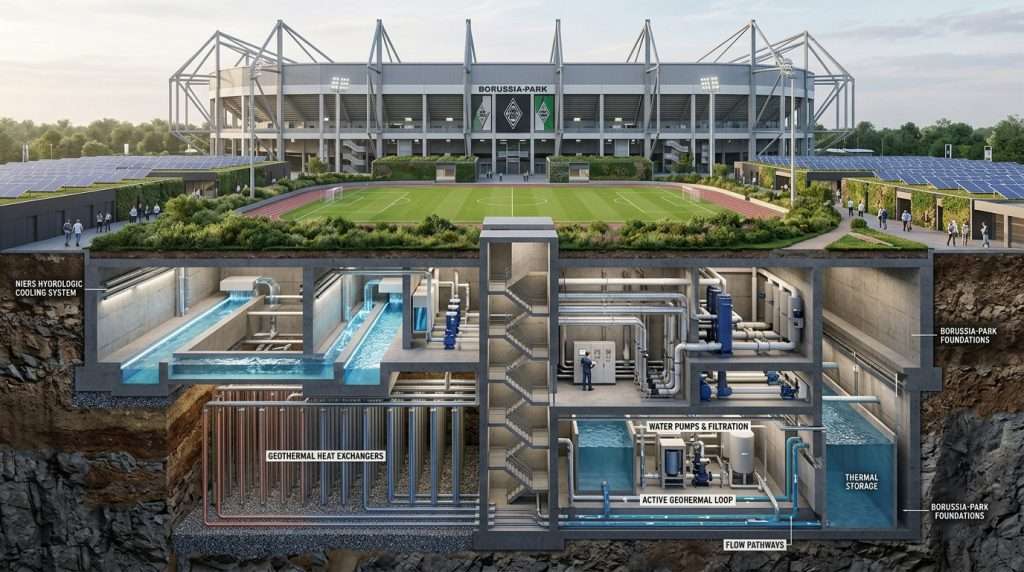
Most fans will never see the hidden system beneath Borussia-Park, though it handles major work in this transformation. I love uncovering stories like this, buried beneath a stadium instead of flashing across its roof. Here, the engineering marvel sits several feet below the pitch and connects directly to the nearby Niers River.
Think of it as the stadium’s quiet circulatory system. Rain falls, gets captured and reused, so nothing goes to waste. It is not glamorous, but it is genuinely brilliant.
4.1 Capturing 100% of Storm Runoff from the Niers River Basin
Borussia-Park now uses subsurface hydrologic heritage engineering to catch every drop of storm runoff from the surrounding Niers River basin. Rather than letting rainwater rush into drains and vanish, engineers built underground vaults to intercept it at the source.
This system captures 100% of the basin’s storm runoff, turning wasted rainfall into a dependable resource. At first, I find that number hard to believe. It shows the stadium treats water as essential infrastructure, not an afterthought.
The vaults sit beneath historic foundations, blending old concrete bones with new hydrologic technology. This is heritage engineering in the truest sense: it protects the past while solving a thoroughly modern problem.
4.2 Closed-Loop Reservoir Stormwater Harvesting in Practice
Once captured, the water does not simply sit there. Closed loop reservoir stormwater harvesting keeps it moving, filtering, and cycling through the stadium’s systems year-round.
- Runoff flows into underground collection vaults
- Filtration removes sediment and debris before storage
- Clean water settles into reservoir tanks beneath the stands
- Pumps redirect water into cooling and irrigation loops
- Any surplus recharges naturally instead of draining away
Nothing gets discharged, which reduces pressure on the regional water system. This detail is easy to miss on game day, but it is worth celebrating.
4.3 Zero-Emission Capillary Cooling for Hotel and Museum
Here is where Niers hydrologic cooling brings everyday comfort. Filtered water travels through capillary tubing woven into the walls and floors of the club hotel and museum.
These capillary loops transfer heat without burning any fossil fuel. Guests and visitors stay comfortable through a quiet exchange of water temperature, not noisy mechanical refrigeration.
There is something satisfying about staying cool inside a building powered by rainwater instead of an air conditioner. It feels effortless, almost as if the building breathes on its own.
Together, these systems show how subsurface hydrologic heritage engineering can quietly reshape a stadium’s relationship with water. The work is unglamorous, but it might be one of the smartest investments Borussia-Park has ever made.
5. Nordkurve Kinetic Microgrid: Turning Fan Passion into Power
Of all the smart engineering at Borussia-Park, the crowd’s role impressed me most. The Nordkurve is the stadium’s loudest corner, where fans sing for ninety minutes and jump until the stand shakes.
I did not expect that movement to feed directly into the Nordkurve kinetic microgrid. Each stomp, bounce, and wild celebration quietly becomes usable electricity. This detail changes how you see a football crowd.
Piezoelectric Plates Beneath the Terraces
Beneath the terrace floor, engineers installed piezoelectric plates. These special materials create a small electrical charge whenever pressure reaches them.
Think of it this way: every single footfall becomes a tiny spark of power. One jump cannot light a stadium, but thousands of jumps during a match add up quickly.
The plates remain hidden beneath the surface, so fans never notice them. You stomp, cheer, and celebrate as usual while the floor works quietly below.
Stadium Kinetic Energy Crowd Harvesting at Scale
Borussia-Park holds more than 54,000 fans on matchday. Multiply a small charge from each footstep by tens of thousands of supporters, and the result becomes meaningful energy.
This is stadium kinetic energy crowd harvesting at a scale that most venues have not attempted. The Nordkurve becomes a concentrated source of clean, renewable power during every single home game.
“We wanted the stadium to feel like it breathes with the fans, not just around them.”
That idea stayed with me long after I left. The crowd is no longer just decoration or atmosphere; it actively supports the building’s energy system.
| Energy Zone | Fan Activity Type | Role in Microgrid |
|---|---|---|
| Nordkurve Standing Terrace | Jumping, chanting, celebrating | Primary kinetic energy source |
| Concourse Walkways | Foot traffic before and after matches | Secondary, lower-intensity contribution |
| Entry Gates and Turnstiles | Repeated pressure from entering fans | Supplemental charging points |
| Seating Sections | Standing ovations, goal celebrations | Periodic high-output bursts |
Surrounded by noise and motion, I kept thinking about how rare this design is. Most stadiums ask fans only to watch and cheer. Borussia-Park asks them to power the place they love, changing how I will experience every future match.
6. Borussia Mönchengladbach’s Net-Zero Stadium Model Redefines Arena Longevity
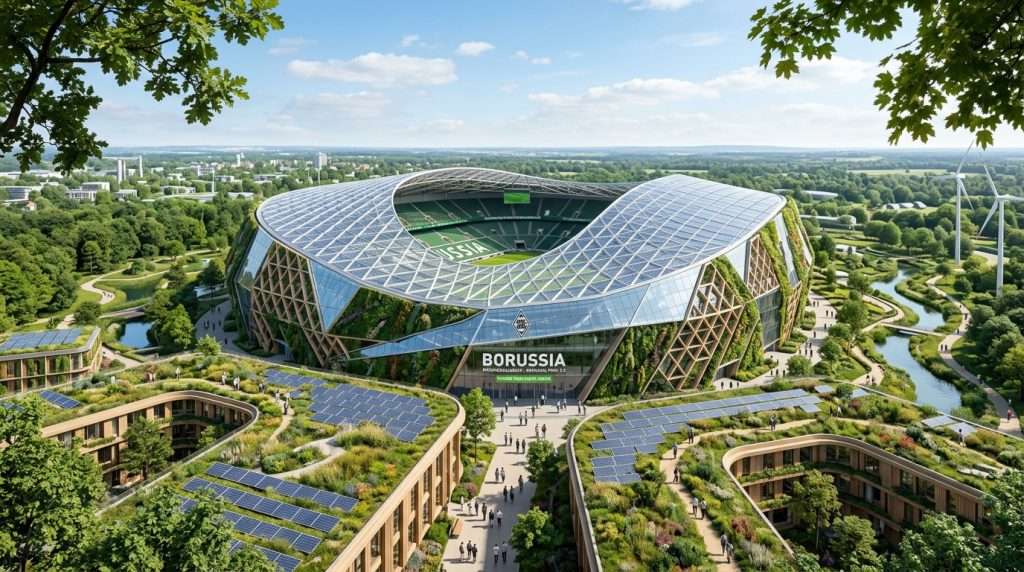
Walking through Borussia-Park, I finally saw the bigger picture. This is not a one-time renovation; it shows how old stadiums can meet climate goals without demolition.
I saw the borussia monchengladbach net zero stadium project as proof of concept. Each layer works with the others instead of standing alone. Old concrete becomes new infrastructure instead of landfill waste.
6.1 Carbon-Negative Status: The Numbers Behind the Claim
Carbon-negative sounds like marketing until you examine the numbers. For a venue holding 54,057 fans, daily operations remove more carbon than the stadium produces each season. That is a real engineering challenge, not a slogan.
The math works because three systems support one another: the solar roof generates power from sunlight overhead. The hydrologic cooling system lowers climate-control demand across the hotel and museum. The kinetic microgrid adds power on matchdays, when thousands of fans already create movement.
| System | Primary Function | Role in Net-Zero Balance |
|---|---|---|
| PTFE Solar Roof | Captures sunlight while feeding light to the pitch below | Main energy generation source |
| Niers Hydrologic Cooling | Captures stormwater, cools hotel and museum spaces | Reduces grid-powered HVAC demand |
| Nordkurve Kinetic Microgrid | Converts fan movement into usable electricity | Supplemental power during matchdays |
None of these systems alone would make the stadium carbon-negative. Together, they create a loop that produces and saves more energy than a typical day requires. That quiet logic supports the claim.
6.2 Lessons for Aging Stadiums Worldwide
I think about older stadiums I have visited over the years. Some are crumbling municipal grounds. Others are historic venues older than many people in their seats.
Many owners assume sustainability requires demolition. Borussia-Park suggests otherwise, and that difference matters.
Smaller venues can borrow parts of this approach without copying the entire system. A few realistic starting points:
- Nano-mineral glazes to protect aging concrete instead of full facade replacement
- Rainwater capture systems retrofitted into existing drainage networks
- Partial solar coverage on sections of roof rather than a full rebuild
None of these options require tearing down a stadium’s history. That may be the most useful lesson here. Longevity doesn’t demand starting over. It means layering new technology onto the existing structure, respecting its design and extending its life for decades.
7. Conclusion
I keep returning to my first image: standing outside the gates and picturing 2050 here. After seeing breathable concrete, a solar-woven roof, a hidden river loop, and fan-powered terraces, that future feels planned.
The Borussia-Park future 2050 is not a distant dream reserved for concept renderings. It is a working idea, built from existing materials and systems, with patience and fresh thinking about an old stadium.
Mönchengladbach quietly shows how an arena can last. There is no loud marketing push or flashy slogan. Instead, a steady commitment keeps a beloved ground alive without draining the planet to do so.
If you came for football history, engineering details, or old places finding new purpose, I hope you found something meaningful. The Borussia-Park future 2050 may change how we see stadiums everywhere. Sometimes, the boldest future begins by protecting what already stands.


Leave A Comment