
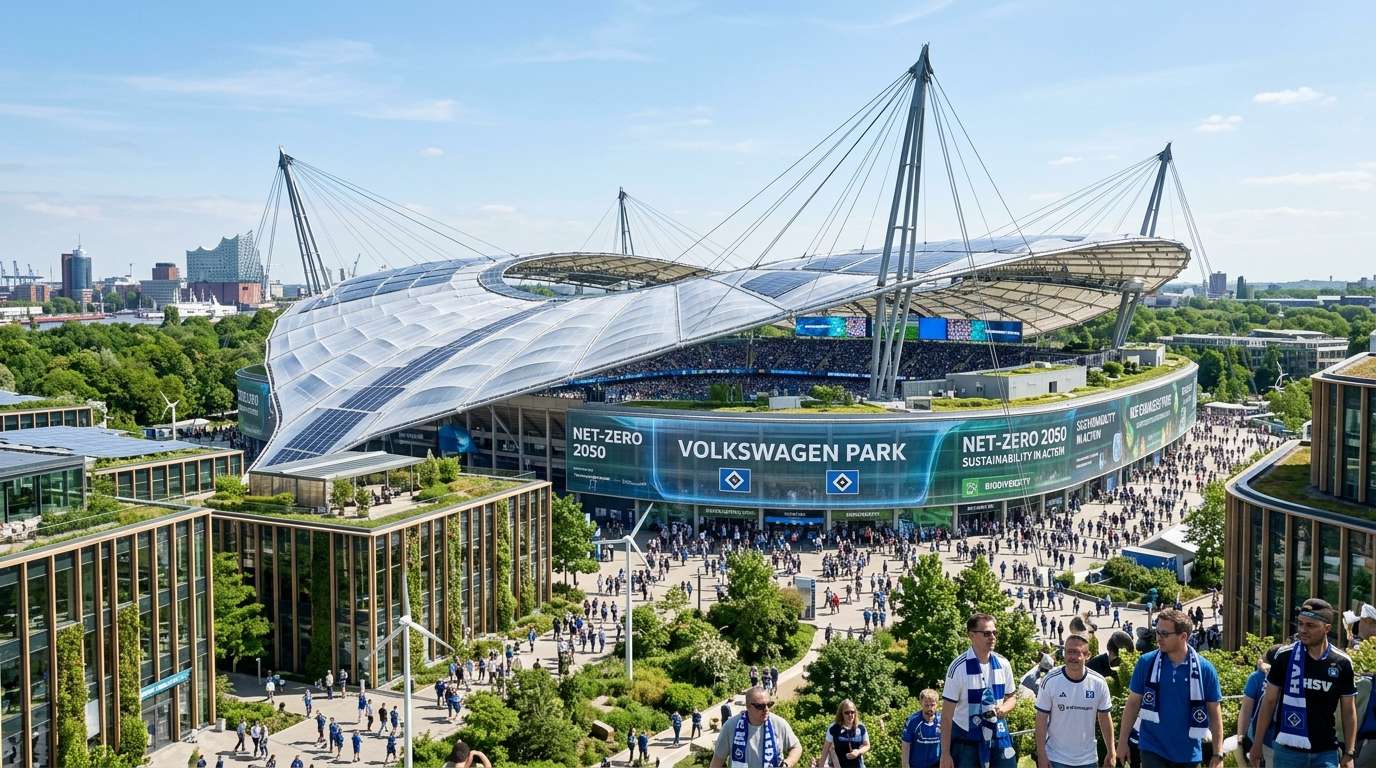
Last fall, I stood outside the stadium gates and studied its cable trusses. I wondered how this place might look in twenty years.
That question concerns city officials, too. Real Olympic bid discussions for 2036 and 2040 included a feasibility study for a new multifunctional arena near the current grounds. Mayor Peter Tschentscher and Senator Andy Grote pushed those plans forward.
Even HSV’s own CFO, Eric Huwer, publicly asked whether this ground could stay competitive decades from now.
That question stuck with me. I’m no engineer. I’m a traveler who loves asking how buildings work and why they last.
So here’s my grounded, speculative look at what a hamburger sv net zero stadium could become by mid-century. It would be a cable-tensile Hanseatic engine built to outlast every storm the North Sea throws at it.
Key Takeaways
- Hamburg’s Olympic bid talks sparked real feasibility studies for a new arena near the current stadium grounds.
- HSV’s CFO publicly questioned whether the existing venue can stay competitive decades into the future.
- Proposed new arena concepts include capacity near 70,000 and multi-use functions beyond football.
- Financing ideas mix city funding with private Hanseatic investment partnerships.
- Temporary athletics infrastructure could convert the stadium for Olympic or Paralympic events, then be removed.
- Tensile roof design and kinetic energy harvesting form the backbone of a possible net-zero transformation.
1. Volksparkstadion Hamburg Future 2050: Why This Arena Redefines the Global Playbook
Most cities tear down aging stadiums and build new ones. Hamburg did not.
Hamburger SV commissioned a feasibility study for a bold, brand-new ~70,000-seat arena. I expected bulldozers, ribbon cuttings, and a shiny replacement for its history.
HSV’s leaders opposed that plan. Eric Huwer said moving would make sense only under strict conditions.
“If capacity, intensity of the stadium experience, and proximity to the pitch all improve” — only then would relocation matter. A running track, often floated as an Olympic-legacy add-on, was ruled out entirely.
Then I found a detail that changed my view. NOlympia Hamburg noted that Volksparkstadion’s planned usage life already extended to 2051. Why build new when the current structure has three decades of legal life left?
That question explains Hamburg’s global importance. Instead of demolishing HSV’s emotional epicenter, the 2050 vision expands the existing 57,000-seat bowl.
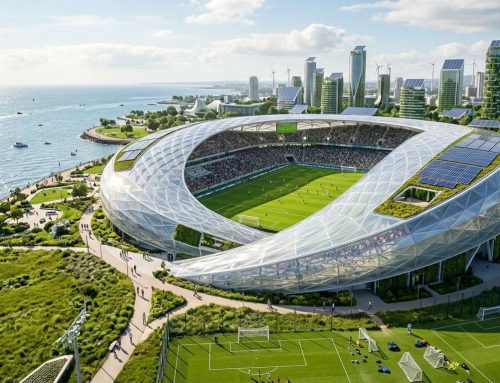
It aims to create a carbon-negative sports colosseum. The plan keeps the stadium’s soul while rebuilding its bones for net-zero performance.
| Factor | New 70,000-Seat Arena | Volksparkstadion 2050 Retrofit |
|---|---|---|
| Projected Lifespan | New build, unproven long-term legacy | Usage already extended to 2051 |
| Fan Proximity to Pitch | Compromised by track-style clearances | Running track ruled out, intimacy preserved |
| Carbon Footprint | Heavy embodied carbon from new construction | Reuses existing frame, targets carbon-negative status |
| Community Identity | Breaks continuity with HSV history | Preserves the club’s emotional epicenter |
2. Engineering the Skeleton: 58-Meter Masts, Cable Girders, and Nano-Mineral Armor
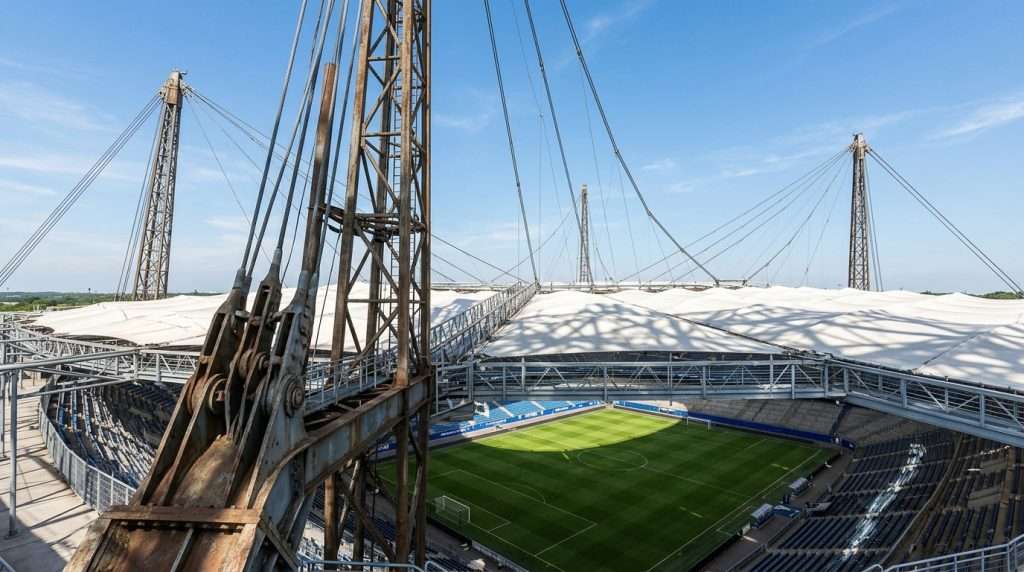
Every great stadium hides an engineering secret, and this arena has one of the wildest skeletons I’ve documented. Outside, you see a sleek bowl rising against Hamburg’s gray sky. Closer inspection reveals 58-meter steel masts standing like sentinels around the perimeter, quietly carrying the heavy load.
I look up first when I enter a new stadium because it’s a photographer’s habit. Here, that glance reveals what most fans miss: a roof held by tension, not brute weight.
2.1 The Physics of Tensile Support Across 57,000 Seats
Traditional stadium roofs push down hard on their supports. This one pulls instead. A cable-girder network stretches between the masts, spreading weight evenly across all 57,000 seats.
The result is simple but brilliant: zero obstructed sightlines. No bulky columns block your view of the pitch, wherever you sit. I have photographed upper decks where thick beams ruined half my frame. Not here.
The tensile system flexes slightly under wind load instead of resisting it rigidly. That flexibility matters more than many realize in a city known for coastal gusts.
2.2 Nano-Mineral Anti-Corrosion Glazes vs. Maritime Wind-Shear Fatigue
Hamburg lies close enough to the North Sea for salt air to threaten exposed steel daily. Most stadiums near coastlines show rust within a decade. This stadium avoids that problem with a nano-mineral glaze coating every mast and girder.
The glaze acts like microscopic armor, sealing steel pores against moisture and salt infiltration. It also resists wind-shear fatigue, slow damage from gusts bending metal back and forth for years.
- Blocks salt penetration into steel surfaces
- Reduces micro-cracking from repeated wind stress
- Extends structural lifespan without heavy maintenance cycles
This thin layer does a massive job, protecting one of the most ambitious tensile systems I’ve seen in a stadium.
2.3 Preserving the Signature Hanseatic Silhouette
None of this changes the stadium’s exterior appearance. That matters in Hamburg, a city proud of its Hanseatic architectural identity.
Locals recognize this silhouette instantly, so engineers kept the upgrade invisible to the naked eye. The masts and cables fit within the existing profile, preserving civic pride while quietly powering a 2050-ready arena underneath.
3. Powering the Pitch: PTFE Bio-Photovoltaic Roof Membrane Technology
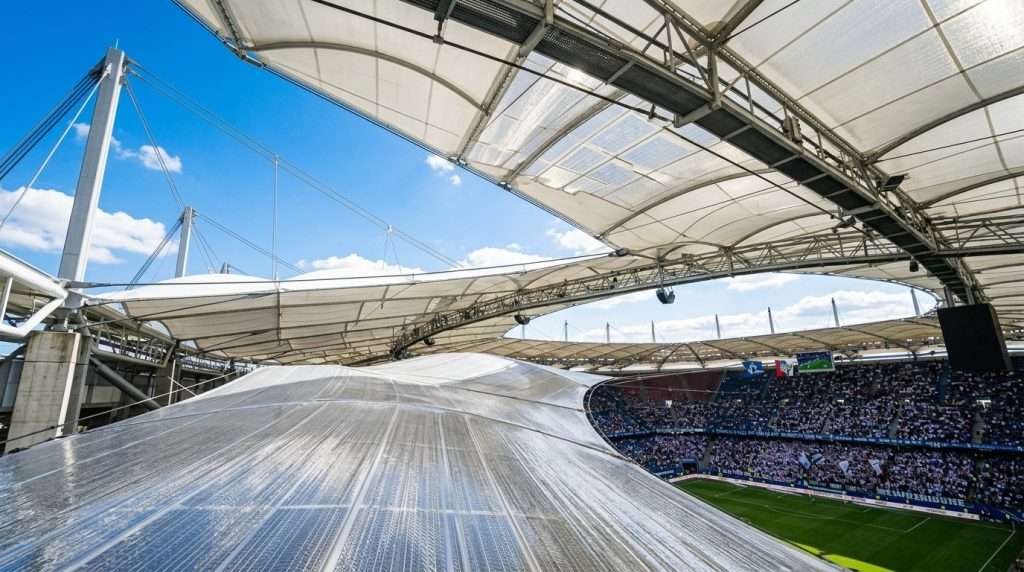
When you enter the bowl, the roof seems less like a roof and more like living skin. It glows while shading the seats. Above the pitch, it harvests sunlight and sends some of that light down to the grass. I call it the stadium’s quiet engine because it works without demanding attention.
3.1 Inside the 35,000 m² Translucent Solar Canopy
Imagine a roof covering six football fields, stretched tightly across towering cable girders. That is the scale of the canopy over the stadium bowl. At 35,000 square meters, it forms one continuous PTFE membrane skin, pulled tight like a drumhead.
From a distance, the material looks thin, almost like stretched parchment. Up close, it is tougher than steel cable per unit of weight, yet it bends and scatters light. Engineers chose this balance on purpose: strength without shadow.
3.2 How PTFE Membrane Solar Roof Technology Captures Sunlight
PTFE membrane solar roof technology works by placing thin-film photovoltaic cells between fluoropolymer fabric layers. Sunlight hits the outer layer, and the embedded cells turn some energy into electricity. The remaining light travels downward, filtered but not blocked.
This dual-layer design solves a problem that has challenged stadium builders for years: covering 57,000 fans without starving the grass. Several features make this membrane different from standard solar panels:
- Lightweight enough to span wide distances without heavy steel framing
- Resistant to UV damage and the coastal wind-shear common along the North Sea
- Translucent enough to transmit usable daylight instead of full shade
- Lower maintenance needs compared with rigid glass-paneled solar roofs
Across a season, the roof earns its keep twice: it powers the stadium and acts as greenhouse ceiling for turf.
3.3 Feeding Photosynthetic Wavelengths to the Hybrid Pitch
Grass does not need every visible wavelength to grow. It mainly needs the red and blue bands that drive photosynthesis, and this membrane passes those wavelengths through. Plants use green and yellow light less efficiently, so the roof redirects it toward solar cells.
That is the clever part. The roof does not compete with the hybrid pitch; it divides sunlight so each system gets what it needs. I have walked across many covered pitches, but none felt as alive beneath a full roof.
“A roof shouldn’t have to choose between generating power and sustaining plant life. This one does both from the same square meter of material.”
Standing pitchside, you would never guess the grass and the electricity powering stadium lights share one overhead sheet.
4. Water as Infrastructure: Subsurface Hydrologic Heritage Engineering
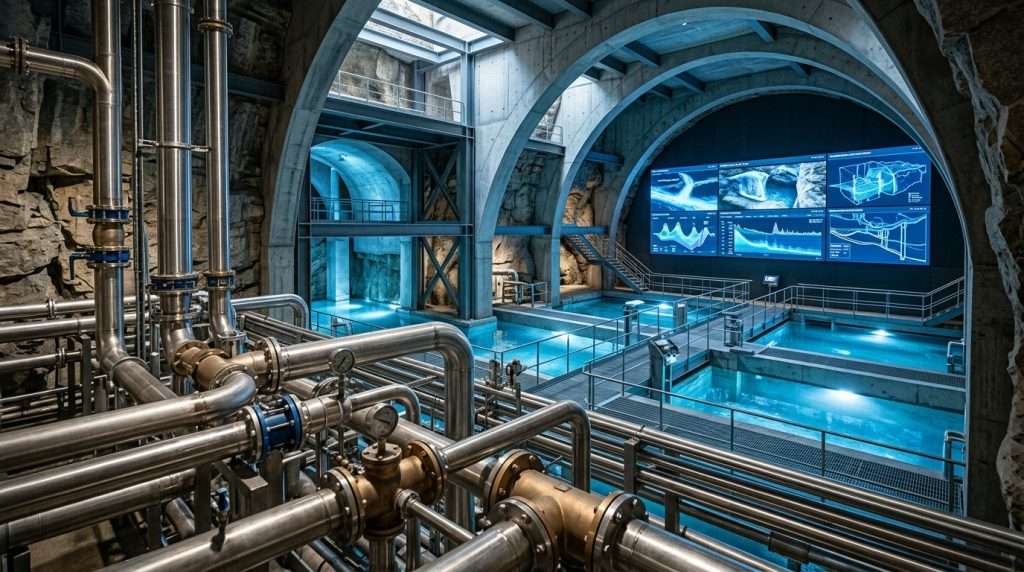
I never expected a stadium drainage system to become my favorite part of this story.
But here it is: subsurface hydrologic heritage engineering runs beneath Volksparkstadion like a hidden second heartbeat. This network of vaults carries water away, protects history, and cools rooms. It works without drawing power from the grid.
4.1 The Altonaer Volkspark Hydrologic Shield Explained
Altonaer Volkspark is real. It is the historic public park around the stadium, with mature trees and old paths. Locals have walked these paths for generations.
Heavy storms once threatened this heritage landscape. Now, the Altonaer Volkspark hydrologic shield protects it through buried vaults built into the stadium foundation.
These vaults catch stormwater before it erodes old soil or floods walking paths. The park stays intact, and the water becomes useful.
4.2 Closed-Loop Reservoir Stormwater Harvesting in Action
Here is the part that impressed me most. The system captures 100% of stormwater runoff from the surrounding park grounds.
Nothing enters city drains. Instead, closed loop reservoir stormwater harvesting filters every drop and returns it to circulation across the stadium complex.
| System Stage | Function | Water Source | Environmental Benefit |
|---|---|---|---|
| Capture Vaults | Collect runoff from park grounds | Rainfall and surface drainage | Prevents erosion and flooding |
| Filtration Reservoir | Removes sediment and debris | Stored vault water | Produces reusable clean water |
| Capillary Loop | Circulates water for cooling | Filtered reservoir supply | Zero added electricity use |
4.3 Zero-Emission Capillary Cooling for Hospitality Suites
That same filtered water does not just sit in storage. It travels through thin capillary tubing behind the hospitality suite walls.
As fans sip coffee before kickoff, the water quietly draws heat from the room. There are no compressors and no extra power draw.
Most guests will never notice this small detail. Still, it shows the invisible engineering I love discovering on these projects.
5. The Crowd as Powerplant: Nordtribüne Kinetic Microgrid
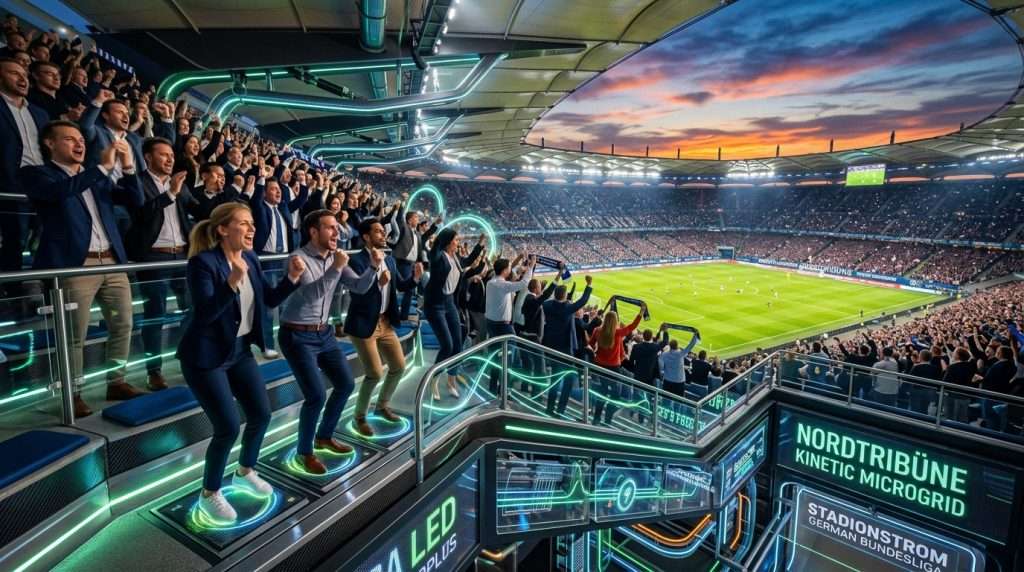
The Nordtribüne feels more human than any solar panel or cooling pipe. It may be my favorite part of the entire design.
Anyone who has stood on that terrace knows it does more than watch the match. It sings, jumps, and stomps for ninety straight minutes. HSV calls the Volksparkstadion its “emotional epicenter,” and the 2050 design captures that energy instead of losing it.
Piezoelectric Plates Beneath the Terraces
Underneath the terrace flooring sits a grid of piezoelectric plates. Every jump, stomp, and celebratory leap presses these plates and creates a small electrical charge.
One footstep creates little power, but thousands of fans jumping together can quickly add up. The plates are tough enough to handle years of pounding without cracking or losing efficiency.
Stadium Kinetic Energy Crowd Harvesting at Scale
Here, stadium kinetic energy crowd harvesting becomes genuinely exciting. It is not a neat trick; the system is engineered to feed usable power into stadium systems.
The Nordtribüne kinetic microgrid helps run smaller matchday loads, including concourse lighting and digital signage. It also powers parts of the sound system, but it cannot power the floodlights alone and offsets real consumption. Every jump becomes a tiny contribution to the grid.
Fan Culture as a Renewable Resource
The most beautiful part of this system is simple: louder, livelier crowds make the building generate more power.
“The Volksparkstadion is more than a venue. It’s the emotional epicenter of HSV.”
That quote gains new meaning when you realize fans create more than atmosphere; they literally create electricity. For HSV’s passionate supporters, this loop means energy in, energy out, powered by people who love the game.
6. Conclusion
I did not expect a stadium to change how I viewed travel in Hamburg. Volksparkstadion did exactly that. Beneath its tensile masts, I wondered why cities demolish old places when new ones seem easier.
Hamburg chose another path. Cable girders, a solar membrane roof, quiet water systems, and crowd noise now become usable power. These features do not erase what this stadium has always been; they give its old bones a reason to remain.
HSV has talked openly about staying competitive in 2040, 2050, and beyond. Walking through renovated concourses, I believe it needs no glass-and-steel replacement built from scratch down the road. It needs this arena, reimagined piece by piece without losing its emotional core.
This discovery stays with me long after leaving. It is something familiar, rebuilt with imagination instead of demolished for convenience. If more stadiums followed Hamburg’s lead, cities might choose reengineering over rebuilding.


Leave A Comment