

Denver International Airport stands as one of America’s most intriguing aviation facilities. The airport serves nearly 82 million passengers in 2024, yet conspiracy theories about it continue to grow. Since its opening in 1995, this massive facility spans 33,531 acres, making it the Western Hemisphere’s largest airport. The project faced substantial delays and exceeded its budget by almost $2 billion.
The airport’s unique features fuel endless speculation. People talk about secret underground tunnels that supposedly connect to NORAD. A massive blue horse statue with glowing red eyes watches over travelers. The airport’s mysterious murals and distinctive architecture have sparked public interest for decades. A dedication marker mentions the “New World Airport Commission” – an organization that doesn’t exist. The artwork throughout the facility seems to hint at apocalyptic themes, according to some interpretations. These Denver airport myths have become so popular that the administration now uses them in their marketing strategy. Staff members occasionally wear lizard masks to play along with stories about “lizard people” living in the tunnels beneath the airport.
The Airport That Sparked Suspicion

Denver International Airport’s troubled birth laid the groundwork for skepticism long before rumors of hidden bunkers and secret societies emerged. The facility opened in February 1995, running 16 months behind schedule and bleeding money—creating perfect conditions for Denver airport conspiracy theories to flourish.
Construction Delays and Budget Overruns
Problems with the airport’s construction surfaced almost immediately. This ambitious project turned into a case study of project mismanagement. The final cost reached over $2 billion, this is a big deal as it means that the original budgets were far exceeded. The pattern of financial bleeding continues with newer projects, especially the Great Hall renovation.
The Great Hall Project shows how the airport doesn’t deal very well with construction management. The project started as a $1.8 billion long-term concession, with Denver paying just $770 million, but it fell apart dramatically. Denver fired the original contractor, Great Hall Partners, in 2019 after endless disputes over rising costs and delays.
The fallout was expensive. The airport paid a massive $184 million to end the partnership. The completion date moved to 2028—seven years later than the original plan. So, the Great Hall renovations will cost $2.35 billion, triple the original budget.
A 2023 audit exposed concerning practices behind these overruns. The report highlighted “DIA’s lax approach to construction oversight” that put the airport “at risk of overspending, a lack of transparency and unfair contracting”. Airport executives reportedly told managers “to limit documentation related to the project because of the number of open records requests the airport received from the public”.
The Failed Baggage System and Early Chaos
The infamous automated baggage system raised more suspicions than budget issues—it became known as “the baggage system from hell”.
This advanced system promised to move luggage throughout the massive facility with minimal human input. The reality proved disastrous. The system “launched, chewed up and spit out bags” regularly during a media demonstration.
The baggage system’s dramatic failure delayed the airport’s opening by 16 months, costing $1 million daily in 1994. The system’s construction alone cost $186 million, with repairs and modifications adding tens of millions more over the years.
The system’s basic flaws persisted after the airport opened:
- Bags got stuck or ended up at wrong destinations
- Automated carts tipped over and dropped their cargo instead of working together
- The “lizard tongue” belt loader failed to work with airplane doors
Denver’s busiest carrier, United Airlines, tried using a simplified version for outbound flights while handling incoming bags manually. This compromise still faced frequent breakdowns despite years of tweaks. The airline ended up abandoning the system in 2005 and switched to traditional manual baggage handling. This saved $1 million monthly in maintenance and reduced errors.
The early problems turned Denver into “a national punchline” that made it onto David Letterman’s “Top Ten” list. One local resident recalled the city’s constant “fingers crossed” attitude during the airport’s first year.
More things to do in Denver.
The Rise of the Denver Airport Conspiracy Theories

Conspiracy theories about Denver International Airport existed before its first flight took off. These theories emerged during the early internet era rather than beginning with social media. A combination of unusual artwork, construction problems and media coverage fueled their growth.
How the Internet Amplified the Myths
The airport’s conspiracy theories started in 1996 when Alex Christopher, a grandmother from Alabama, claimed she explored DIA’s underground tunnels. She shared her findings about alleged New World Order connections on a California radio show (KSCO AM 1080). This broadcast became the starting point for what grew into a complex web of airport myths.
The discussions stayed relatively contained until 2006. That year, sculptor Luis Jiménez died tragically when a piece of his “Blue Mustang” statue fell on him and severed an artery. This accident gave new momentum to existing theories and cast a dark shadow over the controversial artwork.
Conspiracy content expanded across blogs, forums, news sites and broadcast media between 2007 and 2013. The theories gained significant attention in August 2007 when George Noory spent four hours discussing Denver airport secrets on his nationally syndicated radio program “Coast to Coast”. Several dedicated websites emerged to document conspiracy-related content. The site diaconspiracyfiles.com served as the main hub from 2009 to 2013.
The Role of Early Media Coverage
Mainstream media attention changed everything for these theories. Jesse Ventura’s TV show “Conspiracy Theory” featured the airport in 2012, which helped spread the claims beyond niche internet communities. The New York Times published a story in 2009 about the “Blue Mustang” statue and underground facility rumors.
The History Channel’s “America Unearthed” devoted ten minutes to exploring supposed connections between the airport and the New World Order in December 2013. This broadcast triggered widespread coverage from major outlets like ABC News and Complex.
DIA tracked 750 worldwide media mentions about its conspiracy theories in 2019 alone. The airport’s publicity team calculated that conspiracy-related coverage reached nearly 6 million people and generated about $1.50 million in free publicity.
The First Viral Conspiracy Claims
Early online discussions about Denver Airport focused on several key oddities:
- The dedication plaque’s Masonic symbols and references to the “New World Airport Commission”
- Leo Tanguma’s murals showing apocalyptic imagery and children
- The underground baggage system and its alleged secret tunnels
- The runway layout supposedly resembling a swastika
These theories exploded in popularity in 2016 after a viral BuzzFeed video inspired many content creators to make their own conspiracy-focused content. Local news stations started creating segments about the theories for social media.
The airport’s strategic shift toward embracing these theories stands out as remarkable. DIA leadership recognized their marketing potential after years of denying the claims. Former spokesman Heath Montgomery explained in 2016: “We decided a few years ago that rather than fight all of this and try and convince everybody there’s nothing really going on, let’s have some fun with it”.
The 2019 “talking gargoyle” promotion marked this new approach. This animatronic sculpture greeted visitors with playful references to conspiracy claims. The installation generated 720 news stories that reached 67.3 million people, with publicity valued at $1.90 million.
Take a road trip from Denver to Yellowstone.
Art, Architecture and the Fuel for Myths
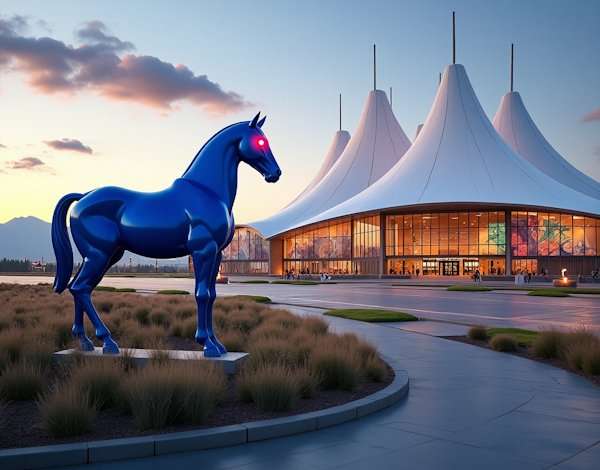
The artistic elements at Denver International Airport serve as the main source that fuels the Denver airport conspiracy theories that engage public imagination. The unique collection of thought-provoking artwork has created the perfect backdrop that leads to extraordinary interpretations.
The Murals and Their Misunderstood Messages
Leo Tanguma’s controversial murals have become the centerpiece of Denver airport conspiracy murals lore. His two-part work “Children of the World Dream of Peace” shows both war’s horrors with a gas-masked soldier wielding a sword and gun and children who celebrate peace in traditional folk costumes. His other work “In Peace and Harmony with Nature” shows the contrast between environmental destruction and humanity’s efforts to restore the natural world.
Tanguma has explained his intentions many times: “I thought and I still think that these people are deranged. For example, one religious minister called the mural satanic. Others said that they saw demons.” Conspiracy theorists see something different – apocalyptic warnings, mass extinction events and coded New World Order messages in these works. The theories started early. Even before he finished, conspiracy theorists came to Tanguma saying, “Don’t paint this. There’s a New World Order.” This left the artist confused as he “had no idea what they were talking about back then.”
Blucifer and the Story Behind the Red Eyes
The massive blue mustang statue—nicknamed “Blucifer”—adds another layer to Denver airport secrets. This 32-foot, 9,000-pound creation has a tragic history. Artist Luis Jiménez lost his life in 2006 when a section of the sculpture fell in his studio and severed an artery in his leg. His sons completed the work that was revealed in 2008.
The fiberglass horse’s glowing red eyes, which many see as demonic, pay tribute to Jiménez’s father’s neon sign workshop. The $2 million insured statue needs regular care, including cleaning with distilled water to remove “dirt, dust and bird poop.” The airport officials have made it clear that “Blucifer” will stay permanently, despite public petitions asking to remove it.
The Talking Gargoyles and Their Symbolism
Two bronze gargoyles rest in suitcases above the baggage claim areas. These sculptures, called “Notre Denver,” follow the old tradition of gargoyles as building protectors. Medieval gargoyles kept evil spirits away, while these modern versions “help ensure the safe arrival of baggage.”
DIA added an interactive talking gargoyle in 2019 as part of its “#TheDenFiles” campaign that embraced the conspiracy folklore with humor. This robotic creation greeted passengers with playful lines like, “Welcome to Illuminati headquarters… I mean Denver International Airport.” The airport accepted the Denver airport myths that made it famous and turned them into entertainment.
How to plan a Colorado road trip and some Colorado puns.
Underground Tunnels and Secret Societies
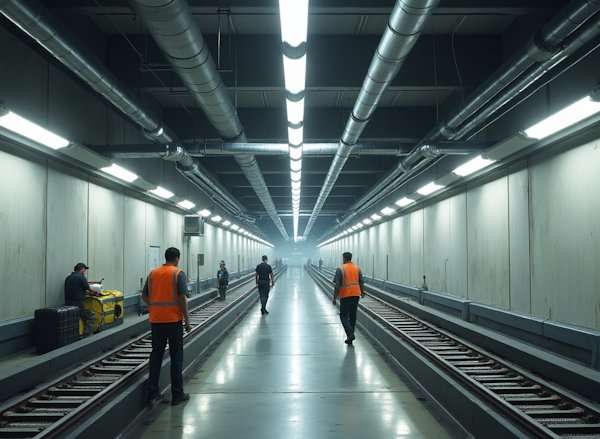
The most fascinating part of the Denver airport conspiracy story lies under the terminal floors – a tunnel system that some believe houses everything from alien bases to doomsday shelters for the world’s elite.
The Truth About the Tunnel System
Denver Airport’s underground network serves a much simpler purpose. The airport’s communications staff member Stephanie Figueroa has shown journalists around these infamous tunnels. She explains that they handle baggage transport. About 1,000 workers manage luggage daily in these tunnels, which run next to the airport’s underground trains. They move bags between ticket counters, planes and baggage claim areas.
The airport confirms several underground levels exist beneath the terminal. These tunnels stretch to the perimeter—less than two miles. This contradicts theorists who claim they extend 90+ miles to NORAD. Building such a connection would need engineering similar to the Channel Tunnel between England and France.
Freemason Symbols and the Time Capsule
The airport’s south entrance has a dedication marker with the Freemasons’ Square and Compasses symbol. This granite stone from March 19, 1994, mentions the Freemasons and a mysterious “New World Airport Commission”. A time capsule lies beneath, set to open in 2094. It holds coins, a signed baseball from Coors Field, Mayor Wellington Webb’s sneakers and casino tokens.
A 2007 investigation revealed that this commission was just a temporary group. They organized opening celebrations, likely drawing inspiration from Czech composer Antonín Dvořák’s “New World Symphony”.
Theories About the New World Order and Illuminati
The conspiracy theories keep coming. Theorists believe the airport contains:
- Underground bunkers for billionaires and political elites during an apocalypse
- Secret facilities for the Illuminati or New World Order
- Military installations (sometimes called “DUMBs”—Deep Underground Military Bases)
- Concentration camps for future use
These theories spread because of the airport’s unusual construction history. The project opened 16 months late and the budget jumped from $2 billion to $4.8 billion. Some construction workers claimed they saw entrances to mysterious tunnels and bunkers.
The airport staff regularly addresses these claims, but the mysteries continue to fascinate people. One commentator put it this way: “For those who have decided that the underground structures have an insidiously evil secret purpose, no mundane explanation will satisfy, whatever how reasonable and well-supported it is”.
From Denial to Embrace: How DIA Turned Myths into Marketing
Denver International Airport turned a PR nightmare into a brilliant marketing chance. The Denver airport conspiracy theories that surrounded the facility for decades led DIA officials to completely change their approach.
The Move in Public Relations Strategy
DIA’s leadership made a smart decision to accept these stories after years of denying conspiracy claims. “We have a CEO who really embraces the conspiracy ideas,” former spokesman Heath Montgomery said in 2016. “We decided a few years ago that rather than fight all of this and try and convince everybody there’s nothing really going on, let’s have some fun with it”.
The strategy became more than just acknowledging myths—it became DIA’s identity. Airport communications staff noted, “We decided to accept them as part of our identity and as a way to better connect with our passengers”. This approach became a soaring win. Conspiracy-related coverage reached nearly 6 million people and generated an estimated $1.50 million in free publicity.
Examples of Conspiracy-themed Signage and Campaigns
DIA’s conspiracy-embracing strategy showed best during recent renovations. The airport’s 2018 construction areas featured large signs with:
- References to “Illuminati headquarters” and “the lizard people’s lair”
- Images of Blucifer shooting red lasers from his eyes
- Mentions of aliens, Freemasons, and gargoyles among food items
“The DEN Files” campaign caught fire immediately. Marketing materials showed it generated “200 articles and over 704 million impressions without spending any advertising dollars”. The airport earned approximately $8 million in media value from this campaign alone.
The airport’s talking animatronic gargoyle became the most memorable addition. It greeted passengers with playful references to conspiracy theories. Even vendors joined the fun—Voodoo Doughnuts placed a large blue alien outside their Concourse B shop as a nod to the Denver airport myths.
The Lasting Legacy of Denver’s Mysterious Airport
Denver International Airport has grown from a troubled construction project to become America’s conspiracy theory epicenter. Without doubt, simple whispers about budget overruns and unusual artwork have changed into a cultural phenomenon that continues to engage visitors decades after the facility opened. The airport’s experience—from denying these theories to welcoming them—shows how organizations can turn potential PR challenges into marketing wins.
The conspiracy theories continue despite full explanations and countless tours of underground tunnels. The mix of truly unusual elements creates perfect grounds for ongoing speculation. Blucifer’s glowing red eyes and apocalyptic murals add to the mystery. The airport’s leaders made a smart choice to embrace these stories instead of fighting them. This approach has helped distinguish DIA from every other major airport in America.
Denver Airport’s conspiracies reveal our deep fascination with secret societies and hidden meanings. Many visitors still look for clues and hidden messages throughout the terminal. The Masonic symbols and mysterious “New World Airport Commission” have been explained many times. Yet people’s endless interest points to something deeper in human nature – we tend to look for patterns and meaning in places that feel cold and institutional.
The stories have become part of the airport’s identity, whatever visitors believe about them. DIA’s officials turned this challenge into an opportunity. They changed what could have stayed an embarrassing chapter into a multi-million dollar publicity success. Rather than resist public imagination, they chose to control it. Sometimes the best way to handle unusual situations is to welcome the strange instead of denying it exists.
FAQs
Q1. What are some of the main conspiracy theories surrounding Denver International Airport?
Some of the main conspiracy theories include claims of underground bunkers, connections to secret societies like the Illuminati, hidden messages in the airport’s artwork and the presence of alien bases. While these theories are unfounded, they have become a significant part of the airport’s mystique.
Q2. How has Denver International Airport responded to the conspiracy theories?
Initially, the airport tried to deny or deflect the conspiracy theories. However, in recent years, they’ve embraced them as part of their marketing strategy. They now use conspiracy-themed signage, interactive displays, and social media campaigns to playfully engage with these myths, turning them into a unique selling point for the airport.
Q3. What’s the story behind the blue horse statue nicknamed “Blucifer”?
The 32-foot blue mustang statue, known as “Blucifer,” was created by artist Luis Jiménez. Tragically, Jiménez died when a piece of the sculpture fell on him during its creation. The statue’s glowing red eyes, which some find unsettling, are actually a tribute to the artist’s father, who owned a neon sign workshop.
Q4. Are there really underground tunnels beneath Denver Airport?
Yes, there are underground tunnels, but they serve mundane operational purposes. These tunnels are primarily used for baggage transport and house the airport’s train system. They extend less than two miles from the terminal, not the 90+ miles to NORAD as some theories suggest.
Q5. What’s the significance of the Freemason symbols at the airport?
There is indeed a dedication marker at the airport’s south entrance featuring Freemason symbols. This marker also mentions a “New World Airport Commission,” which was actually just a temporary group created to arrange opening festivities. While these elements have fueled conspiracy theories, they were not intended to have any sinister meaning.


Leave A Comment