
Pairing the provincial markets southwest of Bangkok with the overnight sleeper train to Chiang Mai turns a lost transit day into one of the sharpest visual runs in Southeast Asia. Most travelers burn half a day sitting in highway traffic or showing up at the wrong train station; executing this transition smoothly requires synching rural commuter rail timetables with an evening departure from Bangkok's northern rail hub.
Destination Reality Check
- Best Overall Booking Window: Lock in your Special Express No. 9 sleeper train berths 30 to 60 days ahead (the moment the State Railway of Thailand opens the booking window), and reserve guided market transport 3 to 5 days prior.
- Peak Crowd Hours to Avoid: Avoid arriving at Damnoen Saduak between 09:30 and 11:30 when tour buses gridlock the canals, and clear the Krung Thep Aphiwat concourse gates before the 17:45 commuter surge.
- Primary Transit Tip: Never rely on afternoon street taxis to cross Bangkok with heavy backpacks; use the MRT Blue Line directly to Bang Sue Station to guarantee you make your evening train departure.
Maeklong Railway Market & Floating Canals: Timing the Umbrella Pull-Back
The Breakdown
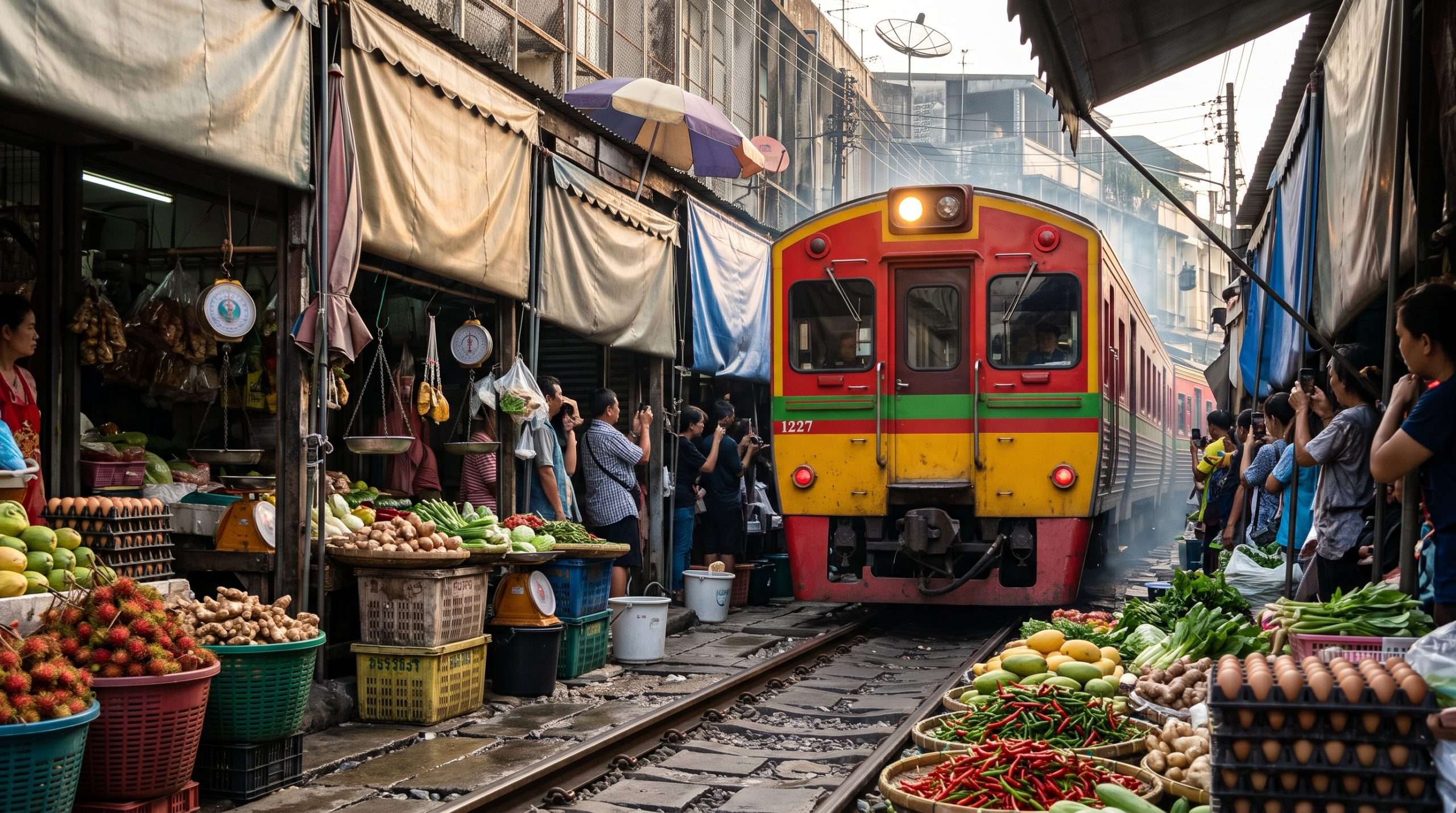
Roughly 80 kilometers southwest of central Bangkok in Samut Songkhram province, vendors at the Maeklong Railway Market (Talad Rom Hoop) lay out trays of mackerel, galangal, and tropical fruit directly across an active meter-gauge train track. Four times a day in each direction—most reliably for day-trippers at 08:30, 11:10, and 14:30—a warning siren sounds across the tin roofs. Within three minutes, stallholders smoothly crank back their bamboo-and-canvas awnings and slide wheeled produce carts inches back from the steel rails as the Ban Laem commuter train rumbles through at walking pace. Combined half-day tours link this spectacle with the nearby canal networks at either Damnoen Saduak or the more laid-back afternoon waters of Amphawa Floating Market, contrasting high-speed rail proximity with wooden longtail boat navigation.
Why Book This Tour vs. Going Solo
Stringing together public minivans from the Southern Bus Terminal (Sai Tai Mai) to Samut Songkhram and negotiating onward songthaews to the floating canals on a day when you have an evening train to catch is a high-stress gamble. If a rural bus runs late, you risk missing your sleeper train north. Booking a coordinated half-day tour handles the 80-kilometer highway transfer in an air-conditioned minivan, times your arrival precisely to the 08:30 or 11:10 locomotive pass, and drops you back in central Bangkok by mid-afternoon with hours to spare before your overnight departure. It also insulates you from the notorious private pier scams outside the floating markets, where independent travelers are routinely quoted 2,000 to 3,000 THB for a single paddleboat ride that should cost 150 to 300 THB per seat. To keep your afternoon friction-free, bypass the aggressive souvenir hawkers lining the main concrete docks, decline unsolicited "private canal detours," and carry a small dry bag to shield your phone and wallet from dirty canal splash. If you are carrying momentum over from our Thailand Day 2: Ancient Ruins & Chinatown guide, this morning route wraps up your southern river basin logistics before you head for the mountains.
Logistics & Mobile Photo Pro-Tips
- Best Time & Lighting: Target the 08:30 or 11:10 train arrival. The early slot offers angled morning sun hitting the exhaust smoke at the open ends of the track, while the 11:10 pass sends bright overhead shafts of light through the narrow gap in the retracted umbrellas.
- The Money Shot: Do not use your 0.5x ultra-wide lens inside the market—the tracks are too tight, and ultra-wide framing stretches the edges of the crowd into distorted proportions while making the train look small. Step back into a recessed, tiled shop doorway with the shopkeeper's permission, switch to your 2x or 3x optical telephoto lens, and aim straight down the rails as the train approaches. This focal compression stacks the oncoming locomotive, the folding market awnings, the hanging lightbulbs, and the onlookers into a dense, gritty, high-impact frame.
- Mobile Pro-Tip: The contrast between the dark, shaded market floor and the bright sky above the open track will blow out the highlights on the train's windshield. Tap and hold on the front nose of the locomotive to lock your exposure and focus, then slide the brightness sun icon down slightly. Switch to burst mode (or hold the shutter to capture Live Photos) as the train reaches 15 meters away to freeze the exact micro-second the final umbrella snaps shut.
- Footwear & What to Wear: Wear closed-toe sneakers with solid rubber grip. The gravel and concrete alongside the rails are permanently slick with fish ice runoff, and open flip-flops are a liability when 200 tourists step backward simultaneously into narrow shop thresholds. Wear breathable linen or moisture-wicking cotton in dark or neutral tones that won't show canal water splashes.
Booking Details: Maeklong Railway & Floating Market Half-Day Tour via GetYourGuide | Duration: 6 hours | Cancellation: Free up to 24 hours before | Maeklong & Floating Market day-tour
Krung Thep Aphiwat Central Terminal: Navigating Bangkok's Northern Transit Hub
The Breakdown
Before mapping your evening departure, clear one major outdated assumption from your notes: historical Hua Lamphong Station in Chinatown is no longer the departure hub for long-distance northern, northeastern, or southern sleeper trains. Every express run to Chiang Mai now originates at Krung Thep Aphiwat Central Terminal (formerly known as Bang Sue Grand Station), a massive, aviation-scale rail complex in northern Bangkok. Because standard hotel checkouts happen at 11:00 or 12:00 and your sleeper train doesn't board until early evening, you need a clean luggage strategy. Either leave your heavy bags locked at your hotel's front desk and swing back after your market tour, or haul them straight to Krung Thep Aphiwat in the morning and store them at the automated smart lockers or manned luggage counters inside the main ground-floor concourse (rates scale by locker size from roughly 40 to 120 THB per hour/day) so you can move through the afternoon unencumbered.
Why Plan This Hub Transition Ahead vs. Winging It
Treating Krung Thep Aphiwat like a neighborhood train stop is how travelers miss their connections. The terminal is cavernous, stretching over half a kilometer in length, and long-distance boarding works like an airport: platforms stay closed behind glass barriers until roughly 20 to 30 minutes before departure, when announcements call passengers through specific numbered gates (Northern Line trains typically board from Gates 1 through 4) to ride escalators up to the elevated tracks. Bypassing surface road gridlock via the MRT Blue Line to Bang Sue Station drops you into an underground pedestrian tunnel that feeds straight into the terminal's lower level. Arriving at least 60 minutes before departure gives you buffer time to retrieve stored bags, hit the ground-floor food court and 7-Eleven convenience stores for provisions, and verify your gate assignment before the evening rush builds.
Logistics & Mobile Photo Pro-Tips
- Best Time & Lighting: Arrive at the terminal between 17:15 and 17:45. Low late-afternoon sunlight pours through the massive western glass facade, casting long geometric architectural shadows across the polished concrete floors of the main waiting hall.
- The Money Shot: Stand at the top of the underground MRT escalator entrance as you emerge into the main concourse and switch to your 0.5x ultra-wide lens. Frame the sweeping, ribbed steel roof arches overhead against the rows of waiting backpackers and monastic orange robes below to capture the scale of modern Thai rail infrastructure.
- Mobile Pro-Tip: Before walking toward the boarding gates, use your phone's 1x camera to snap a clear, high-resolution backup photo of your printed ticket or PDF QR code, noting both the Train Number and Carriage Number. Station Wi-Fi can lag when hundreds of passengers connect simultaneously, and having the info saved to your camera roll avoids fumbling with slow booking apps at the gate scanner.
- Footwear & What to Wear: Before walking through the ticket gates, change out of sweaty day-tour clothes in the terminal restrooms. Slip into long, comfortable joggers or light trousers, thick socks, and a warm zip-up hoodie—essential armor for the heavily air-conditioned sleeper carriages waiting upstairs.
The Overnight Sleeper Train to Chiang Mai (Special Express No. 9): Surviving the 13-Hour Run
The Breakdown
Departing Krung Thep Aphiwat at 18:40 and pulling into Chiang Mai around 07:15 the next morning, the Special Express No. 9 is the gold standard of Thai overland travel because it operates exclusively with modern, red-and-white CNR (China Railway Corp) stainless-steel carriages. You begin the evening seated in clean, face-to-face red plush booths watching Bangkok's concrete sprawl fade into the central plains of Ayutthaya. Around 19:30 to 20:00, uniform-clad attendants move down the aisle with mechanical precision—unlocking upper bunks from the wall, folding lower seats flat, laying down crisp white sheets wrapped in sealed plastic, hanging thick blue privacy curtains, and securing safety straps in under two minutes per bay. You fall asleep to the rhythmic clack of the tracks and wake up as the train winds through the mist-wrapped jungle valleys and brick tunnels of Lampang and Lamphun provinces.
Why Book Specific Berths Early vs. Taking Leftovers
Not all tickets on the northern line are created equal, and waiting until the week of travel almost guarantees you will be stuck on an older, rattling fan train or an upright third-class wooden bench for 13 hours. On Train No. 9, Second Class Air-Conditioned Sleepers split into Lower Berths (approx. 994–1,050 THB) and Upper Berths (approx. 894–950 THB). Always pay the extra ~100 THB for the Lower Berth: it gives you a broader mattress, considerably more vertical headroom, your own dedicated window for morning mountain views, and relief from the unshielded ceiling AC vents that blast straight down onto the upper bunk all night. If you want a lockable two-bed First Class Compartment (complete with a private washbasin and door), you must book 30 to 60 days in advance via the official SRT D-Ticket portal or an authorized aggregator like 12Go, which allows you to pre-select exact berth tiers and issues digital vouchers without wrestling with foreign credit card failures on government servers. Finally, pack your own dinner and snacks before boarding; the dining car serves lukewarm, overpriced pre-packaged microwave trays that pale next to fresh station street food. Once you step off the platform in the northern capital, pick up our Thailand Day 4: Chiang Mai Old City & Northern Foothills itinerary to hit the ground running.
Logistics & Mobile Photo Pro-Tips
- Best Time & Lighting: You have two prime visual windows: 18:40 to 19:30 (twilight during departure before the attendants convert the seats into bunks) and 06:15 to 07:00 (first light breaking over the northern mountain valleys near Khun Tan tunnel).
- The Money Shot (Mid-Transit Twilight): Before the bunks are converted at night, sit in your 2nd-class sleeper bay and switch your phone to its 1x main camera lens (which houses the largest sensor and widest physical aperture, typically $f/1.5$ to $f/1.8$, gathering maximum light without grainy digital zoom). Frame across the aisle at chest height to capture the natural ambient details inside the carriage: the drawn blue privacy curtains, the stainless-steel ladders, the stacked backpacks on the overhead racks, and the motion-blurred blue twilight of the Thai countryside streaking past the glass.
- Mobile Pro-Tip: To shoot through the train window at dawn without catching reflections of the bright fluorescent cabin lights behind you, press your phone lens flat against the glass and cup your free hand around the bezel like a lens hood. Also, prepare for dead zones: cellular reception drops out completely for long stretches as the train climbs through the mountainous tunnels between Phrae and Lampang. Download offline Google Maps for Chiang Mai, Spotify playlists, Netflix episodes, and e-books to your device memory before leaving Bangkok.
- Footwear & What to Wear: The ceiling air-conditioning in the CNR carriages is non-adjustable and drops the cabin temperature to a frigid $18^\circ\text$ ($64^\circ\text$) by 02:00 AM. Sleep in full-length pants, a warm fleece or hoodie, and crew socks. Keep slip-on slides or sandals right underneath your lower berth edge so you can step into the shared corridor restrooms overnight without untying laces on a swaying floor.
Booking Details: Bangkok to Chiang Mai Special Express No. 9 Sleeper Train | Duration: 12.5–13 hours | Cancellation: Varies by ticket class | Overnight Bangkok to Chiang Mai train
Frequently Asked Questions
Where do large suitcases fit inside the 2nd-class sleeper carriages on Train No. 9?
Each sleeper bay features heavy-duty recessed luggage racks at chest/floor level next to the aisle and space beneath the lower berth seating module that easily accommodates standard 24-to-28-inch hard-shell suitcases. Keep a small daypack with your passport, electronics, warm hoodie, and snacks inside your curtained bunk so you never have to unzip your main bag in the narrow aisle.
Can I bring my own food, coffee, and alcohol onto the Bangkok to Chiang Mai night train?
You can bring all the outside food, bottled water, fruit, and non-alcoholic drinks you want onto the train—and doing a 7-Eleven and station food court run at Krung Thep Aphiwat is strongly recommended. However, the State Railway of Thailand strictly prohibits purchasing, carrying, or consuming alcohol anywhere inside the stations or onboard train carriages, enforced by hefty fines and railway police patrols.
Are there power outlets and clean restrooms in the 2nd-class sleeper cars?
Yes, every individual berth (both upper and lower) on the modern CNR Special Express No. 9 carriages has a dedicated 220V universal two-prong power socket next to the reading light, alongside shared Western-style sit-down toilets and stainless-steel washbasins at the end of each carriage. Still, pack wet wipes, pocket tissues, and hand sanitizer, as soap and paper towels frequently run low by 05:00 AM.
What happens if the Maeklong commuter train is delayed or cancelled during my morning market visit?
While the Maeklong–Ban Laem line is a vital local commuter link that rarely cancels without major track maintenance, occasional 15-to-30-minute delays do happen. Guided tours communicate directly with local stationmasters and adjust the sequence of your morning—visiting the floating canals or coconut sugar workshops first—so you are standing trackside when the locomotive actually arrives.
Strategic Itinerary Sequencing
- 07:00 – 07:30: Pack up your hotel room, check out early, and leave your main luggage secured with your hotel front desk (or transfer via MRT Blue Line to drop bags in the automated lockers at Krung Thep Aphiwat Central Terminal).
- 07:30 – 14:30: Meet your half-day minivan tour for the 80-kilometer morning drive southwest. Catch the 11:10 train pass at Maeklong Railway Market using your 2x/3x telephoto lens from a shop doorway, then continue to the floating canals for lunch before returning to central Bangkok.
- 15:00 – 17:15: Collect your stored luggage from your hotel, grab a quick shower or fresh change of clothes if your hostel offers transit facilities, and ride the MRT Blue Line to Bang Sue Station to beat surface rush hour.
- 17:30 – 18:20: Enter Krung Thep Aphiwat Central Terminal. Stock up on hot dinner boxes, pastries, and water at the ground-floor food court and 7-Eleven, confirm your offline map and podcast downloads, and line up at the Northern Line boarding gates.
- 18:40 – 07:15 (+1 Day): Board Special Express No. 9 to Chiang Mai. Shoot twilight carriage details on your 1x main lens before the attendants fold down the beds at 20:00, layer up against the cabin AC, and wake at 06:00 for mountain valley views before rolling into Chiang Mai Station.





Leave A Comment