
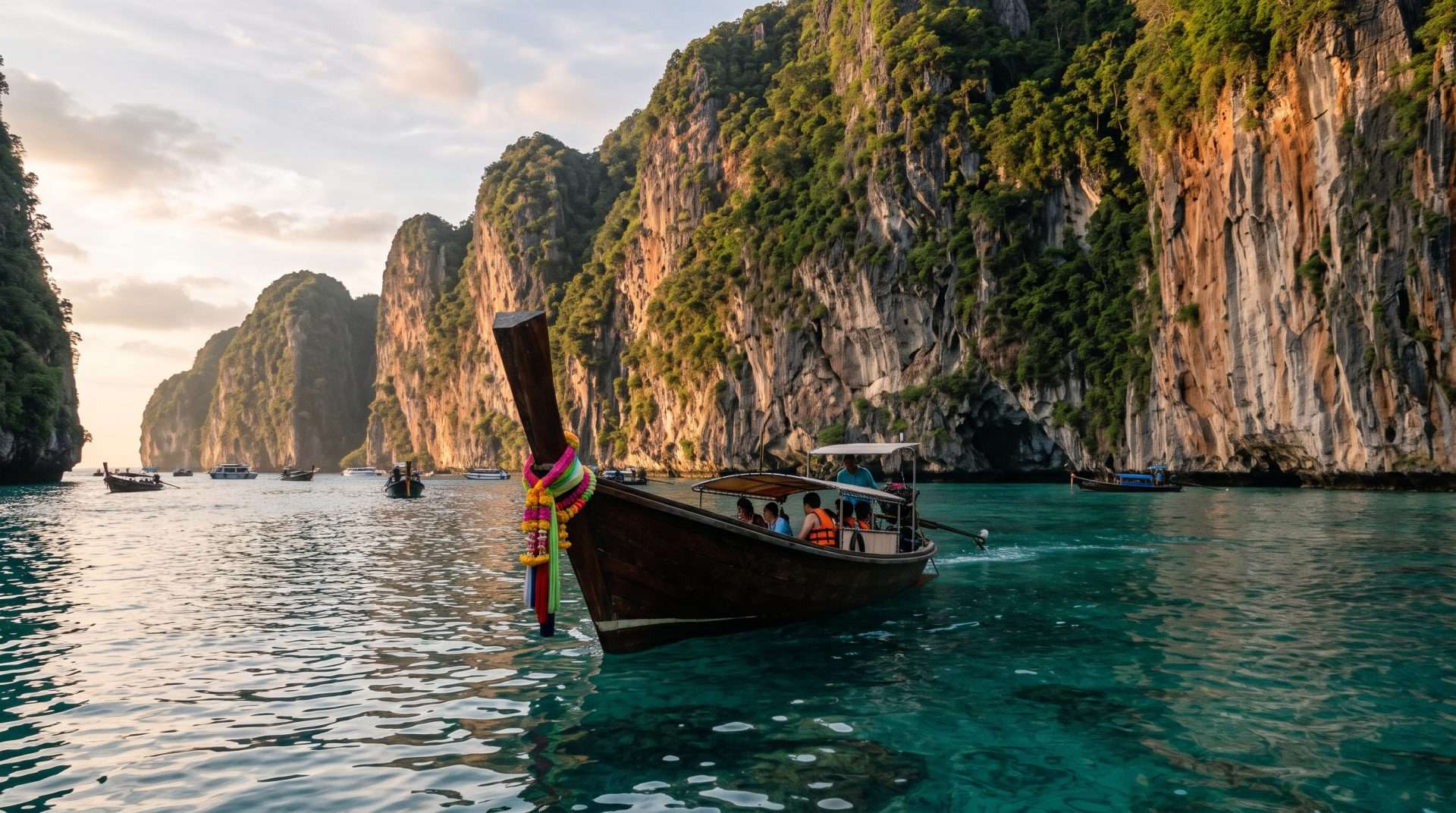
Transitioning from the Krabi mainland to the Phi Phi archipelago requires navigating chaotic pier bottlenecks and strict marine park regulations before you ever hit the water. Travelers who fail to plan their Ton Sai Pier luggage strategy or misunderstand Maya Bay’s swimming bans end up burning half their island time hauling suitcases through sand and paying unexpected cash surcharges.
Destination Reality Check
- Best Overall Booking Window: Lock in morning ferry transfers and certified dive boats at least 72 hours out, especially during the November–April dry season when vessel capacity caps out early.
- Peak Crowd Hours to Avoid: Ton Sai Pier reaches maximum gridlock between 10:30 AM and 1:30 PM as mainland ferries cross paths with day-tripper speedboats; reef sites around Phi Phi Leh are heaviest between 11:00 AM and 2:30 PM.
- Primary Transit Tip: Koh Phi Phi Don has zero motorized road vehicles; every transfer from the pier to your hotel happens on foot or via a hired local handcart, while all inter-island movement relies on longtail boats or dive catamarans.
Krabi to Koh Phi Phi Don: Morning Ferry & Ton Sai Pier Logistics
The Breakdown
Departing from the mainland after wrapping up Thailand Day 10 (Hong Islands & Coastline), the morning sea crossing from Ao Nang (Nopparat Thara Pier) or Krabi Town (Klong Jilad Pier) takes 90 to 120 minutes via standard passenger ferry, or 45 minutes via speedboat. Both vessel types funnel directly into Ton Sai Pier, the narrow commercial artery of Koh Phi Phi Don. Once you step off the gangway, you must pass through a municipal turnstile before entering the labyrinth of brick-paved and sandy pedestrian alleys that make up the island’s village center.
Why Book This Transfer in Advance vs. Going Solo
Booking a bundled transfer ticket online secures your hotel pickup in Ao Nang and guarantees a manifest spot on the 9:00 AM departure, bypassing the inflated walk-up broker booths at the pier. More importantly, arriving on the first morning wave gets you onto Ton Sai Pier before the midday day-tripper boats turn the narrow boardwalk into a shoulder-to-shoulder bottleneck. You will also need small-denomination Thai Baht ready in your pocket: local authorities enforce a mandatory 20 THB island cleaning fee per person at the pier exit gate, payable strictly in cash.
Once through the gate, the reality of a pedestrian-only island sets in immediately. Dragging a heavy, hard-shell checked suitcase—like a full-sized green Delsey—over uneven paving stones, sand drifts, and drainage grates is exhausting in 88°F humidity. Unless you have booked accommodation within a 300-meter radius of Ton Sai Pier, confirm directly with your hotel in advance to have a staff member meet you at the gate with a steel pushcart, or hire one of the independent blue-shirted porters waiting outside the turnstiles for 100–200 THB.
Logistics & Mobile Photo Pro-Tips
- Best Time & Lighting: Book the 8:30 AM or 9:00 AM departure from Krabi so you approach the northern tip of Koh Phi Phi Don around 10:30 AM, when high-angle morning sun illuminates the turquoise shallows without harsh overhead glare.
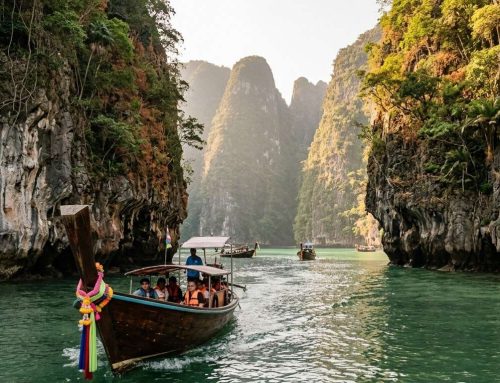
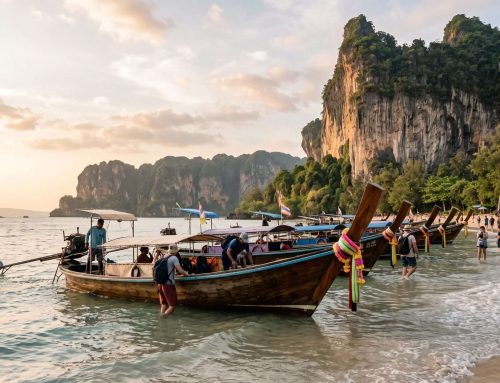
- The Money Shot: Stand on the open upper sun deck or stern walk-around as the ferry rounds the karst headlands into Ton Sai Bay. If you are carrying dedicated glass like the Canon EOS R5 Mark II paired with a 500mm telephoto lens, brace against the deck railing to compress the sheer, vertical limestone cliffs against the tiny wooden longtail boats bobbing at the base, emphasizing the massive geological scale. On a smartphone, switch to the 3x or 5x optical telephoto lens to achieve a similar background compression and cut out the cluttered ferry bow.
- Mobile Pro-Tip: Sea spray coats optical elements quickly on open-deck crossings; keep a dry microfiber cloth in a sealed zip-top bag to wipe down your phone’s camera array before shooting, and fire in burst mode to counteract the pitch and roll of the hull.
- Footwear & What to Wear: Wear rubber-soled sandals or amphibious water shoes with solid grip. Speedboat transfers often require stepping off the bow onto wet, algae-slicked concrete steps or wading calf-deep at Ao Nang before boarding.
Booking Details: Krabi to Koh Phi Phi Ferry & Speedboat Transfers | Duration: 1 to 2 hours | Cancellation: Varies by operator | Krabi to Koh Phi Phi transit booking
Phi Phi Leh Marine Reserve: Scuba Diving & Snorkeling at Bida Nok and Maya Bay
The Breakdown
Once your luggage is stashed at the hotel, the primary afternoon or early-morning objective is heading south across the open channel to the uninhabited sister island of Phi Phi Leh and the surrounding Bida islets. Half-day scuba and snorkeling vessels run two-site itineraries focusing on the submerged limestone pinnacles of Bida Nok and Bida Nai, followed by the outer perimeter walls of Maya Bay and Pileh Lagoon. Dive boats outfit you at the shop in Ton Sai village before loading gear onto custom double-deck platform boats, giving you roughly 45 to 60 minutes of bottom time per site alongside shallow-water mooring setups for surface snorkelers.
Why Book This Tour vs. Going Solo
Many travelers make the mistake of hiring a private longtail boat at Ton Sai Pier expecting to jump straight into the water at Maya Bay. Under strict Department of National Parks conservation mandates, swimming and snorkeling inside Maya Bay are completely banned to protect regenerating blacktip reef shark nurseries and shallow staghorn coral; visitors are only permitted to wade ankle-deep at the shoreline after docking at the rear Loh Samah Bay floating pier.
Booking an organized dive or dedicated reef-snorkeling boat solves this immediately by routing you to the actual offshore aquatic action at Bida Nok’s fingers and Palong Wall, where leopard sharks, hawksbill turtles, and dense schools of yellow snappers congregate in 8 to 25 meters of water. Furthermore, established tour operators coordinate the mandatory 400 THB per person Hat Noppharat Thara–Mu Ko Phi Phi National Park entry fee directly with park rangers on the water, sparing you the confusion of getting flagged down by patrol boats while negotiating with an independent longtail captain.
Logistics & Mobile Photo Pro-Tips
- Best Time & Lighting: Target boats that hit the water at 7:00 AM for morning dives or 1:30 PM for afternoon two-tank runs; vertical sunlight between 10:00 AM and 2:00 PM penetrates the water column deepest, lighting up the gorgonian sea fans at 15 meters without requiring external strobes.
- The Money Shot: Secure a Samsung Galaxy S25 Ultra inside a depth-rated vacuum housing (like Divevolk or Kraken) or switch to a dedicated action camera, and select the 0.5x ultra-wide lens. Swim slightly below the level of the shallow reef shelf at Bida Nok, angling the lens upward at 35 degrees to frame schooling fusiliers and soft corals against the bright blue surface sunbeams.
- Mobile Pro-Tip: Touchscreen capacitance fails completely underwater; lock your phone into its underwater housing interface mode before sealing the O-ring, or map your physical volume buttons to trigger shutter and video recording. Once back in your hotel room, immediately connect to Wi-Fi and push your massive 4K underwater video clips and uncompressed Canon R5 Mark II RAW files to cloud storage—such as a 5TB Google One plan—to protect your media against salt-air hardware failure and clear device memory before heading onward to Thailand Day 12 (Phuket Transit & The West Coast).
- Footwear & What to Wear: Pack a long-sleeved UV rashguard rather than relying on chemical sunscreens, as non-reef-safe lotions are prohibited inside the marine park and wash off into your mask, causing constant fogging. Dive boat decks are strictly barefoot zones once underway to prevent slipping on wet teak.
Booking Details: Phi Phi Leh & Bida Islands Scuba Diving / Snorkeling Excursion via GetYourGuide | Duration: 4 to 5 hours | Cancellation: Free up to 24 hours before | Phi Phi Leh Scuba Diving and Snorkeling Tour
Frequently Asked Questions
How much cash do I need to bring for mandatory Koh Phi Phi fees?
Every traveler must carry at least 420 THB in physical cash per person: 20 THB for the mandatory Ton Sai Pier environmental cleaning turnstile upon arrival, and 400 THB for the National Park entry fee required whenever you step foot on Maya Bay or dive/snorkel the surrounding Phi Phi Leh marine reserve. Rangers and pier attendants do not accept credit cards or digital wallets on the docks or patrol boats.
Can I roll a large hard-shell suitcase from Ton Sai Pier to my hotel?
While physically possible along the central brick pathways of Ton Sai village, dragging a heavy four-wheeled hard-shell suitcase over sand patches, raised door thresholds, and crowded market alleys is notoriously frustrating. If your hotel is located on the eastern beaches (like Long Beach) or uphill toward the viewpoint, you must either take a secondary water taxi from the pier or pay 100–200 THB for a local porter with a heavy-duty handcart.
Do I need an advanced certification to scuba dive at Bida Nok and Phi Phi Leh?
No; the sheltered bays and sloping walls around Bida Nok and Palong Wall feature mild currents and progressive depths starting at 5 meters, making them accessible to first-time Discover Scuba Diving participants and Open Water divers alike. Certified divers can drop down the outer limestone drop-offs to 24 meters to spot resting leopard sharks on the sandy bottom, while snorkelers stay directly above the shallow 3-meter coral plateau.
Are drones allowed at Maya Bay and around Phi Phi Leh?
Operating a drone inside the Hat Noppharat Thara–Mu Ko Phi Phi National Park requires both standard Thai CAAT/NBTC registration and a specialized written permit from the National Park office, which is rarely granted to casual tourists. Park rangers stationed at the Loh Samah pier and Maya Bay beach actively monitor the airspace and enforce strict fines for unauthorized launches.
Strategic Itinerary Sequencing
To execute this transition without losing half a day to logistics, book the 9:00 AM ferry from Krabi, arriving at Ton Sai Pier by 10:45 AM. Clear the 20 THB cash turnstile, hand your heavy luggage off to your hotel’s pushcart porter, and walk unencumbered to your dive shop in Ton Sai village by 11:15 AM to complete paperwork and test-fit your mask and fins. Grab a quick lunch near the pier before boarding the 1:00 PM afternoon dive or snorkel departure to Bida Nok and Phi Phi Leh, which puts you in the water just as the morning day-tripper crowds evacuate the reef sites. Return to Ton Sai by 5:30 PM, plug your devices into hotel power, and queue your RAW photos and 4K underwater footage to your cloud backup overnight so your cards are empty for the next morning’s crossing toward Phuket.








Leave A Comment