
Most travelers lose their first three hours in Bangkok sitting motionless in a metered taxi on the Sirat Expressway while the midday heat drains their energy. Treating the capital’s elevated trains and river ferries as an interconnected transit grid is the only way to outpace the gridlock, cover major historic ground, and make it to the night markets before the best charcoal grills sell out.
Destination Reality Check
- Best Overall Booking Window: Book guided evening food crawls and private airport transfers 48 to 72 hours ahead; public transit and standard river boats require zero advance booking, just small-denomination Thai Baht notes.
- Peak Crowd Hours to Avoid: Avoid road transit entirely between 7:30 AM – 9:30 AM and 4:30 PM – 7:30 PM. Hit major riverside temples before 9:00 AM or after 3:30 PM to dodge the midday tour bus waves and peak UV index.
- Primary Transit Tip: Link the Airport Rail Link, the BTS Skytrain, and the MRT subway to bypass surface streets. When heading to the historic center, transfer to the BTS Silom Line to reach Sathorn Pier (Saphan Taksin station) and let the Chao Phraya river boats carry you past the traffic.
Suvarnabhumi Airport (BKK) to the City: The Rail Link vs. Grab Strategy
The Breakdown
Clearing customs at Suvarnabhumi Airport (BKK) drops you into an immediate logistical test: how to cross the 30 kilometers into central Bangkok without burning two hours in bumper-to-bumper highway congestion. If you are traveling with a single carry-on or flashpack setup, take the elevator down to Basement B level and board the Airport Rail Link (ARL). The train runs every 10 to 15 minutes and covers the distance to the terminal Phaya Thai station in precisely 26 minutes for 45 THB ($1.30 USD), connecting directly to the BTS Sukhumvit Line. If you are landing after midnight or hauling heavy checked bags, skip the chaotic public taxi ticket kiosks on Level 1; instead, walk to the designated ride-hailing pickup zones or pre-book a private arrival transfer so your driver is waiting at the arrival gate with a name sign.
Why Book This Tour vs. Going Solo
Going solo on the Airport Rail Link is unbeatable for speed and budget during daylight hours, provided you can carry your own gear up and down station escalators. However, booking a fixed-rate private transfer via GetYourGuide or calling a Grab through the app eliminates the notorious “broken meter” negotiations and unexpected highway toll surcharges common in the standard airport taxi line. Pre-booking a private car is especially valuable after a long-haul flight when navigating humid train transfers feels like a chore, as highway tolls and meet-and-greet service are locked in upfront.
Logistics & Mobile Photo Pro-Tips
- Best Time & Lighting: Late afternoon arrivals (4:30 PM – 5:30 PM) turn the elevated rail commute into a prime visual introduction as low-angle golden hour light cuts between the glass high-rises along the Makkasan and Ratchaprarop corridor.
- The Money Shot: Stand near the opposite-side doors at the elevated Phaya Thai platform where the Airport Rail Link meets the BTS Skytrain tracks. Use your 1x main lens to frame the multi-level concrete transit tracks curving directly into the dense Sukhumvit skyline, with bumper-to-bumper cars stacked below.
- Mobile Pro-Tip: Moving straight from the freezing airport cabin into Bangkok’s 85% humidity will instantly fog your camera lenses. Keep a microfiber cloth in your pocket and wipe your phone’s rear glass array before shooting, then press and hold the screen to lock focus (
AE/AF Lock) through the train window glass so the autofocus doesn’t hunt on window smudges. - Footwear & What to Wear: Bangkok is a humid concrete jungle where clocking 20,000 steps on Day 1 is standard. Step off the plane wearing moisture-wicking technical activewear and highly cushioned running shoes—like the Nike Pegasus line—to absorb the relentless concrete impact from train platforms to cracked city sidewalks.
Booking Details: Suvarnabhumi Airport (BKK) Private Hotel Transfer via GetYourGuide | Duration: 1 hour | Cancellation: Free up to 24 hours before | Suvarnabhumi Airport Private Transfer
Chao Phraya Express Boat & Wat Arun: Navigating the River Artery
The Breakdown
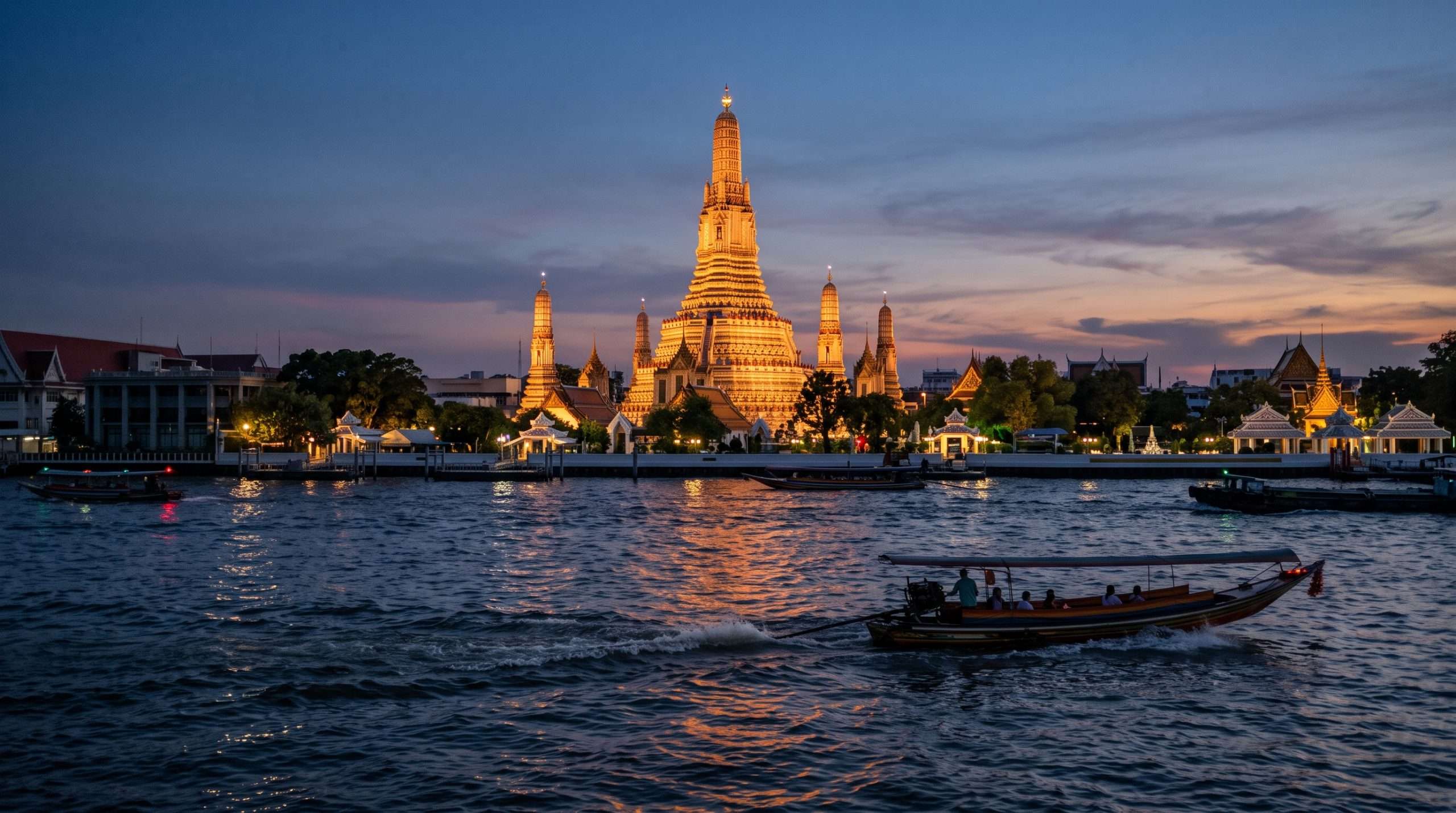
Before heading toward the river, start your morning at one of Bangkok’s specialty coffee roasters along the Sukhumvit or Sathorn corridors for a strong black espresso to cut through the jet lag. From there, take the BTS Skytrain to Saphan Taksin station (Exit 2) and walk straight onto Sathorn Central Pier. Ignore the aggressive touts pushing 1,500 THB private longtail boat charters and head to the commuter queues or the Hop-On-Hop-Off tourist boat desk. The local Orange Flag commuter boat operates like an aquatic subway line, charging a flat 16 THB ($0.45 USD) to carry you north up the Chao Phraya River straight to Wat Arun (Pier N8 / Tha Tien cross-river terminal), where the 82-meter-tall central prang (Khmer-style tower) rises directly off the western bank, encrusted in millions of shards of colorful Chinese porcelain and seashells.
Why Book This Tour vs. Going Solo
Navigating the Orange Flag boat solo is easy once you know which pier flag color to look for, though tickets must be paid in exact cash to the conductor rattling a metal coin cylinder on deck. Booking a Chao Phraya Hop-On-Hop-Off boat pass or a guided Wat Arun walking tour solves two immediate friction points: you get pre-paid digital boarding at dedicated pier lanes with English route announcements, and a licensed guide handles entrance tickets while providing historical context on the spire’s cosmology that isn’t posted on any temple plaques. More importantly, guided tours ensure you clear the strict temple dress code check before you spend 20 minutes standing in the entry queue.
Logistics & Mobile Photo Pro-Tips
- Best Time & Lighting: Board the boat by 8:30 AM to walk the inner courtyards of Wat Arun while the white porcelain reflects crisp morning light, or time your river crossing for 5:15 PM to watch the golden sunset illumination from across the water.
- The Money Shot: Wat Arun’s central prang is notoriously difficult to photograph from its base because the steep vertical geometry distorts badly on wide lenses. Instead, pay 5 THB to take the cross-river shuttle ferry from the temple pier back to the eastern bank (Tha Tien side) just before sunset. Frame the temple from the public pier walkway using your 1x main lens for the full river reflection, or punch into your 3x optical telephoto lens to compress the passing longtail boats directly against the lit spire across the water.
- Mobile Pro-Tip: If you do shoot inside the Wat Arun ordination hall or at the base of the steep exterior stairs, avoid the 0.5x ultra-wide lens unless you stand dead-center and keep your phone perfectly vertical (
0 degrees tilt). Tilting an ultra-wide lens upward will make the towering spires look like they are falling backward. - Footwear & What to Wear: Wat Arun enforces an uncompromising dress code at the ticket gate: both shoulders and knees must be completely covered for men and women. Wear lightweight technical trousers or carry a breathable linen overshirt and packable elephant pants in your daypack to pull over running shorts; otherwise, you will be turned away at the turnstile and forced to rent heavy wrap skirts in the heat.
Booking Details: Chao Phraya River Hop-On-Hop-Off Boat or Wat Arun Walking Tour via GetYourGuide | Duration: 2 to 4 hours | Cancellation: Free up to 24 hours before | Wat Arun walking tour
Navigating the Night Markets: High-Protein Street Food at Yaowarat & Jodd Fairs
The Breakdown
Once the sun drops, Bangkok’s culinary gravity shifts to the open-air stalls of Yaowarat Road (Chinatown) and the organized grid of Jodd Fairs (accessible via the MRT Blue Line). For flashpackers running an intermittent fasting window or prioritizing clean nutrition on the road, surviving on sugar-laden Pad Thai and deep-fried spring rolls is a fast track to an energy crash. Instead, treat the night markets as an open-air protein grill house. Walk past the noodle carts and target the seafood and rotisserie vendors working over white-hot mangrove charcoal. You can break a daily fast effortlessly by ordering whole grilled squid (Pla Muek Yang), giant freshwater river prawns split down the middle, salt-crusted whole tilapia (Pla Pao) stuffed with lemongrass, and unmarinated beef or pork neck skewers (Moo Ping—just wave off the sweet glaze brush).
Why Book This Tour vs. Going Solo
Going solo at Jodd Fairs is straightforward because stalls are arranged in clean rows with printed English prices, though peak hours between 7:00 PM and 9:00 PM turn the narrow tent aisles into a shoulder-to-shoulder sauna. Yaowarat Road, however, is a sensory overload of roaring tuk-tuks, sizzling woks, and zero English signage at the oldest charcoal carts. Booking a small-group evening street food tour cuts out the guesswork: your guide knows which back-alley stalls turn over their seafood fastest (crucial for avoiding foodborne stomach issues on Day 1), secures stools at chaotic sidewalk tables, and communicates dietary tweaks—like ordering seafood sauce (Nam Jim Talay) on the side to avoid hidden palm sugar.
Logistics & Mobile Photo Pro-Tips
- Best Time & Lighting: Arrive at 6:00 PM right as twilight fades into full darkness; the ambient sky still holds a faint deep-blue glow while the stalls switch on their tungsten and neon bulbs, giving your camera sensor dynamic contrast.
- The Money Shot: Position yourself at a 45-degree angle to a charcoal seafood grill as the vendor fans the embers. Switch to your 1x main lens (which has the widest aperture and largest sensor on your phone for low light) or 3x telephoto to isolate the vendor’s hands turning giant tiger prawns through the rising smoke, blurring out the chaotic crowd behind the stall.
- Mobile Pro-Tip: By default, your phone’s native Night Mode will try to turn a dark street market into broad daylight, resulting in blown-out neon signs, ghostly motion blur, and muddy gray smoke. Tap directly on the brightest light bulb or flame in your frame, then manually drag the little sun icon (exposure slider) down by
-1.0to-1.5 stops. This forces a faster shutter speed, preserves the deep shadows, and locks in the rich, cinematic texture of the grill smoke without blowing out the highlights. - Footwear & What to Wear: Leave white sneakers and open-toed sandals back at the hotel. Night market alleys are slick with dishwater runoff, stray charcoal ash, and stray fish sauce splatters. Wear dark, closed-toe running shoes with good wet-grip outsoles and dark breathable t-shirts that hide smoke odor and condensation sweat.
Booking Details: Bangkok Midnight Food Tour by Tuk-Tuk or Chinatown Walking Tour via GetYourGuide | Duration: 3.5 to 4 hours | Cancellation: Free up to 24 hours before | Bangkok Night Market Street Food Tour
Frequently Asked Questions
Can I tap a foreign credit card on the Bangkok Airport Rail Link and BTS Skytrain?
While the MRT subway system accepts contactless Visa and Mastercard directly at the turnstile gates, the Airport Rail Link and the BTS Skytrain still require you to purchase single-journey tokens at the vending machines using Thai Baht cash or a stored-value Rabbit Card. Keep a stash of 20, 50, and 100 THB notes in your pocket specifically for train machines and river boat conductors.
How steep are the stairs at Wat Arun, and is there an elevator?
There are no elevators or ramps on the historic structure of Wat Arun, and visitors are currently only permitted to climb up to the first terrace level of the central prang. Even to reach that first tier, the exterior stone steps sit at an incline of nearly 60 degrees with narrow treads, requiring you to hold the metal side rails on the way down.
How do I avoid getting sick from street food seafood on my first night in Bangkok?
Only order from high-turnover stalls where raw prawns and squid are sitting on crushed ice rather than lukewarm display trays, and ensure the meat is grilled to order over live coals right in front of you rather than reheated. Ask for the green chili-lime dipping sauce (Nam Jim Talay) on the side so you can control the spice level, as the raw bird’s eye chilies can shock an unadjusted stomach.
What is the best way to handle relentless sweating while clocking 20,000 steps in Bangkok?
Avoid 100% cotton clothing entirely, as it traps moisture and chafes within an hour of walking outdoors. Wear synthetic running shorts or lightweight golf trousers, carry a small packable microfiber towel to dry your hands and phone screen, and duck into a 7-Eleven every two hours to grab bottles of cold mineral water and zero-sugar electrolyte packets (Dechamp or Royal-D) for 7 THB.
Strategic Itinerary Sequencing: Your Day 1 Flow
To execute this entire route without backtracking or sitting in a single traffic jam, start by taking the Airport Rail Link from Suvarnabhumi (BKK) to Phaya Thai, transferring directly onto the BTS Skytrain to drop your bags at your hotel and grab an iced black espresso from a neighborhood roaster. Around 2:30 PM, ride the BTS Silom Line to Saphan Taksin and board the Chao Phraya Express Boat north to Wat Arun, giving yourself two hours to walk the grounds before taking the 5 THB shuttle ferry across the river at 5:15 PM to capture the sunset silhouette from the eastern bank. From the pier, walk five minutes to Sanam Chai MRT station (one of the most architecturally striking underground stations in the city) and ride the MRT Blue Line three stops east to Wat Mangkon station, dropping you directly into the charcoal smoke and seafood grills of Yaowarat (Chinatown) or continuing a few stops further to Phra Ram 9 for Jodd Fairs. Locking down this transit and nutrition rhythm on Day 1 sets the baseline for the rest of your trip before you board the northbound train or flight to tackle the mountain temples and night bazaars in our Thailand Day 4: Chiang Mai Logistics Guide.


Leave A Comment