
The Anatomy of a Pun: How Language Puns Work
At its core, a pun is a form of wordplay that exploits multiple meanings of a term, or replaces a word with a similar-sounding one to create humor or rhetorical effect. Understanding the mechanics behind language puns helps us appreciate their cleverness – and perhaps explains why some people love them while others roll their eyes.
Types of Language Puns
- Homophonic puns play with words that sound alike but have different meanings. For example, “Time flies like an arrow; fruit flies like a banana.”
- Homographic puns use words that are spelled the same but have different meanings and sometimes pronunciation. “The soldier decided to desert his dessert in the desert.”
- Homonymic puns leverage words that are both spelled and pronounced the same but have different meanings. “Did you hear about the guy whose whole left side was cut off? He’s all right now.”
- Compound puns combine multiple types of wordplay. “A bicycle can’t stand on its own because it’s two-tired.”
The Cognitive Process
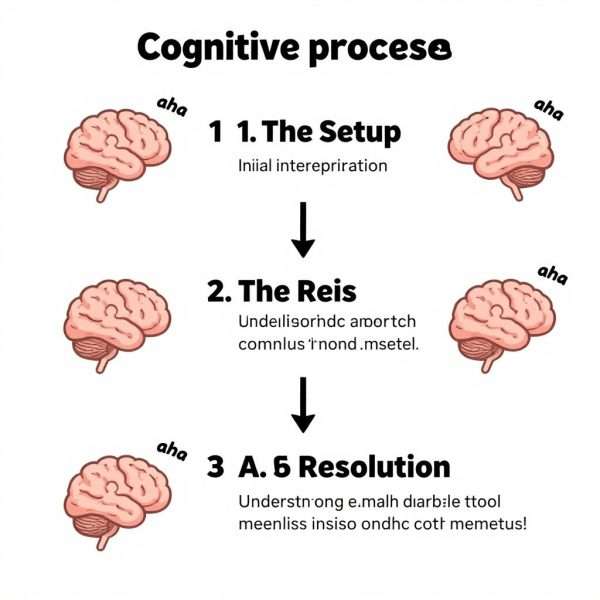
Understanding a pun involves a three-step mental process:
- The Setup: The listener interprets the statement in its most obvious way
- The Surprise: A second possible interpretation becomes apparent
- The Resolution: The brain reconciles both meanings, creating that distinctive “aha” moment that triggers amusement
This cognitive dance is what makes puns both intellectually stimulating and potentially frustrating. When we “get” a pun, we experience a small dopamine reward for solving the linguistic puzzle. When we don’t, we’re left on the outside of the joke – perhaps explaining why puns can be so divisive.
Puns Across Languages: A Global Wordplay Tour
While English speakers might claim to be the masters of the pun, wordplay exists in virtually every language. The specific mechanisms may differ based on each language’s unique structure, but the joy of linguistic cleverness is universal.
English: The Home of the Groan-Worthy Pun
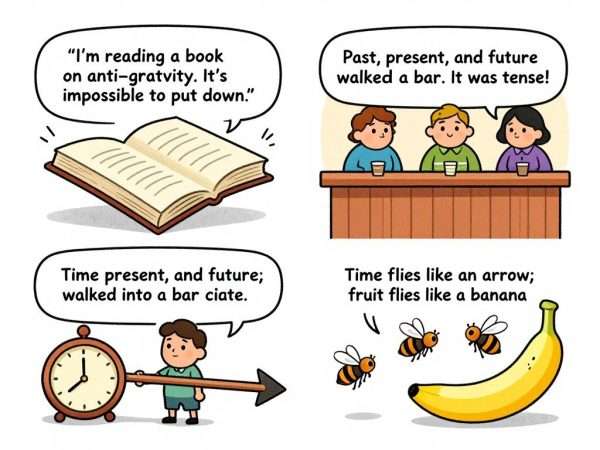
English is particularly fertile ground for puns due to its large vocabulary drawn from multiple language sources and its abundance of homophones. Consider these examples:
This pun works because “put down” can mean both to physically place something down and to stop reading. The context of anti-gravity (the absence of gravitational pull) creates the perfect setup for this dual meaning.
Here, the first “flies” functions as a verb, while the second “flies” refers to the insect. The sentence structure tricks our brain into initially parsing both phrases the same way.
Spanish: Juegos de Palabras
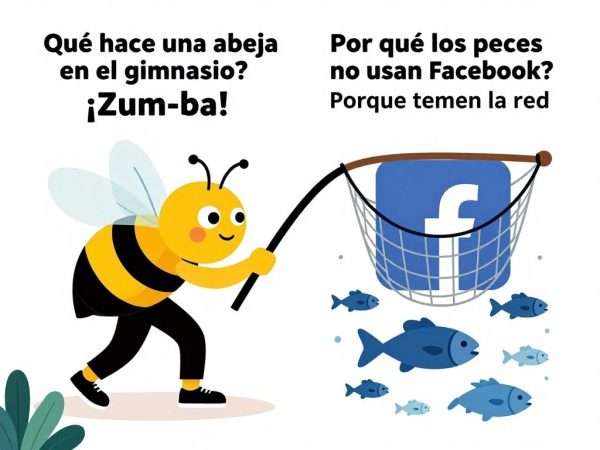
Spanish puns often play with the language’s regular pronunciation and rich conjugation system:
This pun plays on “zumba,” both a popular exercise program and similar to “zumbar” (the buzzing sound a bee makes). The cultural context of fitness classes makes this pun work across Spanish-speaking countries.
French: Jeux de Mots
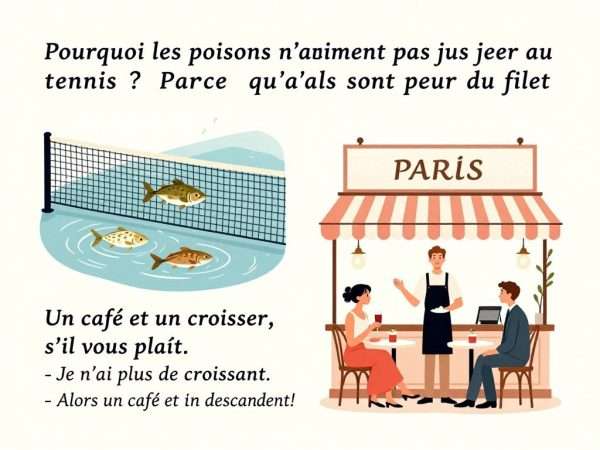
French puns often leverage the language’s many homophones and silent letters:
This pun works because “filet” means both “net” in tennis and “fishing net” – so fish are afraid of nets! The double meaning creates the humorous effect.
German: Wortspiele
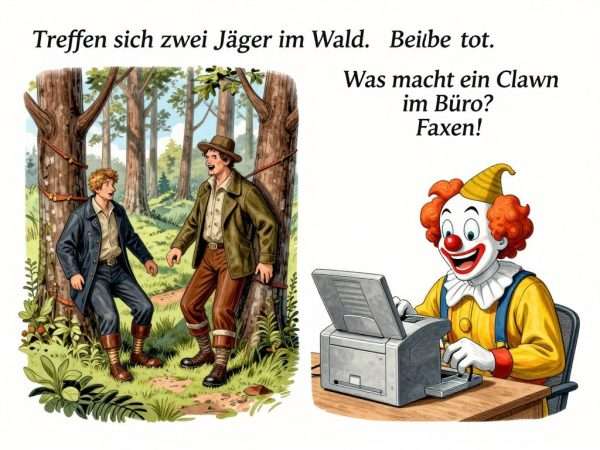
German’s compound words create unique opportunities for wordplay:
This pun plays on the dual meaning of “treffen,” which can mean both “to meet” and “to hit/shoot.” So the joke can be read as “Two hunters meet in the forest. Both dead.” The dark humor reflects a particular German sensibility.
Japanese: Dajare (駄洒落)
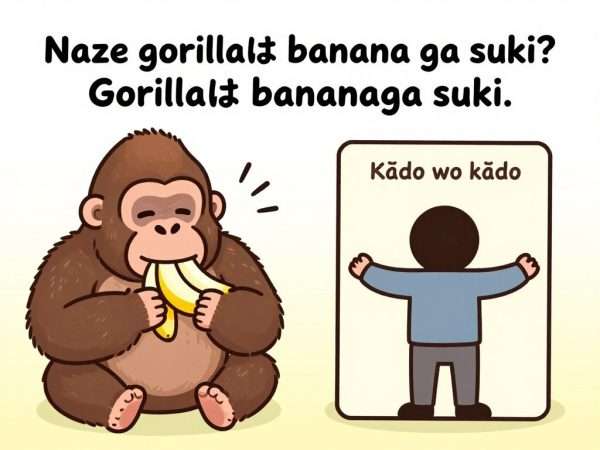
Japanese puns often rely on the language’s limited sound combinations and multiple writing systems:
This pun plays on “banana ga suki” (likes bananas) and “bana na ga suki” (because of the gaps). The similar pronunciation creates the wordplay that’s particularly appreciated in Japanese culture.
Want to Explore More Language Puns?
Download our free “Global Pun Collection” featuring 50+ language puns from around the world, complete with explanations and cultural context!
Lost in Translation: The Challenges of Translating Puns
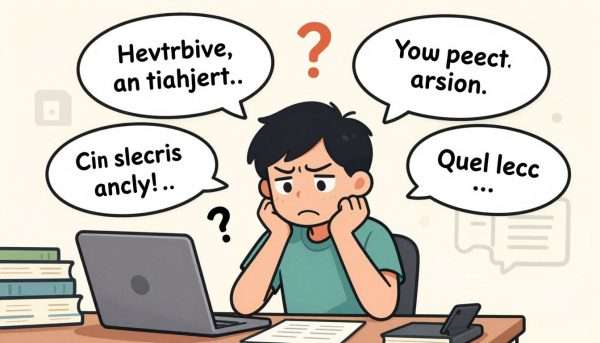
Puns present one of the greatest challenges in translation because they rely on linguistic features specific to each language. When a translator encounters a pun, they face several options:
Direct Translation
Rarely works because the wordplay typically doesn’t exist in the target language. The humor is lost, leaving readers confused.
Functional Equivalence
Creating a new pun in the target language that produces a similar effect, even if the specific wordplay is different.
Compensation
Adding a pun elsewhere in the text to maintain the overall humorous tone, even if not at the same point.

These translation challenges highlight how deeply puns are embedded in their original linguistic and cultural contexts. A truly successful translation of a pun requires not just bilingual knowledge but bicultural understanding – knowing what will create that same moment of surprise and delight in the target language.
Puns in Culture: From Shakespeare to Advertising
Far from being merely the domain of dad jokes, puns have a rich history in literature, advertising, and popular culture. Their ability to create memorable phrases and evoke multiple meanings makes them powerful tools for writers and marketers alike.
Puns in Literature
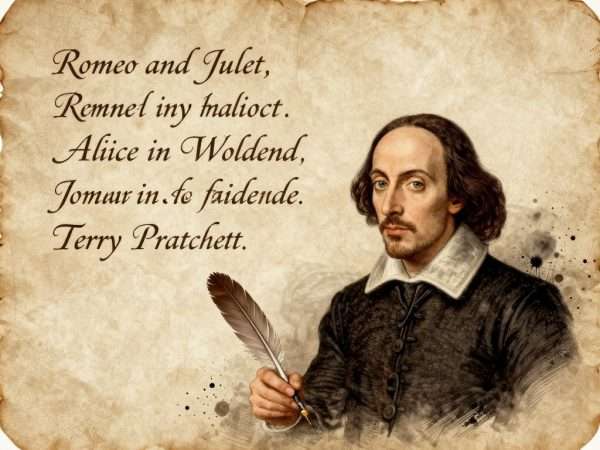
Shakespeare was perhaps history’s greatest punster, embedding wordplay throughout his works. In Romeo and Juliet, the dying Mercutio declares, “Ask for me tomorrow, and you shall find me a grave man” – playing on “grave” as both serious and a burial place.
Lewis Carroll’s Alice in Wonderland is similarly filled with puns and wordplay, reflecting the author’s fascination with language and logic. Modern authors like Terry Pratchett have continued this tradition, using puns to both entertain and illuminate deeper themes.
Puns in Advertising
Marketers have long recognized the power of puns to make their messages stick. From “Bean There, Done That” (coffee shop) to “We’re Ear For You” (hearing aid company), puns create memorable branding that customers are more likely to recall.
The best advertising puns work on multiple levels – they’re relevant to the product, easy to understand, and just clever enough to make consumers feel smart for “getting it.” This delicate balance explains why some advertising puns soar while others fall flat.

“To pun is to treat homonyms as synonyms.”
Whether elevated to the status of high literature or dismissed as the lowest form of humor, puns remain one of our most enduring forms of wordplay. Their persistence across time and cultures speaks to something fundamental about how humans process and play with language.
The Art of the Pun: When it Works and When it Puns Wrong

What separates a brilliant pun from a groan-inducing one? The line is subjective, but certain patterns emerge when we examine puns that tend to succeed versus those that fall flat.
Elements of Successful Puns
- Surprise: The best puns catch us off guard with an unexpected connection
- Relevance: They relate meaningfully to the context or conversation
- Cleverness: They demonstrate genuine linguistic creativity
- Layers: They work on multiple levels of meaning
- Timing: They arrive at just the right moment in conversation
Why Puns Fall Flat
- Predictability: The wordplay is too obvious or telegraphed
- Forced: The connection feels strained or unnatural
- Overused: The pun has become cliché through repetition
- Inappropriate: The humor doesn’t match the social context
- Complexity: The wordplay requires too much explanation
The reception of a pun also depends heavily on audience and context. What might elicit groans in a professional setting could be the highlight of a family dinner. What works brilliantly in one language might be incomprehensible in another. The art of the pun lies not just in its construction but in knowing when and where to deploy it.
“Puns are the highest and lowest form of literature.”
Perhaps the most successful puns are those that make us both groan and laugh simultaneously – acknowledging the cleverness even as we pretend to be above such simple wordplay. In this duality lies the enduring charm of the pun.
Conclusion: The Universal Language of Wordplay
From Shakespeare’s stages to today’s social media, from ancient Chinese poetry to modern advertising campaigns, puns demonstrate the remarkable flexibility and playfulness of human language. They remind us that communication isn’t merely functional – it’s also a source of joy, creativity, and connection.
Language puns, in all their forms across different cultures, reveal something fundamental about how we think and process meaning. They highlight the cognitive pleasure we take in linguistic surprises and the social bonds we form through shared humor. Whether you consider them the highest form of wit or the lowest form of comedy, puns remain one of our most democratic forms of wordplay – accessible to anyone with a love of language and an ear for its possibilities.
So the next time you encounter a pun – whether brilliant or groan-worthy – remember that you’re participating in a tradition as old as language itself. And if you’re inspired to create your own wordplay, remember: the best puns make people both think and smile. After all, that’s a pun-derful combination.
Keep the Wordplay Going!
Subscribe to our weekly “Language Lovers” newsletter for more linguistic fun, including puns, idioms, and fascinating word origins from around the world.


Leave A Comment