
Arriving in Sabah’s capital after enduring the exhausting Borneo Day 5 Labuan Ferry Route requires an immediate shift from transit survival to logistical recovery. Most travelers burn their limited time here wandering in the oppressive midday coastal humidity or trying to secure nonexistent last-minute mountain permits, rather than using the city to reset before pushing east toward the Borneo Day 7 Kinabatangan River jungle.
Destination Reality Check
- Best Overall Booking Window: Book 6 months in advance for Mount Kinabalu summit permits; 24 to 48 hours ahead for Kinabalu Park day tours and guided street food walks.
- Peak Crowd Hours to Avoid: 11:00 AM to 3:30 PM along the exposed Gaya Street and waterfront promenade when the coastal heat index peaks, and 7:30 PM to 8:30 PM at the central night market grills when tour buses unload.
- Primary Transit Tip: Re-activate your Grab app immediately upon arrival at Jesselton Point; local street taxis do not use meters and routinely quote triple the standard rate for short hops across the downtown grid.
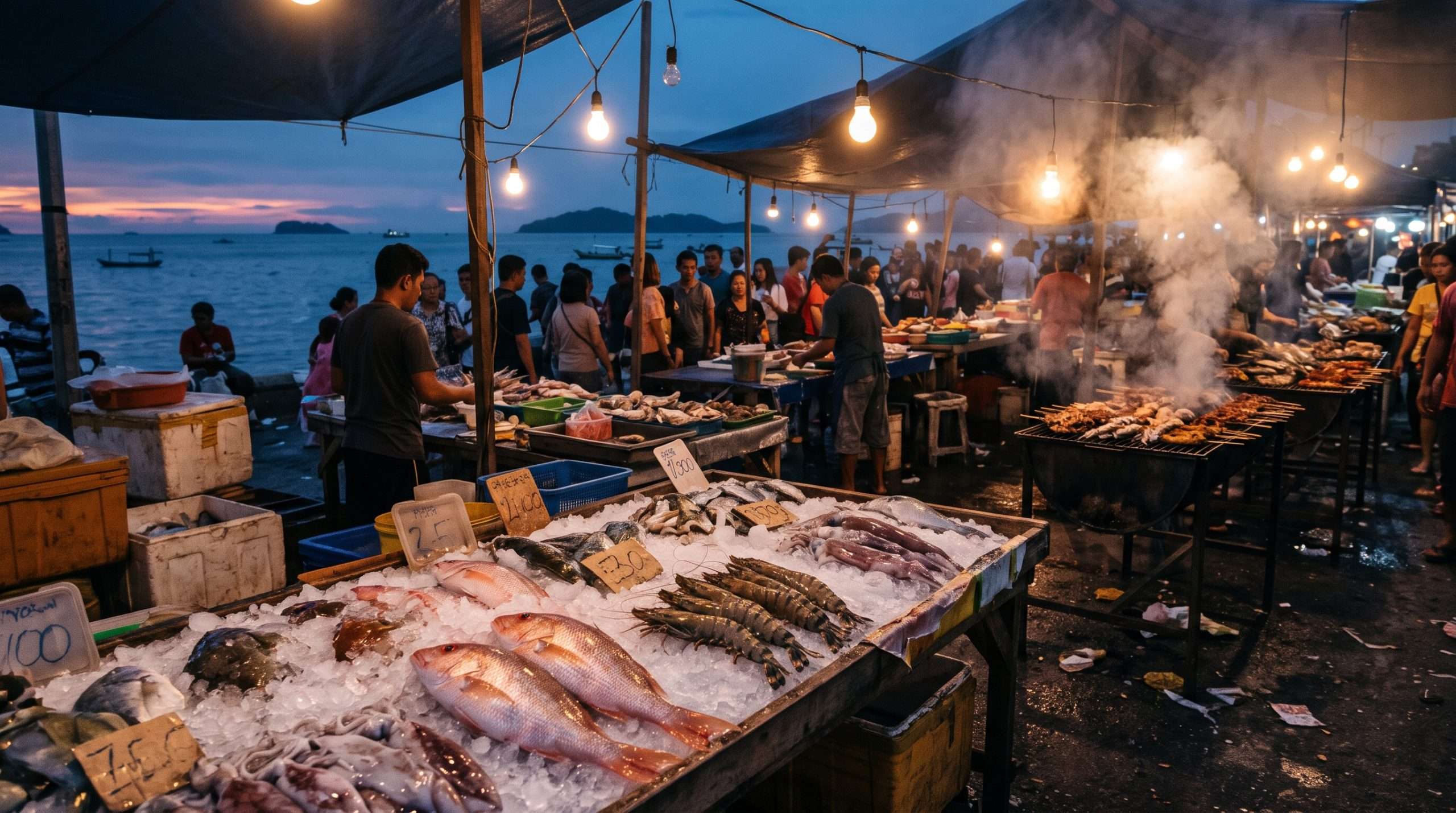
The Filipino Night Market (Pasar Besar): Navigating the Waterfront Charcoal Grills
The Breakdown: Located directly along the central waterfront next to the wet market, the Filipino Night Market (officially the Pasar Kraftangan night food stalls) is an open-air grid of plastic tables, crushed ice displays, and roaring coconut-husk charcoal fires. After days of surviving on basic transit carbs during the boat crossings from Brunei and Labuan, this is where you secure a massive, high-protein dinner for a fraction of western restaurant prices. The operation follows a strict multi-step local system: you inspect the raw catch on the front tarps, select your whole red snapper, squid, or tiger prawns, negotiate the price per 100 grams on the vendor’s scale, and specify your marinade (usually a fiery sambal paste or garlic butter). Once agreed, the vendor tags your basket, hands you a numbered table token, and sends the fish to the back-row grill masters while you claim a plastic stool and order cold calamansi juice from a separate drinks runner.
Why Book This Tour vs. Going Solo: While you can easily walk into the market alone, first-timers frequently get hit with inflated “tourist weight” pricing on the scales or accidentally select older fish that has sat through a freeze-thaw cycle. Booking an evening street food tour pairs you with a local Sabahan guide who knows which specific family stalls pull their catch fresh off the afternoon trawlers. Furthermore, a guide navigates you beyond the central seafood grills into the adjacent fruit and Kuih (local cake) alleys, allowing you to sample complex regional dishes like Hinava (Sabahan raw fish cured in lime juice) without having to buy full family-sized portions alone.
Logistics & Mobile Photo Pro-Tips:
- Best Time & Lighting: Arrive at 5:45 PM just as the charcoal fires are lit and the sky holds a deep blue twilight gradient, rather than waiting until full darkness when the harsh overhead bulbs create stark shadows.
- The Money Shot: Stand at a 45-degree angle to the grill stations and switch to your 1x main lens (which has the widest aperture for low light). Frame the grill master flipping a banana-leaf-wrapped stingray through a rising plume of illuminated smoke, keeping the colorful rows of raw iced seafood in the lower foreground.
- Mobile Pro-Tip: The combination of thick charcoal smoke and bright bare tungsten bulbs tricks smartphone sensors into overexposing the entire frame, turning the atmosphere into a washed-out gray blur. Activate your phone’s native Night Mode, tap directly on the brightest light bulb or neon sign on your screen, and drag the sun icon (exposure slider) down by roughly 40 percent to prevent the lights from blowing out and capture the rich, cinematic texture of the grill smoke.
- Footwear & What to Wear: Wear closed-toe shoes or rubber sandals with serious grip; the concrete alleys between the stalls are permanently slick with melted fish ice and wash water. Wear dark, breathable cotton or linen, as your clothes will absorb the heavy scent of woodsmoke and sambal oil within ten minutes.
Booking Details: Kota Kinabalu Evening Street Food & Night Market Tour via GetYourGuide | Duration: 3.5 hours | Cancellation: Free up to 24 hours before | Kota Kinabalu Evening Street Food & Night Market Tour
The Mount Kinabalu Summit vs. Day Hikes: Solving the Permit Bottleneck
The Breakdown: Towering at 4,095 meters over Sabah’s west coast, Mount Kinabalu is the primary geographical anchor of the region. However, independent travelers and flashpackers routinely arrive in Kota Kinabalu assuming they can arrange a two-day summit trek on a whim, only to hit a wall of bureaucracy. Sabah Parks strictly caps summit permits at fewer than 200 climbers per day, and these allocations sell out up to six months in advance. Furthermore, mandatory mountain guide fees, climbing insurance, entrance permits, and monopolized dormitory beds at Panalaban push the cost of a last-minute cancellation slot well past 400 to 500 USD per person. The practical workaround is booking a full-day highland excursion to Kinabalu Park Headquarters (1,585 meters elevation) and Poring Hot Springs, which allows you to hike the lower montane oak and pitcher plant trails without requiring a summit climbing permit.
Why Book This Tour vs. Going Solo: Getting to Kinabalu Park independently requires taking a Grab to the suburban Inanam bus terminal and waiting for shared long-distance minivans that only depart when completely full—wasting prime morning visibility hours. Once dropped at the highway park gate, Poring Hot Springs and the canopy walk sit another 40 kilometers further down the mountain road with zero public transit links between them. A booked day tour solves the entire two-hour mountain ridge transfer from your downtown hotel, covers all conservation entry fees, and includes a guided walk through the Botanical Garden where a naturalist spots camouflaged carnivorous Nepenthes pitcher plants and endemic orchids you would walk right past on your own.
Logistics & Mobile Photo Pro-Tips:
- Best Time & Lighting: You must view the mountain between 6:30 AM and 9:00 AM. By 10:30 AM almost every day, localized thermal convection pulls a dense blanket of white cumulus clouds up the valleys, completely obscuring the summit plateau until dusk.
- The Money Shot: If the weather is clear at dawn or dusk, find a vantage point at the northern waterfront jetty or the Signal Hill Observatory platform. Switch to your phone’s 3x or 5x optical telephoto lens and aim northeast. The long focal length compresses the spatial distance, making the towering, jagged granite peak of Mount Kinabalu loom dramatically directly behind the modern concrete blocks of the Kota Kinabalu skyline.
- Mobile Pro-Tip: Inside the dense lower montane forest trails at Kinabalu Park, high canopy contrast causes phone cameras to blow out the highlights on glossy wet leaves and pitcher plants. Switch to your 1x main lens, move within 15 centimeters of the subject to trigger macro focus, and use your body to block direct overhead sun shafts before tapping the pitcher rim to lock exposure.
- Footwear & What to Wear: The elevation drop at Park Headquarters brings crisp 18°C temperatures and sudden mist, a sharp shock after Kota Kinabalu’s 33°C coastal humidity. Pack a lightweight windbreaker or fleece layer, and wear trail runners with aggressive lugs for the damp, root-heavy Silau-Silau trail.
Booking Details: Kinabalu Park & Poring Hot Springs Full-Day Tour via GetYourGuide | Duration: 10 hours | Cancellation: Free up to 24 hours before | Kinabalu Park & Poring Hot Springs Day Tours
The Sabah Reset: Grab Transit, Laundry Runs & Jungle Cash Prep
The Breakdown: If you skip the mountain day trip to prioritize physical recovery from the Labuan ferry run, treat Kota Kinabalu as an operational staging ground. Because the coastal heat and humidity between 11:00 AM and 3:30 PM are oppressive, structure your day around a slow morning reset inside the air-conditioned modern coffee roasters lining Gaya Street and Jalan Dewan (such as Woo! or October Coffee). Use their reliable high-speed Wi-Fi to lock in your East Sabah transfers while dropping your salt-crusted travel clothes at a 24-hour self-service laundry hub like LaundryBar on Jalan Pantai to wash off the Brunei and Labuan boat grime. Before dusk, walk over to the Gaya Street branches of Maybank or CIMB to pull your maximum daily limit of physical Malaysian Ringgit (MYR); once you cross east into the Kinabatangan River corridor and Danum Valley, ATMs vanish entirely and rural homestays or boat operators run strictly on cash.
Why Book This Tour vs. Going Solo: While the logistical chores of laundry, banking, and cafe recovery are strictly solo tasks, travelers who want to understand Sabah’s architectural survival story after World War II carpet bombing benefit from a structured three-hour heritage walking or half-day city tour. Going solo to outer landmarks like the floating City Mosque in Likas Bay or the Yayasan Sabah tower means stringing together four separate Grab rides in midday traffic and paying standalone entry and robe-rental fees at each stop. A curated half-day city circuit links the outer waterfront mosques, cultural museum grounds, and the Signal Hill viewpoint in an air-conditioned vehicle during the hottest window of the day, dropping you back downtown right as the afternoon heat breaks.
Logistics & Mobile Photo Pro-Tips:
- Best Time & Lighting: Shoot the Gaya Street shophouses between 8:00 AM and 9:30 AM when the sun angles softly down the street corridor, or wait until 4:30 PM when the harsh overhead glare drops behind the waterfront buildings.
- The Money Shot: At the Kota Kinabalu City Mosque (the “Floating Mosque”), walk to the outer perimeter wall bordering the man-made lagoon. Drop your phone to waist height, switch to the 0.5x ultra-wide lens, and tilt the frame slightly upward to capture the full symmetrical reflection of the blue-and-gold dome in the still water while expanding the dramatic tropical cloud formations overhead.
- Mobile Pro-Tip: Moving from a 20°C air-conditioned Gaya Street cafe or Grab car directly into 85 percent coastal humidity will instantly fog your internal and external smartphone lens glass, creating a blurry halation glow around all light sources. Carry a dry microfiber cloth in a sealed ziplock bag, and hold your phone in the outdoor shade for two full minutes to let the chassis temperature equalize before shooting.
- Footwear & What to Wear: Breathable linen shirts and quick-dry shorts work for downtown Gaya Street errands, and slip-on sandals make navigating uneven storm drains easy. However, if visiting the City Mosque or state museums, both men and women must cover shoulders and knees (or pay to rent a heavy polyester robe at the gate in sweltering heat).
Booking Details: Kota Kinabalu Half-Day City Highlights & Mosque Tour via GetYourGuide | Duration: 4 hours | Cancellation: Free up to 24 hours before | Kota Kinabalu Half-Day City Highlights & Mosque Tour
Frequently Asked Questions
Do vendors at the Filipino Night Market accept credit cards or e-wallets? Almost none of the raw seafood grill stalls accept foreign credit cards, and Malaysia’s DuitNow QR system rarely works for non-resident banking apps. Bring at least 80 to 150 MYR in small physical bills (10 and 20 MYR notes) per person to pay for your grilled fish by weight and separate drink stalls without hassle.
Can I show up at Kinabalu Park Gates at 6:00 AM to buy a walk-in summit permit? While cancellation slots occasionally open up on the morning of the climb, you must still pay full price for a mandatory private mountain guide, climbing permit, and whatever high-end lodge bed remains available on the mountain. Unless you are prepared to spend upwards of 1,800 to 2,200 MYR cash on the spot with no guarantee of entry, stick to a lower-trail botanical day hike.
How hard is the hike on the lower trails at Kinabalu Park Headquarters? The guided botanical trails (like the Silau-Silau and Bukit Tupai loops) involve well-maintained dirt paths, exposed tree roots, and roughly 150 to 250 meters of gradual elevation change over slippery wooden steps. Any traveler with basic mobility and grippy closed-toe shoes can complete them comfortably without trekking poles or altitude training.
Which ATMs in Kota Kinabalu work reliably for foreign cards before heading to the eastern jungle? Use the Maybank or HSBC ATM lobbies located directly on Gaya Street or inside Suria Sabah Shopping Mall, as they dispense up to 1,500 MYR per transaction and clearly display conversion prompts (always decline the machine’s dynamic currency conversion to avoid a 6 percent markup). Avoid standalone convenience store ATMs, which frequently run out of 50 MYR notes on weekends.
Strategic Itinerary Sequencing
To maximize a single recovery day in Kota Kinabalu without backtracking through midday heat, start at 6:30 AM on the northern waterfront or Signal Hill with your 3x/5x telephoto lens to capture the clear morning skyline compression against Mount Kinabalu before the clouds build. By 8:30 AM, drop your ferry-grimed clothes at a self-service laundry near Jalan Pantai, pull your East Sabah cash reserves from the Gaya Street Maybank ATMs, and retreat into an air-conditioned Gaya Street coffee roaster to escape the 11:00 AM to 3:30 PM humidity spike while finalizing your eastern jungle transport. At 4:30 PM, use Grab to hop up to the Floating Mosque for late-afternoon reflection shots, then have your driver drop you directly at the Filipino Night Market by 5:45 PM to claim a waterfront table and shoot the charcoal grill smoke at blue hour. If you have a full 48 hours in the city, dedicate Day 1 entirely to this urban reset and night market feast, and book the 7:00 AM Kinabalu Park & Poring Hot Springs tour for Day 2 so you can experience the mountain cloud forests rested and hydrated.

Leave A Comment