
Look at a map of northern Borneo and the overland trajectory from Brunei’s capital to Sabah looks simple enough. A ribbon of coastal highway threads northeast toward Kota Kinabalu. Look closer at the political borders, however, and you will see why the land route is notorious among overland travelers: driving from Bandar Seri Begawan (BSB) to Sabah requires crossing in and out of Sarawak’s Limbang and Lawas enclaves alongside Brunei’s Temburong district, racking up an exhausting gauntlet of up to eight passport stamps in a single afternoon.
There is a better, grittier, and far more atmospheric way to make the jump: taking to the South China Sea.
After wrapping up our 24 hours exploring golden domes and stilt villages on Borneo Day 4: Bandar Seri Begawan Guide, Day 5 trades pristine sultanate boulevards for rusted iron gangways, freezing ferry cabins, and duty-free port chaos. Bridging BSB and Kota Kinabalu by sea requires a two-stage maritime hop via the Malaysian Federal Territory of Labuan. It is a day of strict morning deadlines, double customs inspections, currency shifts, and a visceral cultural transition as you leave the quiet, alcohol-free order of Brunei and barrel straight into the neon-lit, beer-pouring hawker energy of Sabah.
The Logistics Blueprint: How the Labuan Connection Works
Before you pack your dry bag, you need to understand the domino effect governing the Brunei-to-Sabah sea route. There is no direct passenger boat from Bandar Seri Begawan to Kota Kinabalu. Instead, the journey breaks down into three distinct legs:
Leg 1 (Road): A 25-kilometer morning transfer from downtown Bandar Seri Begawan to Serasa Ferry Terminal (located just south of Muara).
Leg 2 (Sea): A 1.5-hour international ferry crossing from Serasa (Brunei) to Labuan Island (Malaysia).
Leg 3 (Sea): A 3-hour domestic fast boat crossing from Labuan International Ferry Terminal to Jesselton Point in Kota Kinabalu (Sabah, Malaysia).
Because there is usually only one afternoon fast boat connecting Labuan to Kota Kinabalu (typically departing between 1:00 PM and 1:30 PM), everything hinges on catching the first morning boat out of Brunei. Miss that 8:00 AM–9:00 AM departure window at Serasa, and you will be marooned on Labuan for the night.
| Transit Leg | Route | Typical Window | Duration | Currency Needed |
| Leg 1: Road | Downtown BSB to Serasa Terminal | 6:30 AM – 7:15 AM | 30–40 mins (Dart) / 60+ mins (Bus) | Brunei Dollar (BND) |
| Leg 2: International Ferry | Serasa (Brunei) to Labuan (Malaysia) | 8:00 AM – 9:00 AM | 1 hour 15 mins – 1 hour 30 mins | BND (Departure tax included/cash) |
| Leg 3: Fast Boat | Labuan to Jesselton Point (KK) | 1:00 PM – 1:30 PM | 3 hours – 3 hours 30 mins | Malaysian Ringgit (MYR) |
Phase 1: The Dawn Dash from BSB to Serasa Ferry Terminal (6:15 AM – 7:30 AM)
Bandar Seri Begawan sleeps in. While cities across Southeast Asia are usually roaring with motorbike traffic and wok smoke by 6:00 AM, Brunei’s capital is dead silent at dawn. That quietude is your biggest logistical trap on Day 5.
Serasa Ferry Terminal sits roughly 25 kilometers northeast of downtown BSB, tucked near the industrial port of Muara. While Brunei’s purple-and-teal Franchise Public Buses (specifically the Eastern Line routes heading toward Muara and Serasa) technically cover this corridor for a couple of Brunei Dollars, relying on them for an 8:00 AM international ferry is a massive gamble. Public buses rarely get rolling out of the downtown BSB terminal with reliable frequency before 6:30 AM, and requiring a transfer at Muara town can easily burn 75 minutes. When immigration gates at Serasa close 30 to 40 minutes prior to departure, the bus simply does not leave enough margin for error.
Solving the Morning Transit: Pre-Booking Your Dart Ride
Your lifeline in Brunei is Dart, the sultanate’s homegrown equivalent to Grab. However, because Brunei has a high rate of private car ownership and a small pool of gig drivers, opening the Dart app at 6:30 AM on the fly can result in a dreaded “No Drivers Available” screen.
The Fix: Book or schedule your Dart ride the night before, or fire up the app no later than 6:15 AM while you are still lacing your shoes in your hotel room. Expect to pay roughly BND $22 to $28 for the 30-minute highway run from central BSB straight to the Serasa terminal drop-off zone.
Cash Check: Before leaving downtown BSB, burn off your remaining small Brunei Dollar notes (or Singapore Dollars, which are pegged 1:1 and interchangeable in Brunei), keeping around BND $5–$10 on hand for terminal snacks or unforeseen port fees.
Phase 2: Double Maritime Borders & The Duty-Free Anomaly (7:30 AM – 10:30 AM)
Pulling up to Serasa Ferry Terminal feels less like arriving at a tropical island jetty and more like checking into a regional commuter airport. The terminal is low-slung, functional, and distinctly Bruneian—orderly queues, stern signage, and zero touts.
If you have not locked in your seat online, head straight to the ticket counters before joining the departure queue. However, during Malaysian school holidays, weekends, or public holidays, boats between Brunei and Labuan fill up fast with locals making duty-free shopping runs. Booking your ticket in advance removes the stress of turning up at Serasa only to find the morning manifest full.
Navigating Serasa Immigration & Boarding
Once your ticket is printed and terminal fees are squared away, pass through the Bruneian exit immigration booths. Officers are efficient and straightforward; within minutes, an exit stamp is thumped into your passport alongside your earlier entry stamp from Day 4.
After clearing security scanners, you will walk down the covered concrete jetty and onto the passenger ferry (or the passenger cabin of the RO-RO vehicle ferry, depending on the day’s vessel rotation). The 1.5-hour crossing cuts across the sheltered waters of Brunei Bay before hitting the open channel toward Labuan. Keep your daypack with you rather than burying electronics in checked hold luggage, as crew members stack heavy cargo boxes rapidly near the stern.
Welcome to Labuan: Duty-Free Boxes & Customs Gauntlets
Approaching Labuan International Ferry Terminal delivers an immediate visual shock. After the hushed, manicured restraint of Bandar Seri Begawan, Labuan’s waterfront looks unapologetically industrial: oil-and-gas supply vessels anchored offshore, corrugated metal warehouses baking in the sun, and a bustling terminal hall echoing with announcements in Malay, English, and local dialects.
Here is where the maritime border mechanics get interesting:
Malaysian Federal Entry Stamp: Even though you are heading to Sabah later that afternoon, Labuan is a Federal Territory of Malaysia. You will queue at the Labuan immigration desks and receive a fresh Malaysian entry stamp.
The Duty-Free Customs Oddity: Labuan is a designated duty-free port. Immediately outside the baggage claim and inside the terminal complex, you will see shops stacked floor-to-ceiling with cheap imported chocolates, perfumes, spirits, and cartons of cigarettes.
The Alcohol & Tobacco Trap: Do not go overboard loading your backpack with cheap liquor and tobacco during your layover. You must pass through a customs bag scan upon arriving in Labuan, and you will go through customs scrutiny again when boarding the boat to Kota Kinabalu. Sabah enforces strict regulations on untaxed goods entering the mainland from Labuan unless you have stayed on Labuan Island for the minimum required qualifying period (typically 24 to 48 hours for tax-free allowances). If you are only transiting for three hours, buying a crate of duty-free beer will almost certainly result in hefty duties or confiscation at the gate.
Phase 3: The Labuan Midday Layover, Currency Shifts & Dockside Photography (10:30 AM – 12:45 PM)
Once you step outside the arrival gates at Labuan Terminal, your first order of business—before hunting down kopi or nasi campur—is securing your onward ticket to Kota Kinabalu.
Walk immediately to the domestic ticket booths inside the terminal building. Tell the clerk you want the midday fast boat to Jesselton Point. Once that physical ticket is safely zipped into your pocket, you have roughly two hours to stretch your legs, sort out your cash, and grab lunch.
Shifting Back to Malaysian Ringgit (MYR)
In Brunei, everything ran on the strong Brunei Dollar (BND). The moment you step onto Labuan soil, you are back in the Malaysian Ringgit (MYR) economy. If you followed the overland route through Miri earlier in the week, pull your leftover Ringgit out of your wallet now—it saves you hunting for a money changer right off the boat. If you are completely out of MYR, walk five minutes out of the terminal complex into downtown Bandar Labuan, where several major Malaysian bank ATMs (Maybank, CIMB, BSN) line the commercial blocks within easy walking distance of the port.
Mobile Photography Focus: Capturing the Dockside Crowds
Labuan’s ferry terminal between 11:00 AM and 1:00 PM is one of the rawest, most kinetic slices of maritime life in Borneo. This is not a sanitized tourist pier; it is a working commuter artery.
Lens Selection (1x or 2x Standard/Short Telephoto): Skip the 0.5x ultra-wide here, which distorts faces at the edges and forces you uncomfortably close to busy workers. Instead, toggle your smartphone camera to the 1x (24mm equivalent) or 2x (48mm/50mm equivalent) lens. The 2x focal length mimics classic street photography primes, compressing the scene slightly while keeping a respectful working distance.
What to Look For: Position yourself near the edges of the covered waiting concourse or outside by the drop-off lanes. Frame the sweat-drenched porters pushing towering two-wheeled trolleys lashed with cardboard boxes of duty-free chocolates and electronics. Watch for multigenerational family reunions by the railings, and weathered offshore oil rig workers and backpackers hoisting heavy packs toward the metal boarding ramps.
Framing Technique: Practice natural handheld framing from chest or hip level rather than holding your phone out at eye level like a tourist shield. You will catch far more authentic, unposed expressions. Crucial rule: Keep your camera strictly stowed when passing through active immigration booths and customs inspection tables—officers at Labuan do not tolerate photography inside security zones.
Phase 4: The South China Sea Swell to Kota Kinabalu (1:00 PM – 4:30 PM)
By 12:30 PM, make your way back through the departure gate for the final three-hour push northeast across the water to Kota Kinabalu. This corridor is typically serviced by high-speed catamarans or twin-hull passenger vessels such as the Galaxy / Malindo or Jesselton fast boats.
Pro-Tip: Why You Should Upgrade to First Class (And Pack a Hoodie)
When purchasing your Labuan-to-KK ticket, pay the small surcharge (usually around MYR 10 to MYR 15 extra) for First Class, typically located on the upper deck.
Surviving the Afternoon Chop: While the morning waters inside Brunei Bay are relatively flat, the afternoon run up the coast of Sabah exposes the vessel to open South China Sea swells. Between midday winds and cross-currents, the boat frequently pitches and rolls for the middle 90 minutes of the voyage. Having a wider seat with better legroom—and sitting toward the center-rear of the cabin where the fulcrum motion is less violent—makes a huge difference if you are prone to seasickness. If you struggle with motion sickness, pop a tablet 30 minutes before leaving Labuan and keep your eyes fixed on the horizon line out the window.
The Arctic Air-Conditioning: Malaysian ferry operators treat cabin air-conditioning like an endurance test. Within 20 minutes of leaving port, the interior temperature drops into deep-freeze territory. Never check your fleece, windbreaker, or long-sleeved layer into the luggage racks at the back of the boat—wear it to your seat.
Immigration Nuance: Entering Sabah
Even though Labuan and Kota Kinabalu are both in Malaysia, Sabah maintains autonomous state immigration controls (just like Sarawak). Depending on current terminal operational flows, your passport will be checked to verify your entry into Sabah either during departure processing or immediately upon disembarking at Jesselton Point. Keep your passport and boarding stub accessible until you are completely clear of the arrival pier in KK.
Phase 5: Dusk Arrival at Jesselton Point & The Sabah Vibe Shift (4:30 PM Onward)
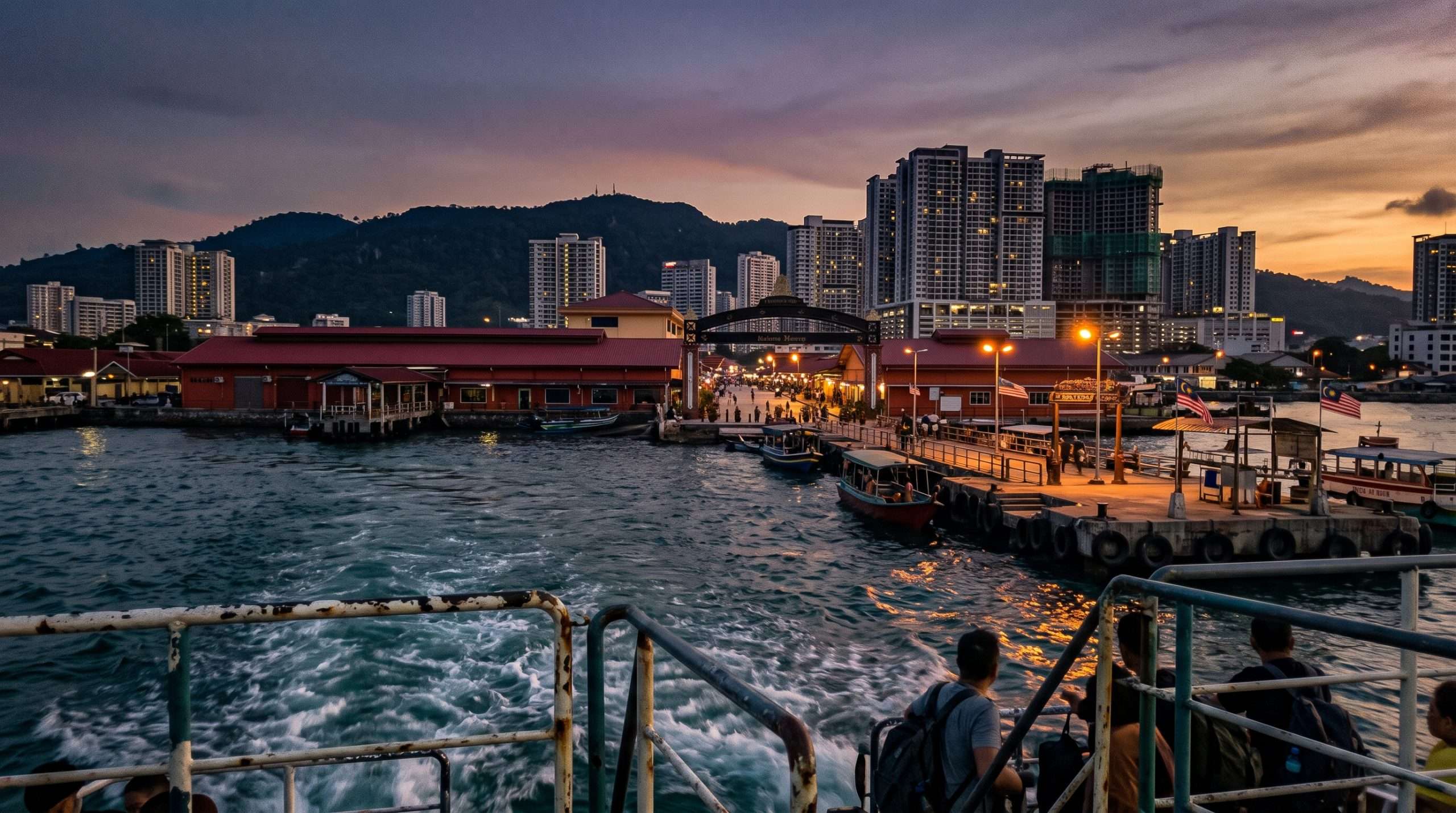
Around three hours after casting off from Labuan, the verdant islands of Tunku Abdul Rahman Marine Park (Gaya, Sapi, and Manukan) materialize off the port bow, acting as a natural breakwater that calms the sea swell. Ahead of you, backed by the green ridge of Signal Hill and the distant cloud-wrapped massif of Mount Kinabalu, rises the waterfront of Kota Kinabalu.
Mobile Photography Focus: Approaching Jesselton Point at Dusk
As the ferry throttles down to idle speed and maneuvers toward the pier in the late afternoon light, stay by a clean side window (or step briefly near the rear doorway if crew permit during docking).
Lens Selection (3x or 5x Telephoto): Switch your phone to its dedicated 3x or 5x optical telephoto lens. Shooting from a moving boat with a wide lens only gives you a giant expanse of grey sea and a tiny sliver of land. The 3x or 5x lens punches straight past the water to stack the visual layers of the city together.
Stabilization & Composition: Ferry engines vibrate heavily at low idle, which can ruin telephoto shots in fading dusk light. Brace both elbows firmly against the window frame or bulkhead—creating a human tripod—before tapping the shutter. Frame the shot so the iconic red-roofed colonial arches of Jesselton Point Ferry Terminal anchor the lower third of the image, contrasted directly against KK’s modern multi-tiered glass hotels, cargo cranes, and warm golden-hour light reflecting off the harbor.
The Cultural Whiplash: From Sultanate Serenity to Sabah Bustle
Stepping off the gangway onto the timber-and-concrete pier of Jesselton Point feels like walking onto a different planet compared to the morning you started in Bandar Seri Begawan.
In Brunei, the streets were hushed, nightlife was non-existent, and strict Islamic law meant not a single cold beer was for sale anywhere in the country. Five minutes after walking under the red historic archway of Jesselton Point in Kota Kinabalu, all your senses are firing at once:
The Sound & Smell: The waterfront boardwalk is alive with families strolling by the sea wall, boat captains shouting out island-hopping transfers for the next morning, and the unmistakable smoky aroma of chargrilled seafood and chicken wings drifting from the night markets down the road.
The Cold Beer Return: Along the waterfront bars and casual kopitiams opposite the terminal, condensation-covered towers of Tiger and Carlsberg beer clink on plastic tables as the sun dips into the South China Sea.
Easy Transit: Grab works effortlessly in Kota Kinabalu—within three minutes of ordering a ride outside Jesselton Point, a driver pulls up for a RM 6 hop down to Gaya Street or the central waterfront hotels, setting you up perfectly for Borneo Day 6: Kota Kinabalu Markets, Islands & Sunset Boardwalks.
Frequently Asked Questions (FAQ): BSB to Kota Kinabalu by Ferry
Can you take a direct ferry from Bandar Seri Begawan to Kota Kinabalu?
No. All passenger ferries departing Brunei leave from Serasa Ferry Terminal (roughly 30 minutes outside central BSB) and terminate at Labuan Island. From Labuan, you must disembark, clear Malaysian immigration, and board a second fast boat to Jesselton Point in Kota Kinabalu.
What happens if I miss the morning ferry from Brunei to Labuan?
Because the connecting fast boat from Labuan to Kota Kinabalu generally runs only once per day in the early afternoon (around 1:00 PM–1:30 PM), missing the morning ferry out of Serasa means you cannot reach Kota Kinabalu the same day by sea. You would either have to stay overnight in Labuan or take a short car ferry from Labuan to Menumbok on the Sabah mainland and catch an overland bus or taxi for the remaining 2.5-hour road journey to KK.
Do I get stamped into Malaysia at Labuan or Kota Kinabalu?
Both matter. Labuan is a Malaysian Federal Territory, so you will exit Brunei at Serasa and get stamped into Malaysia upon arriving at Labuan International Ferry Terminal. However, because the state of Sabah exercises its own autonomous immigration controls, your passport will also be checked/endorsed for Sabah entry when traveling between Labuan and Kota Kinabalu.
Can I buy duty-free alcohol in Labuan to bring into Kota Kinabalu?
Exercise caution. While Labuan’s terminal is packed with duty-free alcohol and tobacco shops, tax-free allowances into mainland Sabah generally require travelers to have spent a minimum qualifying stay (typically 24 to 48 hours) on Labuan Island. If you are only transiting through the terminal for a couple of hours between boats, customs officers at the departure/arrival gates can charge you full import duty on alcohol and cigarettes.
Is the ferry from Labuan to Kota Kinabalu rough?
It can be, especially during the afternoon crossing when winds pick up over the open South China Sea. The middle stretch of the 3-hour voyage often experiences noticeable rolling swells before the boat enters the sheltered waters behind Gaya Island near Kota Kinabalu. Sit toward the rear-center of the vessel and take motion-sickness medication before departure if you are sensitive to choppy seas.


Leave A Comment