

The trip from Porto Novo to Lagos through Badagry Nigeria takes substantially longer than what you’ll see on digital maps. Reality paints a different picture – what Google shows as a 2-hour and 45-minute drive turns into a 5-hour journey. This piece will help you navigate this challenging but important route successfully.
Badagry Lagos is a vital transit point located 43 miles (69 km) southwest of Lagos and 14 miles (23 km) east of the Seme border with Benin Republic. Your vehicle will encounter several checkpoints along the way. Immigration officers often focus on cars carrying foreign passengers. The route starts in Porto-Novo, a city that still shows its rich Portuguese heritage from the 1500s. You can reach it by car from Cotonou in about an hour. Most westbound busses to Lagos end their run at Mile 2 bus stop, which sits 75 kilometers from where you begin.
The border crossing experience comes with its own set of challenges. Officials might ask for passport stamp payments ranging between ₦1,000 and ₦3,000. This detailed breakdown covers everything from your initial preparation in Porto Novo to your final arrival in Lagos. You’ll find practical tips about documents, transport choices and ways to handle common obstacles smoothly.
Starting in Porto Novo: What to Know Before You Leave
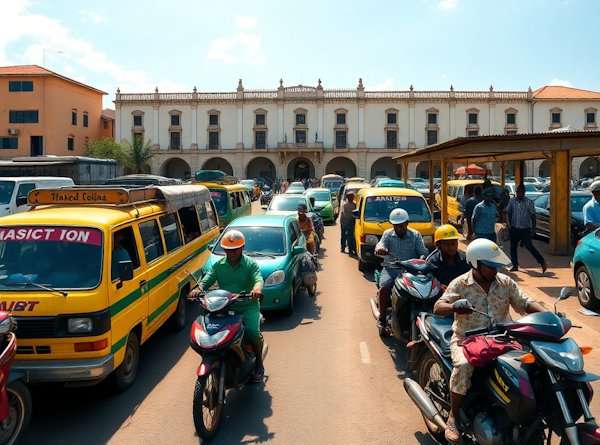
The right preparation in Porto Novo will give a smoother trip to Badagry Nigeria. Benin’s capital has everything you need before your cross-border adventure.
Getting to the Transport Hub
A zemidjan (motorcycle taxi) from Porto Novo costs about 200 CFA to reach where cars leave for the Seme border. You won’t find a regular bus station here – vehicles to Nigeria pick up passengers from specific spots along the road. The 45-minute ride to Seme typically costs around 1000 CFA.
Your accommodation in downtown Porto Novo can point you to the nearest “gare du Nigéria” or “auto gare” where shared taxis depart. If you’re coming from Cotonou, minibusses run to Porto Novo every 45 minutes and cost 600 CFA.
Private cars are the quickest way between Porto Novo and Lagos. The whole trip takes about 1 hour and 43 minutes. Notwithstanding that, border procedures aren’t included in this time and can add delays.
Currency Exchange and SIM Card Prep
You’ll need both currencies ready before you leave. Benin uses the CFA franc BCEAO (XOF), while Nigeria uses Naira. Border rates are usually better than city rates, with 1000 CFA worth about 600 Naira based on recent exchanges.
Porto Novo has several places to exchange money:
- DOFAFLRA BUSINESS CENTER S.A. (Lot 126 R-Dowa)
- DeGott Enterprise (Bd Tokpota)
- GRAND EXPLOIT (Dodji)
- Western Union locations
Check the mid-market rate before exchanging – there’s no such thing as “fee-free” exchanges. Nigeria’s highest bill is 1000 Naira (less than $3 USD), so you’ll get thick stacks when exchanging larger amounts.
A SIM card before crossing is crucial. MTN works well in Benin. Nigeria offers MTN Nigeria, Airtel Nigeria, Glo Mobile and 9mobile. Nigerian SIM cards cost $1-$5 USD, and data plans start at $5. You’ll need to fill forms and give fingerprints to register a Nigerian SIM.
Packing Essentials for the Road
Your Badagry trip needs practical packing. The climate and travel conditions call for:
- Documentation: Passport, yellow fever vaccination card (you must have this) and several photocopies of key documents
- Clothing: Cotton tops that breathe, modest clothes (especially in Muslim areas) and a light jacket for Harmattan season (December-January)
- Electronics: Power bank, flashlight for blackouts and a hand fan for humid days
- Health items: Bug spray, malaria pills, first aid kit and toilet paper for public bathrooms
- Money management: Money belt, small bills in both currencies and zip-lock bags to protect papers
Military or camouflage clothing isn’t allowed in Nigeria. Small change comes in handy as breaking big bills can be tough. Keep your valuables hidden during the trip.
Water is key on your Porto Novo to Badagry Lagos Nigeria trip. Buy bottled water before leaving to avoid unknown stops. Good preparation in Porto Novo makes the Badagry crossing easier by a lot.
Crossing the Seme Border: Step-by-Step
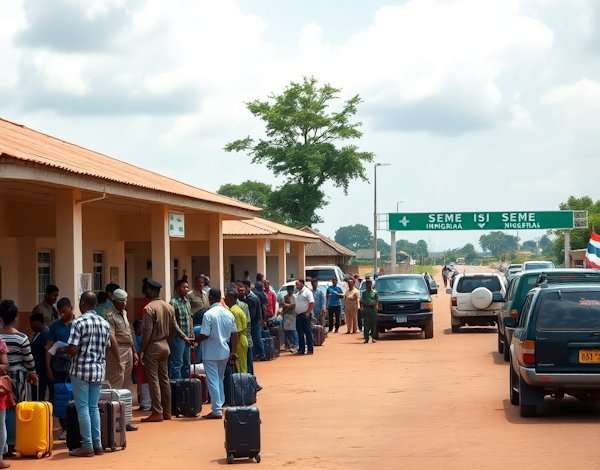
The Seme border crossing has specific procedures that you need to follow when heading to Badagry Nigeria. A good understanding of each step will help you avoid delays at this busy West African frontier.
Benin Exit Procedures
The Benin immigration office sits about 300-500 meters from where transport vehicles usually stop. You’ll likely meet several unofficial “helpers” offering their services—just ignore them unless they’re wearing immigration uniforms.
Officers at the Benin exit point check passports and might ask simple questions about your travel. They process the exit stamp in about 5 minutes per person. The wait can stretch to 30 minutes if it’s crowded.
Official note: ECOWAS agreements allow free movement between member countries on paper, but reality shows a different picture. Unofficial payments between ₦1,000 and ₦3,000 are common for exit stamps. Regular travelers can negotiate these payments, while first-timers often pay more.
Health Checks and Yellow Card Validation
After leaving Benin, health verification becomes your next step. You must have the International Certificate of Vaccination or Prophylaxis (ICVP)—known as the yellow card—to enter Nigeria.
Port Health Service officials check vaccination records and assess health conditions. They focus on:
- Making sure yellow fever vaccination was done at least 10 days before travel
- Matching the certificate number with passport details
- Taking temperature readings and looking for symptoms
- Checking travelers from high-risk health countries
These officials can deny entry to anyone without valid yellow cards, particularly those coming from yellow fever endemic regions. Some travelers might need to get vaccinated at the border at their own cost.
Starting 2025, everyone must fill out the Nigeria Health Declaration Form. You can do this online or get paper forms at the border. This helps track and prevent infectious disease spread.
Nigerian Entry Process and New Security Checks
Nigerian immigration has a new security system in place. Security stakeholders approved four official checkpoints along the Badagry-Seme corridor in 2025 to fight corruption and reduce random checkpoints:
- Seme Point (at the border)
- Gbaji Point
- Apa Point
- Agbara Point (43km from Seme)
These should be the only official stops, with different security agencies working together. But recent reports show more than 21 checkpoints still exist despite the four-point rule.
Nigerian immigration officials handle the formal entry by:
- Checking passport and visa documents
- Asking about your travel purpose
- Sometimes verifying where you’ll stay
- Giving a 90-day stay permit stamp
Customs clearance follows specific steps: customs declaration, submitting documents to various agencies (Nigeria Customs Service, Standards Organization of Nigeria, NAQS and NDLEA), joint inspection and getting customs clearance.
Important security update: Border scanning equipment often has technical issues. Working scanners process people in under an hour, but manual checks can take about two hours.
Badagry lies just 14 miles (23 km) from the Seme border. It’s the first major Nigerian town you’ll reach. The road to Badagry Lagos still has extra unofficial checkpoints, even though the government tries to reduce them.
How to travel from Lome to Porto Novo.
Transport Options from the Border to Lagos
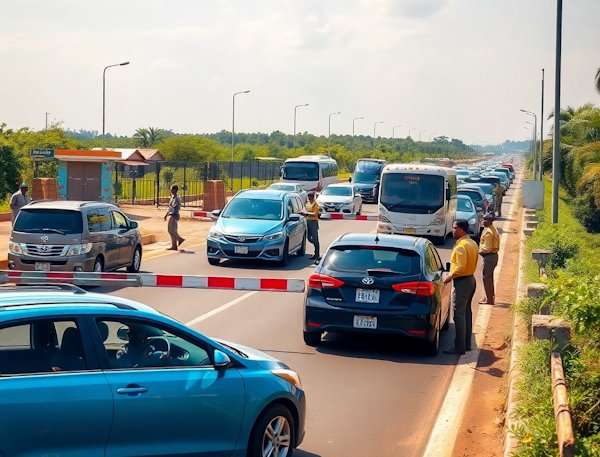
The 82-kilometer experience from Seme border to Lagos through Badagry Nigeria presents travelers with multiple transportation choices. Each option offers different levels of comfort, cost, and travel time.
Private Cars vs. Shared Vans
Your trip from Seme border to Lagos depends on what matters more – convenience or cost. Private vehicles are quick and comfortable but cost more.
Private cars take you straight from the border to anywhere in Lagos. You won’t need to switch vehicles, and your luggage stays secure. This option makes sense financially if you’re traveling with 3-4 people who can split the cost.
Private transport comes in two forms:
- Drivers who only take you to the border (this costs less)
- Drivers who handle the complete trip from Lagos to your accommodation in Benin Republic and back (this premium service costs upwards of ₦120,000 each way)
Shared vans and busses are perfect if you’re watching your budget. These vehicles leave from specific spots near the border and follow set routes to Lagos, usually ending at Mile 2 bus stop. The trade-off is less comfort and extra time because of multiple stops.
Companies like God is Good (GIG), Chisco, ABC Transport and GUO run regular services on this route. These services hit the sweet spot between private and public transport with decent comfort at better prices.
Local motorcycle taxis (okada) connect the border to nearby towns. Nigerian traffic conditions make safety a priority if you choose this option.
Estimated Costs and Wait Times
Transportation prices change based on your choice:
Budget-friendly public transport costs:
- Shared taxi from Badagry to Seme border: ₦150
- Bus from border to Badagry: ₦400
- Complete border-to-Lagos trip via public transport: Under ₦3,000
Private transport costs more:
- Private vehicle (one-way): ₦50,000+
- Complete trip with same driver: ₦120,000+ each way
- Luxury bus services: Prices vary by company and class
The trip should take about 1 hour and 18 minutes. Real-world conditions often extend this time because of:
- Poor road conditions on the Nigerian side
- Over 20 checkpoints between Badagry and Seme
- Lagos traffic jams
- Time spent waiting for vehicles to fill up
A typical 1-hour trip from Seme to Lagos can take 4+ hours on busy days or in bad conditions. Trucks need even more time – sometimes half a day (5+ hours) due to bad roads and frequent checkpoints.
Tips for Choosing Safe Transport
Safety should be your top priority on this route. Solo female travelers need extra caution since police often stop vehicles carrying foreign passengers.
Here’s how to find reliable transportation:
- Choose 10-year-old companies like GUO Transport with their fleet of 80+ vehicles that serve international routes
- Check if drivers have proper ID and vehicle papers
- Look for visible ID cards on motorcycle riders at the border
- Leave early to avoid night travel
- Travel in groups whenever possible
Commercial bus services through well-known companies are your safest bet. These companies handle border paperwork better and deal with fewer random stops.
If you’re driving your own vehicle across the border, you’ll need:
- International driver’s license (valid for one year): ₦7,500
- International car registration (valid for one year): ₦10,000
- ECOWAS Brown Card insurance (valid for 3 months): ₦25,000
Your first vehicle crossing requires a one-time payment of CFA 65,000 (about ₦40,600) to Benin authorities. Keep this documentation handy – you’ll need it to avoid paying this fee again on future crossings.
Navigating Checkpoints and Road Conditions
The road from Badagry to Nigeria puts travelers through a maze of checkpoints that can affect travel times by a lot. Knowing how checkpoints work and what road conditions to expect will save you time and stress on this route.
Types of Checkpoints You’ll Encounter
Security stakeholders have approved only four official checkpoints along the Seme border corridor:
- Seme Point (at the border)
- Gbaji Point
- Apa Point
- Agbara Point
The reality on the ground tells a different story. Between Badagry Bridge and the Seme Border post alone, up to 20 checkpoints exist. The route from Lagos to Seme has checkpoints run by various agencies:
- Nigeria Police Force
- Nigeria Customs Service
- Federal Road Safety Corps (FRSC)
- Immigration officials
- National Drug Law Enforcement Agency (NDLEA)
Some checkpoints serve real security purposes, while others exist just to collect bribes. The Zone 2 Police Command set up a joint task force with members from all security agencies to stick to the four-checkpoint rule. But enforcement isn’t consistent.
Travelers should know that checkpoints increase after dark, so it’s better to travel during the day. First-time visitors often can’t believe how openly officers ask for money, sometimes without even claiming any violations.
How Drivers Handle Bribes and Delays
Smart drivers keep small bills ready for checkpoint payments. Commercial drivers include these costs in their fares, which explains why transport costs more than you’d expect for the distance.
At checkpoints, drivers usually stop briefly, chat with officers, and sometimes hand over money—₦100 to ₦500 depending on the checkpoint. Passengers don’t get involved in these exchanges.
The Nigerian police have rules for safe checkpoint navigation:
- Slow down as you approach
- Keep your hands visible
- Ensure interior lights are on at night
- Lower your car radio volume
- Remain polite and avoid confrontation
- Never touch an officer
Experienced drivers know the unwritten rules at checkpoints. They don’t argue with officers because it can lead to big delays or worse—some incidents of violence have happened when people refused to pay.
Keep an eye on your surroundings at checkpoints and rest stops. Work with security personnel and stay calm to pass through smoothly.
The State of the Badagry-Lagos Road
The Badagry-Lagos road has improved. Governor Sanwo-Olu showed seven upgraded road networks in Badagry Local Government Area and Olorunda Local Council Development Area in 2025. These 16.4km roads include:
- Reconstruction of 3.3km Hospital Road (Phase 1)
- Construction of 7km Samuel Ekundayo-Toga Road (Phase 1 and 2)
- Rehabilitation of Aradagun-Mosafejo-Ilado-Imeke Road (Phase 3)
These better roads now improve transportation and access to tourist spots. The Samuel Ekundayo/Toga road connects Joseph Dosu road to the Lagos-Badagry Expressway, giving drivers another way from Badagry Roundabout to Limca/Ibereko.
Hospital Road (Phase 1) links Idale, Akarakunmoh, Povita, Topo and Ajido communities to the Lagos-Badagry Expressway. These changes have cut down travel times, though checkpoint delays still affect how long trips take.
Badagry plays a huge economic role in Lagos State and Nigeria. It shares a major international boundary and serves as a gateway to at least five West African countries. The Lagos State Government has also removed illegal checkpoints along the Lagos-Badagry Expressway to help traffic flow better.
The roads have gotten better, but you should still plan extra time for your trip because checkpoint stops and traffic can be unpredictable.
Arriving in Lagos: From Mile 2 to Your Destination
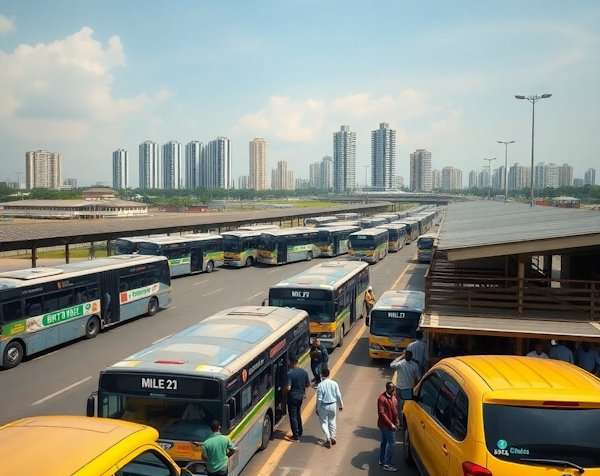
Mile 2 is a vital gateway for travelers heading to mainland Lagos from Badagry Nigeria. This bustling transport hub links passengers to every corner of the sprawling metropolis through several transportation options.
Understanding Lagos Bus Stops
Mile 2 stands as a prominent bus terminal that boasts well-laid-out facilities and plenty of parking space. The Lagos Bus Rapid Transit (BRT) system connects travelers to other parts of the city from this location. BRT busses use dedicated lanes to bypass the heavy traffic on regular routes. These spacious busses run from 6:00 am to 10:00 pm daily and have moved over 400 million passengers in the past five years.
Passengers need a Cowry card to ride the BRT system. You can buy these cards at terminals or kiosks. The cards are rechargeable, and rides cost between ₦250 and ₦600 based on the distance. Modern amenities like free Wi-Fi and USB charging ports make these busses a great choice, especially when Lagos’s power supply isn’t reliable.
The First and Last Mile (FLM) scheme runs community routes using 11-13 seater micro busses. These compact vehicles boost connectivity to main bus routes, rail lines and waterways across Lagos.
Using Uber vs. Local Taxis
Ride-hailing services have transformed Lagos’s transportation landscape. Uber runs round-the-clock throughout the city and provides an alternative to traditional yellow-striped taxis. Bolt, inDriver and Lagos Ride – a government program to replace older commercial cabs – are other popular options.
These ride-hailing platforms offer better safety through emergency assistance buttons and driver tracking. Traditional taxis are nowhere near as safe – experts suggest picking newer, well-maintained vehicles and setting fares before your trip.
How to Negotiate Fares
Negotiation plays a key role in Lagos transport. You should agree on prices with traditional taxi drivers before your trip starts. A typical ride from central areas costs around ₦3,000, while airport taxis charge about ₦5,000 (€2.50) to reach the city center.
Ride-hailing apps show prices upfront. Uber’s partnership with payment platform Paga lets users pay through mobile money apps – perfect if you don’t want to use credit cards.
BRT busses have fixed fares displayed at stations, so no haggling needed. Smart travelers carry smaller bills (₦50, ₦100, and ₦200 notes) for public transport to avoid issues with change.
Your safety comes first no matter which transport option you choose – this becomes even more important for international visitors who arrive from Badagry Lagos.
Settling In: Accommodation and First Impressions
The long trip through Badagry ends at Lagos, Nigeria’s biggest city. You’ll need good accommodation choices and proper planning to make the most of your local experiences.
Where to Stay in Lagos Mainland
The mainland houses most Lagos residents across several distinct districts: Ebute Metta, Mushin, Surulere, Agege, Oshodi, Yaba and Ikeja. Budget-conscious travelers will find many guesthouses, bed and breakfasts and mid-range hotels that put you close to major attractions.
Ikeja’s Government Reserved Area (GRA) ranks among the most desirable neighborhoods, where Nigeria’s top officials make their home. The area showcases spacious, upscale properties from detached houses to bungalows and semi-detached duplexes—perfect for families or luxury seekers.
Young professionals flock to Surulere for its buzzing nightlife and cheaper rent compared to the islands. Yaba, nicknamed “Yabacon Valley,” draws people interested in Lagos’s thriving tech scene.
Generator Culture and Power Issues
New visitors quickly learn about Lagos’s generator culture. These noisy backup machines are such a part of life that neighbors follow unwritten rules about running them at night.
Nigeria stands among the world’s six largest users of backup generators. Private generators supply about 40% of all power in western Africa. The country’s total generator capacity reaches 15-20 GW while the power grid manages only 5-15 GW.
Hotels and restaurants struggle with high power costs that affect their bottom line. Guests should expect occasional blackouts, though generators usually kick in right away.
First Meal and Local Food Experience
Nigerian dishes pack bold, spicy flavors that can surprise first-time visitors.
Jollof rice, a popular West African fried rice dish, serves as a great introduction to local food. Many people pair it with Asun (spicy goat meat) for a complete first meal. Suya brings more heat with grilled meat over open flames, served alongside onions and fresh tomatoes. Fried yam chips offer a milder option.
The city serves up both fancy restaurants and lively street food spots. You can try Ofada rice with its peppery sauce for an authentic taste, while Moi moi (steamed bean pudding) works well for those who prefer less spice.
Enjoy Porto Novo to Lagos by Land
The trip from Porto Novo to Lagos through Badagry needs patience, preparation, and persistence. Digital maps might show a quick journey, but reality turns it into a day-long adventure with checkpoints, document verifications and multiple transport changes. Good planning helps both newcomers and seasoned travelers handle this border crossing smoothly.
Proper preparation is the life-blood of a successful trip. Smart travelers collect their documents, exchange money, buy SIM cards and pack essentials before leaving. Breaking down the border crossing into steps makes it easier to understand – you’ll go through Benin’s exit procedures, health checks, Nigerian immigration and customs clearance.
Your budget and priorities determine your transport choices. Budget-conscious travelers can pick shared taxis and busses. Private vehicles cost more but offer better comfort. Better roads between Badagry and Lagos have cut down travel time, though checkpoint delays still affect the overall duration.
Lagos greets visitors with plenty of places to stay in mainland areas like Ikeja, Surulere and Yaba. Newcomers should expect occasional power cuts, but generators keep everything running. The city’s food scene bursts with flavor – from hot jollof rice to tasty suya on the grill.
This border crossing gives travelers their first real taste of West African travel. The information in this piece helps you direct your way from Porto Novo to Lagos with confidence. You’ll know what hurdles to expect and rewards to look forward to. Maps and online guides rarely show the complete picture, but the journey itself adds to your West African adventure.
FAQs
Q1. How long does the journey from Porto Novo to Lagos typically take?
While digital maps suggest a 2-hour and 45-minute trip, the actual journey usually takes around 5 hours due to border procedures, checkpoints and road conditions.
Q2. What documents are required for crossing the Seme border?
Essential documents include a valid passport, yellow fever vaccination card and multiple photocopies of important documents. The International Certificate of Vaccination or Prophylaxis (ICVP) is mandatory for entering Nigeria.
Q3. What are the transportation options from the Seme border to Lagos?
Travelers can choose between private cars, shared vans and commercial bus services. Private vehicles offer convenience but at a higher cost, while shared transport is more budget-friendly but less comfortable.
Q4. How many checkpoints should travelers expect between Badagry and Lagos?
Despite official directives for only four checkpoints, travelers often encounter over 20 checkpoints along the route. These are operated by various security agencies and can cause significant delays.
Q5. What should first-time visitors know about staying in Lagos?
Lagos offers various accommodation options on the mainland, including areas like Ikeja and Surulere. Visitors should be prepared for occasional power outages and the prevalent use of generators. The local cuisine is known for its bold, spicy flavors, with dishes like jollof rice and suya being popular choices.


Leave A Comment