
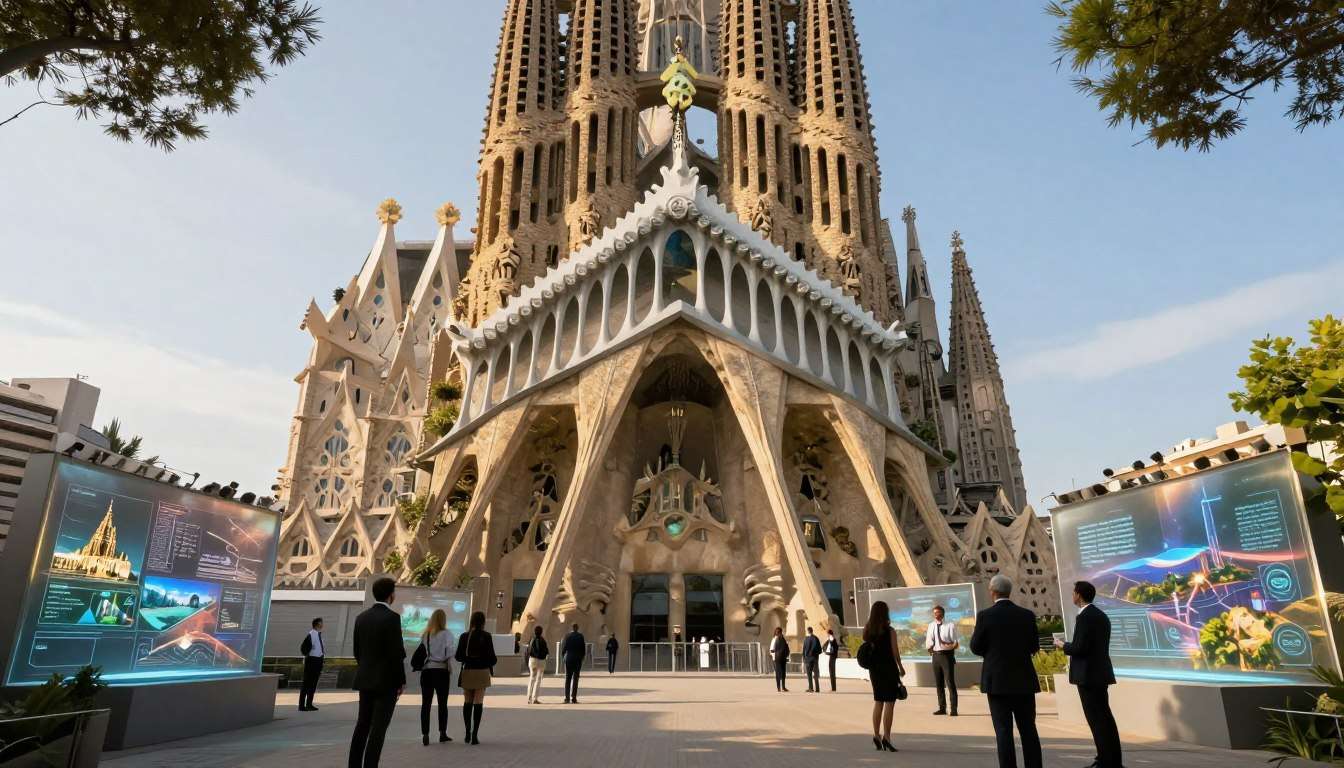
Imagine standing in Barcelona’s Eixample district in 2026. Look up and see the Tower of Jesus Christ towering at 172.5 meters. The Pope has just blessed the final cross. After 144 years of work, there’s a sudden silence.
I’ve seen this building grow over many visits. The cranes have become a part of the skyline. But with barcelona basilica completion near, something feels different. The noise has stopped, but the story is far from over.
Most visitors don’t know this: Gaudí’s unfinished masterpiece isn’t complete in 2026. The tower dedication is a milestone, not the end. The Glory Façade and the grand stairway on Carrer de Mallorca still need work. Decorative details will continue until 2034 and beyond, aiming for 2050.
So, is the work really done? Or are we just starting the most debated phase yet?
Key Takeaways
- The 2026 completion date marks only the Tower of Jesus Christ inauguration, not the entire basilica’s finish
- Construction began 144 years ago and will continue through 2034 for decorative elements and the Glory Façade
- The 172.5-meter central tower makes this Barcelona’s tallest building upon completion
- A Papal visit is expected in 2026 to coincide with the centenary of Antoni Gaudí’s death
- The long-term vision extends to 2050, offering photographers multiple opportunities to document evolving architecture
- The controversial Great Stairway leading to the main entrance remains one of the final major projects
- Visitors between 2026 and 2050 will witness living architectural history rather than a static monument
Why 2026 Is Both Everything and Nothing: The Tower of Jesus Christ Paradox
Many people mark June 2026 on their calendars, expecting it to be the end. But, it’s actually a new beginning. When I planned my Barcelona trip, I thought the Gaudí 100th anniversary would mean the end of construction. But, it’s more than that.
This paradox changes how I see visiting the Sagrada Família. It should also change your travel plans.
The 172.5-Meter Moment We’ve Been Waiting For
2026 is historic because the Tower of Jesus Christ will reach 172.5 meters. It will be the tallest Catholic church in the world.
I’ve looked at many pictures of what this will look like. The tower will have a four-armed cross on top. It will shine in the day and light up the night sky.
This achievement is not just about architecture. It’s a statement of faith. The tower of jesus christ completion will change Barcelona’s look.
Photographers will love this. Visitors can go up in elevators or stairs. They’ll see amazing views from the top.
I’m planning to take photos at different times. The light will change, offering unique shots.
The gaudí 100th anniversary in June 2026 will be special. A Papal visit will mark this milestone. It’s 144 years of work coming to fruition.
The Uncomfortable Truth About “Completion”
2026 is not the end of everything. It’s when the main towers are structurally complete. But, the decoration will take decades.
The sagrada família construction timeline goes into the 2030s. Sculptures, decorations, and the Great Stairway won’t be done by 2026.
The Glory Façade stairway is the biggest challenge. It will cover two city blocks. It needs to move 1,000 families and businesses.
There are big political and logistical issues. Reports say it might not be done until 2034 or later.
| Milestone Year | Major Completion | Visitor Experience | Construction Status |
|---|---|---|---|
| 2026 | Tower of Jesus Christ, main towers structural completion | Full tower access, transformed skyline views | Active work on facades and decorative elements |
| 2030-2034 | Glory Façade sculptural work, interior details | Evolving artistic features, progressive sanctification | Reduced construction presence, focus on artistry |
| 2034+ | Great Stairway (pending approvals), final ornamentation | Complete ceremonial entrance, fully realized vision | Transition to maintenance and preservation |
| 2050 | Total artistic and architectural integration | Sacred sanctuary fully emerged from construction site | Monument preservation phase begins |
This timeline is an opportunity, not a letdown. The sagrada família construction timeline lets us see change over time.
2026 marks a shift from construction site to sacred place. The cranes will leave, and Gaudí’s vision will be complete.
By 2026, you can see through all 18 towers for the first time. The structure will be complete, but the details will keep evolving.
This paradox is freeing for travelers. You don’t have to wait for a mythical “finished” state. 2026 is a dramatic moment of change, even as details continue to evolve.
I’m planning to visit in June 2026 and return in 2030 and 2040. Each visit will capture a different stage of this ongoing transformation.
The Sagrada Família 2050 Vision: A Quarter-Century of Transformation Ahead
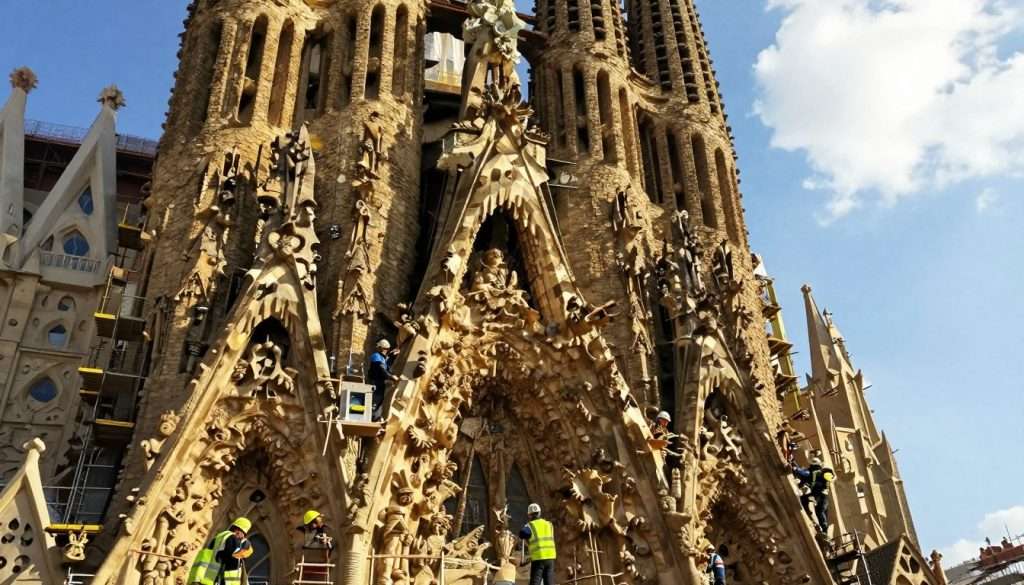
Many think 2026 marks the end, but it’s just the start of the Sagrada Família’s biggest change. The Tower of Jesus Christ’s completion is a big deal, getting lots of attention. But the sagrada família final design goes beyond that tower, aiming for a 2050 vision. This vision will change this barcelona landmark 2050 from a construction site to a complete sanctuary.
It’s surprising how few visitors grasp the work still ahead. The next 25 years promise changes as big as anything in the last 140 years. It’s not just about adding the final touches or small details.
We’re talking about finishing the biggest façade Gaudí ever dreamed of. And changing how the basilica relates to Barcelona itself.
From Building Zone to Place of Worship
Every time I visit the Sagrada Família, I’m struck by the unique atmosphere. The sound of equipment, the cranes against the sky, and the workers moving among the towers create a special experience. You’re not just visiting a monument; you’re seeing it being built before your eyes.
Imagine visiting in 2050 when all the construction noise is gone. The soundscape will change to pure acoustics for worship and contemplation. The views will be clear, showing Gaudí’s complete vision.
The shift from a construction site to a sacred place changes the visitor experience. Right now, the basilica hosts religious services despite ongoing work. By 2050, it will be exactly what Gaudí envisioned—a complete spiritual and artistic statement.
The Sagrada Família is a temple born from the earth and reaching for the sky, a blend of all Christian symbols.
For photographers, this transformation offers unique opportunities across different decades. A 2026 visit captures the central towers’ completion. A 2035 visit shows the Glory Façade’s final form. A 2050 visit reveals the fully realized sanctuary Gaudí envisioned.
The Decades Between: Your Timeline Roadmap
Understanding the timeline between 2026 and 2050 helps plan visits to see the most significant changes. I’ve outlined the timeline based on current construction and architectural priorities.
The most visible changes happen between 2027 and 2035. This period focuses on the sagrada família glory façade, starting its main construction after 2026.
| Period | Primary Focus | Visitor Impact | Photography Opportunities |
|---|---|---|---|
| 2026-2030 | Glory Façade foundation and structural work | Increased construction activity on main entrance side | Contrast between completed towers and emerging façade |
| 2031-2035 | Glory Façade sculptural elements and completion | Most dramatic exterior transformation visible | Documenting the most monumental façade taking shape |
| 2036-2045 | Interior finishing, Great Stairway project, urban integration | Exterior appears complete while interior refinements continue | Capturing the completed exterior form |
| 2046-2050 | Final details, consecration of complete sanctuary | Full access to completed building without construction barriers | Pure architectural photography without scaffolding |
The years after 2026 are special for architecture fans. You can see the Sagrada Família’s completion timeline speeding up as teams focus on the Glory Façade. This effort shows weekly progress during peak construction times.
I suggest planning visits during these key times:
- 2027-2028: Watch the Glory Façade foundations and structural framework emerge
- 2033-2034: Witness the sculptural elements being installed at their most dramatic phase
- 2040-2042: Experience the near-complete exterior with final urban integration projects underway
- 2049-2050: Visit the fully finished sanctuary without any construction presence
The Glory Entrance: Gaudí’s Most Ambitious Vision
The sagrada família glory façade is Gaudí’s most complex statement. He designed it to answer humanity’s biggest questions: our origin, destiny, the Final Judgment, and Eternal Glory. It’s even more monumental than the Nativity Façade he partially completed himself.
The Glory Façade faces Carrer de Mallorca and was always meant as the main entrance. Gaudí wanted visitors to see the basilica’s grandeur from afar. But today, urban development blocks this view.
The Great Stairway project is crucial and controversial. Gaudí’s 1915 plan included a grand staircase crossing Mallorca Street. This would provide the grand entrance and unobstructed views currently impossible.
But there are big urban planning challenges. Closing or modifying a major Barcelona street needs political negotiations, community agreement, and creative solutions. These discussions are complex and non-architectural aspects of achieving the sagrada família final design.
The Glory Façade’s symbolic program covers seven key themes that Gaudí spent years developing:
- Creation and Original Sin
- The theological and cardinal virtues
- The gifts of the Holy Spirit
- The sacraments of the Church
- Death, Final Judgment, and Glory
- Heaven and Hell
- The intercession of the Virgin Mary
Each theme translates into sculptural elements and architectural forms. This façade will be the most detailed and symbolically rich of the three. While the Nativity Façade celebrates Christ’s birth and the Passion Façade depicts his suffering, the Glory Façade addresses humanity’s ultimate destiny.
For slow travelers planning multiple visits through 2050, the Glory Façade construction is key. Each visit reveals new layers of meaning as sculptural elements emerge. By 2035, when this façade nears completion, the Sagrada Família will have its intended main entrance. This will change how millions of future visitors experience this extraordinary building.
Why Slow Travelers Should Plan Multiple Visits Through 2050
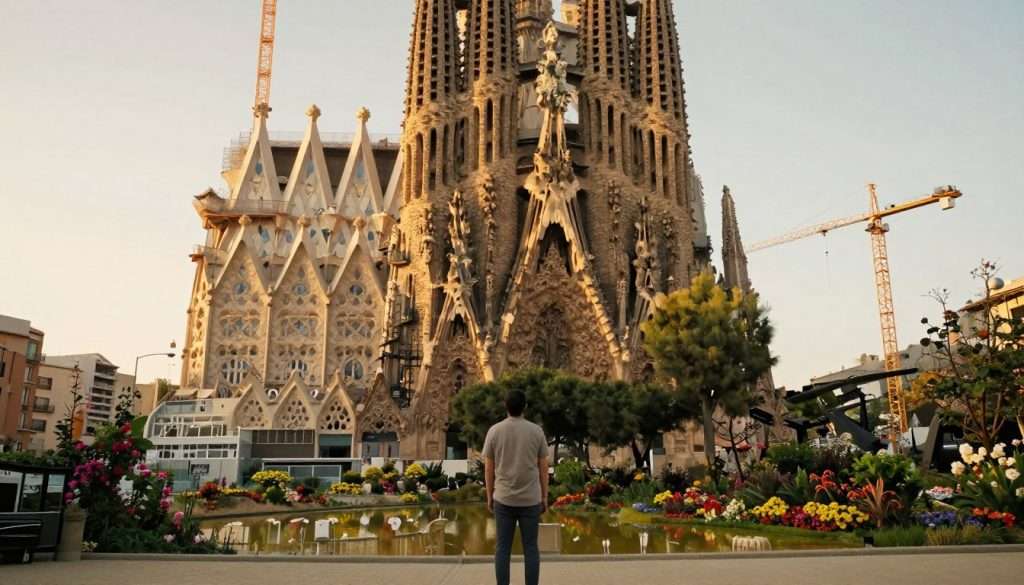
I’ve been to Barcelona’s famous basilica three times in ten years. Each time, it was different. I saw new parts, new sections, and new interior spaces.
This wasn’t just about lighting or seasons. The Sagrada Família changes in ways that other landmarks can’t.
For travelers from the U.S. who love depth, this is a great chance. Visiting multiple times over 25 years is essential to see its true beauty.
The Case for Witnessing Decades of Evolution
Most famous landmarks are finished when you see them. You take pictures of the Eiffel Tower, explore the Colosseum, and admire the Taj Mahal. They were all finished long ago.
These landmarks slowly get worse over time. Efforts to keep them up are ongoing.
The Sagrada Família does the opposite. It’s getting more beautiful every year, following Gaudí’s 140-year plan.
This gives you a rare chance to see a famous landmark finish during your lifetime. You’re not just visiting; you’re documenting history.
Going back every 5-10 years lets you form a special bond with the building. Your photos show the building’s growth over time.
The basilica gets almost 5 million visitors a year. Tickets cost between €25-40. This brings in about €125 million yearly, with half going to finish Gaudí’s work.
This money keeps the building changing. Each visit is different, guaranteed.
2026, 2035, 2050: Three Distinct Experiences
Planning visits for these years offers unique experiences. It’s not just about seeing it grow. Each year is a new chapter in its story.
A 2026 visit captures the Tower of Jesus Christ completion during Gaudí’s centenary. This is history in the making, possibly with a Papal visit.
You’ll get to climb the 172.5-meter spire for the first time. The centenary celebrations and media attention make it unforgettable.
A 2035 visit shows the Glory Façade nearing or reaching completion. This is when the exterior matches Gaudí’s vision.
The main entrance façade changes how you see the building. It’s a game-changer for exterior photos.
A 2050 visit presents the fully realized sanctuary. The building is finished, ready for worship and contemplation.
This is when the Sagrada Família becomes a masterpiece. It’s worth seeing in person.
| Visit Year | Major Milestone | Unique Experience | Photography Focus |
|---|---|---|---|
| 2026 | Tower of Jesus Christ completion | Centenary celebrations, potential Papal visit, first spire access | 172.5-meter vantage point, completed central tower, historic ceremonies |
| 2035 | Glory Façade near completion | Main entrance transformation, exterior vision realized | Complete façade documentation, entrance approach, exterior unity |
| 2050 | Full sanctuary completion | Construction-free environment, final interior details, pure worship space | Completed masterpiece, finished details, transformation documentation |
| Cumulative | 25-year documentation | Personal historical record, evolving relationship with structure | Time-lapse portfolio, generational comparison, legacy documentation |
For budget-conscious travelers, visiting three times over 25 years is smart. It’s cheaper than one expensive trip and you get to see more.
This approach fits perfectly with any barcelona slow travel guide philosophy. It’s about depth, building relationships, and witnessing change.
Barcelona’s Living Monument vs. Static Landmarks
The Sagrada Família’s evolution makes it special for travelers who love discovery. It’s not just about collecting stamps; it’s about building a relationship with a place over time.
Photographing Notre-Dame Cathedral many times shows different views. But the building itself doesn’t change.
Photographing the Sagrada Família shows a different story. The building changes, new parts appear, and light moves differently through the spaces.
I’ve seen windows where scaffolding used to be. I’ve watched towers grow into spires. Each visit makes me rethink my photos because the building demands it.
This living quality makes the Sagrada Família perfect for explorers. They seek unique experiences that can’t be had with one visit or a virtual tour.
The building has survived wars, economic crises, and pandemics. It stayed true to Gaudí’s vision. This shows human perseverance and collective effort over generations.
Seeing this perseverance firsthand across multiple visits creates a connection that single trips can’t. You become part of the story, documenting milestones, and bridging decades of achievement.
For American travelers, seeing a structure that spans centuries is unique. The Sagrada Família teaches patience, dedication, and the value of vision across generations.
Planning visits for 2026, 2035, and 2050 is not too much. It’s the only way to truly understand this extraordinary building. You’re not just seeing progress; you’re witnessing a dream come true.
Photographing History in Real Time: Technical and Artistic Challenges
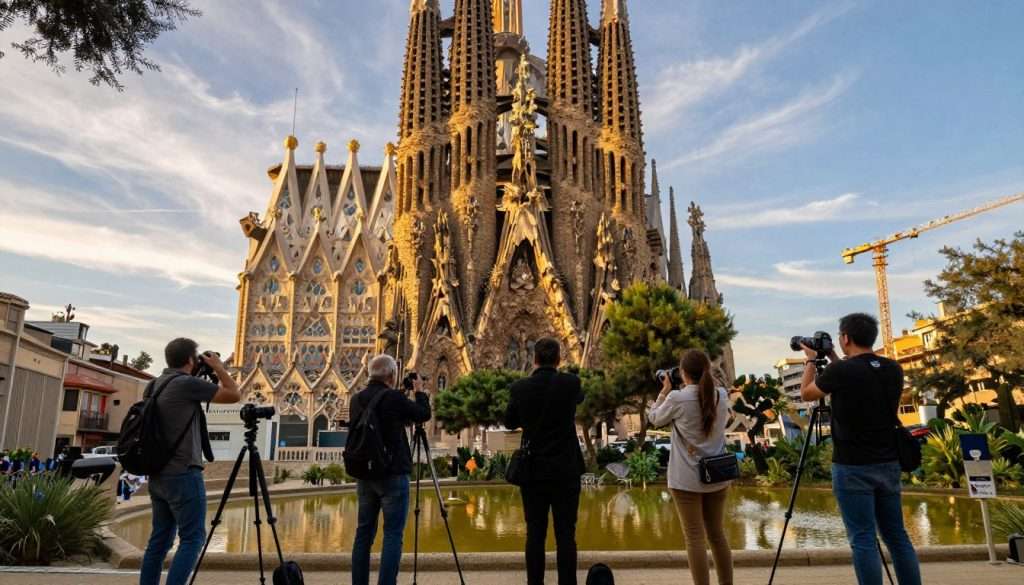
Understanding architectural photography has shown me the challenges of capturing the Sagrada Família’s new spire. The Tower of Jesus Christ is not just a tall building. It’s a 172.5-meter spiritual statement that demands a unique approach.
I’ve researched the best spots to photograph the Sagrada Família once the tower is complete. This has changed how I approach architectural photography. It’s not just about showing up with a camera and hoping for the best.
The Golden Hour Problem: Capturing a 172.5-Meter Spire
Traditional golden hour photography works well for subjects at manageable heights. But the Sagrada Família’s spire is nearly 173 meters tall. This means the top and bottom are in different lighting conditions.
During sunrise or sunset, the top of the spire gets direct sunlight while the base is in shadow. The exposure difference can be 5-6 stops. This is a huge technical challenge.
To solve this, you need exposure blending techniques. You’ll need a sturdy tripod and multiple exposures. I plan to shoot at least three bracketed frames for every composition.
The cross on the tower creates a unique opportunity. It shines with sunlight by day and projects its own light at night. There’s a magical twilight window when the sky still has color and the cross lights up against the darkening blue.
That twilight moment might produce the most spectacular shots of the barcelona skyline 2026 has to offer. I’m planning long exposures to capture the illuminated cross. I want to keep detail in the surrounding architecture and sky.
For focal lengths, I’ve chosen two essential ranges. A 14-24mm wide-angle captures the full vertical drama from ground level. An 85-200mm telephoto is also key for close-up shots of the cross against the sky. The ceramic and glass details deserve close examination.
Best Vantage Points for the Tower of Jesus Christ
Ground-level spots around the Sagrada Família are obvious but limited. I’ve found elevated viewpoints throughout Barcelona for clear sight lines to the tower. These spots will become favorites for photography enthusiasts.
Park Güell offers a distant perspective showing the spire dominating the entire cityscape. From here, you can capture context while the tower still commands attention. Morning light works beautifully from this angle, with warm tones hitting the eastern façades.
The bunkers at Turó de la Rovira provide a 360-degree panoramic opportunity. You can shoot the tower against different backdrops depending on your position. Sunset from here places the illuminated cross against the Mediterranean in the distance.
Tibidabo gives an elevated vantage point from the opposite direction. This position lets you photograph the tower rising above Barcelona’s urban grid with the mountains behind you. It’s perfect for showing scale and urban context.
The best photograph is the one that tells a story nobody else has discovered yet.
I’m excited about the internal photography opportunities. The tower will be open to visitors with elevator and stairs access. Shooting down through the structure, capturing light through that glazed ceramic cross from inside, documenting Barcelona from 172.5 meters up—these are unprecedented angles.
Those stained-glass windows create chromatic effects that change throughout the day. Cool tones—blues and greens—dominate eastern windows in morning light. Warm tones—reds and oranges—flood western windows during afternoon and sunset. Planning your interior shots around these color shifts is essential.
| Viewpoint Location | Best Time of Day | Photography Strength | Distance from Tower |
|---|---|---|---|
| Park Güell | Morning (7-10 AM) | Cityscape context shots | 2.4 kilometers |
| Turó de la Rovira Bunkers | Sunset (Golden hour) | 360-degree panoramas | 3.1 kilometers |
| Tibidabo Mountain | Midday (Clear light) | Urban grid perspective | 5.6 kilometers |
| Inside Tower Access | Varies by window | Unique interior angles | Ground zero |
Documenting Change: Creating Your 25-Year Portfolio
This isn’t a single photographic project ending in 2026. The transformation continues through 2050, and I’m planning a quarter-century portfolio documenting every major milestone.
Think of this as time-lapse photography stretched across decades. Establish consistent vantage points that you return to every two or three years. Shoot from identical positions using GPS coordinates and reference photos to maintain framing consistency.
The Glory Façade’s progression alone will provide years of documentation opportunities. Construction equipment gradually disappearing, scaffolding coming down, sculptural elements being added—each phase tells part of the story.
Creating a cataloging system is essential for a project spanning this timeline. I’m building a database tracking which angles I’ve covered, which seasons I’ve documented, and which lighting conditions I’ve captured. Without organization, a 25-year project becomes chaos.
There’s an artistic question I’ve wrestled with: should I process all images consistently for direct comparison, or allow my style to evolve alongside the building? I’ve decided on a hybrid approach. Maintain consistent exposure and color balance for direct comparison shots, but allow creative processing on supplementary images.
Equipment will change over 25 years—sensors improve, resolution increases, processing software evolves. My strategy is to shoot RAW files that can be reprocessed with future technology while maintaining original JPEGs as historical records of the barcelona skyline 2026 through 2050.
This long-term documentation creates something beyond pretty pictures. You’re building a historical archive with artistic and scholarly value. Future generations will reference your work to understand this transformation.
The technical challenges are significant, but that’s what makes this project compelling. We’re photographing architectural history as it happens, capturing a transformation that occurs at human timescale rather than construction speed. That’s a rare privilege for any photographer.
Appreciate Sagrada Familia
Standing before the Sagrada Família, I see the Tower of Jesus Christ reaching 172.5 meters in 2026. It’s just the start of a long story. This isn’t just about seeing a landmark. It’s about connecting with Gaudí’s masterpiece as it evolves.
The construction timeline from now to 2050 is unique. I plan to visit in 2026, 2035, and 2050. Each time, I’ll see new layers of this amazing building. The completion of the Barcelona Basilica is more than a feat of architecture. It shows what we can achieve together over time.
This basilica has faced wars, economic downturns, and pandemics. When it started in 1882, it was surrounded by farmland. Barcelona grew around Gaudí’s vision, just like we’re growing with its completion.
I suggest you join this 25-year journey. Bring your camera back often. See the Glory Façade rise. Capture the change from a construction site to a sacred place. Your grandchildren will love hearing about your experiences.
The Sagrada Família teaches us that great works last beyond our lifetimes. We’re lucky to see Gaudí’s dream come true in our time. That’s worth coming back for, again and again.



Leave A Comment