
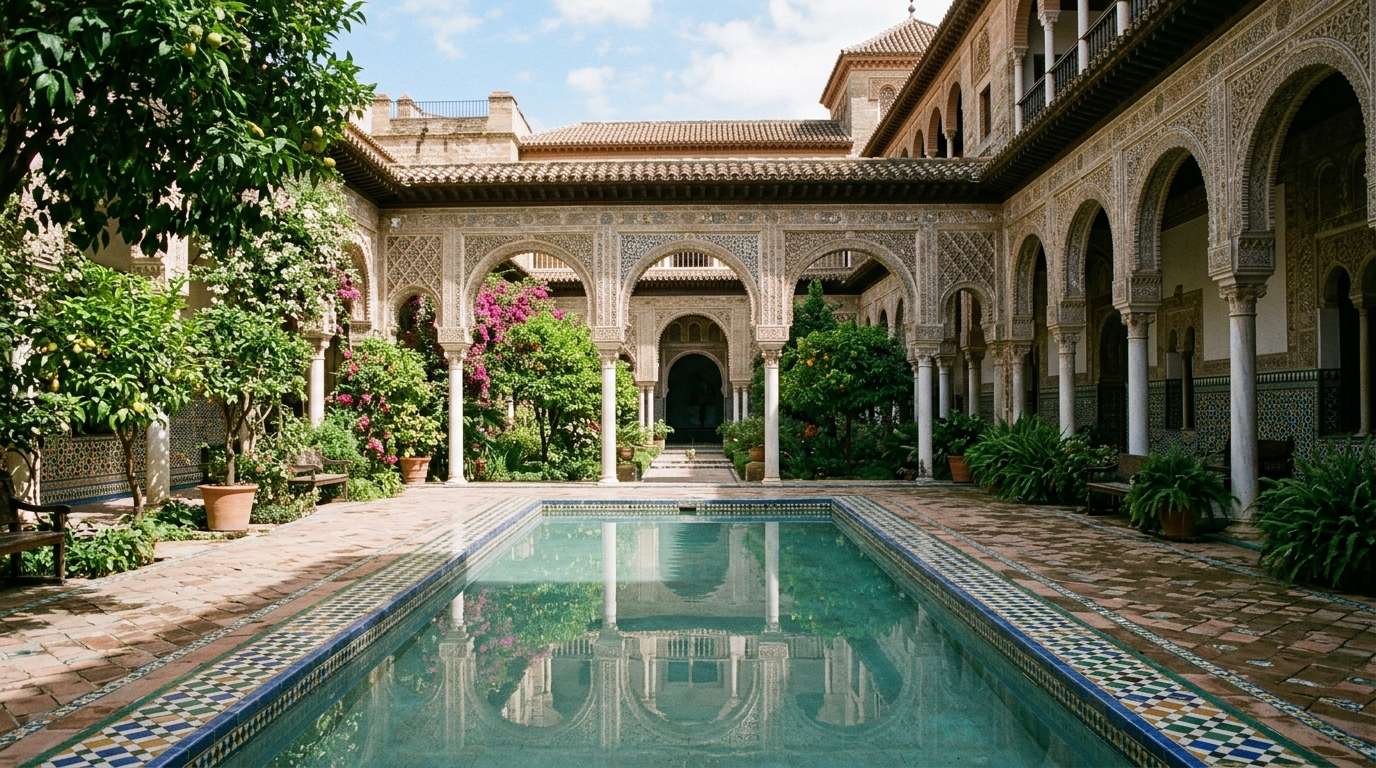
How does Europe’s oldest royal palace still in use survive 45°C heatwaves? The Royal Alcázar of Seville has a bold answer for 2050.
Step from a hot Seville street at midday into a courtyard, and the air drops. Shade, stone and water from its long history do the work.
This UNESCO World Heritage Site, listed in 1987, is still a family home today. The Spanish royal family uses the upper floors when they visit. Its Mudéjar carved plasterwork dates to the 14th century.
The owner’s 2050 vision is a carbon-neutral sanctuary. Breathable nano-mineral consolidants, liquid mineral treatments that rebind crumbling plaster without sealing it, would protect the walls. Subterranean retention vaults would capture 100% of seasonal downpours, while capillary cooling loops chill the halls and piezoelectric pavers feed a microgrid.
This living palace must stay cool, dry and powered without losing its look. I will show three ideas: protect the surfaces, use the water, make power from footsteps. We start with what this palace actually is.
Key Takeaways
- The Alcázar is a working royal residence, so every upgrade must be hidden and reversible.
- Its oldest fortress dates to 913-914, and the Mudéjar palace to the 1360s.
- Andalusia has warmed about 1.5 °C since the mid-20th century.
- The 2050 vision stores rain, cools halls with water, and turns footsteps into small amounts of power.
- Breathable mineral treatments protect old plaster and tile without making them look new.
- Book a timed slot ahead, plan 2-3 hours, and go in the morning.
What the Royal Alcázar Is and Why It Still Matters
The Royal Alcázar of Seville, called the Real Alcázar de Sevilla in Spanish, is a royal palace that people still use today. It is an official residence of the Spanish royal family, and Patrimonio Nacional administers it. The family occupies the upper storeys on visits.
The word alcázar comes from the Arabic al-qaṣr, which goes back to the Latin castrum, a fort. So the name simply means fortress. You may also see it written as alcázar sevilla on Spanish maps.
Inside, the complex mixes Mudéjar, Gothic and Renaissance parts. UNESCO listed it in 1987 with the cathedral and the General Archive of the Indies, as one world heritage entry. Few places serve as both a monument and a home.
The mix shows in a single walk. A carved Mudéjar ceiling may sit beside a Gothic vault, and a Renaissance garden waits outside the window.
Because people live in these rooms, every 2050 upgrade must be quiet, hidden and reversible. One exception surprises many travelers: the royal apartments upstairs are not part of the ordinary visit.
In a palace that is still lived in, every upgrade must stay hidden and reversible.
That rules out loud machines, visible pipes and glue that cannot be undone. Anything fitted behind a wall or under a path must come out again without a scar. To see why such care matters, look at how the site grew, layer by layer.
Auschwitz-Birkenau Memorial future.
From Umayyad Fort to Mudéjar Palace: How the Alcázar Grew
The Alcázar is about 1,100 years old in its oldest form, though most of what you photograph dates to the 1360s. The first fortress goes back to 913-914, and the famous Mudéjar palace of Pedro I came about 450 years later.
Christian rulers did not wipe out Islamic craft. They kept the old skills and hired the craftsmen who knew them, and Granada’s ruler Muhammad V probably sent some. The result is a palace where two cultures share the same walls, and much of the oldest Islamic work is hidden.
The Islamic Citadel and the Almohad Palaces
Seville fell to the Umayyads in 712. In 913-914, Abd al-Rahman III built a roughly square fortified enclosure, about 100 meters on each side. In the 11th century, al-Mu’tamid expanded it, and the new palace took the name al-Mubarak.
Around 1150 the Almohads made Seville their capital in al-Andalus. In 1163 caliph Abu Yaʿqub Yusuf made the Alcázar his main residence. Most of this layer lies out of sight: in 1997 an Almohad palace turned up under the Patio de la Montería.
That hidden layer shapes today’s care. Any new pipe or vault in 2050 must keep clear of it.
Castilian Rebuilding and the Palace of Pedro I
Ferdinand III took Seville in 1248. Alfonso X built his Gothic palace in 1258, and Alfonso XI’s Hall of Justice followed around 1340. Each king added a new wing beside the old ones.
Pedro I rebuilt much of the complex in the 1360s. A Latin inscription gives 1364, and an Arabic one gives 1366. That is the Mudéjar palace most visitors come to see.
Pedro’s palace looks a lot like the Alhambra palaces in Granada. That is why Muhammad V probably sent craftsmen to help. Plaster, tile and carved wood speak one Islamic design language under a Christian king.
Later Additions and the 1755 Earthquake
The Catholic Monarchs, Isabella and Ferdinand, turned the upper floor into their main residence. Charles V built an upper story on the Patio de las Doncellas between 1540 and 1572. Later rulers kept adding rooms and gardens through the 16th century and 17th century.
Then nature struck. Much of Alfonso X’s palace was destroyed in the 1755 Lisbon earthquake. Even so, every phase of construction left its mark, and those buildings survived.
Plaster and tile feel every shift, so a palace this old needs gentle care, not heavy repair. That care now faces a new test: the climate those old walls must endure.
The Heat Seville Is Heading Toward by 2050
Andalusia has already warmed about 1.5 °C since the mid-20th century, and a further rise of 2-3 °C is projected by 2050. For a stone palace in a river city, that means longer hot spells and drier summers. The stress case for the Alcázar is a 45°C heatwave.
Four stressors press on the site today:
- Hotter average years across the whole area
- Fiercer, more frequent heatwaves that raise evaporation and stress garden plants
- Thinner mountain snowpack, with Sierra Nevada snow cover down 30-50% in recent decades
- Falling groundwater, with aquifer depletion up to 1 meter a year in some areas
Snow in the Sierra Nevada melts slowly into rivers that feed the region. Less snow means less water in summer, just when the city needs it most.
Heat is not the whole story. Big swings between hot days and cool nights make plaster expand and shrink, so it cracks. The same swings loosen glazes on tile, one small flake at a time.
The real test is a dry year followed by a violent downpour. Parched ground sheds water, walls soak up moisture and salts, and the next hot week bakes it all. That cycle is what a 2050 plan must break, and it calls for a clear picture of a net-zero palace.
The Royal Alcazar of Seville Future 2050: What a Net-Zero Palace Looks Like
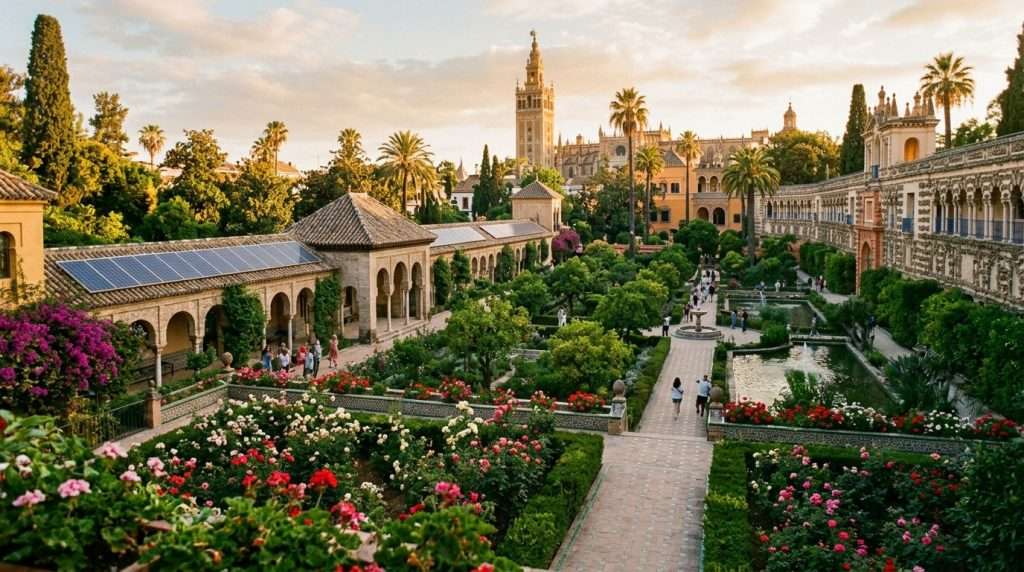
A net-zero Alcázar looks almost unchanged on the surface. Spain’s long-term decarbonization strategy aims at climate neutrality by 2050, and Europe’s oldest active royal residence could meet that goal quietly. The rule is simple: nothing visible may change the palace’s character.
The Royal Alcazar of Seville future 2050 vision treats the palace as a carbon-neutral sanctuary. It also aims to become a model of historic palace resilience.
Net zero means the palace takes no more carbon from the world than it gives back. For a building of thick walls and big courtyards, the biggest savings come from not needing machines at all. Five pillars carry the idea:
- Breathable repair of plaster and tile
- Rainwater vaults under the gardens
- Capillary cooling loops behind the surfaces
- Footstep power in courtyards
- Drought-ready gardens with careful visitor flow
Each pillar hides below, behind or under something old. You would not see a vault, a loop or a paver unless someone told you where to look. The pillars also work as a loop: vaults store rain, rain feeds gardens and cooling, and visitors’ steps help run the pumps.
Prestige matters here. Seville was once the capital of a trading empire, and a working model could guide other World Heritage sites facing the same heat. Every site with old plaster and a hot summer asks the same questions. The first job is the skin of the building: its plaster, tile and gilded wood.
Protecting Carved Plaster, Azulejos and Gilded Domes
Carved plaster fails when salts and moisture cycle in the heat. A nano-mineral consolidant is a breathable liquid mineral treatment that soaks into crumbling plaster or tile and rebinds it without sealing the surface or erasing its aged look.
Breathing matters because moisture must escape through the surface. A sealed surface traps water and later blows off flakes. That is why modern cement or plastic coatings are a mistake in palaces like this one.
Carved Plasterwork That Does Not Flake
The Mudéjar carved plasterwork in the rooms dates to the 14th century. In the vision, the consolidant would reach loose plaster deep inside the carving, so the sharp edges stay sharp. Nothing would shine or look new.
The Patio del Yeso shows that old plaster can survive when handled gently. Its sebka arches were found covered in 1890 by Francisco María Tubino. They were recovered in 1912 under the architect José Gómez Millán.
Glazed Tiles and the Patina Rule
Glazed ceramic azulejos cover many lower walls in the building. Here the patina rule applies: keep the soft tone of old glaze and plaster rather than making it look fresh. A faded blue tells you the tile has lived through time.
The consolidant would rebind loose glaze and crumbling edges. It would not paint over them. Tiles that already shed flakes get the first care.
Gilded Cedar Domes in a Heatwave
The Hall of the Ambassadors has a great dome from the 14th century, and gilded cedar domes crown other halls. Heat dries wood and makes gilding lift. Gentle monitoring and mineral care aim to steady that surface without touching the gold.
Each surface asks for a different touch, and how each tile was made decides how it is treated.
Arista and Majolica: Reading the Tiles Before Anyone Treats Them
Arista tiles are pressed into a mould, and majolica tiles are painted. That one difference decides how each azulejo ages and how a restorer treats it. The table shows the contrast.
| Feature | Arista | Majolica |
|---|---|---|
| How it is made | Pressed into a mould | Painted onto an opaque white glaze |
| How it looks | Raised ridges, three-dimensional | Flat, with painted color |
| When it developed | Earlier than majolica | Later, in the 15th-16th centuries |
| Seville example | Mudéjar geometric panels | Niculoso altarpiece |
Seville was a trade center with many tile producers, and designs were mostly geometric, inspired by arabesque ornament. Arista ridges trap dirt and moisture in their grooves, while majolica chips at its painted edge. A restorer reads the tile first, then picks the gentlest fix.
Francisco Niculoso Pisano from Pisa made two majolica altarpieces for the Catholic Monarchs’ chapel. One survives in the oratory of the royal apartments. Along the walls near the Patio de las Doncellas, you will meet the geometric panels instead.
Here is a photographer’s tip: raking afternoon light shows arista ridges best. Low sun throws tiny shadows from each ridge, and the pattern pops. Also note the lion panel above the Puerta del León. It dates to 1892, by Manuel Tortosa y Fernández, made at the Mensaque factory, and it replaced an older painted lion.
Tiles are only one part of the story. The palace also keeps a hidden source of cool, and it sits in the water under the palace.
Rainwater Vaults Under the Gardens and the Baños de Doña María de Padilla
The idea is to store every storm for the dry months. In the 2050 vision, automated subterranean retention vaults capture 100% of seasonal downpours and hold them below the gardens.
The vaults would filter rain beneath garden paths. A violent storm then becomes a store of water, not a flood. The filtered cistern water later feeds the cooling loops.
The palace already has a store like this. The Baños de Doña María de Padilla is a basement chamber below the Patio del Crucero, and its name misleads. María de Padilla was the mistress of Pedro I, yet the chamber dates to Alfonso X’s Gothic palace.
It is not a bath at all. It is an elongated water basin, a cistern, under Gothic cross-ribbed vaults. The 2050 vaults copy that old logic with modern filters and sensors.
The vaults sit below ground, so the visible gardens stay unchanged. Before any construction starts, archaeologists would check each area, because the history of this site runs deep. Once the water is stored and clean, it can cool the halls.
Capillary Cooling Loops for the Palace Halls
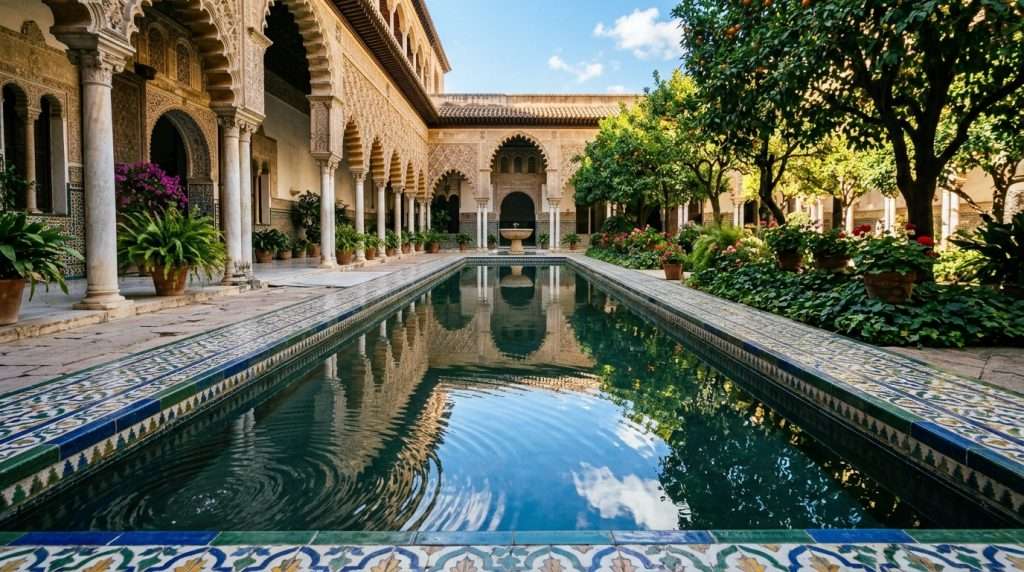
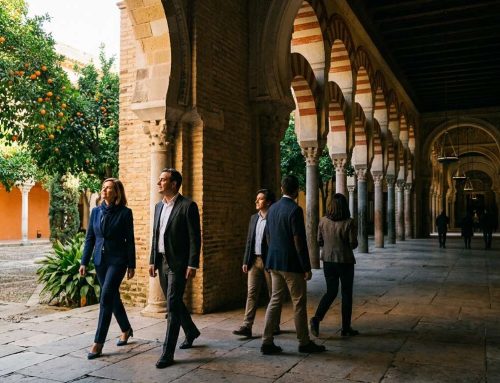
The palace already cools itself with shade, thick walls and water. The Patio de las Doncellas has a long reflecting pool, with flowerbeds one meter below the pavement. The 2050 plan builds on that same logic.
A capillary loop is simple: thin tubes carry cool water behind a surface. A peer-reviewed study in Energy and Buildings monitored the Courtyard of the Maidens for temperature and humidity from 2020 to 2023, including heatwaves. It found that the courtyard moderates extreme temperatures and helps keep conditions good for plasterwork.
| Element | Old role | 2050 role |
|---|---|---|
| Thick walls | Block midday heat | Same job, watched by sensors |
| Shaded courtyard | Keeps the air cool | First line of defense |
| Reflecting pool | Cools air as water evaporates | Filled from stored rain |
| Underground basin | Holds cool water | Retention vaults feed clean water |
| Cooling loops | Not used | Thin tubes of cool water in hidden backing |
The vision calls for zero-emission, closed-loop capillary cooling loops that use filtered cistern water. Do not run loops through carved plaster surfaces. They stay in hidden backing, such as the rear of a modern wall layer in a building area that holds no decoration.
Closed loops lose no water, so the cool store lasts. Pumps still need power, and the palace has a plan for that.
Footsteps as Power: Piezoelectric Pavers in the Patio de las Doncellas
Every step you take could feed a small share of the palace’s power. Under-floor piezoelectric pavers turn footsteps into clean power for the microgrid, across the Patio de las Doncellas and the garden walks.
A piezoelectric layer makes a small electric charge when something presses it. Walkers press it with each step, and wires carry that charge to the local microgrid. The power is modest, so it suits sensors, lighting and pumps, not the whole palace.
The pavers would sit under walkways, not under delicate floors. The patio’s ground level dates to the 1360s, and Charles V added the upper story from 1540 to 1572. Those layers stay untouched.
Think of the courtyard as a quiet power station. Year after year, thousands of feet cross the Las Doncellas courtyard, and each step adds a trickle. A trickle can run a humidity sensor or a small pump for a long time.
The same footfalls would also tell staff where crowds gather. Above these paths, though, live the plants that need all that water.
Keeping the Gardens Alive in a Hotter Seville
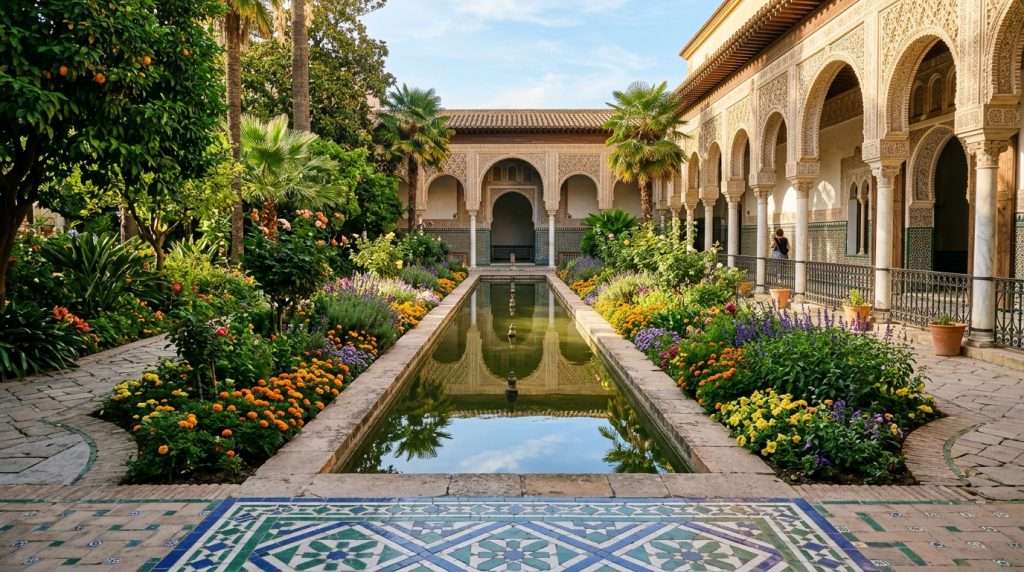
Seville’s palace gardens were buried for centuries and came back. The garden and pool of the Patio de las Doncellas were built in 1356-1366, then buried under marble in 1581-1584. Excavations in 2002-2005 brought them back.
That hidden Mudéjar garden stayed in good shape beneath the marble for more than four centuries. Sunken beds protect plants, and the flowerbeds there still sit one meter below the pavement. Four measures would carry that lesson into 2050:
- Irrigate from stored rainwater
- Favor drought-hardy Mediterranean plants beside the historic citrus and shrubs
- Keep sunken beds, which hold moisture and shade
- Water at night to cut evaporation
The Almohad sunken garden under the Patio de la Montería lay about 1.5 meters beneath the halls, with a channel for irrigation. Mudéjar courtyards use a water line, a long reflecting pool. Almohad quadrant gardens are preserved in the Patio del Crucero.
Old designers already knew the trick. A sunken bed sits in its own shade and keeps moisture from escaping. At the top of the care list, the 2050 plan simply keeps the old shape and waters it wisely. Sensors would watch all of this from the shadows.
Sensors, Low-Carbon Repairs and Smarter Visitor Flow
A quiet network of sensors is the palace’s early warning system. Sensor networks can track humidity, temperature and wear in Mudéjar and Gothic rooms in real time. Readings tell staff a hall is too humid before damage appears.
Today, staff mostly spot damage by eye, after it shows. A sensor would flag a damp wall weeks earlier, and a crew could fix a leak while the plaster is still sound. One caution matters: sensors must be tiny and hidden, never fixed to carved surfaces.
Repairs follow the same gentle rule. Low-carbon materials like lime, with traditional craft methods, match centuries-old work. Lime breathes, and cement does not, so lime is the repair choice.
Visit timing is the last tool. Pre-booked, staggered time slots are the current model for visit control. Timed groups spread crowds so narrow courtyard areas avoid heavy wear at any one time.
All this care serves a place that belongs to more than the royal family. It sits in a wider World Heritage site.
Where the Alcázar Sits in Seville’s World Heritage Trio
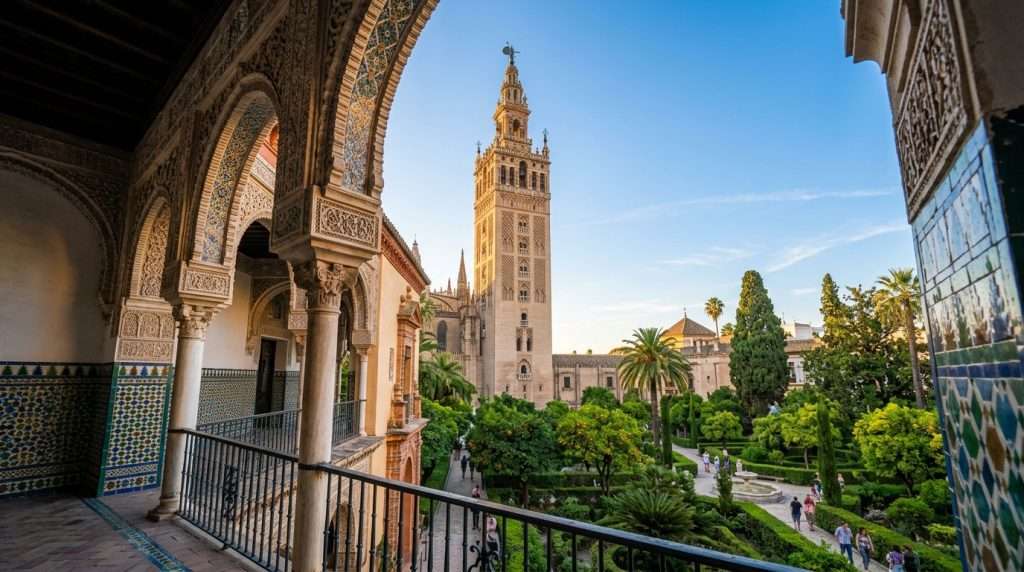
Three buildings share one UNESCO listing. UNESCO inscribed the Cathedral, the Alcázar and the Archivo de Indias together in 1987, with a minor boundary change in 2010. The property covers 12 hectares, with a buffer zone of 187 hectares.
| Monument | What it is | Key fact |
|---|---|---|
| Alcázar | Royal palace complex | Sala de los Almirantes housed the Casa de Contratación |
| Cathedral and Giralda | Gothic cathedral, former minaret as bell tower | Five naves, largest Gothic building in Europe |
| Archivo de Indias | Archive building | Dates to 1585, became the Archivo General de Indias in 1785 |
The listing meets criteria (i), (ii), (iii) and (vi). The Giralda, a former minaret, is the cathedral’s bell tower. In the Alcázar’s Sala de los Almirantes, plans for Magellan and Elcano’s circumnavigation of 1519-1522 were made.
Seville was the capital of the Carrera de Indias, the only trading port with the Indies from 1503 until 1718. A day plan labeled Alcázar Archivo Indias will cover all three heritage site stops within a short walk.
For most first-time visitors, the Alcázar and the cathedral together are the top thing to do in Seville. The three sit within walking distance, so any 2050 work must keep their shared setting intact. If this makes you want to go, here is how to do it today.
Planning a Visit Today: Tickets, Timing and Route
Book a timed slot ahead. Anyone searching for Royal Alcazar of Seville future 2050 tickets will find that the 2050 systems are a vision, while today’s tickets are ordinary timed entries.
Is the Real Alcázar Seville free? It is usually paid, with limited free windows that change, so confirm on the official site before relying on one. I give no prices here, because they and the hours change.
Tickets and Timed Entry
Entry runs through timed, pre-booked slots. Pick the earliest one you can. A mistake I see often is arriving late: a missed slot can mean a long wait or a lost visit.
How Long a Visit Takes
Most visitors take about 2-3 hours to go around the palace. Add extra time for the gardens, and more if you like photography or travel with family. Rushing the courtyards loses the best part.
A Route and Photo Plan That Beats the Crowds
The main gate is the Puerta del León. After it comes the Patio de la Montería, then the Mudéjar palace. This order works well:
- Puerta del León
- Patio de la Montería
- Patio de las Doncellas and the Hall of the Ambassadors
- Patio del Yeso, an Almohad courtyard reached from the Sala de Justicia
- Gardens and the Baños beneath the Patio del Crucero
Photographer’s tip: go at opening time for soft light and fewer people. Then decide whether the visit is worth the effort.
Is the Alcázar Worth It, and How Does It Compare With the Alhambra?
Yes, the Alcázar is worth it. In my Royal Alcazar of Seville future 2050 review, the verdict is clear: it suits anyone who loves tile, courtyards and layered history. Pick Seville for city life and Granada for mountain setting, and see both if you can.
| Feature | Alcázar | Alhambra |
|---|---|---|
| City | Seville | Granada |
| Setting | Guadalquivir river basin | Foothills of the Baetic mountains |
| Main style | Mudéjar | Nasrid |
| Royal use | Still used by the royal family | No active royal use |
| Main period | 1360s, under Pedro I | Nasrid era |
Both are fortified palace complexes built mainly under Al-Andalus culture, and both were listed about forty years ago. The Alcázar is Mudéjar, from Christian-ruled Seville, while the Alhambra is Nasrid. Pedro I’s palace resembles the Alhambra palaces, and Muhammad V of Granada probably sent craftsmen.
The architecture differs in feel. Seville gives you gardens, tile and a living palace in a busy city. Granada gives you a hilltop view. A century of change sits in each.
One “when not to” note: skip the Alcázar on a hot midday if you cannot book a morning slot. The courtyards are cool, but the walk between them is not. Heat makes the visit shorter and less happy, and staying comfortable matters as much as the plan.
Staying Safe and Smart Around the Palace
Seville is generally safe, especially in lit and busy streets. Central areas are usually fine at night with normal city precautions against pickpockets. The main risks are the summer midday heat and crowds.
Plan around the midday heat and watch your bag in crowds, and the city treats you well.
The Alcázar sits near the cathedral in one of the most visited areas of Andalusia’s capital. Crowded places draw pickpockets, as they do in any large city. Five things not to do:
- Skip booking ahead
- Walk the old town at 3 pm in summer
- Carry valuables openly in crowds
- Buy from street touts near the gates
- Wander dark, quiet lanes alone late
Walking at night in the center is usually fine with common sense. Stay on lit streets where other people walk, and keep your phone and wallet out of sight. At any time of day, a small cross-body bag worn in front works best.
Bring water, a hat and sunscreen for the long courtyard walks. With those habits in place, I can offer some closing thoughts.
Conclusion
What stays with me from this palace is how little it needs to learn. Its old water and shade ideas are the base of the Royal Alcazar of Seville future 2050 plan: thick walls, cool basins, shaded courtyards and gardens that sit low in the ground.
The best way to understand that plan is to stand in a courtyard and feel the difference yourself. Step from the street into the shade and notice how fast the air changes. This World Heritage palace explains itself.
Your next step is simple: book a morning timed slot and bring a camera for the tiles. The palace is waiting, so go and see it.




Leave A Comment