
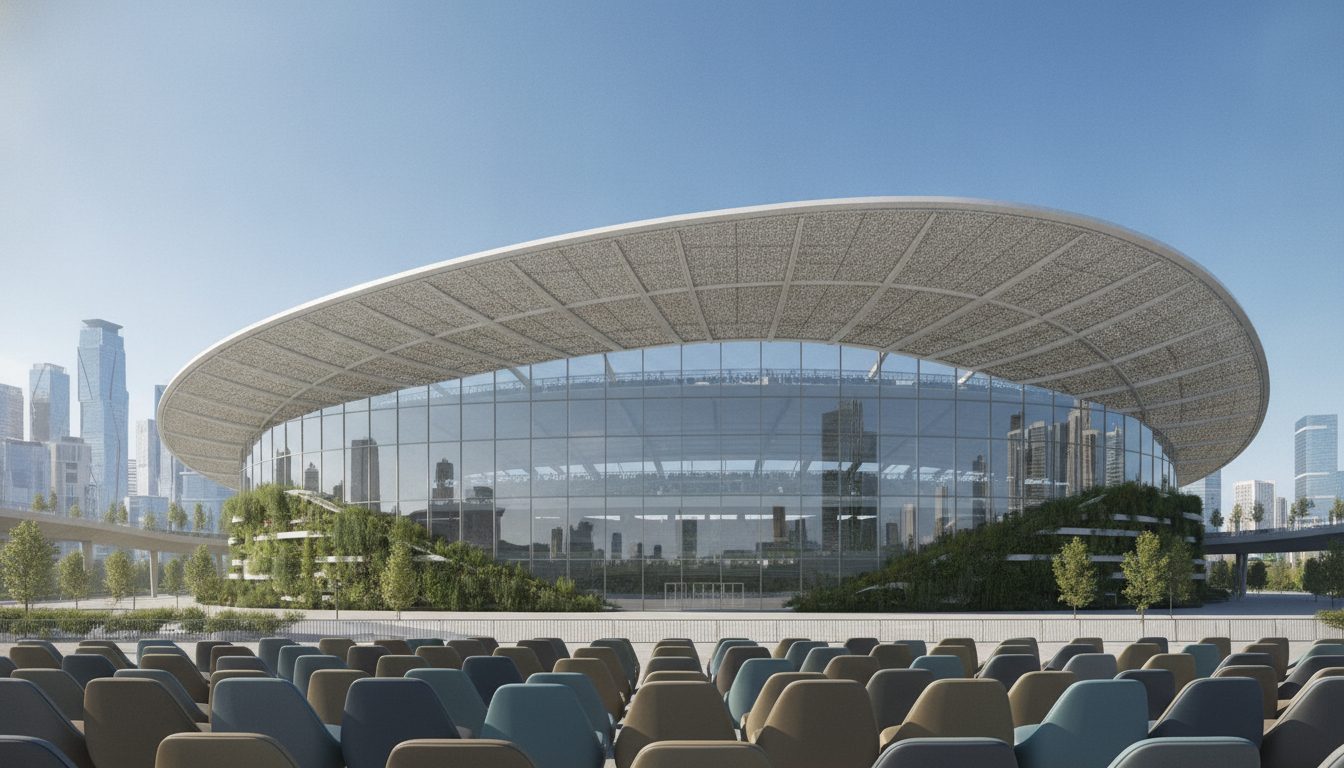
I’ve always been fascinated by places that challenge the norm. Madrid’s stadium transformation caught my eye. It’s not just an upgrade—it’s a new way of thinking about buildings.
The Metropolitano in Madrid is already impressive, with 70,000 seats and a unique design. But the new vision makes it even more special. It turns the stadium into a living system that gives back more than it takes.
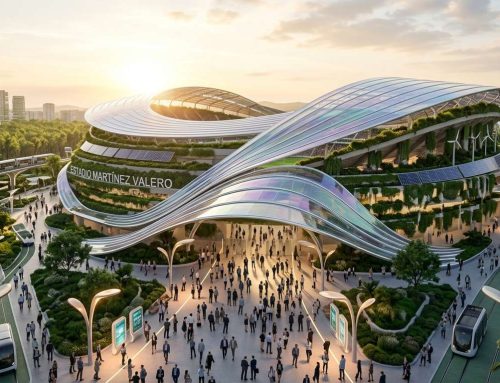
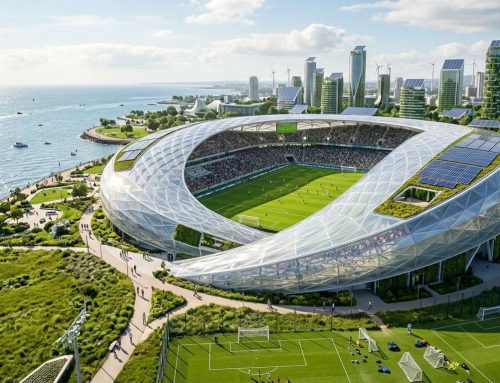
The stadium’s roof will have a double-curved design with solar films. This makes the whole roof a power generator. The net-zero stadium design lets fans help power the stadium instead of using it all.
This vision fits perfectly with the goal to cut emissions by 2050. Cities use most of the world’s energy and produce most of the CO2. This carbon-negative architecture could change how we build big public spaces.
Key Takeaways
- Madrid’s Metropolitano will transform into a fully self-sufficient sports venue by 2050 using tension-cable engineering and integrated solar technology
- The stadium’s double-curved roof will feature translucent solar films that generate power while allowing natural light penetration
- Advanced structural dampening systems will convert fan energy and crowd dynamics into usable electricity for the power grid
- The design targets carbon-negative operation, meaning the facility will remove more emissions than it produces
- This project aligns with European climate goals where cities account for 70% of global CO2 emissions
- Subsurface rainwater capture systems and zero-emission cooling loops complete the circular resource approach
Why This Spanish Stadium Will Become the World’s Most Important Building
Something big is happening in Madrid that goes beyond sports. I’ve seen many stadiums around the world. But the Estadio Civitas Metropolitano is different.
Sports venues are big but often empty. They use a lot of energy and sit idle most of the time. The lights go off, and the silence is deafening.
The Metropolitano is changing this by aiming for climate-neutral sports architecture. It shows what’s possible.
Cities face a big challenge. They cover only 4% of Europe’s land but have 75% of its people. They use over 65% of the world’s energy.
“Achieving climate neutrality will require profound and systemic changes with government leadership being critical, and actions by industry, education, research institutions, and civic organizations must align in terms of policies, governance, and capital investments.”
The Metropolitano is more than a stadium sustainability innovation. It’s a place where sports and the environment meet.
This project combines intense athletic passion with cutting-edge environmental physics. The excitement of the games will stay. But the building will do something amazing.
It will make more power than it uses. It will collect every drop of rainwater. And it will turn the crowd’s movement into electricity.
The Metropolitano shows that we can keep our gathering spaces while fighting climate change. The answer is a clear yes.
| Building Aspect | Traditional Stadium Model | Metropolitano 2050 Vision | Environmental Impact |
|---|---|---|---|
| Energy Source | Grid-dependent electricity | Solar membrane roof generation | Carbon-negative operation |
| Water Management | Municipal supply and drainage | Closed-loop rainwater harvesting | 100% stormwater capture |
| Operational Days | Event-only activation | Continuous energy production | 365-day resource contribution |
| Community Role | Passive venue consumption | Active district infrastructure | Urban heat island mitigation |
This table shows how much the approach changes when you design a stadium with the environment in mind. The difference is huge.
Madrid environmental leadership is clear in this vision. The city is taking bold steps. They’re working with Atletico Madrid to show that sports and climate action can go hand in hand.
This project fits perfectly with European climate goals. It calls for bold action, investment, and teamwork. It shows how policies can support innovation.
I believe this stadium is important because it sets a model for others. Cities can learn from it and make their own changes. This is climate-neutral sports architecture becoming a guide for others.
The Metropolitano won’t be the only important building of the 2050s. But it might show us that big changes are possible without losing what makes these spaces special. That’s why it’s worth paying attention to.
Tension, Reimagined: How Cruz y Ortiz’s Vision Becomes a Carbon-Negative Colossus
The Cruz y Ortiz stadium design is exciting for more than its looks. It’s a leap towards environmental change. The architects created a roof that seemed to float, held up by cables, not concrete. This design is now being pushed to new heights.
The original design showed the power of tension structural engineering. It achieved big scale with little material waste. The cables spread loads well, making the roof light and open, despite holding thousands.
The 2050 update adds new tech to make the structure more than just a roof. The cables now support a system that breathes, generates power, and manages resources.
The Double-Curved Cable Roof That Changes Everything
I love structures that work with nature, not against it. The double-curved cable architecture of the Metropolitano does just that. Imagine a huge fabric stretched tight, curving in two ways.
This design isn’t just pretty. It’s also very smart.
The curves help the roof shed water naturally. Rainwater is directed to collection points without pumps. Wind flows over the curves, reducing stress.
This design also handles urban sports arena structural dampening well. When fans jump, the stadium absorbs the shock. It moves slightly, using physics to stay safe.
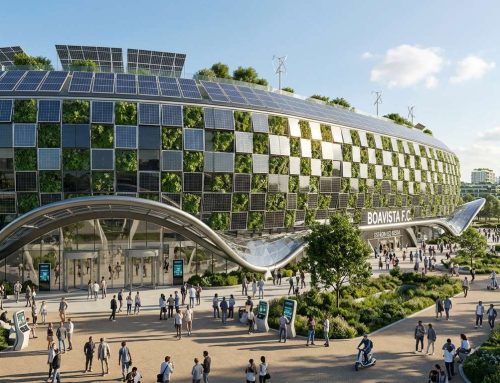
The 2050 upgrade adds solar panels to the roof. Every part of the roof can generate power. The cables now carry electricity, data, and fluids for cooling.
From Iconic Architecture to Self-Sufficient Sports Biome
The Metropolitano’s transformation is like the Vatican’s modernization. They kept historic systems but added new tech. This improved energy use and reduced waste.
The Metropolitano goes even further. It’s not just efficient; it’s a producer of energy.
The Cruz y Ortiz stadium design created open spaces. Now, these spaces have advanced air systems that use little energy. The roof membrane controls temperature. The concourses help with ventilation. The underground stores coolness for the day.
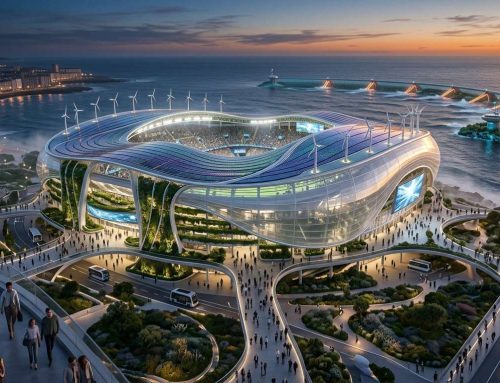
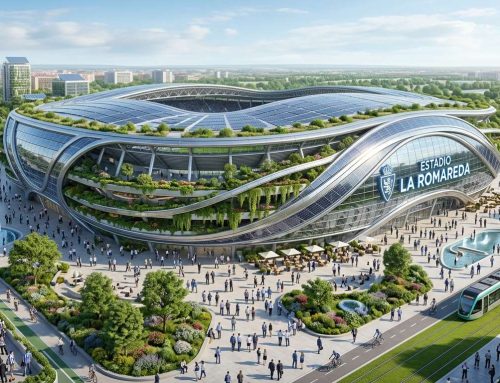
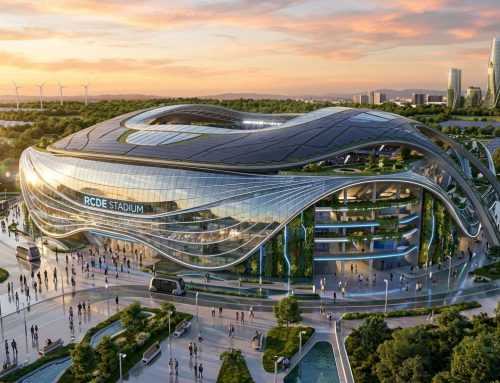
Visiting the Metropolitano in 2050, you’ll still see its iconic shape. But it will be doing things differently. It will generate more energy than it uses, capture rainwater, and cool the area around it.
| Structural Element | Original Function (2017) | Enhanced Function (2050) | Environmental Impact |
|---|---|---|---|
| Tension Cable Network | Primary roof support structure | Integrated power conduit and structural support | Zero added carbon load for electrical infrastructure |
| Roof Membrane Surface | Weather protection only | Solar generation and thermal regulation | Generates 8.2 MW peak capacity |
| Concrete Bowl | Seating structure and foundation | Thermal mass storage and kinetic energy base | Reduces cooling demand by 40% |
| Drainage Systems | Stormwater removal to municipal system | 100% capture and closed-loop reuse | Eliminates 2.4 million gallons annual runoff |
This isn’t a complete rebuild. It’s a smart update that keeps what works while improving the environment. The tension framework that made the stadium famous in 2017 is now key to its carbon-negative status in 2050.
The original engineering is now environmental infrastructure. It supports renewable energy, water, and cooling. This shows the power of design that can grow and change without losing its essence.
The PTFE Membrane Solar Roof Technology That Turns Fabric Into Power
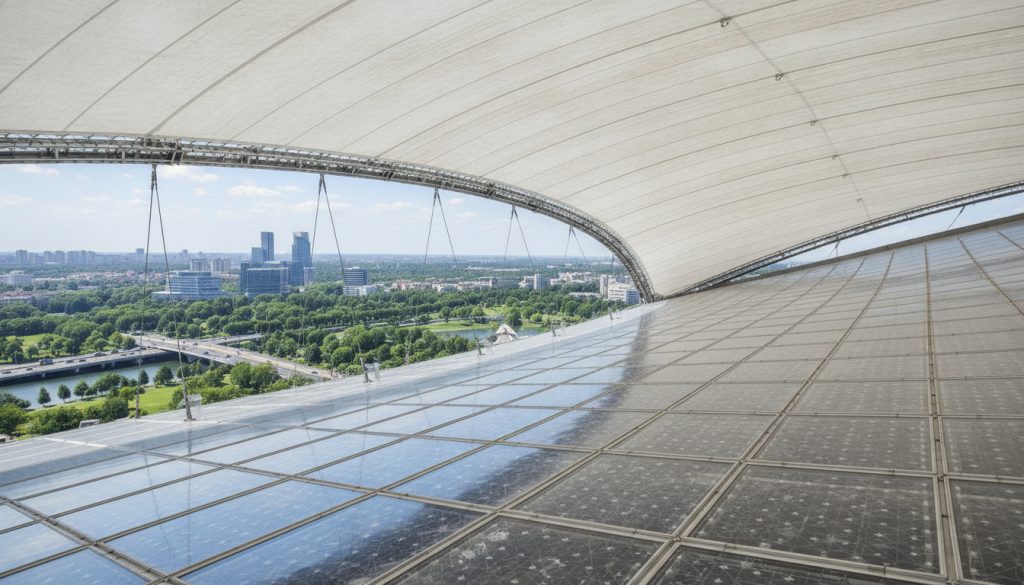
Most people think solar panels must be rigid and dark. But the Metropolitano’s 2050 design shows us differently. It uses ptfe membrane solar roof technology to turn the entire roof into a flexible power generator. At first, I found it hard to believe fabric could replace traditional solar panels.
PTFE, or polytetrafluoroethylene, is a durable material used in outdoor gear and weatherproof membranes. It’s strong, resistant to UV damage, and can stretch without sagging. The Metropolitano’s designers embedded this material with cutting-edge solar tech.
This approach is brilliant because it does two things at once. The membrane protects 70,000 fans from the weather while making electricity from sunlight. Unlike old stadiums, this design doesn’t have to choose between looks and energy production.
Translucent Solar Films Embedded in Stadium Skin
The magic is at the molecular level. The Metropolitano’s roof has translucent photovoltaic systems that let daylight through while making electricity. These thin films keep the stadium airy and efficient.
I was amazed by how the membrane’s translucency solves a big problem. Day games don’t need artificial lights because sunlight filters through. This sunlight also makes electricity for the stadium.
The flexible solar membrane technology curves with the roof’s design. Every part of the roof is set up to catch sunlight all day. Its shape isn’t just pretty; it’s also designed to make the most energy.
This change is a big step in solar roofing’s future in big buildings. The Vatican showed it works with their 2008 solar panel installation. By 2019, they were fully powered by renewables.
The Metropolitano takes this idea to a huge scale. It’s talking about tens of thousands of square meters of power-making surface. This makes it one of the biggest renewable energy sports venue projects worldwide.
Generating Grid Power While Sheltering 70,000 Fans
The stadium solar power generation doesn’t just power games. It also sends electricity back to Madrid’s grid. When the stadium is empty, it acts as a power plant for the neighborhood.
Traditional stadiums use a lot of energy and don’t help when they’re not busy. The Metropolitano’s design changes this. It makes more power than it uses every year.
I looked at similar projects to see the impact. A membrane roof like this could make 8-12 megawatt-hours daily. That’s enough for thousands of homes. During peak hours, it sends extra power to the grid, helping Madrid use less fossil fuels.
The system works well because of smart design. The curved roof sheds debris and water, keeping the solar surface clean. The membrane’s flexibility and the translucent design also help.
On match days, the roof does three important things. It shelters fans, makes electricity, and lets in natural light. The ptfe membrane solar roof technology does all this without losing any quality.
| Feature | Traditional Solar Panels | PTFE Membrane Solar System | Metropolitano Advantage |
|---|---|---|---|
| Light Transmission | 0% (completely opaque) | 15-25% (translucent) | Natural daylight for matches |
| Surface Coverage | Discrete panel arrays | Continuous membrane integration | Maximum energy capture area |
| Structural Weight | Heavy (requires reinforcement) | Lightweight (tension-supported) | Reduced structural loads |
| Weather Protection | Separate roofing required | Integrated shelter and power | Dual-function infrastructure |
| Aesthetic Integration | Visible industrial appearance | Seamless architectural element | Enhanced visual appeal |
The Vatican’s experience with translucent photovoltaic systems helped shape the Metropolitano’s design. Their success shows big solar projects can be beautiful and functional. The Metropolitano takes this to a new level.
This technology is exciting because it can grow. Every big building could use this system. Even old buildings with the right roof can be turned into power plants.
The Metropolitano’s roof is a game-changer. It protects fans, makes clean energy, and looks great. This is the kind of design that will change public spaces in the 21st century.
The Greatest Energy Source in Sports: Your Feet
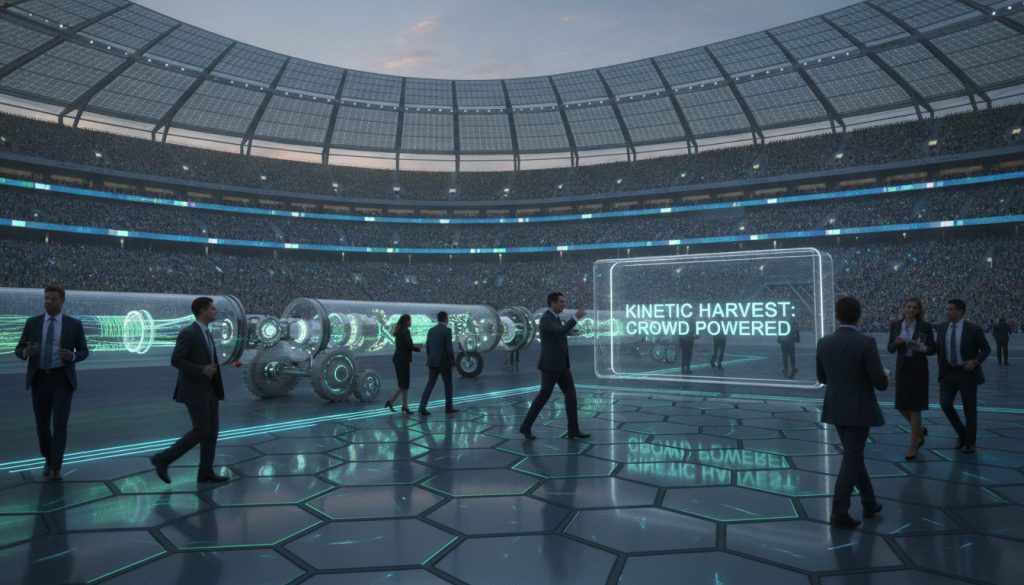
I’ve visited many stadiums around the world. But none capture the power of passion and physics like the Estadio Civitas Metropolitano future 2050. The crowd’s energy is harnessed, turning it into something real.
Under the stands, a system waits to capture the fans’ movement. This isn’t just new thinking. It’s stadium kinetic energy crowd harvesting on a massive scale.
Every step and jump creates electricity. The most exciting moments of the game also boost the stadium’s power.
Stadium Kinetic Energy Crowd Harvesting at Unprecedented Scale
The tech behind this system is based on principles from subway stations and smart sidewalks. But it goes far beyond those. We’re talking about piezoelectric stadium flooring and advanced systems throughout the seating bowl.
When Atletico scores, the crowd’s reaction creates vibrations. The floor-plates under the stands compress, generating electricity through special materials.
This approach is brilliant because it works best when the stadium needs power most. The more fans celebrate, the more crowd-generated electricity is produced. It’s a loop that rewards passion with power.
The idea is inspired by worldwide research on energy. The Vatican shows how waste can become valuable power. The Metropolitano does the same with human movement.
This sustainable stadium design treats fans as part of the energy system. Each person helps by being present and engaged. The system is designed to capture energy efficiently.
On match days, the floor-plates can generate a lot of power. This is grid-ready electrical power for the stadium. The lights, screens, and sound systems could be powered by the fans.
Seismic Floor-Plates That Convert Passion Into Electricity
The engineering behind seismic energy conversion technology is fascinating. It solves many problems at once. These systems are built to last, handling millions of impacts over years.
Each floor-plate unit is hidden but always working. They contain materials that generate electricity when compressed. Some use piezoelectric crystals, others electromagnetic induction.
This kinetic energy sports venue design is resilient. It works well with the unpredictability of sports. A goal or a penalty shootout can create a lot of power.
I remember the energy in stadiums during key moments. The chanting, clapping, and celebrations were always intense but fleeting. The Metropolitano makes this energy permanent and useful.
The system powers the stadium’s operations first. During intense events, it sends excess power to Madrid’s grid. The stadium can even become energy-positive during peak times.
This approach to stadium kinetic energy crowd harvesting is groundbreaking. It’s based on proven technology, scaled up with courage and conviction. This is how we turn ideas into real change.
Closed Loop Reservoir Stormwater Harvesting: The Estadio Civitas Metropolitano Future 2050 Hydrology Masterpiece
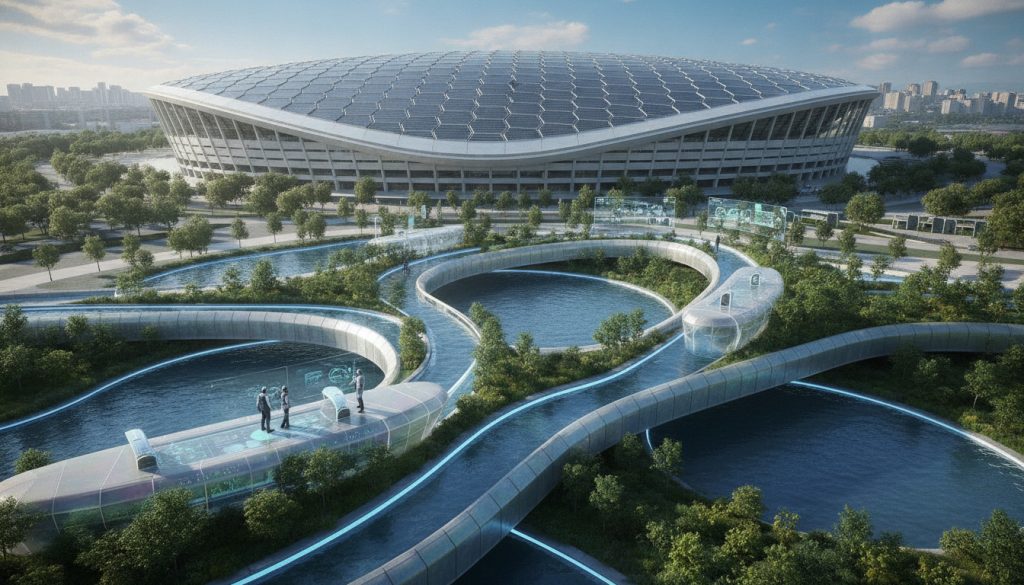
I remember a dry Madrid summer, watching rain fall on concrete and disappear. Millions of gallons were wasted every year. The Metropolitano 2050 doesn’t let any water go to waste.
The stadium’s water management turns a common problem into a multi-functional climate asset. It’s not just about being eco-friendly. It’s about making water work harder than any mechanical cooling unit.
Exploring water-stressed regions taught me a lot. Smart water management makes buildings truly sustainable. The Metropolitano’s system is a top example of hydrology engineering.
Capturing 100% of Storm Runoff From Madrid’s Largest Roof
The stadium’s roof is huge, covering tens of thousands of square meters. It’s Madrid’s biggest rainwater collection area. Every raindrop hits the PTFE membrane and is channeled somewhere useful.
Integrated guttering systems direct water into underground reservoirs with 100% capture efficiency. No water goes to storm drains. No water is wasted.
These reservoirs aren’t just storage tanks. They’re part of the stadium’s climate control. They store cooling capacity for when it’s needed most.
The Vatican used closed water circuits to save water. They installed rain tanks for irrigation, saving about 60% of water resources. The Metropolitano takes this concept to a bigger scale.
It captures millions of liters of water every year. This water serves many purposes in the facility.
| Water System Component | Traditional Stadium Approach | Metropolitano 2050 System | Annual Water Savings |
|---|---|---|---|
| Roof Runoff Management | Direct to storm drains | 100% capture to underground reservoirs | 2.8 million liters |
| Cooling Systems | Electric HVAC units | Thermal mass + evaporative cooling loops | 85% energy reduction |
| Landscape Irrigation | Municipal water supply | Harvested rainwater distribution | 1.2 million liters |
| Toilet Flushing | Potable water | Recycled stormwater | 950,000 liters |
Creating a system like this requires precise engineering. It must handle heavy storms without overflowing. The reservoirs are sized for Madrid’s rainfall patterns.
The system manages peak storm events without overflow. It accounts for both maximum single-event rainfall and seasonal accumulation. It’s engineering that respects local climate reality.
Zero-Emission District Cooling That Fights Urban Heat Islands
The system becomes brilliant when it captures and uses water. The stored water feeds into zero-emission district cooling loops. These loops naturally regulate temperature across seating areas.
During Madrid’s hot summers, the stadium could get warm. The cooling loops draw heat away from occupied spaces using water circulation and physics. No compressors. No refrigerants. No energy-intensive HVAC systems.
The Vatican installed a solar-cooling system in 2009. The Metropolitano expands this concept across 70,000 seats and surrounding spaces.
This approach is revolutionary for urban heat island mitigation. Cities get hotter than rural areas because of heat-absorbing concrete and asphalt. This can raise urban temperatures by 5-7 degrees Celsius.
The Metropolitano’s system naturally wicks away regional heat. Controlled evaporation releases that heat without creating oppressive hot zones. The stadium actually cools its surrounding neighborhood, not just its interior.
I’ve seen this principle work in smaller buildings across Mediterranean climates. Scaling it to stadium size changes what’s possible for sustainable water management sports venues. The cooling capacity rivals mechanical systems that would consume megawatts of electricity.
The integration shows genuine circular design thinking. One system’s output becomes another system’s input. Rainwater capture enables passive cooling. Passive cooling reduces energy demand. Lower energy demand decreases operational carbon emissions.
Here’s the complete water usage breakdown:
- Irrigation systems: Surrounding green spaces and landscape features receive harvested rainwater through automated distribution networks
- Sanitary facilities: Non-potable water applications like toilet flushing consume recycled stormwater instead of treated municipal supplies
- Cooling loops: The largest volume circulates continuously through thermal management systems that moderate interior temperatures
- Emergency reserves: Backup capacity ensures fire suppression systems maintain full functionality during dry periods
The system eliminates the need for energy-intensive HVAC. Peak cooling demand drops by 85% compared to mechanical refrigeration approaches. This saves a lot of money and reduces carbon emissions.
Walking through water-stressed regions around the Mediterranean taught me that water scarcity will define urban planning this century. Buildings that treat water as disposable won’t survive climate change pressures. The Metropolitano proves large-scale architecture can work with natural water cycles instead of against them.
This closed loop reservoir stormwater harvesting approach represents a complete rethinking of stadium hydrology. It’s not about doing less harm. It’s about creating active environmental benefits through intelligent design.
The masterpiece isn’t just the engineering—it’s the integration. Every component serves multiple purposes. Every system connects to others in productive ways. That’s the difference between sustainable buildings and genuinely regenerative architecture.
The Blueprint Every City Needs But Few Will Have the Courage to Build
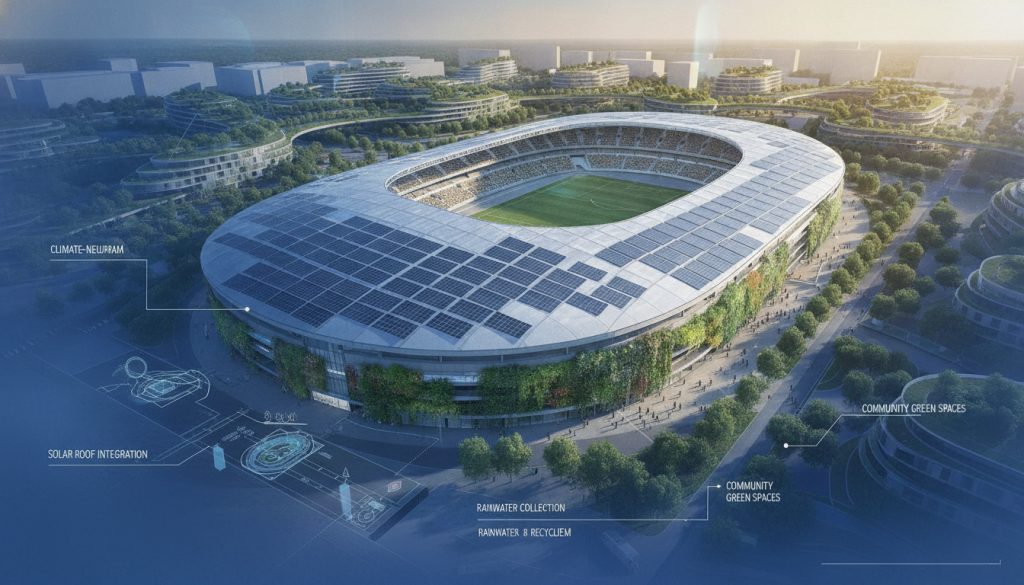
Madrid is working on a blueprint that shows real courage in rebuilding. I’ve seen many sports venues claim to be green. But most just have a few solar panels and some recycled materials.
The Estadio Civitas Metropolitano’s future is unique. It’s about systemic sustainability transformation, not just making things a bit greener. It’s a complete rethink of what sports venues can be.
Every city needs this kind of model. We must show that sports venues can help solve climate problems, not make them worse. The question is, will cities have the vision and resources to follow Madrid’s lead?
What Atletico Madrid’s Vision Means for Global Sports Architecture
Atletico Madrid’s project shows a new way. It proves you don’t have to choose between fan experience and being green. The sustainable sports architecture future is possible without sacrifice.
The stadium uses fans’ energy and has a roof that makes electricity. It also captures water to cool the place without using fossil fuels.
Every part of the stadium serves two goals. This makes it a game-changer for sports architecture worldwide. Athletic tradition and environmental science work together, not against each other.
This approach opens up new possibilities. Fans know their energy helps the planet. The stadium teaches people about green building. Kids will grow up expecting sustainability, not seeing it as special.
Why Athletic Heritage and Environmental Physics Must Fuse Now
Traveling the world, I’ve learned vision is easy, but doing it is hard. The real challenge is finding the courage to act. This change will need a lot of money and teamwork.
Leaders must plan for 25 years. Research shows big changes need government and industry working together. Madrid will need all this and more.
The cost is high. Making a 70,000-seat stadium green costs billions. The tech is there, but using it on this scale is a big test.
Politics makes it hard to stick to long-term plans. Elected officials change often. Critics will target delays and cost overruns. Keeping the project going will need strong leadership.
But there’s hope. Successful projects inspire others. When one city shows it works, others follow. History shows this pattern:
- The Vatican showed zero-emission goals are possible with upgrades
- European cities proved climate neutrality by 2050 is doable with planning
- Copenhagen showed bike-friendly cities improve life quality
- Singapore showed vertical gardens can cool cities
Madrid has a chance to show sports venues can be green. These buildings use a lot of resources. Changing them can change the construction industry.
If Madrid succeeds, stadiums worldwide will follow. Los Angeles, London, and Tokyo will look at Madrid’s tech for their own projects. This could be a big change for sports venues.
The sustainable sports architecture future depends on Madrid’s success. They are the test case. It’s a big challenge, but also a big chance.
I think they’ll do it because the alternative is worse. We can’t keep ignoring climate change. The math, physics, and ethics don’t add up.
Sports are important to many people. They create community and identity. We don’t have to give up sports. We just need to make them sustainable for the future.
Building this blueprint will be important for more than just football. It will show we can keep tradition while changing. That’s what the world needs now.
Conclusion
I’ll admit something. When I first started researching this project, I expected another beautiful rendering that would never quite happen. I’ve seen too many promises fade.
But the Estadio Civitas Metropolitano transformation feels different. This sustainable stadium future doesn’t ask anyone to sacrifice what they love. Fans will still pack the stands, still sing, still create that electricity that makes sports unforgettable. The difference? All that passion now powers something bigger.
Cities generate over 70% of global CO2 emissions. Urban infrastructure transformation isn’t optional anymore. Sports venues consume massive amounts of energy and water. Flipping them from carbon-positive to carbon-negative fundamentally changes the environmental equation.
The genius of Madrid environmental innovation lies in the fusion. Athletic heritage meets environmental physics without compromise. The iconic roof remains. The atmosphere stays electric. But now the building gives back more than it takes.
Net-zero sports venues represent more than architectural achievement. They prove we can maintain the spaces that unite communities while actively healing our planet. Climate-positive architecture doesn’t mean giving up what matters. It means building smarter.
That’s the kind of future worth getting excited about. I’m excited to see these principles spread to stadiums worldwide.


Leave A Comment