
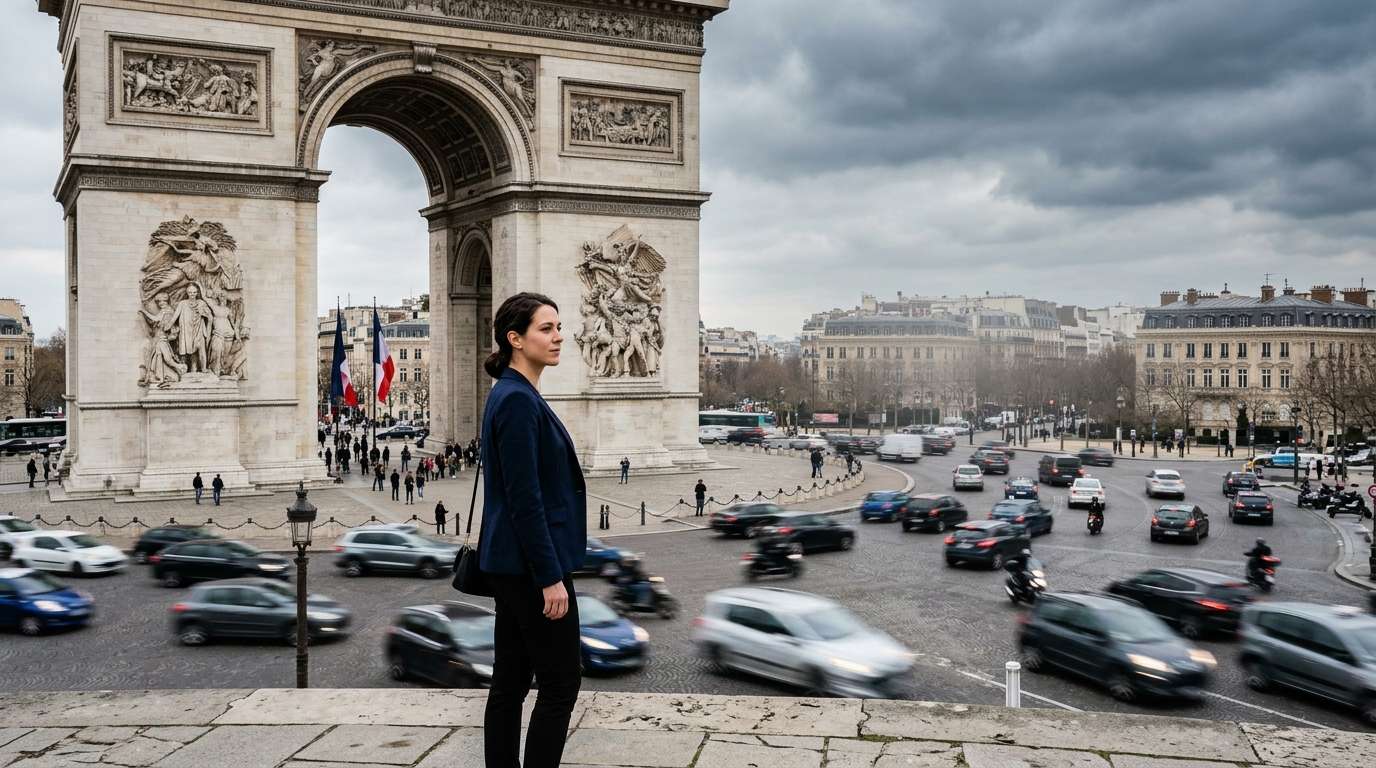
I stood under the Arc de Triomphe, turned in a slow circle, and counted the 12 avenues fanning out from the plaza. Horns blared, scooters buzzed, and my ears rang. I wondered how the Arc de Triomphe future 2050 would sound and feel.
The monument is about 50 meters tall. It is made of Lutetian limestone and covered in François Rude’s reliefs. In my picture of 2050, Paris keeps all of that and adds quiet help: a breathable coating on the stone, water stored below the ground, and power from footsteps.
None of this is something I saw. It is a vision of how it could work, and the Arc will be protected, not redesigned.
I will walk you through four parts: city goals, stone, water and power. The goals come first, because they make the rest possible.
Key Takeaways
- The Arc stays a protected monument; the city around it changes.
- Paris aims to cut greenhouse gas emissions by 75% by 2050.
- A breathable nano-mineral glaze could shield the stone from pollution.
- Underground vaults could store rain and cool exhibition halls.
- Footstep power suits lighting and sensors, not whole buildings.
- The metro is the best way to reach the plaza.
Why the Arc de Triomphe Future 2050 Depends on Paris Climate Goals
The Arc will not change shape, but the city around it will. Napoleon ordered the monument in 1806 after Austerlitz, as a tribute to his armies, and it stays a protected historic monument. Only its surroundings are expected to change.
Paris aims to cut greenhouse gas emissions by 75% by 2050 under its climate energy plan. The city approved a plan on March 21, 2018 to run fully on renewable energy. The UN climate action page on the City of Paris also lists carbon neutrality goals and a phase-out of diesel and petrol mobility.
The Arc stays as it is. Paris cuts its fossil fuels and emissions around it.
Here are the measures that matter most for the Arc and its avenues:
- Emissions cuts of 3% a year on average, and 50% by 2030.
- 500 green initiatives across the city.
- Diesel vehicles barred from 2024.
- All combustion engines barred from 2030.
Cars in the city are expected to fall from 600,000 to 300,000 by 2050. A plaza with fewer cars and more walkers seems likely. That is a direction, not a finished design.
Cleaner air still cannot undo the damage of past decades. So how does the stone itself survive 2050?
Shielding the Stone: How the Arc Could Survive Pollution
Limestone is soft, and it drinks in polluted air. The Arc is built from it, so every year of exhaust leaves a mark. My 2050 vision gives the stone a gentle shield.
The goal is to stop damage without erasing the patina, the aged look people love. This is a vision, not a proven treatment.
| Threat | What it does to the stone | 2050 answer |
|---|---|---|
| Sulfation | Forms a dark crust | Nano-mineral glaze |
| Spalling | Crust flakes off | Glaze arrests the cycle |
| Lost patina | Old surface is stripped | Gentle cleaning only |
Why Lutetian Limestone Suffers From Smog
Stone sulfation is a slow reaction where sulfur pollution in the air turns limestone surfaces into a crust that flakes off, called spalling. The sulfur compounds come from vehicle and heating pollution. More vehicles around the plaza means faster damage to the stone.
Some designers also float the Antismog Towers idea, with titanium dioxide surfaces that filter smog from the air.
Breathable Nano-Mineral Glazes
In my vision, the nano-mineral glaze is the protective coating. It arrests sulfation and spalling while keeping the authentic patina. It is breathable, so moisture can leave the stone.
That matters. A sealed coating can trap water inside, and trapped water pushes the stone apart from within.
Protecting Rude’s Relief Sculptures
François Rude’s carved reliefs need gentler care than flat walls. Deep folds hold dirt and water, and sharp edges wear fast. Cleaning that is too hard can strip the patina, and no coating brings it back.
Even a protected stone faces storms. So what happens when heavy rain hits the plaza?
Capturing Storm Water Beneath Place Charles de Gaulle
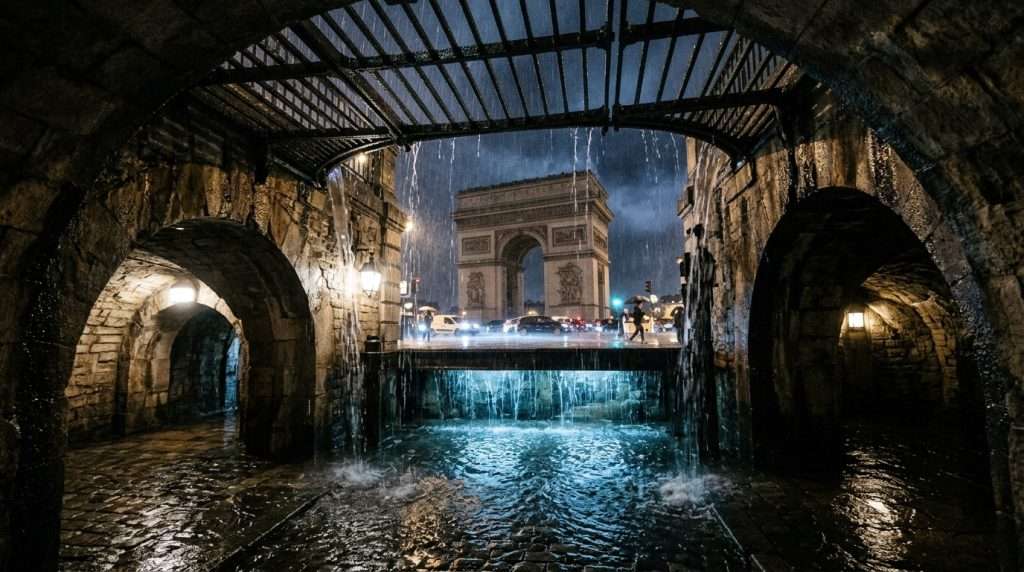
Picture a summer downpour hitting the plaza and vanishing underground. In the design concept, automated subterranean retention vaults sit under the 12 radiating avenues. In the vision, they capture 100% of Seine basin storm downpours.
The cycle is simple. Rain falls on the plaza, the water vaults store it, the water gets filtered, and cooling loops use it. Those loops are zero-emission capillary cooling for the internal exhibition halls.
Capillary loops are thin tubes of cool water in walls and ceilings. They need no fossil fuels, because stored water does the cooling instead of a gas-fired system. Other Paris concepts, like the Mountain Towers idea, also use rainwater tanks for storage between basins.
For a traveler, this matters. A summer visit to the Arc is hot, and a cooler exhibition hall is a real comfort.
This is a concept, so no one should expect to see it today. Next to the vaults, I imagine something even smaller: the plaza making power from footsteps.
Turning Footsteps Into Clean Microgrid Power
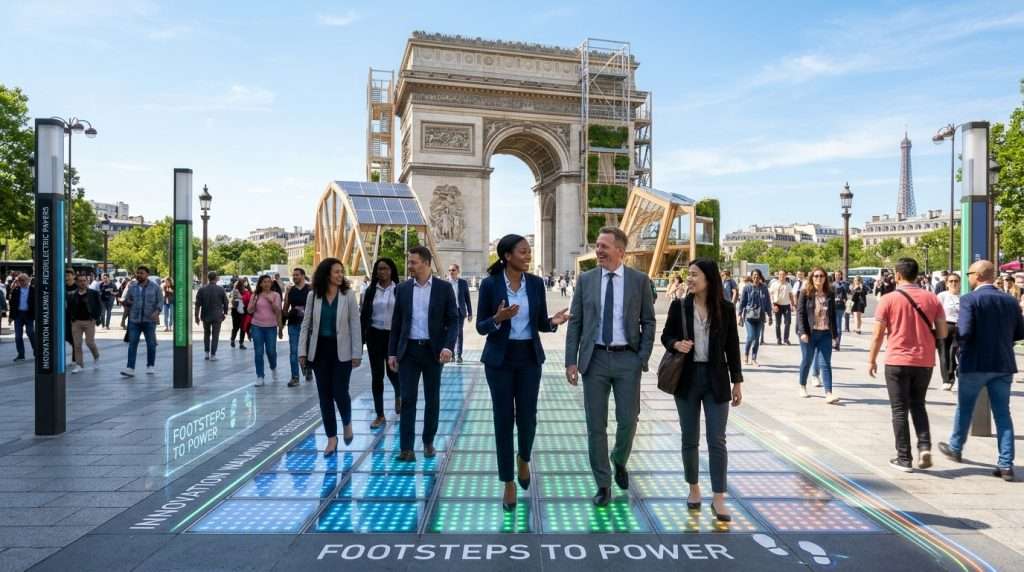
Every step I took around the Arc could count for something. In the vision, under-floor piezoelectric pavers across the circular plaza and rooftop terrace turn footsteps into clean microgrid power. Paris towers and railway tunnels have also been proposed for piezoelectric promenades.
A microgrid is a local power network. It makes and uses electricity close to home, so the monument does not depend on a distant plant. A 2025 review of piezoelectric pavement says harvested power suits low-power uses such as sensors.
Four sources fit the Arc area:
- Piezoelectric pavers in the plaza floor.
- Rooftop solar panels, since Paris plans panels on 20% of buildings by 2050.
- Small Solar Trees for phone and e-scooter charging.
- A local microgrid to tie them together.
Footsteps give small amounts of power, so they suit lighting and sensors better than a whole building. The solar panels carry the bigger load.
So what would all this look like for a visitor on the ground?
Visiting the Arc in a Low-Carbon Paris
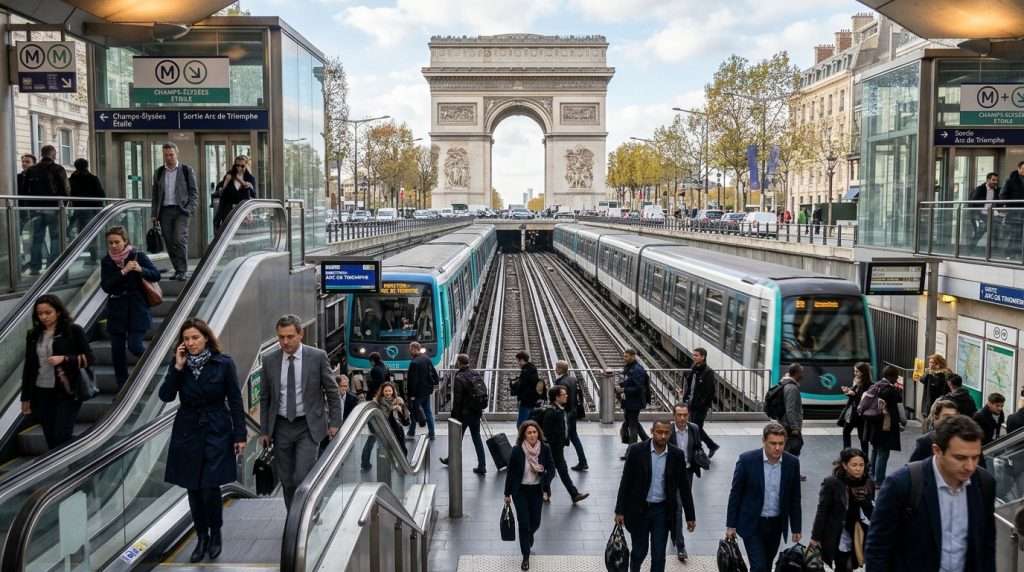
The best way to reach the Arc is by metro, not car. About 60% of travel distance in Paris is by public transport. Each day, 1.1 million Parisians move around the city, along with 220,000 tourists.
The Grand Paris Express rail extension is one of the largest sustainable mobility projects in the world. It costs an estimated up to 30 billion euros. The Paris 2024 Games were also planned as low-carbon.
Once there, study the map of Place Charles de Gaulle. Look at the 12 avenues from above, from the rooftop terrace, to see how traffic radiates like spokes.
My four tips:
- Use the metro or rail.
- Walk the Champs-Élysées.
- Bring a camera for the avenues at dusk.
- Avoid midday heat.
Beyond the plaza, the neighborhoods are changing too.
The City Around the Arc: Homes, Towers and Food in 2050

Homes cause about 20% of the city’s carbon dioxide. Paris has 1.4 million homes covering 80 million square meters. Parisians use 12,100 GWh of energy each year, about 5,400 kWh per person.
The first renovation project covered 40,000 homes, and one million private homes are to be renovated by 2050. Offices cover another 59 million square meters. Freight by rail is 7% today and aims at 34% by 2050.
The 2050 Paris Smart City study from 2014, by Vincent Callebaut with Setec Bâtiment, shows 8 tower prototypes. Here are four:
| Concept | Where | Main idea | Energy or food angle |
|---|---|---|---|
| Mountain Towers | Rue de Rivoli | Stacked slopes | Rainwater storage |
| Photosynthesis Towers | Montparnasse (58 floors) | Algae facade | Algae bioreactors |
| Bamboo Nest Towers | Massena | Woven bamboo frame | Food gardens |
| Farmscrapers | Porte d’Aubervilliers | Farms in towers | Vertical farming |
Here is the reality check. These are concept studies, not funded projects.
That leaves one question: what will I look for myself?
Conclusion
On my next visit, I will look at the ground as much as the monument. The Arc stays itself, while stone, water and power systems could work quietly around it. Paris is heading toward a lower-carbon future, and travelers can already see hints of it in the streets.
Here is one next step. Walk the plaza slowly, and note the stone, the drains and the traffic. Then come back years later and compare. I would love to hear what you notice.



Leave A Comment