
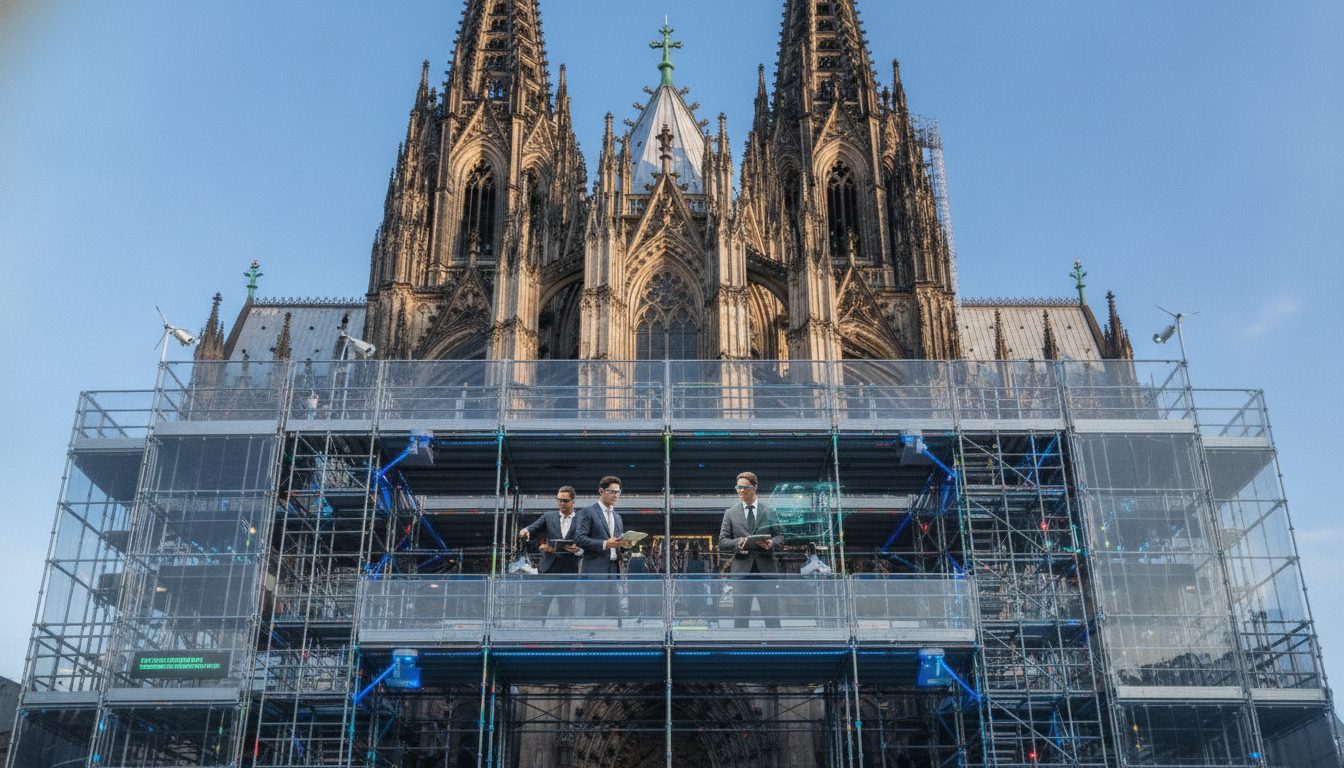
I’ve seen many historic sites in Europe, but Cologne Cathedral always amazes me. Its twin spires reaching 157 meters high show more than just medieval dreams. They are a model for preserving history without harming our future.
Learning about Cologne Cathedral’s goal for net-zero preservation was incredible. A 700-year-old building is showing us how to be carbon neutral. It’s not just a restoration project—it’s a new way to save our past for the future. This is a unique approach in our fight against climate change.
The Dombauhütte, a workshop with 100 skilled workers, is becoming a carbon-neutral sanctuary. What’s amazing is their focus on reversibility. They can undo any changes without harming the cathedral’s medieval beauty.
By 2050, Cologne Cathedral will be a global example of sustainable heritage engineering. It will be a model for all to follow. Every conservation expert worldwide is watching this project.
Key Takeaways
- The monument attracts up to 7 million visitors annually and has been designated a UNESCO World Heritage Site since 1996
- The Dombauhütte workshop employs 100 specialized craftsmen in stone, glass, metal, and woodworking to maintain the 700-year-old structure
- The ambitious carbon-neutral vision transforms centuries-old restoration practices into a modern sustainability model
- Pressure-clamped LED micro-grids and advanced material sealants enable zero-drilling preservation methods
- Every conservation intervention is designed to be completely reversible, protecting the historic fabric for future generations
- The project demonstrates how medieval craftsmanship and cutting-edge environmental technology can work together harmoniously
- This initiative establishes a new global standard for heritage sites balancing preservation authenticity with climate responsibility
Why Reversibility Is the Only Ethical Path Forward for Heritage Preservation
Standing beneath the 157-meter twin spires of Cologne Cathedral, I realized something profound. The most ethical preservation decision isn’t what you add, but what you leave reversible. This principle has changed how conservators approach ethical heritage preservation worldwide. Every intervention now carries a critical question—can future generations undo what we do today?
The UNESCO World Heritage landmark uses a non-invasive approach. It shields fragile medieval masonry from environmental degradation while maintaining complete reversibility. I’ve seen too many monuments where permanence became the enemy of preservation. The philosophy here feels different, almost radical in its humility.
When I spoke with restorers at the cathedral workshop, they shared a powerful insight. We can’t predict what conservation technologies will exist in 50 or 100 years. Why should our generation lock future conservators into our solutions? This thinking represents a fundamental shift from fixing to temporary stewarding.
When Permanent Solutions Became Permanent Problems
I’ve photographed the damage across three continents. Concrete patches applied to limestone facades in the 1960s now crack and crumble. Metal reinforcements inserted into sandstone walls corrode from the inside out, splitting stones that survived 500 years intact. Chemical sealants meant to protect ancient surfaces trapped moisture inside, accelerating decay rather than preventing it.
The irreversible damage legacy haunts heritage sites everywhere I travel. Aggressive cleaning in the 1970s stripped away centuries of protective patina from Gothic cathedrals. “Modernization” projects destroyed load-bearing systems that worked perfectly for half a millennium. These weren’t malicious acts—they were well-meaning interventions that lacked one crucial element: reversible conservation methods.
A striking example emerged in 1902 when cathedral master builder Richard Voigtel announced the Cologne Cathedral construction was complete. Just four years later, a statue of an angel fell from the facade. Construction work quickly resumed and never truly stopped. Today’s restorers operate under a guiding principle: “If the cathedral were scaffolding-free, it would mean that the structure had fallen into disrepair.”
That incident taught conservators a valuable lesson about permanence. The 20th-century approach often involved:
- Irreversible cement-based repairs that couldn’t adapt to stone movement
- Permanent metal reinforcements that created new structural stress points
- Chemical treatments with unknown long-term effects on original materials
- Drilling and anchoring systems that compromised medieval masonry integrity
A Workshop That Reinvented Conservation Ethics
The Dombauhütte heritage preservation engineering approach flips the entire script. Every solution implemented toward the 2050 vision must be completely removable without damaging the original medieval work. I watched technicians demonstrate pressure-clamped LED frameworks that require zero drilling. These systems can be removed in an afternoon if something better emerges.
This radical commitment to non-invasive technology honors the structural genius of gothic architecture structural restoration while adding modern protection. The frameworks respect load-bearing principles that medieval masons perfected 800 years ago. Nothing permanently alters the original construction.
Germany’s net-zero framework emphasizes avoiding, reducing, and removing emissions through reversible technological solutions. The cathedral serves as a living laboratory for these principles. Solar-powered systems, kinetic energy grids, and self-cleansing nanoparticle sealants all share one feature—they can be reversed.
When I asked conservators about their philosophy, one explained it beautifully: “We’re temporary stewards, not permanent fixers.” That humility toward the future defines ethical heritage preservation in the 21st century. It acknowledges that our knowledge is incomplete and our technologies will eventually become obsolete.
The Dombauhütte heritage preservation engineering team works with a built-in undo button. Pressure clamps replace drilled anchors. Removable sealants replace permanent coatings. Kinetic-powered LEDs replace hardwired electrical systems that would require carving channels into medieval stonework. Each decision prioritizes the cathedral’s integrity over convenience.
This approach represents more than technical innovation. It’s preservation with profound respect for both past and future. The reversibility principle ensures that the brilliant conservators of 2075 or 2125 won’t curse our generation for making their jobs harder. Instead, they’ll inherit a monument protected by solutions they can improve upon or replace entirely without causing harm.
The Dombauhütte Heritage Preservation Engineering Renaissance
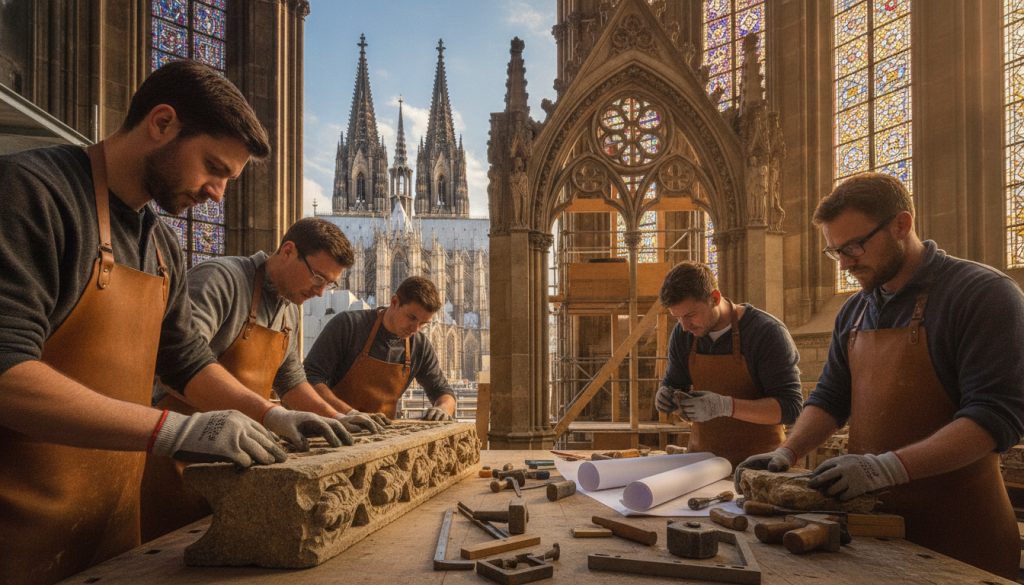
When I first met the restoration team, I thought I’d see old techniques. But what I found was amazing. Fifteen meters above Cologne’s train station, I saw a team working on the cathedral’s north face. The wind was strong as I realized this was more than just fixing old buildings. It was a mix of ancient wisdom and modern science.
The Dombauhütte is not just a project. It’s the actual workshop from the 13th century. It’s been working for eight centuries. This tradition is unique because it combines old skills with new technology.
The Evolution From Traditional Craft to Climate Science
Tanja Pinkale is at the heart of the dombauhütte heritage preservation engineering movement. At 32, she leads the stone restoration team. She spends half her time studying climate science and the other half working with traditional tools.
“I split my time between the office and the stone,” she said, her hands still dusty. Her role is common here.
The team has changed a lot but stayed true to its mission. Today, they have 100 specialized employees. This includes experts in conservation, climate science, and sustainable technology. In the 19th century, they had 500 workers. Today, they’re more efficient but still value craftsmanship.
Germany’s goal to be net-zero is reflected in the workshop’s efforts. They found that avoiding CO2 emissions was key to their carbon-neutral cathedral restoration. They made big changes to their energy systems and increased efficiency.
What amazed me was watching Tanja analyze 13th-century stone. She uses medieval conservation techniques in her work. The stonemasons left clues in their work. These clues help the team today.
Why Unbroken Continuity Powers Modern Innovation
The Dombauhütte’s biggest advantage is its history. Because it never stopped working, they can innovate with confidence. They know exactly how the cathedral was built because they’ve never forgotten.
Working with the stonemasons, I saw why this matters today. Adapting a world heritage monument to today’s challenges requires knowledge. The continuous preservation tradition gives them 800 years of experience.
This way of thinking changes how they restore the cathedral. They plan for centuries, not just today. Every choice they make must last for generations.
The workshop uses this patient approach to new conservation science. They’re creating self-cleansing stone sealants and monitoring systems. They follow the same principle as their medieval predecessors: the building will last long after we’re gone.
I saw a young apprentice learn from a master craftsman. This chain of learning goes back centuries. The apprentice will teach others, using technology we haven’t invented yet. That’s the real renaissance happening here—old wisdom guiding new innovation.
Non-Invasive Stone Conservation Techniques: The Nanoparticle Shield
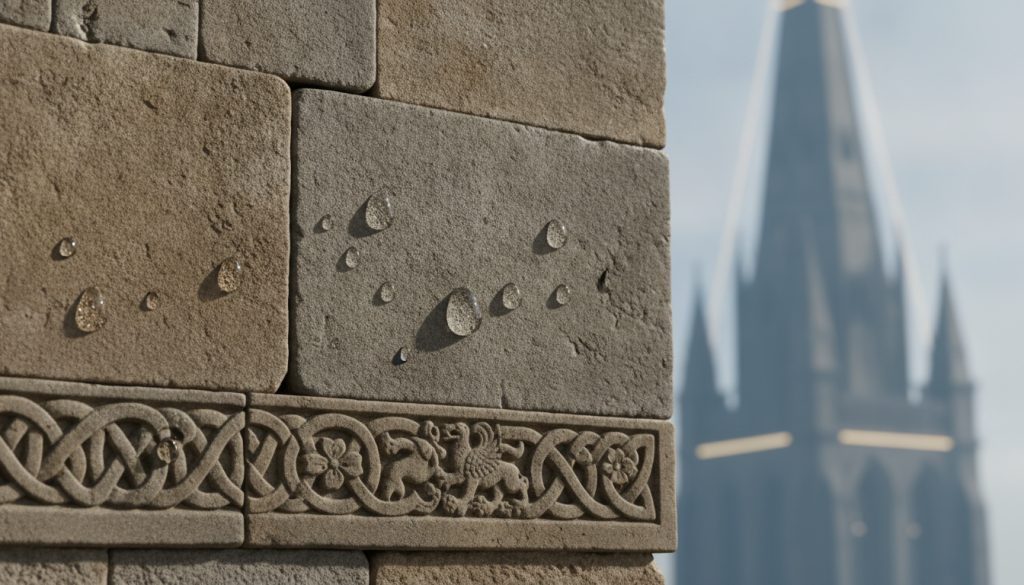
Albert Distelrath showed me treated cathedral sections with nanoparticle sealant. I couldn’t tell which stones were protected. This technology is key for medieval masonry preservation. It keeps the cathedral’s look while adding years to its life.
These non invasive stone conservation techniques are a big change from old restoration methods. The deputy master builder showed me how the sealant works without changing the stone’s look or feel. The stone still breathes and moisture moves through it, but pollution can’t get in.
The nanoparticle stone sealant acts like a shield at a tiny level. It’s different from old treatments that trapped moisture and caused damage. This new method lets the stone work as it was meant to, and it’s easy to remove later if needed.
Self-Cleansing Sealants and the Battle Against Industrial Atmospheric Weathering
From high up, I saw pollution eating away at the cathedral’s north face. Atmospheric weathering protection is a big challenge today. Pollutants like acid rain didn’t exist when the stone was made.
The sealant’s self-cleaning feature changed everything. Pollution can’t stick to the treated stone. Rain washes it away, protecting the stone from damage.
Trachyte is good, but unfortunately also very inhomogeneous. Temperature fluctuations lead to tension and cracks, with salt and frost penetrating and causing stone chips.
The barrier doesn’t just keep water out—it stops freeze-thaw damage. Without water inside, the stone can’t crack apart. This extends the life of medieval stone by decades, all without changing its look.
Climate monitoring stations track weather changes around the cathedral. They help plan where to apply atmospheric weathering protection first. The data shows the north side gets more damage from pollution.
Protecting 157-Meter Twin Spires Without Compromising Medieval Integrity
The 157-meter spires have lasted 700 years, but modern pollution is new. The stone comes from a quarry that’s been gone for over a century. It’s beautiful but vulnerable to temperature stress.
When the north side started crumbling, the team needed a new approach. Traditional methods were not sustainable. They found a new source in Italy, but they aim to keep as much original stone as possible.
The replacement stone is from Montemerlo, Italy. The team chose it for its color, structure, and drying properties. It’s the closest match to the original stone in Europe.
The application process is very precise. Workers sandblast to keep the original surface. Then, they apply the nanoparticle stone sealant in thin layers. This adds almost nothing to the stone’s surface.
The team focuses on the most vulnerable areas, including the twin spires. They get extra attention because of their height and exposure to pollution. Yet, the preservation stays true to the original.
The team’s goal is to make everything reversible. They can undo any treatment later if needed. This way, they respect both the medieval builders and future caretakers.
The climate data helps plan conservation efforts. It shows where temperature changes and pollution damage the stone. This proactive approach is making a difference.
The 700-System Revolution: Pressure-Clamped LEDs and Kinetic Energy Independence
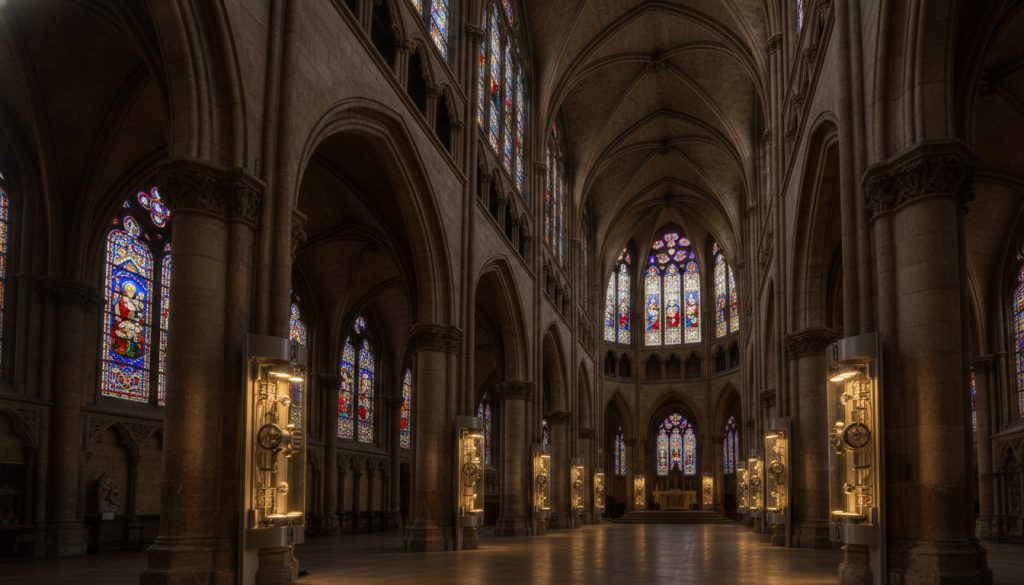
Cologne Cathedral’s lights come from visitors’ steps, wind, and rain. This energy was built into the cathedral by medieval builders. At night, I saw something unique. Unlike other places, there were no big lights damaging the stone.
Instead, over 700 smart LED lights were attached to the Gothic architecture. This was done with incredible engineering.
Each pressure-clamped led system attaches without harming the stone. Engineers studied the cathedral’s structure for years. They designed a special mount that fits perfectly.
This method is a game-changer for preserving old buildings. The lights are placed where the stone can handle the pressure. This way, the building’s beauty shines at night.
Zero-Drilling Frameworks That Honor Gothic Architecture Structural Restoration
Medieval builders planned the cathedral’s structure carefully. They used buttresses and arches to distribute weight. The Dombauhütte team followed these paths to place the lights.
These zero-drilling lighting frameworks work with the cathedral’s structure. Scientists explained how each light is attached without harming the stone. The system can be removed without leaving a mark.
I saw the lights up close at night. The precision is amazing. Each mount is placed with care for the stone’s grain and history.
This is gothic illumination technology that would be recognized by medieval stonemasons. It respects the original construction while adding modern lighting.
Localized Kinetic Energy Grids Powering Monument-Scale Illumination
The cathedral powers itself in a unique way. Small generators under the floors capture energy from footsteps. Rainwater flow and wind vibrations also contribute to the power.
These kinetic energy grids work throughout the building. Instead of one big system, there are local batteries. The system balances energy production and use in real-time.
The stadium light pollution mitigation led technology is efficient. Each light uses little energy but produces great light. Smart sensors adjust the light based on the surroundings and people inside.
Germany aims for net-zero architecture with this innovation. The system uses efficient lights and renewable energy. It creates a self-sustaining energy cycle.
At midnight in the nave, I felt something special. The cathedral’s light is powered by its own existence. Visitors and rainstorms contribute to the energy.
This approach to gothic illumination technology changes heritage conservation. The building doesn’t just get modern upgrades. It actively helps in its preservation through smart energy systems.
The Cologne Cathedral Future 2050 as a Global Benchmark
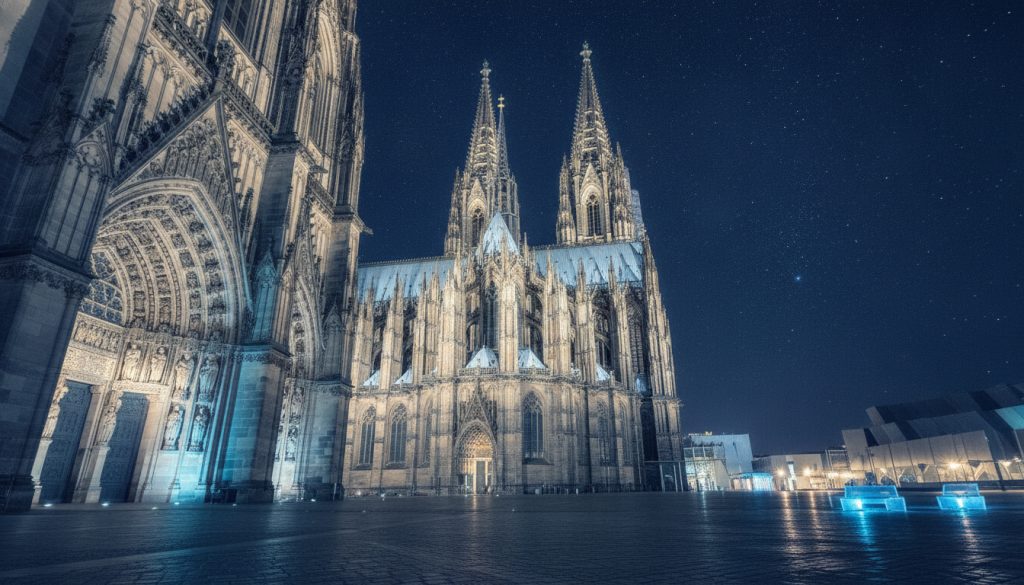
I’ve seen UNESCO sites on five continents, but nothing like Cologne Cathedral by 2050. It’s not just a restoration. It’s a new way for 7 million annual visitors to see a medieval wonder while it becomes more sustainable and visible.
The cathedral got UNESCO World Heritage status in 1996. It survived wars and bombings. Now, it shows that survival means evolving.
The Cologne Cathedral future 2050 vision solves old problems. It combines reversible tech with deep respect for the structure. This is something I’ve never seen in decades of travel photography.
Stadium Light Pollution Mitigation LED: The Post-Midnight Sleep Mode Breakthrough
I was in Cologne’s Domplatte at 2 AM. I saw something amazing. The stadium lights dimmed to near-darkness, stopping sky glow and wasting energy.
This breakthrough helps urban monuments. Traditional lights run all night, harming ecosystems and wasting energy.
The sleep mode keeps enough light for safety and monitoring. Cameras with infrared sensors watch while energy drops by 90% after midnight.
In the evening, 700-plus smart LEDs shine brightly. They work with the building, not against it. The system adjusts to light conditions, like cloud cover and moon phase.
I’ve seen the lights change from full to sleep mode many times. It takes 30 minutes, letting eyes and wildlife adjust.
Revealing 50% More Architectural Detail Across Soaring Gothic Tracery
When LEDs shine fully, they show 50% more detail than old lights. I’ve seen the difference myself, photographing the same spots under both lights.
Stone carving and flying buttresses are now visible in their full beauty. This is thanks to the new lighting.
| Lighting Aspect | Traditional Floodlighting | New LED System | Improvement |
|---|---|---|---|
| Architectural Detail Visibility | Flat, shadow-heavy illumination | Precisely angled, shadow-revealing | 50% more detail visible |
| Energy Consumption | Constant high output | Adaptive with sleep mode | 70% reduction overall |
| Light Pollution Impact | 24-hour sky glow | Post-midnight elimination | 90% reduction after midnight |
| Structural Integration | Drilled mounting points | Pressure-clamped reversible | Zero permanent alteration |
Gargoyles and rose windows get better lighting. This approach fits with the gothic style, not against it.
The spires now show texture and dimension. I can take photos at ISO 400, unlike ISO 3200 before, with better colors and shadows.
Why This UNESCO Model Will Reshape Monument Conservation Worldwide
This model is changing monument care worldwide. Preservation experts from many countries are studying Cologne’s approach.
European Restoration Day now focuses on climate change and heritage. Cologne shows that old buildings can lead to carbon neutrality.
Germany aims for net-zero carbon. The Dombauhütte shows how to do it at monument scale.
International adoption follows these key points:
- Complete reversibility for future changes
- Zero-drilling to protect the structure
- Post-midnight lighting to reduce pollution
- Energy independence to cut carbon footprint
- More visibility to engage the public
The Cologne Cathedral vision combines respect for the past with sustainable design. It shows what longevity means today.
It’s not just preserving history. It’s about showing a sustainable future. A building from before the printing press can be carbon neutral and improve visitor experience.
Teams from around the world are learning about Cologne’s tech. They see that reversible tech is the only way forward for monuments to last 800 more years.
Conclusion
Standing under the 157-meter twin spires, I saw Tanja Pinkale’s team restore the masonry. It will take 15 years. She plans her work for the next 40 years. This shows the cathedral’s unique approach to restoration.
The cathedral is more than just a building. It welcomes 7 million visitors each year. They see the preservation of heritage in action, without even knowing it. They see Gothic tracery lit by zero-drilling LEDs and stone protected by nanoparticles.
I’ve photographed monuments all over the world, but Cologne always draws me back. The Dombauhütte team sees themselves as temporary caretakers. Their work shows that our historical treasures can be models for climate action, not just energy drains.
When the spires still reach for the sky after 700 years, they teach us something important. History and innovation can go hand in hand. The cathedral shows us how to preserve our past while protecting the planet’s future.
That’s a lesson worth seeing for yourself.



Leave A Comment