
I’ve seen many ancient sites around the world. But nothing surprised me like Hagia Sophia’s secret. It’s not just a simple fix. It’s a race against time on a dangerous fault line.
This 1,500-year-old wonder has fallen three times from earthquakes. Its huge dome, 102 feet wide, sits over a city at high risk for earthquakes.
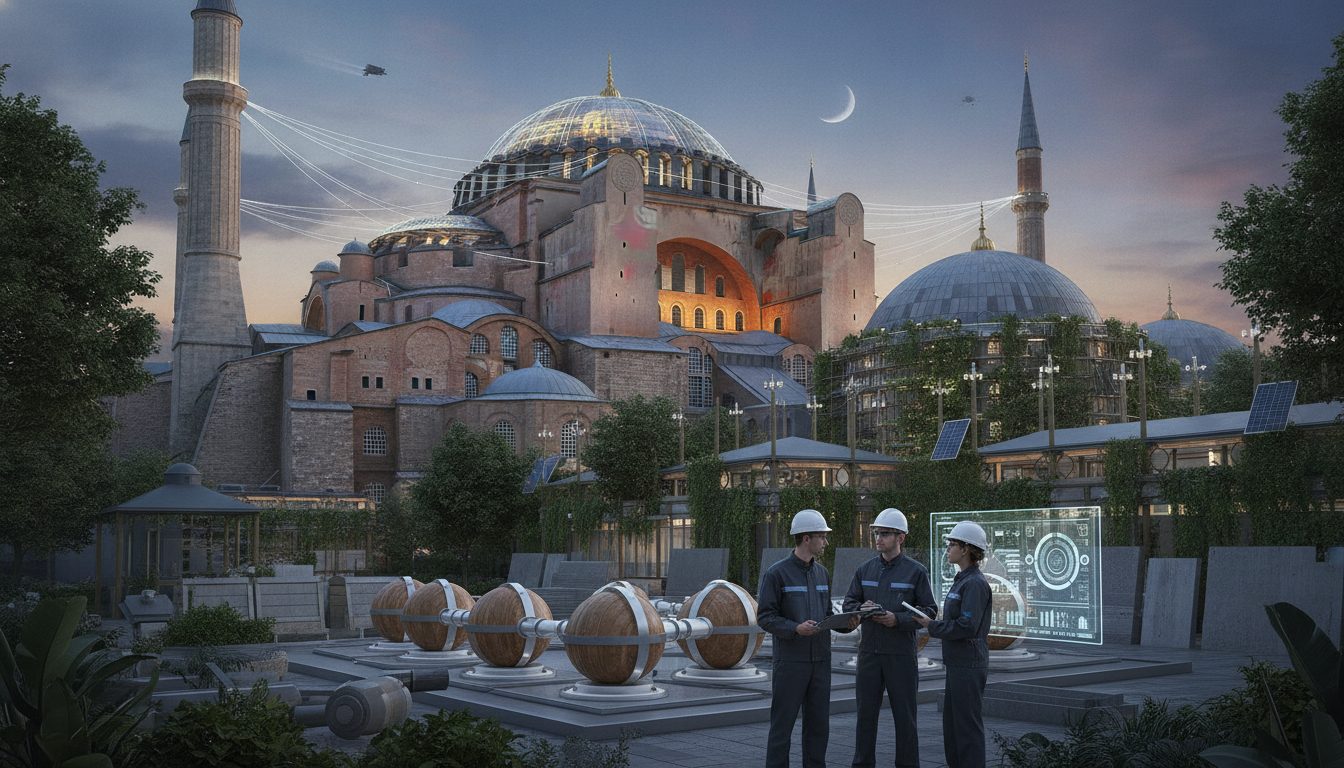
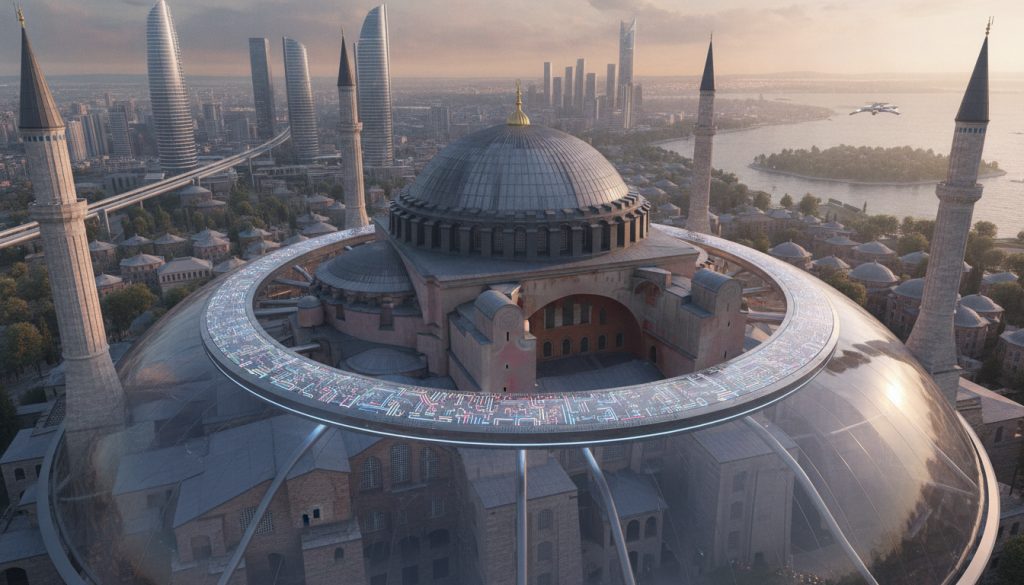
What really caught my attention was the plan to wrap the dome in an invisible titanium tension system. This will be done without touching the original stones. The renovation is the biggest change in over 150 years.
This 50-year plan will keep every Byzantine mosaic safe while holding the building strong against earthquakes. I learned that this effort is taking preservation to its absolute limits. The techniques used here will change how we protect ancient sites everywhere.
Key Takeaways
- Exterior titanium tension rings will anchor the 31-meter dome against severe seismic events without disturbing original masonry
- The structure has survived three major earthquake collapses since 558 AD on Istanbul’s active fault line
- Modern lightweight materials replace worn lead coverings while maintaining historical authenticity
- Non-invasive structural conservation techniques protect fragile interior mosaics and calligraphy during reinforcement
- The 50-year preservation roadmap establishes the global blueprint for ancient monument earthquake protection
- Advanced microclimate controls will stabilize interior conditions to preserve 1,500-year-old artwork
1. Why the World’s Most Endangered Dome Became Its Most Protected
Every day, Istanbul gets closer to a disaster that could destroy Hagia Sophia. I started studying seismic data and became obsessed with the threat to this Byzantine masterpiece. This is a reality that hits hard.
Istanbul is at risk from earthquakes, sitting on a very active fault line. It’s almost as risky as Tokyo, but Tokyo has spent billions on earthquake safety. Hagia Sophia, built 15 centuries ago, lacks modern engineering.
The Hagia Sophia dome earthquake restoration project is a must. Fault lines, including the North Anatolian Fault, are close to Hagia Sophia. Seismologists know a big earthquake will hit, but they don’t know when.
Istanbul’s Tectonic Time Bomb and the 1,500-Year-Old Target
Hagia Sophia has survived many disasters. Its original dome fell in 558 AD, just twenty years after it was built. The Byzantine engineers rebuilt it, but earthquakes struck again.
There were more collapses in the tenth and fourteenth centuries. Each time, medieval builders fixed it with the tools they had. But their tools were not as advanced as today’s.
Conservation expert Stephen J. Kelley warned:
There are seismic threats to Hagia Sophia, and they are great. One tremor and the whole thing could come falling down.
This warning is serious. It comes from someone who has studied Byzantine architecture for decades. The fault beneath Istanbul doesn’t care about history or culture. It follows geological timescales, and the pressure keeps building.
Hagia Sophia’s construction makes it vulnerable. It uses massive domes and semi-domes that transfer weight onto columns. These techniques were revolutionary but create weak points.
| Year | Earthquake Impact | Structural Damage | Restoration Duration |
|---|---|---|---|
| 558 AD | Complete dome collapse | Main dome destroyed, eastern arch severely damaged | 5 years (rebuilt with higher dome) |
| 989 AD | Western arch failure | Partial collapse of western semi-dome | 2 years (reinforced buttressing added) |
| 1346 AD | Eastern section damage | Cracks in pendentives and supporting arches | 18 months (structural repairs and bracing) |
| 1894 AD | Minaret damage | Ottoman-era minarets cracked, interior masonry shifted | 3 years (Ottoman reinforcement methods) |
The Monument Too Important to Let Fail
Architectural historian Dan Cruickshank called Hagia Sophia “a sacred mountain of a building, vast and elemental.” This captures why it’s so important. It’s not just a building—it’s a symbol of Byzantine achievement.
Preservation specialists see Hagia Sophia as a treasure. It has Byzantine mosaics that are priceless. These mosaics show emperors, saints, and the Virgin Mary in ways later artists tried to replicate.
The building also has Islamic calligraphy. These panels were created in the nineteenth century. They show a dialogue between Christianity and Islam.
Hagia Sophia’s design influenced all major cathedrals after it. Its dome seemed to float on light, a marvel that puzzled architects for ages. Medieval builders across Europe studied Byzantine techniques, thanks to travelers’ descriptions of Hagia Sophia.
This building is a bridge between Eastern and Western cultures. It started as a church, became a mosque, and is now a museum. Its history makes it precious to many cultures.
Modern science faces a big challenge here. How do you protect a building from earthquakes without damaging its history? Traditional methods could harm the ancient materials.
The stakes are high. If Hagia Sophia falls, we lose a piece of history, a symbol of human achievement, and a bridge between cultures. Preservationists say it’s too important to fail, no matter the cost or challenge.
2. The Titanium Tension Ring: When Invisible Engineering Saves Visible History
I’ve seen many restoration projects, but Hagia Sophia’s solution was unique. Engineers found a way to strengthen the structure without touching it. This was a major achievement.
The solution was a titanium tension ring system. It surrounds the dome, offering protection without being seen. This shows a new way to save historic buildings.
Wrapping a 31-Meter Byzantine Dome Without Scarring It
The dome is 102 feet, or 31 meters, in diameter. Traditional methods wouldn’t work. The Byzantine architects used four massive columns and four arches.
They also used pendentives, curved shapes that connect the arches. This allowed a circular dome to sit on a square base. The dome has 40 ribs and 40 windows, letting in lots of light.
After a big earthquake in 559 AD, the dome was rebuilt. This was the start of the preservation plan for Hagia Sophia.
Modern engineers studied the ancient solutions. They found that adding something from the outside was the best way. The titanium ring system is like an invisible exoskeleton.
How Exterior Reinforcement Conquered the Non-Invasive Paradox
The installation process was fascinating. Engineers used precise laser measurement and computer modeling to map the dome. This allowed them to design the rings perfectly.
The system works by holding the dome together under compression. It’s like wrapping a fragile bowl in bands that absorb shock. This is the vision for Hagia Sophia’s future.
This approach is revolutionary because it doesn’t harm the original masonry. Byzantine builders used stone buttresses and thick walls. Modern engineers use less visible methods.
The best preservation doesn’t fight against the original structure—it embraces it, supporting and protecting without altering the fundamental character that makes a building worth saving.
The rings don’t just add strength—they also redistribute stress. This prevents cracks during earthquakes.
Space-Age Materials Protecting Ancient Masonry From Tectonic Fury
Why titanium? It’s strong, yet light. This is perfect for adding reinforcement to an old building.
It also doesn’t corrode, so it lasts a long time. Istanbul’s climate would quickly damage other materials.
The table below shows how modern materials compare to traditional Byzantine methods:
| Engineering Approach | Material Used | Strength-to-Weight Ratio | Lifespan | Visual Impact |
|---|---|---|---|---|
| Byzantine (537-559 AD) | Stone buttresses, brick | Low (massive structures) | 500-1000 years | Highly visible |
| Traditional Steel (20th century) | Carbon steel reinforcement | Medium | 50-100 years (corrosion) | Moderate visibility |
| Modern Titanium System (2050) | Titanium alloy tension rings | Very high | 200+ years | Minimal to invisible |
| Composite Alternatives | Carbon fiber, advanced polymers | High | 50-150 years (UV degradation) | Low visibility |
The team chose titanium for its long-term reliability. Composites are strong, but their long-term behavior is uncertain. Titanium is well understood and stable.
Installing the rings required great precision. Each section had to be placed and pre-stressed exactly right. Too much tension could damage the masonry. Too little wouldn’t protect well.
The rings work with the dome’s original design. The 40 ribs carry vertical loads, while the titanium handles lateral forces. It’s a partnership across 1,500 years.
Temperature changes were another challenge. Istanbul’s seasons cause materials to expand and contract. The titanium system has expansion joints and flexible connections to handle this without stressing the masonry.
The system protects against all kinds of earthquakes. It’s not just for one type of shaking. The ring matrix can handle multiple stress vectors at once.
This protection comes from the ring’s design. It’s not just one band, but multiple rings at different levels. This creates a three-dimensional network that stabilizes the dome.
The cost was high, but it’s worth it. Titanium is more expensive than steel, but it lasts longer and needs less maintenance. It also avoids the need for future repairs.
Visitors don’t know they’re seeing a cutting-edge engineering achievement. The invisibility is key. It’s about preserving without showing off.
3. Hagia Sophia Future 2050: The Fifty-Year Gamble That Redefined Preservation
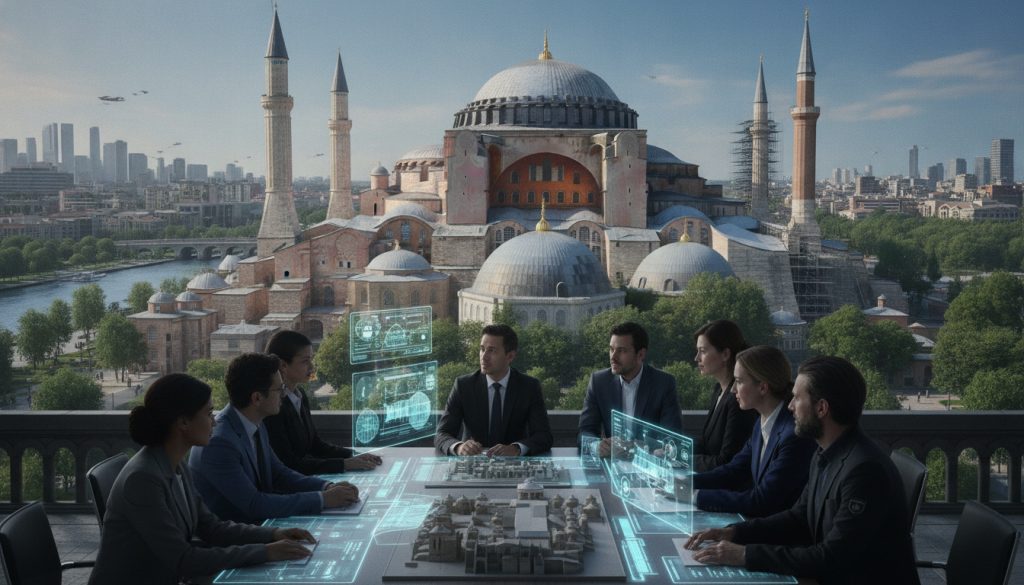
The hagia sophia future 2050 vision was born from frustration and hard-won lessons. I’ve seen many restoration projects, but Hagia Sophia’s needed a half-century effort. At first, “fifty-year master plan” seemed too long. But understanding the complexity of the ancient walls made it clear.
The breakthrough was not just technical—it was philosophical. Stakeholders realized Hagia Sophia needed a generational commitment, not a quick fix.
3.1 Why the Master Plan Took Half a Century to Perfect
Early efforts were more like crisis management than planning. I found that conservators worked sporadically, tackling urgent problems. Scaffolding would appear, then everything would go quiet for months.
Zeynep Ahunbay, a professor at Istanbul Technical University, became the building’s guardian angel. She saw the maddening cycle firsthand.
For months at a time, you don’t see anybody working. One year there is a budget, the next year there is none. We need a permanent restoration staff, conservators for the mosaics, frescoes and masonry, and we need to have them continuously at work.
The piecemeal approach couldn’t address the seismic vulnerability threatening the structure. You can’t earthquake-proof a Byzantine cathedral by patching cracks and hoping for the best. The building contains fifteen centuries of construction layers, each requiring specialized expertise and careful analysis.
Financial constraints added to the technical challenges. The World Monuments Fund contributed $500,000 and raised another half million in matching funds for urgent repairs over a decade. While significant, these amounts barely scratched the surface of what comprehensive preservation required. John Stubbs of the World Monuments Fund captured the overwhelming scope perfectly.
It’s an unbelievably complex structure. There’s the roof, the stonework, marble, mosaics, paintings. We don’t even know all that’s in play in there. But we do know that it requires ongoing, vigilant attention.
The master plan adopted a systematic approach born from these painful lessons. First came exhaustive structural analysis using ground-penetrating radar, laser scanning, and advanced seismic modeling. Then phased reinforcement began with the most vulnerable elements. Lastly, long-term environmental controls were implemented to prevent deterioration between major earthquakes.
3.2 From Experimental Intervention to Global Heritage Standard
What excites me most is how experimental techniques evolved into proven methodology. Early interventions tested materials and approaches on a small scale, learning what worked before committing to large-scale implementation. This careful progression prevented costly mistakes and respected the building’s irreplaceable authenticity.
The non destructive heritage preservation science developed for Hagia Sophia became a blueprint for endangered monuments worldwide. Other historic structures now follow the same playbook: comprehensive assessment, non-invasive reinforcement, continuous monitoring, and sustainable funding mechanisms.
| Preservation Approach | Traditional Method | Hagia Sophia 2050 Model | Key Innovation |
|---|---|---|---|
| Timeline | Short-term urgent repairs | 50-year systematic strategy | Generational commitment |
| Funding | Sporadic annual budgets | Dedicated continuous allocation | Predictable resources |
| Intervention | Reactive crisis response | Proactive phased reinforcement | Prevention over repair |
| Technology | Basic structural repairs | Advanced monitoring systems | Real-time threat detection |
| Staff | Contract workers per project | Permanent specialist team | Institutional knowledge retention |
By 2050, these innovations transformed how the heritage preservation community approaches endangered monuments. The fifty-year timeline wasn’t a gamble—it was recognition that truly protecting irreplaceable heritage requires sustained effort across generations. Quick fixes might address immediate symptoms, but only comprehensive strategy prevents catastrophic loss.
The cultural impact extends beyond engineering achievements. Other nations with earthquake-vulnerable heritage sites now understand that inadequate preservation isn’t just risky—it’s irresponsible. The standards established through the hagia sophia future 2050 project raised expectations globally for how we protect our shared human legacy.
I’ve learned through years of exploring historic sites that the most ambitious projects rarely follow straight paths. They evolve through setbacks, learning, and adaptation. Hagia Sophia’s journey from fragmented repairs to systematic preservation proves that patience combined with scientific rigor can accomplish what seemed impossible. The building stands today not because of heroic last-minute interventions, but because stakeholders committed to doing the difficult work properly, regardless of how long it took.
4. The Microclimate Revolution: Automated Atmosphere for Fragile Byzantine Souls
The biggest threat to Hagia Sophia’s mosaics isn’t earthquakes. It’s the moisture from tour groups’ breath. I learned how damaging human presence can be when millions visit each year. Every breath adds moisture, and every step brings heat and vibration.
Every year, four million people visit, causing environmental disaster for artworks that lasted fifteen centuries. The solution was to think of the atmosphere as infrastructure. Hagia Sophia has an automated system that controls temperature, humidity, and air quality.
This system works invisibly throughout the building. Advanced sensors monitor dozens of zones at once. It adjusts conditions in real-time to protect the mosaics from damage.
4.1 Invisible Containment Fields Fighting Humidity Chaos From Four Million Annual Visitors
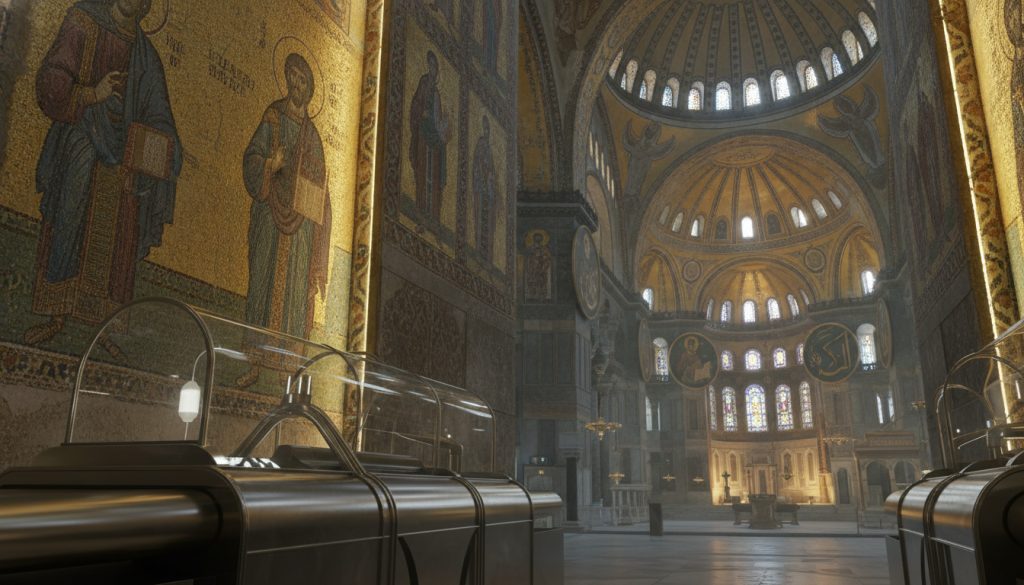
When you walk through Hagia Sophia, you might not see the invisible air curtains protecting the mosaics. These fields create separate zones without barriers. Visitors can move freely while the system keeps conditions stable.
The challenge was huge. Istanbul’s weather changes a lot, and tourists add moisture. Summer heat and winter cold, plus rainy seasons, all affect the mosaics.
A single group of fifty people can raise humidity by fifteen percent in minutes. Their breath adds moisture that condenses on cold surfaces. This causes salt crystallization that destroys the mosaics.
The system prevents damage through constant vigilance. It extracts moisture and guides air away from sensitive areas. It also keeps temperatures stable to prevent paint peeling and tesserae loosening.
| Environmental Threat | Impact on Heritage | Automated Solution |
|---|---|---|
| Visitor breath moisture | Humidity spikes causing mosaic loosening and paint peeling | Real-time dehumidification with localized extraction |
| Seasonal temperature swings | Thermal expansion cracking substrates and adhesives | Year-round climate stabilization maintaining narrow temperature range |
| Salt crystallization cycles | Destructive growth within stone and mortar destroying from inside | Humidity control preventing condensation that activates salts |
| Uneven air circulation | Microclimates creating differential weathering patterns | Strategic airflow design eliminating stagnant zones |
4.2 Permanently Stabilizing Mosaics and Calligraphy That Survived Empires
Hagia Sophia once had four acres of golden glass mosaics. These mosaics reflected candlelight, creating a shimmering effect. They were irreplaceable artistic achievements documenting Byzantine history.
The mosaics span from 537 AD to the late fourteenth century. They include early Christian iconography and imperial portraits. No other monument covers such a wide time span.
Traditional conservation methods couldn’t protect them. Environmental conditions changed too much. Winter was cold, summer was hot, and rainy seasons brought humidity.
A single tour group of fifty people can raise humidity by fifteen percent in minutes. Their breath adds moisture that condenses on cold surfaces, causing damage.
The byzantine mosaic structural conservation approach changed everything. Engineers designed environmental control as essential infrastructure. The system creates stable microclimates and monitors conditions closely.
This represents a fundamental shift. You can’t just stabilize structure and hope for the best. You must actively manage the atmosphere around fragile materials every minute.
4.3 When Environmental Control Becomes Non-Negotiable Heritage Infrastructure
The technology is sophisticated. Monument microclimate humidity control loops function like the building’s respiratory system. Multiple dehumidification units work together, each handling specific zones. Air handling systems maintain gentle circulation, preventing moisture accumulation.
Temperature control is also critical. The system eliminates hot and cold spots that cause damage. It makes gradual seasonal adjustments to prevent shock to materials.
Understanding the scale of investment required changed my perspective. This isn’t simple HVAC installation. The system required custom engineering for every zone. Sensors needed careful positioning, and air handling equipment had to be concealed yet accessible.
The results justify the complexity. Mosaics that were deteriorating have stabilized. Calligraphy panels no longer suffer moisture damage. The grime and mustard-colored paint covering walls can now be cleaned without immediate re-soiling.
I’ve visited many monuments and see Hagia Sophia’s approach as the global standard. Any heritage site with heavy visitation faces similar threats. Human presence creates environmental chaos that destroys cultural treasures.
The lesson is clear: environmental control isn’t a luxury—it’s non-negotiable heritage infrastructure. Just as seismic reinforcement protects against earthquakes, microclimate systems protect against the silent destruction caused by millions of visitors. Both are essential. Both require significant investment. Both determine whether monuments survive another millennium or gradually crumble despite our best structural interventions.
5. The Sacred-Museum Paradox: How Active Worship and Conservation Can Coexist
For years, Hagia Sophia was at the center of a big fight. Different groups wanted to own this special place. It changed from a church to a mosque and then to a museum, causing a lot of trouble.
I’ve seen how buildings can become symbols of conflict. Laws from the 1930s said no praying in the museum. But, people from both Christian and Muslim sides wanted it for their faith.
Hagia Sophia is a symbol of a huge cultural clash. It mixes medieval Christianity, the Ottoman Empire, Islam, and modern Turkey.
In 2007, Chris Spirou wanted Hagia Sophia to be a place of prayer for all Christians. At the same time, Turkish Islamists wanted it to be a mosque again. Pope Benedict XVI’s visit in 2006 made many people protest, saying “Constantinople is forever Islamic.”
Thirty-nine men were arrested for praying inside the museum. The building was seen as more than just a place—it was a symbol of impossible expectations.
5.1 Technology as the Mediator Between Faith and Preservation
Looking into the hagia sophia future 2050, I found technology helped solve the problem. It showed that keeping the building safe and allowing worship could work together.
Worship needs a comfortable temperature and good air. But, the mosaics need stable humidity and light. Monument microclimate humidity control loops help with both, making it a win-win situation.
These systems let prayers happen without harming the building. They adjust air flow as people move, keeping the mosaics safe from moisture and heat.
The way they manage visitors is clever. They use environmental barriers, not walls, to keep the art safe. This way, people can move around without damaging the building or blocking views.
| Requirement Type | Worship Function Needs | Conservation Needs | Unified Solution |
|---|---|---|---|
| Temperature Control | 18-22°C comfort zone for congregants | 18-20°C stability for mosaics | Precision climate at 19°C ±0.5°C |
| Humidity Management | 40-60% for respiratory comfort | 45-55% prevents material damage | Automated loops maintain 50% ±3% |
| Air Quality | Fresh air for large gatherings | Filtered air protects surfaces | HEPA filtration with CO2 monitoring |
| Lighting Standards | Adequate visibility for rituals | UV-filtered to prevent fading | LED systems with spectral control |
5.2 Why Dual Identity Demanded Dual Innovation
The building’s safety is crucial for both its history and worship. A damaged dome would harm everyone. This shared need helped find common ground.
The monument microclimate humidity control loops protect all the art, no matter its age or faith. It’s all about science, not religion.
This approach calmed the conflict. It showed that preserving the building respects all its pasts. You can’t ignore the mosaics and calligraphy—they’re together and need the same care.
By using the hagia sophia future 2050 plan, the site shows that worship and preservation can go hand in hand. Technology makes it possible to honor both.
The building now works as both a place of worship and a museum. Prayers are said while sensors keep the art safe. This balance is a model for other sites around the world.
This solution is not just for Hagia Sophia. It can help other places where faith and history meet. By investing in smart technology, we can find common ground.
When we use technology to meet everyone’s needs, we can work together. This way, both the Byzantine art and Ottoman craftsmanship are protected. It’s a win-win for all.
6. Net-Zero Immortality: The Case for Treating Historic Architecture as Living Infrastructure
After years of documenting crumbling heritage sites, I’ve come to believe every monument deserves extreme care like Hagia Sophia. It might seem expensive and unrealistic. But the preservation package through 2050 shows something revolutionary.
This isn’t just traditional conservation. It’s treating historic architecture as living infrastructure that needs active care, not just occasional fixes.
The old way of preserving buildings saw them as static objects to repair when needed. But monuments of global significance need a new approach. Hagia Sophia shows us the way.
Original Material Integrity Meets Physics-Driven Reinforcement
The success of this approach is clear. Non destructive heritage preservation science works well with aggressive structural intervention. The titanium rings add no new material but offer great earthquake protection. It’s a unique solution.
Imagine wrapping a 1,500-year-old dome in modern metal without touching the original brickwork. The reinforcement is external and can be removed if needed.
The same principle applies to byzantine mosaic structural conservation. Microclimate systems control temperature and humidity without touching the mosaics. The environment is kept perfect, but the mosaics themselves are untouched.
This method is a game-changer. The original construction was fast, using innovative architecture and recycled materials. The green marble columns from the Temple of Artemis are still in place today.
Why Every Endangered Monument Deserves the Hagia Sophia Treatment
I’ve seen priceless heritage crumble in earthquake zones. This has made me believe the hagia sophia dome earthquake restoration model should be the global standard.
What makes a monument truly irreplaceable? It’s not just its beauty or historical value. It’s the authentic materials that span centuries, which can never be recreated.
Once the green marble columns from Artemis’s temple are lost, they’re gone forever. The same goes for Byzantine mosaics that took generations to create.
Hagia Sophia was a groundbreaking building that influenced all major cathedrals. It’s not just a monument—it’s the foundation of Western and Eastern religious architecture for a thousand years.
Monuments of such significance need active protection, not just repairs. Every monument representing centuries of culture and innovation deserves the same care.
The Economic and Cultural ROI of Extreme Preservation
Extreme preservation is costly. The 50-year plan needed funding, international help, and new technology. But the benefits are worth it.
Heritage tourism brings in a lot of money. Hagia Sophia attracts millions, boosting Istanbul’s economy. This is a clear financial gain.
The knowledge from hagia sophia dome earthquake restoration helps seismic projects worldwide. The technology for byzantine mosaic structural conservation protects museum collections globally. The solutions have far-reaching benefits.
The cultural value of preserving Hagia Sophia is priceless. It’s a symbol of centuries of Roman, Greek, Christian, and Islamic civilization.
Assigning a value to preserving 15 centuries of human achievement is impossible. That’s why the investment is justified.
I believe the Hagia Sophia vision for 2050 sets the standard for preserving our most important architecture. Net-zero immortality means buildings stay in perfect condition without deteriorating or needing destructive repairs.
This approach is not just preservation—it’s architectural life support. For monuments documenting centuries of civilization, it’s the only responsible way.
The alternative is watching priceless heritage crumble because we thought extreme care was too expensive. I’ve seen this tragedy too many times. We can do better, and Hagia Sophia shows us how.
7. Conclusion
I began by wondering how a building could last 15 centuries in an earthquake zone. What I found changed my view on preservation. The Hagia Sophia experience shows that ancient sites can host millions while being carefully protected.
The vision for Hagia Sophia’s future by 2050 is more than just saving a building. It’s a guide for preserving heritage sites around the world. Imagine titanium rings around Byzantine domes and systems that keep mosaics safe. There are plans to care for the building for the next 50 years, treating it as a living part of history.
In Istanbul, Hagia Sophia will keep adding to its history while lasting another 1,500 years. The technology to preserve it now matches our dreams. We can now protect ancient structures without harming them.
Visitors in the future will see a building more secure than ever before. The Hagia Sophia’s future shows us how to save not just one building but our shared architectural heritage. It teaches us that our most treasured monuments need the strongest protection, as anything less won’t last against earthquakes or time.



Leave A Comment