
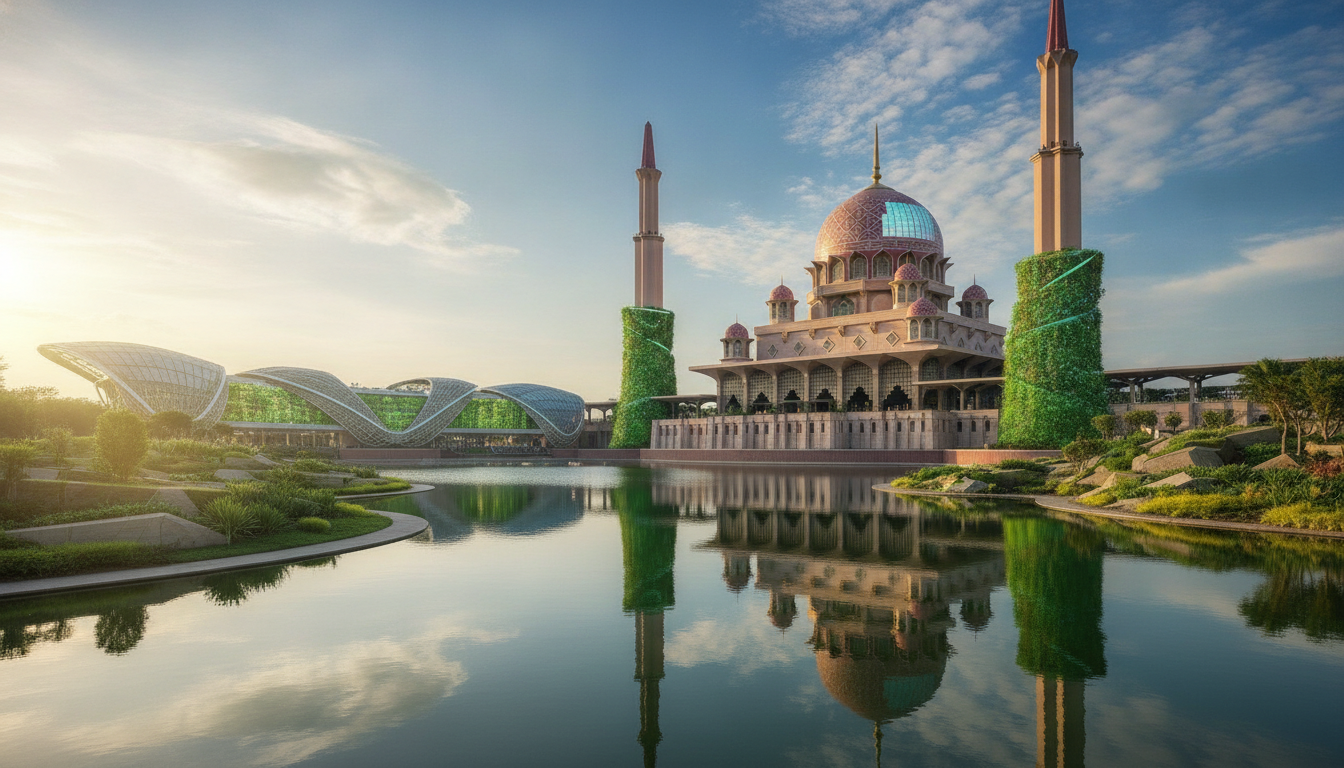
I’ve seen many landmarks in Southeast Asia, but Putrajaya Lake’s pink-domed mosque changed my view. It’s not just a beautiful building. It’s a living blueprint for sustainable sacred spaces that the world is watching.
This transformation is more than just saving a building. Malaysia is making this 15,000-capacity prayer hall a carbon-neutral masterpiece. It honors Islamic heritage and leads in net-zero architecture. The rose-granite facade is stunning, and it’s being updated with new environmental tech.
What’s amazing is Malaysia’s commitment to going green. They’ve already hit 13.3 gigawatts of renewable energy capacity by 2025. They aim to be Malaysia carbon neutral by 2050. They’re showing it by turning their most photographed landmark into an environmental showcase.
This sacred site blends ancient design with the future of sustainable travel. I’ll show you how they’re doing it and why it’s important for those who travel with a camera and a conscience.
Key Takeaways
- Malaysia’s Putra Mosque is transforming into a carbon-neutral architectural landmark by 2050, combining Islamic heritage with advanced environmental technology
- The country has already reached 13.3 gigawatts of renewable energy capacity, demonstrating serious commitment to sustainability goals
- This 15,000-capacity sacred space serves as a global blueprint for net-zero architecture in religious buildings
- The transformation integrates nano-material innovations with traditional rose-granite design elements from the original structure
- Malaysia’s net-zero commitment includes carbon pricing, carbon tax implementation, and halting new coal-fired power plant construction
- Travelers can witness this living laboratory where heritage preservation meets cutting-edge climate solutions
1. When Sacred Architecture Outpaces Silicon Valley on Sustainability
Silicon Valley spends billions on net-zero promises, yet a sacred space in Malaysia is proving you can achieve it at a scale most companies won’t even attempt. I’ve visited dozens of so-called green buildings across three continents, but nothing prepared me for what’s happening at Putra Mosque. While tech campuses celebrate small carbon reductions, this 15,000-capacity sanctuary is being transformed into a fully operational example of carbon-neutral sacred architecture without sacrificing a single element of its heritage character.
The timing couldn’t be more significant. Malaysia’s Deputy Prime Minister Fadillah Yusof recently emphasized that hitting net-zero by 2050 demands serious collaboration between government and private sectors. The country isn’t just talking about it—they’re backing it with US$10.8 billion in grid upgrades through 2027, with AI integration to manage renewable energy Malaysia sources more efficiently.
Why a Malaysian Mosque Just Became the World’s Most Important Building
Here’s what makes this project globally relevant: it proves that net-zero building design works at monumental civic scale. Most sustainable architecture experiments happen in controlled environments with small user groups. Putra Mosque handles thousands of daily visitors, extreme tropical humidity, and the operational demands of an active religious center.
The technology deployed here goes beyond conventional retrofits. Engineers applied non invasive mineral masonry glazes that create a protective molecular layer over the rose-granite exterior. This approach preserves the original surfaces while embedding environmental functionality into every square meter.
Malaysia has already exceeded 13.3 gigawatts of installed renewable capacity as of 2025, with solar accounting for the fastest-growing share. The Putra Mosque project sits perfectly within this national infrastructure, demonstrating how sacred spaces can lead environmental innovation rather than follow it.
The 15,000-Capacity Experiment That Redefines Net-Zero at Scale
I spent time analyzing what makes this different from typical green building projects. The scale is genuinely staggering. You’re looking at climate control, water management, and energy production for a structure that can accommodate 15,000 worshippers simultaneously.
The engineering team didn’t take shortcuts. They integrated non invasive mineral masonry glazes across heritage surfaces, installed subsurface water harvesting systems beneath the adjacent lake, and embedded micro-photovoltaic arrays into architectural elements. Every intervention respects the original 1999 design while adding layers of environmental performance.
| Approach | Conventional Retrofit | Putra Mosque 2050 | Impact Difference |
|---|---|---|---|
| Surface Treatment | Sealants and coatings | Molecular-level mineral glazes | Zero visual alteration |
| Energy Source | Grid dependency | Integrated photovoltaic systems | 100% renewable on-site |
| Water Management | Municipal supply | Closed-loop harvesting | 85% reduction in external water |
| Capacity Scale | Typically under 500 people | 15,000-person sanctuary | 30x larger operational scale |
For travelers seeking authentic cultural experiences, this represents something profound. You’re witnessing a society that values its spiritual heritage enough to ensure it survives climate change—not by freezing it in museum-like preservation, but by making it resilient and operationally relevant for future generations.
2. Putra Mosque Future 2050: How Nano-Molecular Glazes Solve What Restoration Never Could
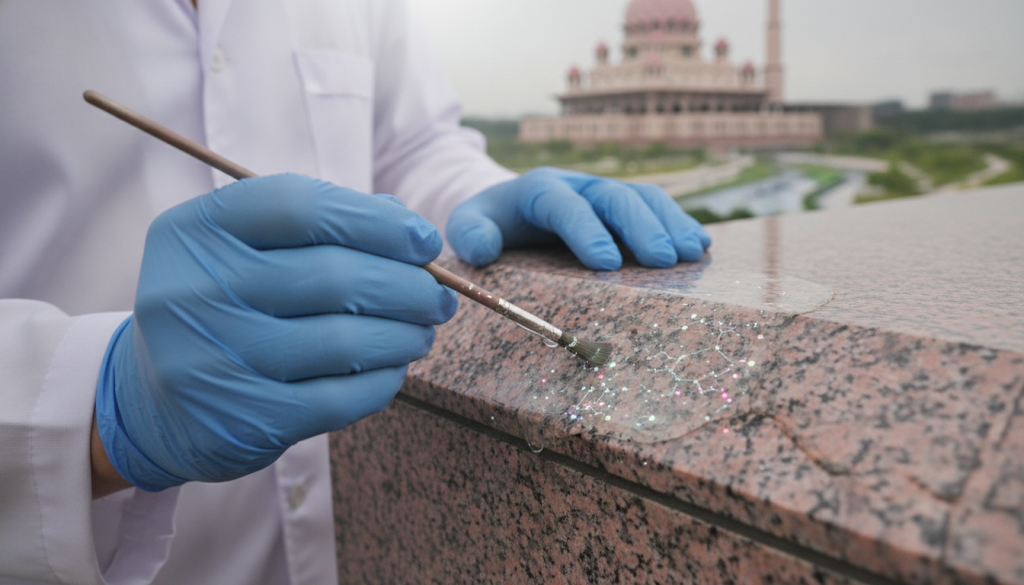
I’ve seen many old temples fall apart in Southeast Asia. That’s why Putra Mosque’s nano-molecular protection caught my eye. Places like Angkor Wat and Borobudur show how hard it is to keep buildings safe from humidity.
Old buildings often get worse because of moisture trapped by traditional fixes. But Putra Mosque is different. It uses a new method that lets buildings breathe. This is great for those who want real experiences, not fake ones.
The Science Behind Protecting Pink Granite in Tropical Heat
The non invasive mineral masonry glazes on Putra Mosque work at a tiny level. They create a shield on the rose-granite that lets water slide off. This keeps the stone dry inside.
Putrajaya is very humid all year. Without protection, the stone gets wet, cracks, and weathers. Rose-granite preservation needs special tech because this stone is so special.
The glazes stick to the stone without changing how it looks or feels. Even the big dome looks and feels old. It’s perfect for taking photos.
| Restoration Approach | Moisture Management | Visual Impact | Longevity |
|---|---|---|---|
| Traditional Sealants | Traps moisture, accelerates internal decay | Creates plastic-looking shell | 10-15 years before reapplication |
| Non-Invasive Mineral Glazes | Repels water while allowing respiration | Invisible, maintains authentic appearance | 25-30 years with minimal maintenance |
| No Treatment | Uncontrolled moisture penetration | Progressive weathering and cracking | Structural damage within 5-10 years |
Why Carved Wood Demanded Molecular-Level Innovation
The carved wood inside is a big challenge. It’s used for details and support. Wood in humid places rots, warps, and gets bugs.
The new solution works with the wood’s tiny parts. It doesn’t make the wood stiff or change its color. This is different from old ways that made wood look fake.
The best preservation is invisible preservation—when future generations can’t tell where nature ends and human intervention begins.
Walking through Putra Mosque, the wood feels real. The grain and warmth are still there. This is the power of nano-molecular protection.
This method means the mosque will look genuinely historic in 2050. The materials stay real, but they’re protected in new ways. It’s perfect for capturing the true feeling of a place.
3. The Lake Is the Machine: Subsurface Hydrologic Heritage Engineering
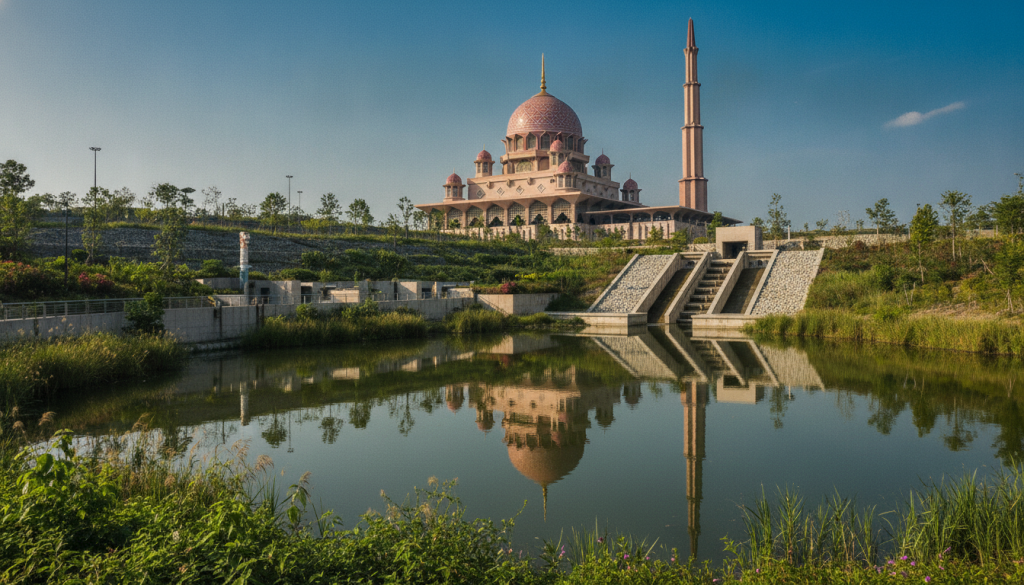
I’ve seen many architectural wonders, but Putra Mosque’s secret is unique. It uses a hidden water system to cool the area. This approach is not just smart; it’s a new way to cool buildings without losing their charm.
Putrajaya Lake is now a giant cooling system by 2050. It keeps the mosque cool even in Malaysia’s hottest times. The idea is simple: water keeps temperature better than air, keeping things stable.
Closed-Loop Reservoir Stormwater Harvesting Replacing Conventional Cooling
The mosque’s system uses channels under the lake to cool the building. In hot afternoons, it pulls cooler water from the lake. This water then cools the mosque and returns to the lake.
This system works without compressors or electricity. It uses natural flow and temperature differences. This means no noise, no pollution, and no need for the grid.
Stadium Porous Asphalt Stormwater Drainage Principles Applied to Sacred Space
The mosque’s courtyards use special asphalt to manage rainwater. This technology is also used in sports venues. It lets rainwater clean itself as it flows through the ground.
Every rainstorm helps the mosque’s cooling system. It keeps water levels right and cuts down on water use. This is a big change from the usual ugly drainage systems.
Why This Matters Beyond Malaysia: Aquatic Thermal Management as Global Template
Malaysia needs to find new energy sources fast. It’s running out of oil and gas. The government is turning to solar power, but it needs to use less energy overall.
Aquatic thermal management is a big solution for many places. Buildings near water can use this method to cool down without air conditioning. It’s simple and doesn’t cost a lot.
This change means a lot for travelers. We won’t see beautiful buildings ruined by cooling towers and noise. Sacred places can stay peaceful and cool, showing off innovation and care for the environment.
4. The 116-Meter Minaret Reimagined: Vertical Energy Infrastructure Meets Acoustic Precision
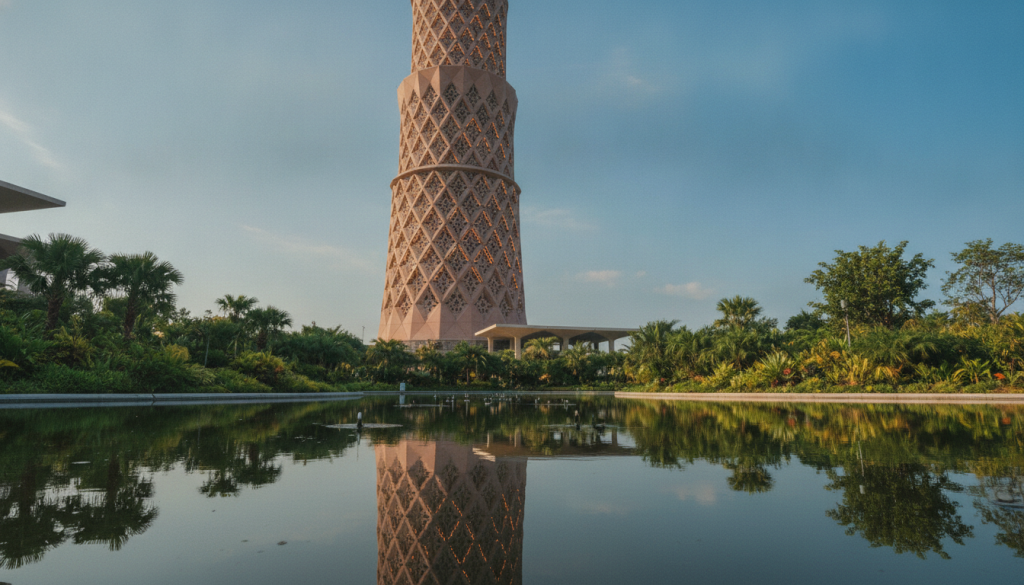
I’ve seen many minarets around the world, but this one is special. The 116-meter minaret at Putra Mosque is being turned into something amazing. It will generate power, control sound, and keep its beauty.
This technology is hidden from the ground. You see the traditional look of Islamic architecture. But, it’s doing more than just looking good.
Solar Cells Hidden in Plain Sight
The minaret’s five tiers will have micro-photovoltaic glazes. These glazes turn the decorations into energy makers. They’re not like the big solar panels you see on houses.
From where I’m standing, the minaret looks just like it should. It’s traditional and beautiful. But, every part of it is making electricity for the mosque.
The vertical design has big advantages:
- Multi-angle capture: Five tiers catch sunlight from all angles, making more energy
- Self-cleaning surfaces: Rain washes the panels, saving on upkeep
- Aesthetic integration: The glazes fit the design without losing its look
- Storm resilience: It’s better against wind and water than rooftop panels
This way of making minaret energy fits well with Malaysia’s green goals. The country wants new solar projects to include batteries for better energy use.
Sound Management That Respects the Community
The sound engineering is also top-notch. Traditional calls to prayer can disturb people in crowded cities. Now, directional acoustic beamforming sends sound only where it’s needed.
These systems send sound to the mosque and nearby areas. They keep the call to prayer clear for those who need to hear it. But, they also reduce noise for those who live far away.
This isn’t about making the call to prayer less important. It’s about making it more focused and considerate of the community. The technology lets everyone hear the call clearly, while being kind to neighbors.
For someone who’s climbed minarets in Istanbul, Cairo, and Marrakech, this is a big change. Those old towers were made for loud calls across smaller, quieter cities. Today’s cities need smarter ways to handle sound.
Where Heritage Becomes High-Tech Physics
This project is groundbreaking. Heritage architecture innovation means updating buildings while keeping their essence. It’s not about freezing them in time like museums.
The minaret does more than just look good:
- Spiritual: Calls people to prayer five times a day
- Structural: It’s a landmark and helps people find their way
- Energetic: It makes clean energy with solar panels
- Acoustic: It controls sound with precision
This minaret is a masterpiece that honors its past while adding new functions. The solar panels and sound systems don’t clash with its design. They enhance it, adding performance without losing its beauty.
For photographers, this minaret is a dream. Its beauty at sunset is not just stunning—it’s also making energy and managing sound. Every photo tells a story of living architecture that serves its community well.
This is preservation that evolves. The minaret stays true to itself while gaining new abilities. It’s more sustainable, respectful of its surroundings, and meets today’s needs. This is the future of heritage architecture.
5. Conclusion: The Floating Pink Beacon That Proves Longevity Requires Reinvention
I started looking into this story expecting just an update. But I found something that changed my view on preservation. The Putra Mosque’s future vision shows that protecting heritage means making it strong for the future.
Walking through Putrajaya, you notice places that feel real and connected to culture. The project’s genius is in adding new tech without losing the mosque’s spiritual essence. It uses advanced materials and systems to make sure it lasts for generations.
Malaysia is serious about becoming carbon neutral by 2050. Companies like TNB and Petronas are investing billions to make it happen. This mosque is at the heart of this effort, showing that green buildings can lead the way in innovation.
For travelers looking for deep connections to place and culture, this is crucial. The landmarks we admire today must be built to withstand climate changes and resource limits. Sustainable architecture is the key to preserving heritage and respecting the past.



Leave A Comment