

China’s wildlife ecosystem stands among the most diverse on our planet. The country ranks as one of just 17 megadiverse countries worldwide. Its impressive wildlife includes 7,516 vertebrate species – 4,936 fish, 1,269 bird, 562 mammal, 403 reptile, and 346 amphibian species.
The wildlife’s remarkable feature lies in its high level of endemism. China’s unique ecosystem hosts one-sixth of all mammal species and two-thirds of amphibian species that exist nowhere else on Earth. The giant panda serves as the most iconic example, living only in specific areas of Sichuan and Gansu Provinces.
The country’s rich biodiversity faces significant challenges with at least 840 species now threatened, vulnerable, or close to local extinction. The Hainan gibbon population has crashed from 2,000 individuals in the 1950s to just 20-30 mature adults today. Asian elephant numbers have dropped drastically from 100,000 at the start of the 20th century to fewer than 10,000 in the wild.
Conservation efforts have gained momentum over the last several years. The country now maintains over 2,349 nature reserves that cover nearly 15 percent of its total land area. These protected zones stretch across seven different ecoregions, from misty mountains to sprawling deserts. They provide safe havens to rare species like the Chinese alligator, golden monkey, and the Yangtze dolphin.
Giant Panda

Image Source: CNN
The giant panda stands as one of the most recognizable symbols of Chinese wildlife and global conservation. Its distinctive black and white markings have captured worldwide attention and represent China’s dedication to protecting its unique biodiversity.
Species Overview
The giant panda (Ailuropoda melanoleuca) belongs to the bear family Ursidae. Males grow larger than females and weigh between 220-330 pounds, while females reach around 200 pounds. Their body length stretches beyond four feet, with a round body structure that gives them their distinctive look. The scientific name means “black and white cat-foot,” which points to their unique coloring and paw structure. Scientists once thought pandas were related to raccoons because of their plant-based diet. The largest longitudinal study in the 1990s proved they were true bears.
Habitat and Range
Giant pandas once roamed throughout eastern Asia during the early Pleistocene Epoch. Now they live only in small, scattered areas of bamboo forest in China. You’ll find them in six mountainous regions across Sichuan, Shaanxi, and Gansu provinces. Most wild pandas call the Minshan and Qinling mountains home. These temperate forests reach up to 3,000 meters and provide the thick bamboo vegetation pandas need to survive. Protected habitat covers about 13,000 square kilometers, just 1% of their old range.
Conservation Status
Giant pandas have become a remarkable success story in conservation. China’s panda population has grown steadily from just 1,114 in the 1980s. The 2014-2015 Fourth National Survey counted about 1,864 pandas living in the wild, and experts believe this number will reach 1,900 by 2025. The captive panda population has grown twice as large in the last decade, reaching 808 pandas by 2025.
These population gains prompted the International Union for Conservation of Nature (IUCN) to change pandas’ status from “endangered” to “vulnerable” in 2016. All the same, several challenges remain:
- Habitat fragmentation poses the biggest threat as roads, railways, and dams separate panda populations
- Protected reserves house only 67% of wild pandas
- Climate change threatens bamboo forests more each year
China created an integrated network of 73 nature reserves, now merged into the Giant Panda National Park, which protects 54% of their habitat. On top of that, authorities use advanced monitoring technologies, including AI and integrated “space-air-ground” systems to track wild populations.
Unique Traits
Giant pandas have adapted to eat almost nothing but bamboo—99% of their diet. This specialized diet began about three million years ago. Pandas must eat between 26-84 pounds of bamboo daily. Bamboo provides little nutrition, and pandas digest only 17% of what they eat, so they spend 12-16 hours each day eating.
Pandas’ bodies have evolved special features that make eating bamboo easier. Their most notable adaptation is an enlarged wrist bone that works like a thumb, letting them handle bamboo stalks with skill. Strong jaws and special teeth help them crush and grind tough bamboo fibers.
These bears live mostly alone and use scent marking to communicate. Unlike other bears, pandas stay active all winter instead of hibernating. Female pandas face tough breeding challenges—they can only get pregnant during a 24-72 hour window each year. After carrying their cubs for 90-184 days (usually about 135), they give birth to very tiny babies weighing just 112 grams—about 1/800th of the mother’s weight. Captive pandas can live past 30 years, while wild pandas usually live around 20 years.
Hainan Black Crested Gibbon
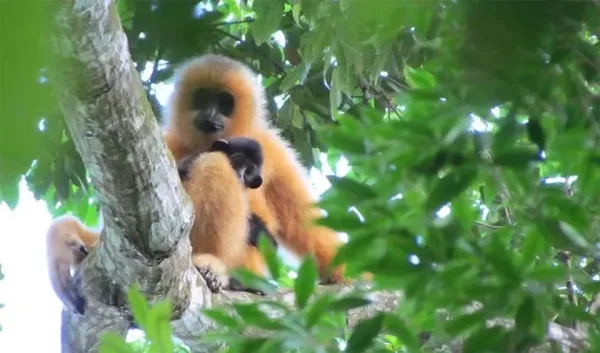
Image Source: BioDB
One of the rarest treasures in Chinese wildlife, the Hainan black crested gibbon stands as the world’s rarest ape, rarest primate, and one of the rarest mammals on Earth. These critically endangered primates now live only in a single forest patch on Hainan Island, China’s southernmost province, unlike their mainland relatives.
Species Overview
Scientists once thought the Hainan black crested gibbon (Nomascus hainanus) was a subspecies of N. concolor or N. nasutus. Today, molecular evidence, different vocalizations, and unique fur patterns show it’s a distinct species. The males have completely black fur, while females show beautiful golden or buff colors with black patches and a distinctive black streak on their heads. Female gibbons’ faces feature a thin, white ring that grows thicker above the mouth and below the eye ridge. The hair around their faces creates a rounded look. The female Nomascus’s sweat can turn their fur more orangey as humidity rises. These graceful primates have long arms and legs but no tail – perfect adaptations for life in the trees.
Habitat and Range
Today, all Hainan gibbons live in Bawangling Nature Reserve within the Hainan Tropical Rainforest National Park, in Changjiang County on Hainan Island’s western side. Government records from the 17th century suggest these gibbons once lived across half of China, though these accounts might describe several different species.
These primates now inhabit mountainous tropical rainforests between 2,133 and 3,937 feet (650 to 1,200 meters) above sea level. Their original habitat mostly included lowland tropical primary forest at lower elevations. The loss of these lowland forests pushed the gibbons into harsher mountain rainforests with less food. Scientists used to believe their home range was large, spanning 2.0-9.87 km². Recent analysis shows they actually need about 1.49 km², similar to related species.
Conservation Status
The IUCN Red List labels the Hainan black crested gibbon as Critically Endangered. Their numbers have dropped dramatically through the years. More than 2,000 gibbons lived on Hainan Island in the 1950s. By 1989, only 21 gibbons remained in four groups. A 2003 count found just 13 individuals. Thanks to conservation work, their population grew to 42 individuals in seven family groups by February 2024.
These gibbons face several threats:
- Logging, slash-and-burn farming, and rubber plantations destroy their habitat
- New settlements and infrastructure push into their territory
- People hunt them for meat and traditional medicine
- Poachers capture them for the illegal pet trade
The tiny population size brings more risks: inbreeding, trouble finding mates, and vulnerability to natural disasters.
Unique Traits
These gibbons have adapted their social structure to their shrinking habitat. They live in polygynous groups – one breeding male, two adult females, and their young. Groups usually have 4-8 members, averaging 5.3-5.5 individuals. The largest recorded group had 11 members between 2009-2011.
Their breeding patterns show interesting adaptations. Females give birth every two years, matching the fruit-blooming cycles on Hainan Island. Their pregnancies run shorter than other gibbon species. Young gibbons take six to eight years to become sexually mature.
These primates love fruit, especially soft, sweet varieties like wild lychees, rambutans, and figs. They eat leaves, shoots, and insects when fruit becomes scarce. Food gets hardest to find from February through April, when only a few food plants produce.
The gibbons share a fascinating trait – they sing together. Males and females perform morning “duets” each day, helping researchers track their movements and study their behavior. Modern conservation teams now use audio devices that can spot and classify their calls with 89.2% accuracy.
South China Tiger
The South China tiger stands as China’s only native tiger subspecies. This majestic predator was once a powerful symbol in Chinese culture and art. Today, it teeters on the edge of extinction in the wild.
Species Overview
The South China tiger (Panthera tigris amoyensis) is the oldest of all tiger subspecies. It first appeared in China approximately 2 million years ago. Scientists believe all other tiger subspecies evolved from this ancestral root. The species belongs to the Panthera tigris tigris subspecies classification.
The South China tiger is nowhere near the size of other mainland Asian tigers but larger than the Sumatran tiger. Males reach 230 to 265 cm (91 to 104 inches) in length and weigh between 130 to 175 kg (287 to 386 lb). Females are smaller at 220 to 240 cm (87 to 94 inches) and weigh 100 to 115 kg (220 to 254 lb).
These tigers have unique physical traits. Their coat shows a lighter, more yellowish shade than other subspecies, with a paler belly and white facial features. You’ll notice more narrow, sharp-edged stripes on their bodies compared to other tigers. Their skull structure is different too, with a larger skull and eyes set closer together.
Habitat and Range
These tigers once roamed an enormous territory in China – 2,000 km (1,200 mi) east to west and 1,500 km (930 mi) north to south. Their range extended from Jiangxi and Zhejiang provinces in the east to Guizhou and Sichuan provinces in the west. The territory stretched from the Qinling Mountains and Yellow River area in the north to Guangdong, Guangxi, and Yunnan provinces in the south.
The tigers made their home in mountainous tropical forests. Dense vegetation gave them perfect cover to stalk their prey. They thrived in Fujian, Guangdong, Hunan, and Jiangxi provinces. Before their numbers dropped, they lived as far south as Hong Kong.
Conservation Status
The South China tiger’s survival hangs by a thread. The IUCN Red List and China’s Red List of Vertebrates list it as Critically Endangered. Most experts now call it “functionally extinct” in the wild. No one has confirmed seeing these tigers in the wild since the late 1980s.
The population crash tells a tragic story:
- Early 1950s saw around 4,000 tigers in the wild
- By 1982, only 150-200 tigers remained
- 1987 showed a mere 30-40 survivors
- 2001 field studies found no wild tigers at all
Several factors led to this collapse:
- Government “anti-pest” campaigns in the 1950s killed 2,000 tigers
- Forests disappeared and habitats split apart
- Prey became scarce
- Hunters killed tigers for traditional medicine
The species now exists only in captivity. About 150 South China tigers lived in Chinese facilities as of 2019. The Chinese Association of Zoological Gardens manages a breeding program that started in 1994, housing 144 tigers. These captive tigers face big challenges. They struggle to reproduce and lack genetic diversity since they all come from just six wild-caught ancestors.
Unique Traits
The South China tiger means more than its physical features suggest. It represents a cultural icon in China’s art, literature, and philosophy. The tiger symbolizes wilderness and promotes conservation awareness as China’s population grows.
Like most tigers, they prefer to live alone. They meet only to mate and raise cubs. These territorial animals defend their space fiercely. They mark their territory with scents and tree scratches to warn others away.
These skilled hunters stalk and ambush their prey, mainly wild boar, deer, and smaller mammals. A single tiger can eat up to 40 kg of meat in one meal – that’s like eating 45 large pizzas.
Conservation efforts continue through programs like “Save China’s Tigers,” launched in 2002 with support from China’s State Forestry Administration. The program wants to teach captive-born tigers how to catch wild prey in large enclosures before releasing them into the wild. Their goal? To establish 15-20 tigers living in at least 1,000 km² of habitat.
Chinese Mountain Cat
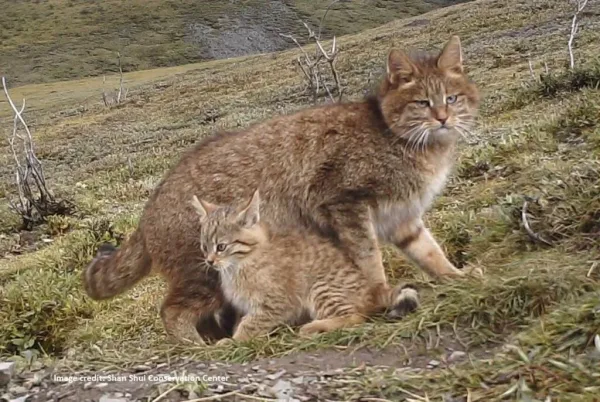
Image Source: International Society for Endangered Cats (ISEC) Canada
The Chinese Mountain Cat, nicknamed the “ghost cat” of the Tibetan highlands, stands as one of China’s most mysterious wildlife treasures. Scientists could not photograph this secretive feline in the wild until 2007. This cat holds a special place in China’s fauna as the country’s only endemic cat species.
Species Overview
The Chinese Mountain Cat (Felis bieti), also called Chinese desert cat or Chinese steppe cat, has distinctive sand-colored fur. Black-tipped ears and faint dark stripes adorn its face and legs. These cats reach 69-84 cm in head-body length with a 29-41 cm tail. Their weight ranges from 6.5-9 kg (14-20 lb).
Scientists have debated this cat’s classification for years. The species earned its independent status in 2017, after being considered a wildcat subspecies (Felis silvestris bieti). DNA studies show it belongs to a Felis lineage that split from the Asiatic wildcat about 1.5 million years ago. The cat’s scientific name honors French missionary Félix Biet, who found the first specimens.
Habitat and Range
Despite its alternative name suggesting otherwise, this cat avoids desert environments. These felines live only on the Tibetan Plateau’s north-eastern edge, specifically in Qinghai province and northwestern Sichuan. They thrive in high-elevation steppe grasslands, alpine meadows, shrublands and near coniferous forests at heights between 2,500 to 5,000 meters (8,200-16,400 ft).
Local residents call it the “grass cat” because its fur matches dry grass perfectly. The fur shows gray near the skin and transitions to brown with blond tips. Recent sightings in Ruoergai county, Xinlong County, and the Sanjiangyuan region have expanded our knowledge of their territory.
Conservation Status
The IUCN Red List classifies this species as Vulnerable. Less than 10,000 mature cats remain alive today, and their numbers keep dropping. These cats face several threats:
- Government programs targeting their main prey (pikas and rodents) cause indirect poisoning
- Breeding with domestic cats dilutes their genetic makeup
- New infrastructure projects fragment and destroy their habitat
- Some hunting for fur continues, though less than before
Yet hope remains. China elevated the species to National First-Class Protected status in February 2021, giving it the same protection as giant pandas. A significant breakthrough came in July 2023 when researchers attached a GPS collar to a rehabilitated male, helping us learn about their movement patterns.
Unique Traits
Nature has equipped these cats with remarkable features for high-altitude living. Long fur grows between their toe pads to protect against freezing ground. Their coat changes with seasons – pale gray in winter becomes darker brown in summer.
These cats hunt differently from their relatives. Though active mainly at night and twilight, they use exceptional hearing to detect prey moving underground. They can dig rodents straight from their burrows, a rare skill among cats.
Their tail shows 5-6 dark bands with a black tip, similar to a raccoon’s pattern. During daytime, they shelter in burrows on south-facing slopes. This location shields them from extreme mountain temperatures that swing between hot days and frigid nights.
Red Panda

Image Source: Red Panda Network
The red panda made its mark in science 50 years before anyone found the giant panda. This unique creature stands as a symbol of China’s wildlife heritage and leads conservation efforts throughout the Eastern Himalayas.
Species Overview
The red panda (Ailurus fulgens) belongs to its own taxonomic family, Ailuridae. Its name might suggest otherwise, but it shares no close relation to giant pandas and sits on its own evolutionary branch. Scientists recognize two subspecies: the Himalayan red panda (A. f. fulgens) lives in Tibet and northwestern Yunnan, while the Chinese red panda (A. f. styani) calls the Hengduan Mountains of Sichuan and eastern Yunnan home. These subspecies split genetically about 250,000 years ago.
A fully grown red panda stretches 51-63.5 cm long with a tail measuring 28-48.5 cm, and weighs between 3.2-15 kg. Its striking features include thick reddish-brown fur, white facial markings, black belly and legs, white-lined ears, and a fluffy ringed tail.
Habitat and Range
Chinese red pandas thrive in temperate broadleaved and coniferous forests where bamboo grows abundantly at heights of 2,400-3,900 meters. Their territory covers the Himalayan temperate zones where yearly temperatures average 18-24°C. These animals prefer steep hillsides with thick bamboo growth near water.
Red pandas once roamed through Guizhou, Gansu, Shaanxi, and Qinghai provinces. Today, they live only in Sichuan, Yunnan, and Tibet. China’s population stands at 6,000-7,000 individuals – Sichuan houses 3,000-3,400, Yunnan supports 1,600-2,000, and Tibet protects 1,400-1,600.
Conservation Status
The IUCN Red List labels red pandas as Endangered, with fewer than 10,000 individuals worldwide. Their Chinese habitat has shrunk to just 37,436.5 km². The population has dropped by about 40% in the last 50 years because of:
- Habitat destruction and fragmentation
- Human encroachment and infrastructure development
- Poaching for fur and the illegal pet trade
- Competition from livestock for bamboo resources
China has responded by creating 31 nature reserves that protect 42.4% of red panda habitat. These safe havens cover 15,864.9 km² across Sichuan (18 reserves), Yunnan (7 reserves), and Tibet (6 reserves).
Unique Traits
Red pandas amaze scientists with their specialized diet – bamboo makes up 98% of what they eat. They need to eat 20-30% of their body weight in bamboo each day, yet their bodies only process about 24% of this intake. A special “pseudo-thumb” – an enlarged, modified wrist bone – helps them grab bamboo stems.
These creatures sleep up to 17 hours daily. Their long, bushy tails help them balance in treetops and stay warm. When temperatures plummet, they enter a torpor state that reduces their metabolic rate and body temperature. Nature equipped them well – their reddish fur blends perfectly with the red moss and lichen in their forest homes.
Baiji Dolphin

Image Source: Natural History Museum
The Baiji dolphin’s extinction from the wild stands as one of the most devastating losses in Chinese wildlife conservation history. This freshwater dolphin, revered as the “Goddess of the Yangtze,” became the first dolphin species to vanish due to human activities.
Species Overview
The Baiji (Lipotes vexillifer) was a member of the Platanistidae family. This remarkable creature had a fusiform body, featuring a small head, tiny eyes, and a distinctive long, narrow beak that curved slightly upward at the tip. Its low, triangular dorsal fin resembled a white flag during swimming, earning it the name “white-flag dolphin”. Gray coloring dominated its dorsal area, with whitish streaks running into its face and head. Female Baiji grew larger than males, reaching 2.53m and 170kg compared to males’ 2.29m and 130kg.
Habitat and Range
The Yangtze River in China served as the Baiji’s exclusive home. These dolphins roamed roughly 1,100 miles of the river. The species also lived in the connected Dongting and Poyang lakes. The dolphins preferred areas near sandbars and tributary junctions, where fish gathered around nutrient-rich deposits.
Conservation Status
The Baiji’s population crashed from about 6,000 individuals before 1950 to just 300 by the 1980s. Scientists found only 13 dolphins during a 1997 survey. A detailed six-week search in 2006 found no surviving individuals, leading scientists to declare the species functionally extinct. The last wild Baiji sighting dates to 2001, while Qi Qi, the final captive specimen, died in 2002.
Several factors sealed the Baiji’s fate:
- Fishing gear entanglement, particularly in hooks and gillnets
- Dam construction destroyed their habitat, notably the Gezhouba Dam (1970) and Three Gorges Dam (1994)
- Busy waterways led to frequent boat collisions
- Industrial pollution harmed both the dolphins and their food sources
Unique Traits
The Baiji compensated for its poor eyesight with advanced echolocation to navigate the Yangtze’s murky waters. Their specialized long, narrow beaks helped them find fish like carp and catfish in muddy river bottoms. Female Baiji carried their young for 10-11 months and gave birth every 2 years. Males reached sexual maturity at 4 years, while females matured after 6 years. Studies of their teeth revealed these dolphins could survive up to 24 years in their natural habitat.
Finless Porpoise
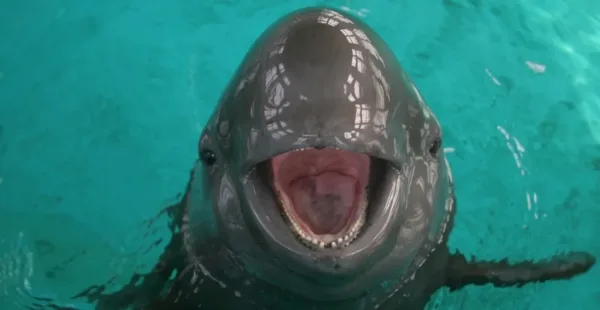
Image Source: Natural History Museum
The finless porpoise still traverses China’s waterways despite mounting odds, offering hope for aquatic conservation where its extinct cousin, the Baiji dolphin, could not survive.
Species Overview
The genus Neophocaena includes three distinct species of finless porpoises. The Yangtze finless porpoise (N. asiaeorientalis) lives only in the Yangtze River basin. The Indo-Pacific finless porpoise (N. phocaenoides) ranges from the Persian Gulf to the Taiwan Strait. The East Asian finless porpoise (N. sunameri) makes its home in waters from Taiwan to Japan.
These porpoises stand out because they lack a dorsal fin. A ridge of small tubercles runs along their back instead, with widths ranging from 0.2 to 12.0 cm across species. Their bodies look more slender than other porpoises. They have a rounded forehead that rises sharply from a beakless snout. Adult porpoises grow just over 2 meters long, while newborns measure 75-85 cm.
Local residents call the Yangtze finless porpoise the “river pig.” These creatures show intelligence that matches a gorilla’s and sport what looks like a playful smile. Their soft, mushy bodies and flexible necks let them move with surprising grace through the water.
Habitat
These remarkable creatures prefer shallow waters with soft or sandy bottoms across their range. The world’s only freshwater porpoise, the Yangtze finless porpoise, lives exclusively in the main Yangtze River and its connected lakes. These freshwater specialists spend their time in shallow bays, swamps, and estuaries throughout the year.
Recent population numbers show promise after years of decline. The population dropped from over 2,500 in the 1990s to about 1,012 in 2017. Overfishing, pollution, and boat traffic caused this sharp decline. The current count stands at roughly 1,300. This uptick suggests that conservation measures like fishing bans and pollution control are working effectively.
Comparison Table
| Species | Scientific Name | Conservation Status | Population Size (Latest) | Habitat Type | Geographic Range in China | Key Threats |
| Giant Panda | Ailuropoda melanoleuca | Vulnerable | ~1,900 wild, 808 captive (2025) | Temperate bamboo forests | Sichuan, Shaanxi, and Gansu provinces | Habitat fragmentation, infrastructure development, climate change |
| Hainan Black Crested Gibbon | Nomascus hainanus | Critically Endangered | 42 individuals (2024) | Mountainous tropical rainforests | Bawangling Nature Reserve, Hainan Island | Habitat destruction, human pressure, historical hunting |
| South China Tiger | Panthera tigris amoyensis | Critically Endangered | ~150 in captivity, presumed extinct in wild | Mountain tropical forests | Historical presence throughout central and southern China | Hunting, deforestation, habitat fragmentation, declining prey |
| Chinese Mountain Cat | Felis bieti | Vulnerable | <10,000 mature individuals | High-elevation steppes, alpine meadows | Qinghai and northwestern Sichuan | Poisoning effects, domestic cat breeding, habitat loss |
| Red Panda | Ailurus fulgens | Endangered | 6,000-7,000 in China | Temperate broadleaf and conifer forests | Sichuan, Yunnan, and Tibet | Habitat destruction, poaching, human pressure |
| Baiji Dolphin | Lipotes vexillifer | Extinct in the Wild | None (Declared extinct 2006) | River waters | Yangtze River | Fishing net entanglement, dam building, boat impacts, pollution |
| Finless Porpoise | Neophocaena asiaeorientalis | – | ~1,300 | Rivers, coastal waters | Yangtze River basin | Excessive fishing, pollution, water traffic |
FAQs
Q1. What is considered the rarest animal in China? The Hainan black crested gibbon is widely regarded as the rarest animal in China. With only about 42 individuals remaining in the wild as of 2024, it is critically endangered and confined to a single forest patch on Hainan Island.
Q2. How many giant pandas are left in the wild? As of 2025, there are approximately 1,900 giant pandas living in the wild. This represents a significant increase from the 1980s when there were as few as 1,114 pandas in China, demonstrating the success of conservation efforts.
Q3. Are there any tigers native only to China? Yes, the South China tiger is the only tiger subspecies uniquely native to China. However, it is considered functionally extinct in the wild, with no confirmed sightings since the late 1980s. Currently, about 150 South China tigers exist in captivity.
Q4. What unique adaptations does the Chinese Mountain Cat have? The Chinese Mountain Cat has long fur growing between its foot pads, providing insulation against cold terrain. It also has incredibly acute hearing that allows it to detect underground prey movements and can dig rodents directly from their burrows.
Q5. Has China lost any species to extinction recently? Yes, the Baiji dolphin, also known as the “Goddess of the Yangtze,” was declared functionally extinct in 2006. It was the first dolphin species driven to extinction due to human activities, with the last confirmed sighting occurring in 2001.









Leave A Comment