
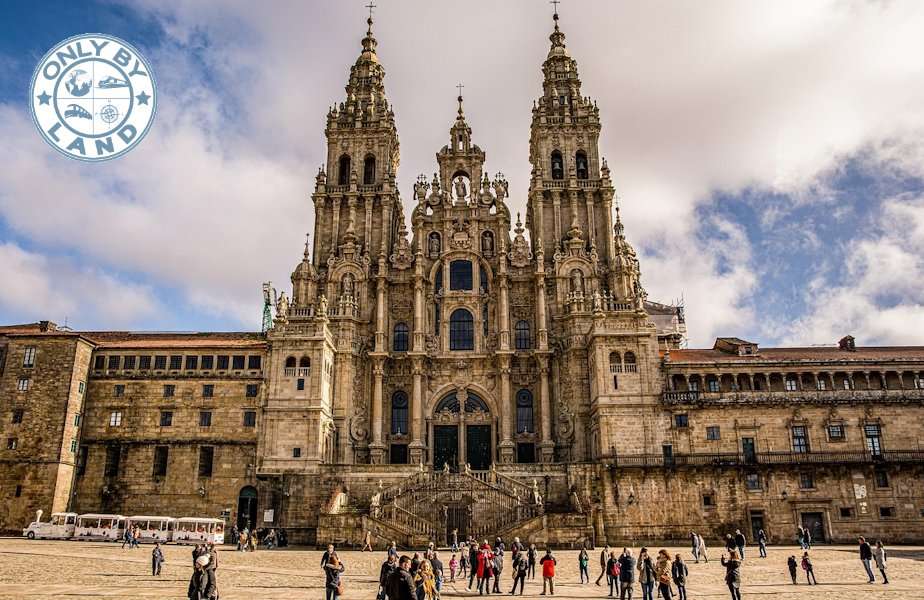
Spain’s largest Romanesque church, Santiago de Compostela, stretches an impressive 308 feet and welcomes more than 200,000 pilgrims each year. This sacred destination earned its UNESCO World Heritage status in 1985 and marks the final stop on the historic Camino de Santiago pilgrimage route.
The church’s heart in Galicia holds remarkable treasures, especially when you have the magnificent Portico of Glory, a masterpiece by Master Mateo from the 12th century. Sacred elements define this structure’s uniqueness – from the Botafumeiro, a special thurible used in ceremonies, to the Holy Door that opens exclusively during Jubilee years. This complete guide unveils the church’s hidden features to help visitors prepare for their 2025 pilgrimage journey.
The Origins of Santiago de Compostela Church
The amazing story of Santiago de Compostela Church started with a vision in the early 9th century. A hermit named Pelagius saw mysterious lights that lit up the night sky above the Libredon forest. He and Bishop Theodomirus of Iria Flavia later found what would become one of Christianity’s most sacred sites.
Discovery of Saint James’ Tomb
Around 820, Pelagius and Bishop Theodomirus found three funerary monuments hidden beneath the undergrowth. They uncovered the remains of a beheaded man with his head placed under his arm. An inscription next to the remains identified him as “James, son of Zebedee and Salome”. This matched the historical accounts of Saint James the Elder, one of Jesus Christ’s twelve disciples, who was beheaded by Herod Agrippa in Jerusalem in 43 AD.
Early Church Construction
King Alfonso II of Asturias ordered builders to construct a small chapel in 819 AD after they found the tomb. This original structure laid the foundation for what would later become the magnificent Santiago de Compostela Cathedral. The church’s early days faced big challenges. In 997, Al-Mansur’s Moorish army attacked and burned the structure to ashes. The raiders destroyed much of the building but left Saint James’ tomb and surrounding relics untouched.
Development Through Centuries
The cathedral’s architectural development happened in many phases. Work on the present cathedral began in 1075 under King Alfonso VI of Castile’s rule and Bishop Diego Peláez’s guidance. The architects, including “Bernard the elder” and his helpers Robertus Galperinus and Esteban, designed the structure to match the plan of Saint Sernin’s monastic brick church in Toulouse.
Building took several decades with many breaks along the way. Historical records show that workers placed the final stone in 1122, but the cathedral wasn’t fully complete by then. King Alfonso IX of Leon presided over the grand consecration ceremony in 1211.
The cathedral mixed different architectural styles as it grew. The original Romanesque construction had thick walls, rounded arches and large columns. Gothic influences appeared in the 13th and 14th centuries. These new elements brought pointed arches, ribbed vaults and bigger windows that let more natural light into the sacred space.
The 16th through 18th centuries saw Renaissance and Baroque changes to the cathedral’s look. Workers redesigned the main façade, added new chapels, and made Baroque changes to the altars. These additions made the cathedral’s visual story even richer.
Saint James’s tomb’s discovery shaped Santiago de Compostela into a key pilgrimage destination. The site quickly became Europe’s spiritual and cultural center, joining Rome and Jerusalem as one of Christianity’s most sacred pilgrimage spots. The Jubilee Year tradition started in the 15th century and made it even more important to believers. Records suggest the first Holy Year happened in either 1428 or 1434.
Hidden Architectural Features
Santiago de Compostela Church’s grand exterior hides a world of architectural mysteries. Each stone tells a story of medieval craftsmanship and sacred secrets. The cathedral holds everything from hidden passages to ancient mason marks that give us a peek into its rich history.
Secret Passages and Chambers
A hidden tunnel lies deep within the cathedral’s walls and connects the church to San Paio convent across the plaza. This secret passage runs beneath the Quintana stairs and has romantic stories about a local priest and nun who met there in secret. Their story adds an unexpected chapter to the cathedral’s past.
The archeological rooms are available from the Obradoiro. These chambers hold amazing finds from digs under the cathedral. You’ll find precious pieces of the city’s Roman history here, along with remains of Romanesque basilicas that came before the current cathedral.
Ancient Mason Marks
The western part of Santiago de Compostela Church shows us an intricate system of medieval craftsmanship through mason marks. These symbols are carved into countless stones and are vital links that help us understand when different parts were built.
Master stonemasons used three types of marks during construction:
- Quarry marks to identify stones
- Assembly marks to guide precise construction
- Banker marks by stone cutters to track their work
These marks weren’t just decorative – they were part of a secret language medieval builders used. The system helped workers put complex parts like doorways and niches together correctly. The mason marks also link the west crypt to the narthex and gallery, showing different building phases.
The marks show up next to traditional line-based symbols. Some from the 13th-16th centuries look like letters, which helps historians date specific parts of the cathedral. By studying these marks and how rough the stone blocks are, researchers can figure out how many stonemasons worked there. They can track building phases and even learn about the money available during construction.
Forgotten Medieval Doorways
The cathedral used to have seven medieval gateways, but many are gone now. Their names – Faxeiras, Mamoa, Entremuros, Enremurallas, Atalaya, Porto do Camino and Mazarelos – still echo from the past. Archbishop Sisnando II had these entrances built into protective walls to guard against Viking raids.
The Porta Santa, also called the Door of Forgiveness, stands as one of these historic entrances. It was first dedicated to St. Pelagius and opens only during Jacobean years when Saint James’ Day falls on a Sunday. James’ image sits in the door’s niches with his disciples Athanasius and Theodore beside him.
The Plateresque door is another architectural treasure that connects to the cloister and leads to the vestibule before the Sacristy. The Treasury, which you reach through these passages, has rectangular spaces topped with ribbed vaults on corbels. Pedro Noble painted beautiful murals in its lunettes in 1536, showing the Ascension and Assumption.
These architectural features are more than just interesting history. They are a great way to get knowledge about medieval building techniques, religious practices, and daily life of the builders who managed to keep this magnificent structure standing through centuries. Every mark, passage, and doorway helps make this cathedral both an architectural marvel and proof of human creativity.
Sacred Symbols and Their Meanings
Sacred symbols decorate every corner of Santiago de Compostela Church. Each symbol carries deep spiritual meaning that generations have passed down. These emblems tell silent stories and show the connection between faith, art and medieval craftsmanship.
Shell Motifs Explained
The scallop shell, scientifically known as Pecten Jacobaeus, is the most recognizable symbol of Santiago de Compostela. This sacred emblem made its first appearance in pilgrimage settings at the start of the twelfth century. Merchants around the cathedral sold actual mollusks from nearby Atlantic beaches at first. The practice changed when they started making metal and jet reproductions.
The shell’s meaning has many interpretations. Its lines that spread out show different pilgrimage routes that meet at Saint James’ tomb. The shell’s longest line points toward Santiago in some areas, especially along the Camino Primitivo and parts of the Camino Portugues.
Pilgrims in medieval times wore these shells on their cloaks or hats. The shells served both practical and symbolic purposes. They worked as makeshift bowls for food and water during long trips. Churches and establishments used them to measure food portions for pilgrims.
The Codex Calixtinus, a vital medieval text, mentions the shell three times. It gives both pagan and Christian meanings. One story tells of a crusader’s miraculous healing through shell contact, which suggests people used it as a protective amulet.
Hidden Religious Inscriptions
The cathedral’s intricate religious inscriptions tell stories of faith and devotion. The Porta Santa, once dedicated to St. Pelagius, shows carved niches with James’s images next to his disciples Athanasius and Theodore. Stone preserves these sacred carvings forever as visual prayers.
Specific chapel entrances show founding capitals tied to foundation stone laying rituals. Bishop Diego Gelmírez’s leadership turned Santiago de Compostela into what many called a second Rome.
Beautiful marble columns at the old Paradise Door catch everyone’s eye, as described in the Codex Calixtinus. A powerful moral lesson appears in stone through a striking story of a woman forced by her husband to kiss her lover’s severed head twice daily.
Medieval Number Symbolism
Sacred numerology appears throughout the cathedral’s design. Seven gateways marked the original structure, a number with deep biblical meaning. Medieval geometric symbolism shows in the chapels’ polygonal footprint, which changed during various construction phases.
Archbishop Pedro Muñiz led the cathedral’s consecration in 1211, with King Alfonso IX present. The ceremony used specific ritual disks that held symbolic meaning. These consecration elements showed the sacred bond between earthly and divine realms.
Common symbols found throughout the cathedral complex include:
- The scallop shell of the Cathedral Chapter
- The pine tree of the Monastery of San Martín Pinario
- The five stars of the University of Santiago
- The cross of the Hospital of the Catholic Monarchs
These sacred marks on lintels and walls stand as proof of Compostela’s rich urban and church heritage. The shell symbol appears in churches dedicated to St. James worldwide, showing their connection to the saint. French speakers call it “Coquille Saint Jacques,” while Germans say “Jakobsmuscheln” – both names honor Saint James.
Lesser-Known Religious Treasures
The sacred walls of Santiago de Compostela Church hide amazing treasures waiting to be found. Each artifact tells stories of faith, preservation and rediscovery through the centuries.
Forgotten Relics
A silver reliquary rests deep under the main altar. Master artisan José Losada crafted this beautiful piece in 1886. It holds Saint James’s sacred remains along with his faithful disciples, Saint Theodorus and Saint Athanasius. These precious relics disappeared from sight for many years.
Archbishop Juan de Sanclemente made a vital decision in 1589. English pirates, especially Francis Drake, posed a serious threat to the church. The Archbishop ordered the relics hidden near the main chapel. Years passed, and people forgot where exactly these treasures lay. Pilgrims lost their central point of devotion.
Cardinal Miguel Payá e Rico led a determined search in 1879. The University of Santiago and the Holy See studied the remains carefully. Pope Leo XIII confirmed their authenticity through the papal bull ‘Omnipotens’ in 1884.
Ancient manuscripts
The cathedral’s library houses the Codex Calixtinus, a mid-12th-century manuscript of great historical value. Diego Gelmírez, Santiago’s first archbishop, commissioned this remarkable document between 1120-1130. It helped spread Saint James’s cult and encouraged pilgrimages throughout medieval Europe.
The Codex has five distinct books, put together around 1150. Its pages show:
- A complete liturgical guide for Santiago de Compostela Cathedral
- Stories of Saint James’s miracles
- Important information for pilgrims
- Musical pieces, including some of Europe’s oldest polyphonic works
- The famous Dum Pater Familias pilgrims’ hymn
Four different scribes created this masterpiece, but their names remain unknown. The manuscript goes beyond religious content and teaches us about medieval European culture and pilgrimage customs.
Thieves stole this precious manuscript from its secure archive in 2011. Authorities found the Codex a year later, perfectly preserved, securing its legacy for future generations.
The fifth book, believed to be Aymeric Picaud’s work, describes the Camino Francés route from France to Santiago de Compostela in detail. Elías Valiña used this section in the 1980s as his main historical reference to bring back the traditional pilgrimage path.
The manuscript’s musical section contains 22 polyphonic compositions that share similarities with Paris’s Notre-Dame Cathedral’s style. The hymn Congaudeant catholici stands among Europe’s earliest examples of polyphonic music.
Learn about Virgin Mary tourism.
Modern Church Restoration Projects
The Santiago de Compostela Church stands in its full glory today thanks to extensive restoration work that protects its sacred heritage. Modern conservation techniques work alongside traditional craftsmanship to keep this spiritual landmark’s architectural beauty intact.
Current Preservation Work
The Pórtico da Gloria welcomed pilgrims back in 2018 after a detailed 10-year restoration project. Teams from Spain, Italy, and Germany worked together on this project. They focused on historical research, structural studies and kept track of environmental conditions.
The restoration team used advanced techniques that included:
- Removal of harmful surface deposits
- Treatment of unstable mortars
- Conservation of existing polychromy
- Implementation of preventive measures
The Spanish Cultural Heritage Institute provided technical coordination while the Barrié Foundation and Santiago Cathedral Foundation led this preservation work. This project shows how private-led initiatives can tackle complex conservation challenges successfully.
Future Conservation Plans
Several ambitious projects protect the cathedral’s architectural integrity. A detailed renovation project started in 2013 with a 9.2 million Euro investment. This major project included:
- Clock Tower restoration
- Azabacheria façade renovation
- Royal Porch preservation
- Obradoiro façade towers rehabilitation
New projects worth 15 million Euros will run through 2025. These include nine different restoration initiatives. The Cathedral Foundation makes sure visitors and worshippers can still access the cathedral during renovations, though some restrictions apply.
Visitor Impact Management
The cathedral’s management team balances preservation needs with visitor access through strategic measures. The Royal Patronage of the City, a 1991-old organization, works with the Consortium of Santiago. This inter-administrative group oversees urban, cultural and tourist policies.
Recent visitor surveys show impressive results:
- 98.4% think Santiago is an attractive destination
- 89.7% want to visit again
- 97.5% would recommend the experience to others
- Overall satisfaction rating of 4.5 out of 5
Three public administrations share the cost of the Tourism Excellence Plan with a 4.06 million euro budget. This plan develops eco-friendly tourism practices. The plan creates new tourism products beyond traditional pilgrimage experiences. It also sets up specialized groups like the Tourism Quality Board that manages the Integral System of Tourism Quality at Destination.
The cathedral’s management team knows they must balance religious significance with tourism appeal. Government organizations, urban planners and cultural managers work together. This collaboration is vital for religious and tourism activities to exist side by side.
Daniel Lorenzo, the Cathedral Foundation’s director, watches renovation’s effects on visitor experiences closely. Service schedules face some limits, mostly during heavy restoration periods when they happen only on weekends and afternoons. The famous Botafumeiro incense burner ceremonies also stop temporarily during specific renovation phases.
Pilgrim Access Guide 2025
Pilgrims making their way to Santiago de Compostela Church in 2025 will find efficient procedures that boost their spiritual experience. These guidelines will give a meaningful visit to this sacred destination.
New Entry Procedures
The Pilgrim’s Reception Office on Rúa das Carretas uses a digital system to manage visitor flow. You need a QR-coded ticket that allows live queue monitoring. This virtual system needs pre-registration through an online platform. Visitors then complete their registration at the office.
The Compostela certificate requirements stay unchanged:
- Walking minimum 100 kilometers or cycling 200 kilometers to Santiago
- Collecting at least two stamps daily on the Pilgrim Credential
- You must appear in person at the office – no third-party requests allowed
The office stays available throughout the year, except for Christmas Day and New Year’s Day. Pilgrims can get their Compostela directly from the cathedral on these holidays.
Prayer Times
The cathedral follows a well-laid-out schedule of religious services that welcomes both pilgrims and local worshippers. Starting March 6, 2025, daily prayers happen as follows:
Morning services start at 8:02 AM. The main mass at 1:45 PM sees high attendance. Afternoon prayers begin at 4:56 PM, and evening services start at 7:30 PM. The final prayer session ends at 8:58 PM.
Confession services stay available all day. Large pilgrim groups benefit from advance coordination, but reservations aren’t usually needed unless you want guided cathedral tours.
Photography Rules
The cathedral’s photography guidelines balance preservation with visitors’ wish to capture their experience. Simple principles include:
- No flash photography inside churches
- Don’t disturb people during prayer or contemplation
- Ask permission before photographing people
Professional photographers suggest these approaches to capture the cathedral’s essence:
- Focus on specific architectural features instead of general panoramic shots
- Learn different vantage points beyond common views
- Think over varied lighting conditions throughout the day
Photographers should keep respectful distances from religious ceremonies inside the cathedral. The prominent Botafumeiro ceremonies need special attention – photographers must position themselves properly without disrupting the ritual.
The Pilgrim’s Reception Office shows exceptional visitor satisfaction rates – 98.4% call Santiago an attractive destination. Additionally, 89.7% plan to return, while 97.5% would recommend the experience to others. These numbers prove current management practices work in preserving both the site’s spiritual significance and visitor experience.
You should arrive early, before 10:00 AM, as the first 150-200 entry slots fill faster. Getting the Compostela might take extra waiting time during high pilgrim influx. Pilgrims should plan for possible extended stays in Santiago instead of scheduling immediate departures after arrival.
The cathedral’s management keeps refining these procedures to maintain balance between availability and preservation. By doing this and being organized, Santiago de Compostela Church continues as both a sacred pilgrimage destination and a well-preserved historical treasure.
Enjoy Santiago de Compostela Church
Santiago de Compostela Church is more than Spain’s largest Romanesque church. This sacred destination has become Christianity’s third-most important pilgrimage site through centuries of preservation and restoration. Stories of remarkable craftsmanship and spiritual significance live within the cathedral’s hidden passages, ancient mason marks and forgotten medieval doorways.
The detailed restoration projects planned through 2025 show a steadfast dedication to protecting this architectural marvel for generations to come. Traditional methods work naturally with modern conservation techniques. This approach helps the cathedral maintain its spiritual and historical integrity while welcoming more pilgrims.
Pilgrims who plan their 2025 trip will benefit from efficient digital systems and clear guidelines that improve their experience. The procedures may change, but completing the Camino de Santiago keeps its deep spiritual meaning. Every pilgrim finds inspiration in the stones, symbols, and sacred spaces of Santiago de Compostela Church, making each trip a unique path to self-discovery.
FAQs
Q1. What is the significance of the scallop shell symbol in Santiago de Compostela?
The scallop shell is the most iconic symbol of Santiago de Compostela, representing the pilgrimage routes converging at Saint James’ tomb. Pilgrims traditionally wore these shells as badges and used them as makeshift bowls during their journey.
Q2. How can I obtain a Compostela certificate in 2025?
To receive a Compostela certificate in 2025, you must walk at least 100 kilometers or cycle 200 kilometers to Santiago, collect a minimum of two stamps daily on your Pilgrim Credential, and appear in person at the Pilgrim’s Reception Office.
Q3. Are there any restrictions on photography inside the cathedral?
While photography is allowed, visitors should avoid using flash, refrain from disturbing those in prayer and seek permission before photographing individuals. It’s recommended to focus on specific architectural features and maintain a respectful distance during religious ceremonies.
Q4. What are some hidden architectural features of Santiago de Compostela Church?
The church contains secret passages, including one connecting to a nearby convent, ancient mason marks that reveal construction history, and forgotten medieval doorways that were once part of the city’s protective walls.
Q5. When is the best time to visit the cathedral to avoid crowds?
For the best experience, it’s recommended to arrive early, preferably before 10:00 AM, as the first 150-200 entry slots typically fill quickly. During peak pilgrim seasons, be prepared for potential waiting times to obtain the Compostela certificate.



Leave A Comment