
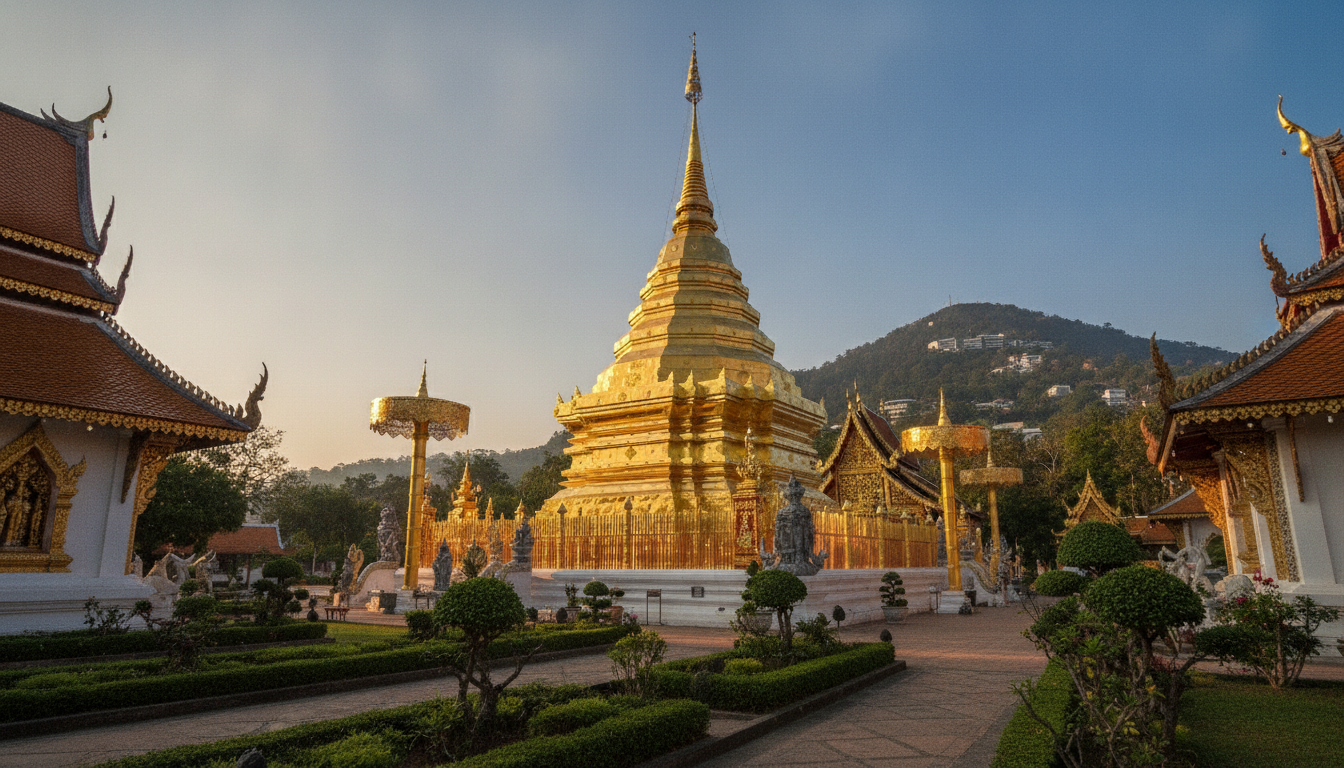
I stood at the mountain’s base, coffee in hand, looking up. The golden chedi was hidden in the clouds, over 1,050 meters high. It felt like a timeless wonder, untouched by time.
But what if something must change? This thought lingered after climbing the 306 Naga steps. Thailand has set a new goal to be carbon neutral by 2050, 15 years sooner than before. Their plan, NDC 3.0, aims to reduce net emissions by 47% by 2035.
This ambition made me think about applying it to Wat Phra That Doi Suthep. This piece envisions Wat Phra That Doi Suthep as a model for the future. It combines ancient craftsmanship with modern, net-zero engineering.
I must be clear. This is a speculative, informed piece, not a news report. It’s based on real research into climate policy, preserving heritage, and sustainable tech for sacred sites.
Key Takeaways
- Thailand accelerated its carbon neutrality target to 2050, announced at COP30 in November 2025.
- NDC 3.0 targets a 47% cut in net emissions by 2035 versus 2019 levels.
- This article presents a speculative, research-grounded vision, not confirmed fact.
- Doi Suthep’s mountain slope and elevation create unique climate and engineering challenges.
- The 306-step Naga staircase and golden chedi serve as symbolic anchors for this thought experiment.
- Sacred heritage sites may become testing grounds for sustainable, self-healing building technology.
Ethical elephant sanctuaries in Chiang Mai.
1. Wat Phra That Doi Suthep Future 2050: Redefining Sacred Mountain Preservation
Years ago, I hiked up to Wat Phra That Doi Suthep. I didn’t know it was part of a bold climate experiment. The golden chedi seemed timeless, shining over Chiang Mai.
But, by 2050, this mountain will be a world leader in preserving sacred sites at high altitudes.
This change didn’t happen quickly. It took decades of hard work and a new way of thinking about protecting temples.
From a 14th-Century Pilgrimage Site to a Carbon-Neutral Heritage Citadel
The story of Doi Suthep began with a white elephant. It carried a sacred relic up the mountain in the 1300s. The elephant trumpeted three times and died at this spot.
Monks built the temple here, seeing it as a sign. Pilgrims have climbed this ridge ever since. Their devotion is strong.
By 2050, the temple will be carbon-neutral. Solar panels and battery storage will be hidden from view. This won’t change the temple’s sacred feel.
Why the 1,050-Meter Ridge Demanded a New Preservation Philosophy
Doi Suthep faces challenges that flat temples don’t. It’s at 1,050 meters, exposed to wind, erosion, and wildfire smoke.
I’ve seen the weather in northern Thailand change. Rain comes harder and faster. Dry seasons are longer and smokier.
Thailand’s ranking in the Climate Risk Index jumped to 17th in 2026. This shows that sites like Doi Suthep need to plan for resilience now.
| Threat | Old-School Response | 2050 Solution |
|---|---|---|
| Wind erosion on exposed ridge | Periodic hand re-gilding | Wind-modeled protective coatings with real-time monitoring |
| Wildfire smoke acidifying gold surfaces | Manual cleaning after burn season | Air-quality sensors triggering automatic filtration |
| Monsoon runoff destabilizing slopes | Sandbags and seasonal patchwork | Engineered subsurface drainage linked citywide |
| Isolated site funding cycles | Temple-only maintenance budgets | Shared resources through the Chiang Mai UNESCO heritage grid |
Anchoring the Chiang Mai UNESCO Heritage Grid for the Next Century
Thailand has a plan to reduce greenhouse gas emissions. It includes heritage sites, which need their own plans.
Doi Suthep is part of a network called the Chiang Mai UNESCO heritage grid. This network connects temples, museums, and historic areas across the city.
Sites in this grid share funding, technology, and data. If one temple sees a wildfire risk, the whole network responds together.
This approach is exciting. Doi Suthep will be a model for other temples in Southeast Asia. They can prepare for a hundred years of climate change, not just one season.
2. Lanna Golden Chedi Preservation Through Molecular-Level Defense
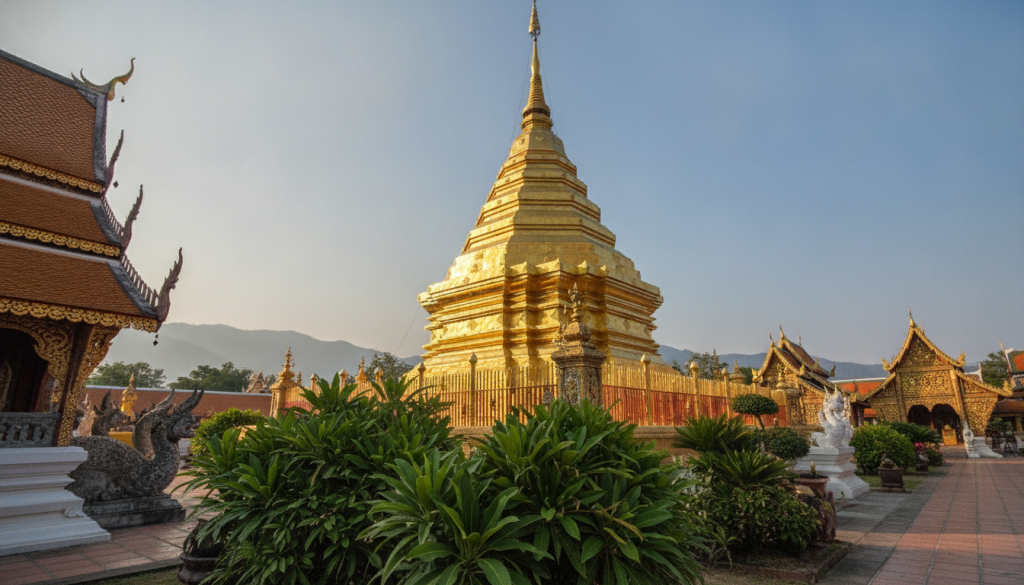
The secret to keeping a 600-year-old chedi shining isn’t paint or varnish. It’s chemistry working at a scale you can’t even see.
I remember standing at the base of that golden spire on my first trip up Doi Suthep, squinting into the sun bouncing off the metal. I had no clue the real protection happens where no visitor ever looks, down at the molecular level. Lanna golden chedi preservation in this 2050 vision goes far beyond polish and elbow grease. It leans on advanced coatings that guard gold, brass, and teak without changing how any of it looks or feels to the millions of pilgrims who climb the mountain each year.
Non-Invasive Mineral Masonry Glazes: How They Halt UV and Smoke Erosion
Chiang Mai’s burning season hits hard every spring. I’ve woken up more than once to an orange sky and a haze thick enough to blur the mountains I’d photographed clearly the week before. That smoke doesn’t just irritate lungs. It eats away at ancient surfaces too, leaving behind acidic residue that speeds up decades of natural erosion.
Non invasive mineral masonry glazes solve this problem without sealing the chedi inside a plastic-like shell. These coatings sit on top of the original gold leaf and stone almost like a breathable skin. They block ultraviolet rays and smoke particles from bonding to the surface, yet they still let trapped moisture escape freely.
Conservators apply these glazes in microscopic layers, some thinner than a human hair. The finished result looks nearly invisible to the eye, but it filters out damage around the clock. I find that kind of quiet engineering more impressive than any dramatic renovation project I’ve ever covered.
Protecting Brass Repoussé Panels From Chiang Mai’s Wildfire Season
Walk around the temple grounds and you’ll spot hand-hammered brass panels decorating walls and doorways. Artisans shaped these repoussé designs generations ago, and each one tells a story through raised imagery of deities and mythical creatures.
Wildfire smoke carries sulfur compounds that react with brass over time, creating dark, uneven patches. I’ve noticed similar tarnish on old temple bells during smoky months, and it only worsens without regular intervention.
The molecular-level defense strategy applies targeted anti-tarnish treatments directly onto these panels. These treatments neutralize sulfur before it ever bonds with the metal’s surface. Conservators reapply the protective layer seasonally, timed around Chiang Mai’s burning months, so the brass keeps its warm glow for the next generation of visitors.
Good conservation science protects a surface by working with its natural chemistry, not by fighting against it.
Teakwood Viharns and the Challenge of Letting Historic Masonry Breathe
The prayer halls, or viharns, at Doi Suthep rely on massive teakwood beams that have stood for generations. Teak naturally expands and contracts with humidity, and that subtle movement actually helps the wood survive Chiang Mai’s shifting wet and dry seasons.
Sealing this wood too tightly would trap moisture inside, leading to rot and structural weakness over time. So conservators use breathable treatments that shield the teak from pollution and UV damage while still letting it flex and release moisture the way it always has.
This same breathing principle applies to the old stone masonry throughout the temple complex. Trapped moisture behind an impermeable seal can crack stone from the inside out during sudden temperature swings. Preservation teams test humidity levels constantly, adjusting treatments so every material keeps functioning the way nature originally intended.
Here’s a quick look at how each material stays protected without losing its authentic character:
| Material | Main Threat | Protective Solution | Key Benefit |
|---|---|---|---|
| Gold-plated chedi surface | UV rays and smoke residue | Non invasive mineral masonry glazes | Breathable shield against fading |
| Brass repoussé panels | Sulfur compounds from wildfire smoke | Seasonal anti-tarnish coatings | Preserves the metal’s original shine |
| Teakwood viharns | Trapped moisture and rot | Breathable timber treatments | Allows natural expansion and drying |
| Historic stone masonry | Cracking from sealed-in moisture | Humidity-responsive coatings | Prevents internal structural stress |
3. Naga Staircase Kinetic Energy: Faith in Motion, Power in Every Step
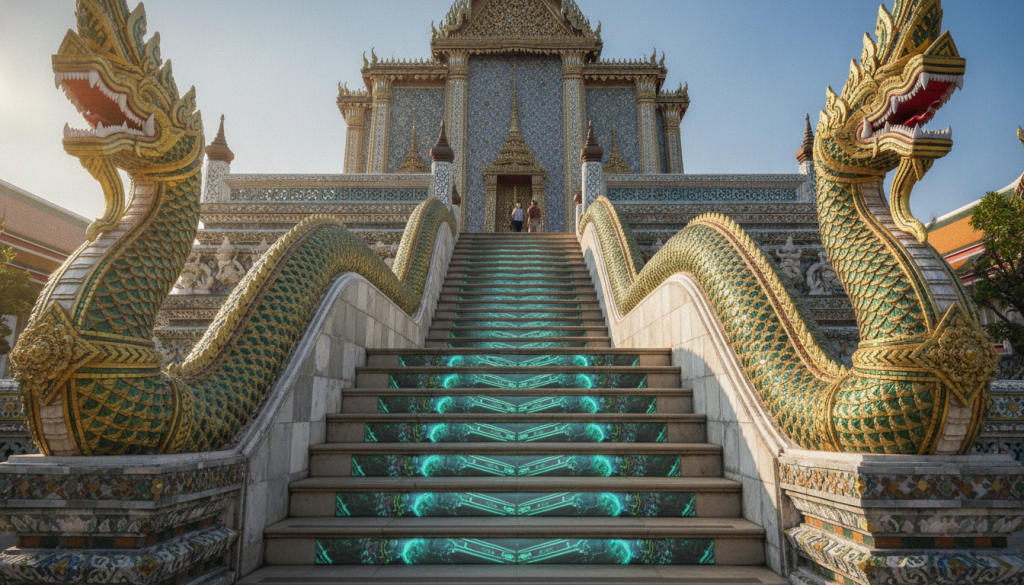
Every step of the 306 mosaic steps tells a story of devotion. By 2050, those steps will also tell a story of clean energy. I’ve climbed those steps myself, catching my breath around step two hundred. I wondered how many millions of feet had worn those tiles smooth over the centuries.
Now, imagine climbing those steps and generating electricity with every step. The concept of naga staircase kinetic energy is simple. It turns the mechanical force of a footstep into usable power, without disturbing the sacred path pilgrims have followed for over six hundred years.
Engineering Beneath the 306 Mosaic Steps
Underneath the tiles, engineers install pressure-sensitive plates. These plates flex slightly with each step. This creates a tiny electrical charge, using technology found in busy subway stations and airport terminals worldwide.
The plates stay hidden beneath the original surface. Climbers notice nothing different. The serpents still guard every step, and the incline still tests your legs the same way it tested mine years ago.
What changes lives underground. Wiring channels the collected energy down to storage units near the mountain’s base. It feeds directly into the temple’s wider power system.
Turning Pilgrim Traffic Into a Renewable Power Source
Doi Suthep welcomes thousands of visitors daily. Each climb up the staircase now contributes a small jolt of electricity. Multiply that across thousands of pilgrims and tourists every single day, and the numbers add up quickly.
This system quietly transforms foot traffic into a steady, renewable energy source. No wind turbines or solar panels are needed for this piece of the puzzle. It runs day and night, powered entirely by human motion.
“The most sustainable energy source is often the one already built into human behavior. We just need to capture it,” notes an engineer specializing in pressure-based power systems.
I love the symbolism as much as the science here. Pilgrims have always offered something to this mountain. Now they offer kinetic energy too, without changing a single step of their journey. Every visitor becomes part of the mountain’s sustainable future, not just a witness climbing past it.
4. Subsurface Hydrologic Heritage Engineering: Water as Guardian of the Mountain
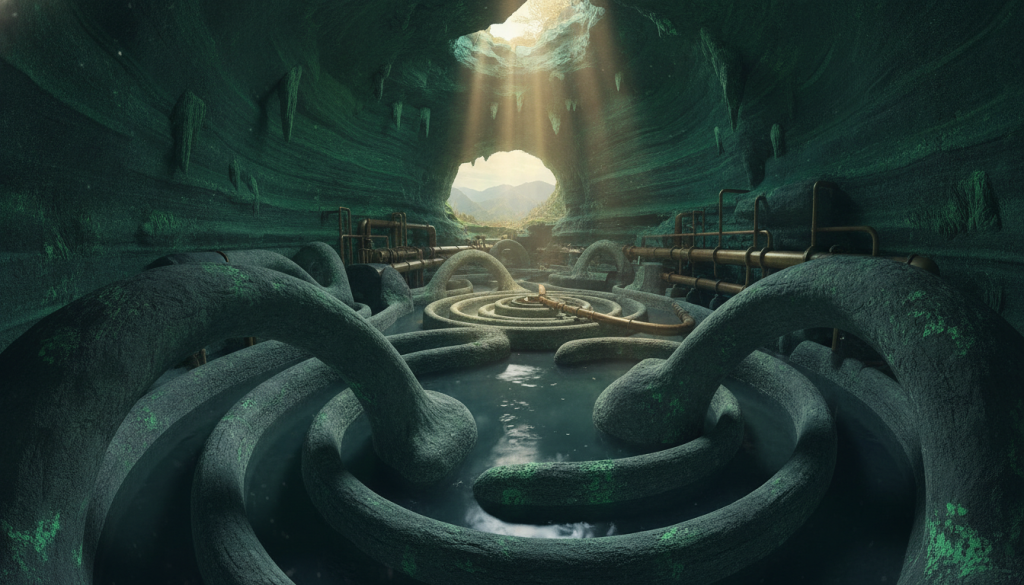
I never thought a temple visit would make me think about stormwater drainage. But Doi Suthep’s monsoon runoff problem changed that. Water pours down the mountain’s slopes with great force every rainy season.
This water erodes soil, weakens the ridge, and puts centuries-old structures at risk. It’s not just a theory anymore. Thailand jumped to 17th place in the 2026 Climate Risk Index, a big jump from 72nd just a few years earlier.
The 2025 floods across Southern Thailand made that shift clear. Mountain heritage sites like Doi Suthep are at risk. This is where subsurface hydrologic heritage engineering comes in.
This design works with water, treating rainfall as a resource. It stores, filters, and reuses water instead of fighting it.
Subterranean Retention Vaults and Closed Loop Reservoir Stormwater Harvesting
Imagine massive underground vaults built into the mountainside. They catch runoff before it hits the surface trails or temple foundations.
These vaults are part of a closed loop reservoir stormwater harvesting system. They filter water and keep it circulating in a sealed system. The goal is to capture 100% of seasonal monsoon runoff before it can harm the slope.
A saturated ground is unstable. A ridge at 1,050 meters doesn’t need extra weight during a downpour.
Borrowing From Stadium Porous Asphalt Stormwater Drainage to Fight Landslides
Engineers are using stadium porous asphalt stormwater drainage for mountain pathways at Doi Suthep. This is the same permeable paving used in large sports venues.
Stadiums need to clear heavy rainfall fast for games to continue. Mountain trails need the same speed to prevent slope saturation and slides.
“Water doesn’t destroy mountains. Poorly managed water does.”
This idea is at the heart of this approach. Porous surfaces let rainwater pass through immediately, preventing pooling on fragile ground.
| System Component | Primary Function | Inspired By | Key Outcome |
|---|---|---|---|
| Subterranean Retention Vaults | Capture underground monsoon runoff | Traditional Lanna water cisterns | Ridge stability, reduced landslide risk |
| Closed Loop Reservoir System | Filter and recirculate stored water | Modern rainwater harvesting plants | Zero water waste |
| Porous Asphalt Pathways | Absorb heavy rainfall along trails | Stadium stormwater drainage systems | Lower slope saturation |
| Capillary Cooling Network | Passive courtyard temperature control | Urban district cooling systems | Zero-emission comfort for visitors |
Zero-Emission District Capillary Cooling Across the Inner Courtyard
Once the vaults filter the water, it doesn’t just sit in storage. It gets redirected into a zero-emission district capillary cooling system under the temple’s inner courtyard.
This passive network cools the air naturally, without electricity or fossil fuel. Pilgrims walking the grounds during hot afternoons feel the difference.
It’s a closed loop in every sense. Rain falls, gets captured, filters through the vaults, cools the courtyard, and the cycle starts again next season.
That’s the quiet brilliance of subsurface hydrologic heritage engineering at Doi Suthep. The mountain isn’t just surviving the monsoon anymore, it’s learning to use it.
Conclusion
As I walk down from the chedi, I think about the mountain’s seven centuries. It has survived by making small changes over time. This is the essence of what I’ve imagined here.
This idea isn’t official. There’s no plan in Chiang Mai’s planning office called Wat Phra That Doi Suthep future 2050. My thoughts are based on Thailand’s climate goals and how they might affect places I love.
Thinking about this feels real after Thailand’s big move at COP30 in November 2025. They pushed their Net Zero target forward with NDC 3.0. A country serious about climate change can rethink its sacred sites too.
I wish for Doi Suthep’s golden surfaces to stay bright. But I hope the changes underneath are towards something cleaner, smarter, and more resilient.
If you climb Doi Suthep, slow down at the staircase and courtyard. Look at the details. The mountain might change in the future, even if it looks the same in photos.



Leave A Comment