
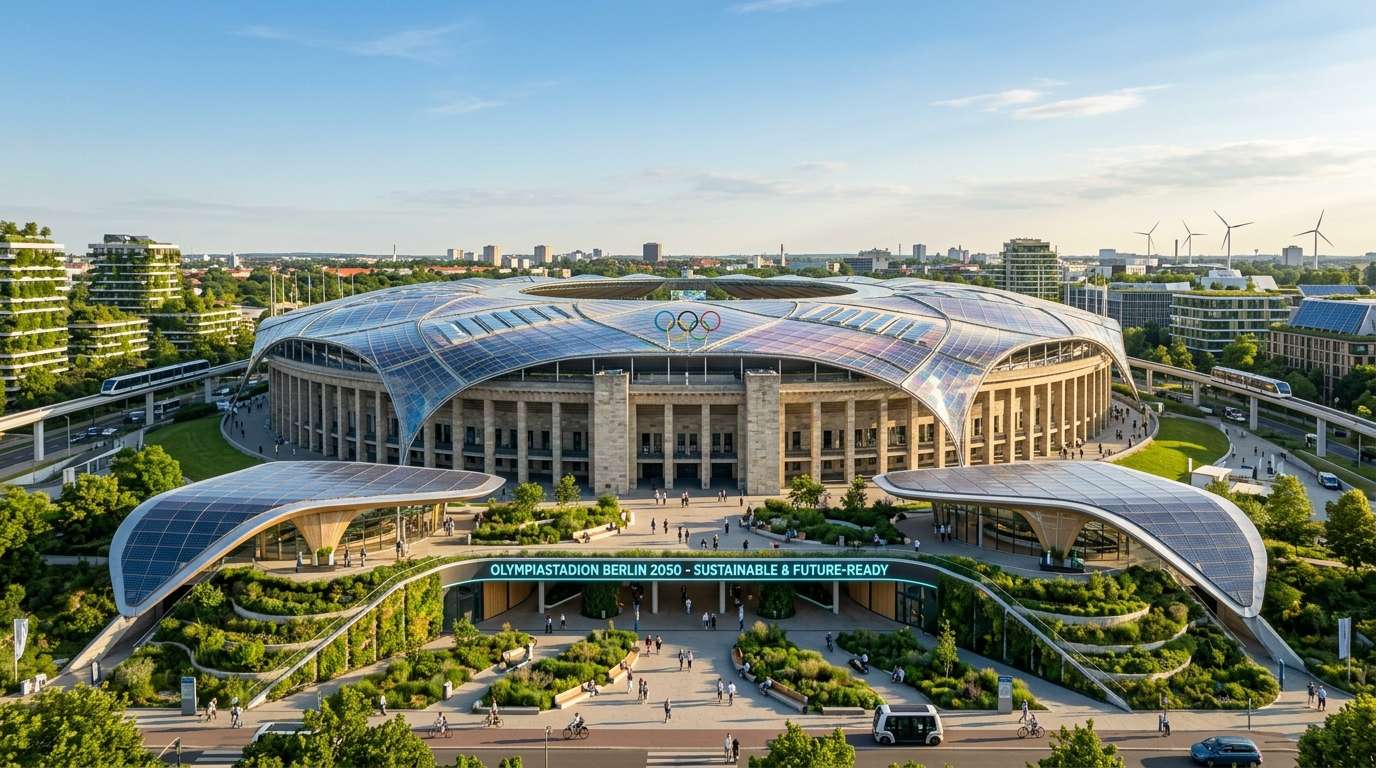
I stood outside the gates and stared for a while. The limestone walls looked ancient, almost frozen in time.
Yet something remarkable was happening beneath that old stone skin. This arena was built in 1936 and carries a heavy history through its curved stone corridors.
By 2050, this same ground will use almost only clean, self-generated power. That contrast drew me in.
How can a 90-year-old stone giant become one of the planet’s cleanest venues? How can planners protect Olympic Plaza’s original character while adding space-age engineering?
Here, 74,475 seats face a stage where history and innovation meet. Solar canopies stretch above the stands.
Hidden water systems work beneath the plaza, while crowd footsteps on the Ostkurve help power the grounds. This Olympiastadion Berlin future makes the year 2050 feel real.
This is the story of Berlin’s carbon-negative stadium. I tell it from the edge, amazed that this future is possible.
Key Takeaways
- Olympiastadion’s 1936 limestone structure will stay intact while gaining a fully modern energy system.
- Translucent bio-photovoltaic canopies will generate clean power without changing the stadium’s iconic silhouette.
- Underground hydrologic vaults beneath Olympic Plaza will manage water and support the site’s cooling needs.
- Kinetic flooring in the Ostkurve will convert fan movement and crowd energy into usable electricity.
- The venue aims for carbon-negative status by 2050, setting a new benchmark for historic stadium upgrades.
- The project shows how century-old architecture can merge with advanced climate engineering.
1. Olympiastadion Berlin Future 2050: A Monument Reimagined
I’ll admit it: the first time I read about Olympiastadion Berlin future 2050 plans, I doubted it.
I doubted it could become a global model for carbon-negative design. But here we are: by 2050, this stone bowl isn’t just surviving; it’s leading.
The transformation seems almost impossible on paper. A monument marked by 1936 history becomes a blueprint that other cities study and copy. That reinvention story surprised me.
From Nazi-Era Relic to Carbon-Negative Colosseum
Let’s be honest about this building’s origins. Olympiastadion Berlin opened in 1936 as a stage for Nazi propaganda. It showcased a regime’s twisted vision of power, and that history should not disappear.
Engineers and historians work side by side to decide what stays and what gets reinvented. The stone skeleton remains, and the limestone columns still stand guard. Yet the systems inside and above the shell now point toward a carbon-negative future.
I see it this way: the building’s bones tell one story, while its systems tell another. That tension is the whole point. You cannot erase difficult history by tearing a building down; instead, transform what it produces.
“A stadium that once hosted propaganda now powers a neighborhood with clean energy — that’s not erasing history, that’s answering it.”
By 2050, Olympiastadion generates more clean energy than it consumes. Solar membranes stretch across the roofline. Kinetic systems capture crowd energy, turning a painful relic into something like redemption.
Why 74,475 Seats Still Matter in a Decarbonized World
Here’s what surprised me: the Olympiastadion Berlin future 2050 plans keep all 74,475 seats. In an era focused on smaller footprints, that number feels almost rebellious.
But scale carries meaning here. Keeping the full seating bowl proves three important things:
- Decarbonization doesn’t require sacrifice. You can run a massive venue and still hit net-zero targets.
- Historic capacity preserves cultural memory. Fans who’ve attended games for decades still recognize the place.
- Large-scale proof matters more than small pilot projects. If a 74,475-seat colosseum can go carbon-negative, smaller venues have no excuse.
I keep coming back to this idea: ambition and sustainability aren’t opposites. Olympiastadion Berlin future 2050 plans prove a stadium can remain massive and historic while answering the climate crisis. That combination is rare, which is why this place deserves attention.
2. Guarding the 1936 Stone Skeleton
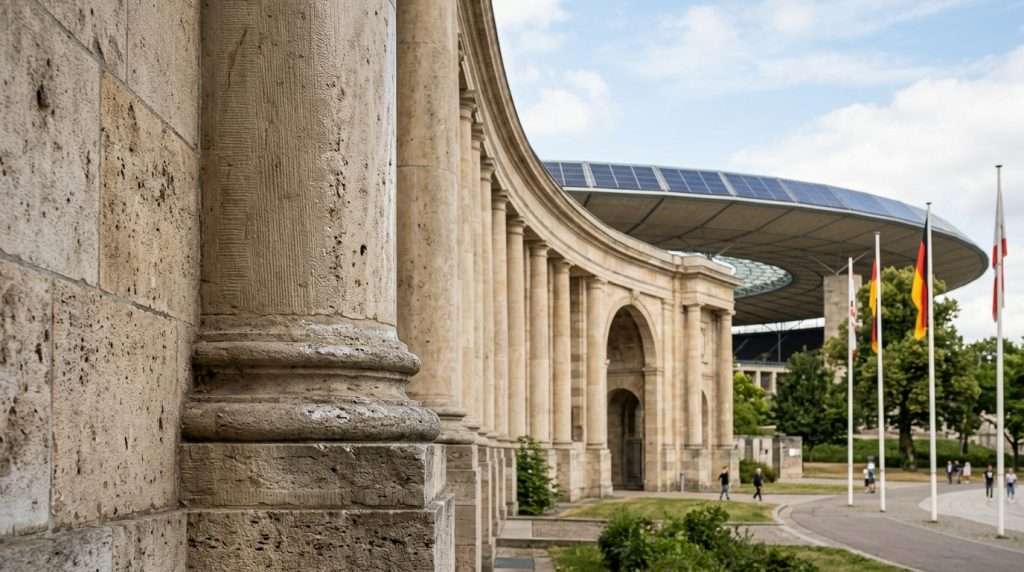
Standing beside stone that outlasted wars, regimes, and nearly ninety winters feels humbling. I felt it when I first touched an original pillar. The surface felt cool, pitted, and strangely alive beneath my hand.
That stone tells the real story of this stadium’s rebirth. Before solar canopies or kinetic floors, conservators must keep the 1936 bones standing. They protect limestone, travertine, and other stone with modern chemistry.
Muschelkalk Limestone and Travertine Colonnade Against Freeze-Thaw Decay
The original builders chose Muschelkalk limestone and travertine for good reasons. These stones are strong, warm in color, and once seemed nearly indestructible. Nearly a century later, they face an enemy slower than time.
Freeze-thaw decay begins when water enters tiny pores in stone. When Berlin’s winter temperatures fall, the water freezes and expands by roughly nine percent. Over decades, this cycle cracks stone from the inside out.
- Spalling: thin layers of stone flake away from the surface
- Micro-cracking: hairline fractures spread deeper with each winter cycle
- Erosion: exposed travertine edges round off and lose detail
Last winter, I saw frost lines along certain colonnade joints. Watching history weather in real time felt strange.
Non-Invasive Mineral Masonry Glazes: Breathable Armor for History
Old fixes sealed stone with heavy, waterproof coatings. These coatings often trapped moisture inside, speeding decay from within. New non invasive mineral masonry glazes work in a different way.
These silicate-based, nano-mineral coatings bond with the stone’s crystal structure. They block liquid water but let water vapor escape. In simple terms, the stone keeps breathing.
| Treatment Type | Moisture Behavior | Long-Term Effect |
|---|---|---|
| Traditional sealant | Blocks vapor and liquid equally | Traps moisture, worsens spalling |
| Mineral masonry glaze | Blocks liquid, allows vapor out | Slows decay, preserves texture |
| No treatment | Fully exposed to freeze-thaw | Rapid, visible erosion |
Conservators apply these glazes in thin, nearly invisible layers. You would not notice the coating unless someone pointed it out.
Marathon Gate Preservation as the Gold Standard for Restoration
To see these best practices together, visit the Marathon Gate. Athletes entered there during the 1936 Games, and it now showcases the restoration effort.
Marathon Gate preservation combines breathable glazes, freeze-thaw monitoring, and hand-finished repairs. Workers use matching Muschelkalk quarried from the same original region. Every stadium technique gets tested there first.
Preservation isn’t about freezing a building in time. It’s about giving stone room to keep breathing for another century.
Walking through the gate, you can still trace the original tool marks in the stone. That’s the whole point. Nothing here looks new, and that’s exactly how it should feel.
3. The Canopy That Breathes Light and Power
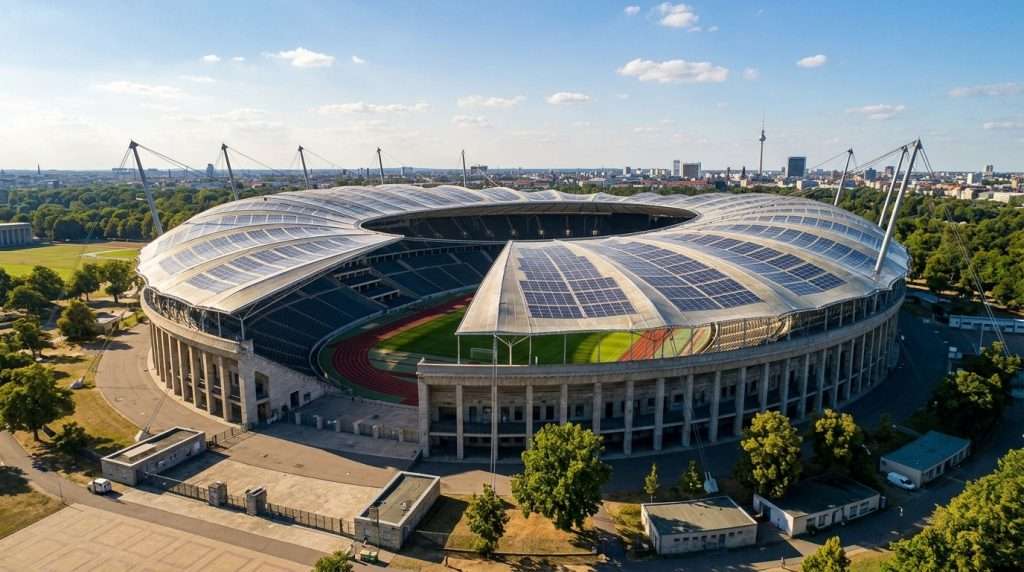
Nothing about Olympiastadion’s skyline prepared me for the canopy stretched above the bowl like a second skin of light.
I stood near the upper tier and watched afternoon sun ripple across it, half-transparent and half-electric. It looked less like a roof than a living membrane stretched over steel ribs, quietly serving a purpose.
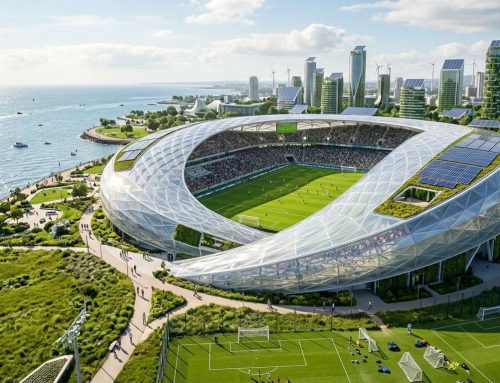
The cantilevered ring canopy wraps the entire bowl without a single support column blocking the view. Engineers hung it from a tension ring, letting it float above spectators while also generating solar power. That was the first trick worth noticing.
PTFE Membrane Solar Roof Technology Spanning the Bowl
Here’s where it gets interesting. PTFE membrane solar roof technology sounds contradictory at first. How can something generate electricity and still let light through?
The answer lies in the material itself. PTFE, a lightweight fluoropolymer fabric, uses ultra-thin photovoltaic cells woven directly into its fibers. The fabric remains translucent because cells cover only a fraction of its surface, spaced like a loose net.
This approach keeps the canopy incredibly light, important for a 1936 stone structure never built for heavy modern loads. I learned that weight, not energy output, decided the issue.
Traditional solar panels would have exceeded the old colonnade’s load limits. PTFE membrane solar roof technology solved that problem by trading bulk for clever design. It spreads power generation across a huge surface instead of concentrating it in heavy panels.
Bio-Photovoltaic Membranes and Photosynthetic Wavebands for the Pitch
Above the bowl, the sweeping cantilevered ring canopy features translucent bio-photovoltaic membranes. They generate clean electricity while admitting photosynthetic wavebands to the pitch and blue track below.
That detail matters more than it sounds. Grass needs specific light wavelengths, mostly red and blue bands, to photosynthesize properly. Block too much of that spectrum, and turf turns patchy and weak, despite strong energy numbers on paper.
So the design team tuned the bio-photovoltaic cells to filter selectively. They absorb wavelengths plants need less, such as excess green and infrared, while letting photosynthetic bands pass through almost untouched.
Standing on the sideline, I noticed the light felt softer, almost filtered through a thin curtain rather than blocked outright. The blue track below still looked vivid, showing that engineers found the balance mostly right.
Engineering Trade-Offs Between Energy Yield and Turf Health
I won’t pretend this is a perfect, frictionless system. More solar coverage almost always means less usable light reaches the grass, and that tension shapes every roof decision.
“Every square meter of solar membrane is a square meter of negotiated light. You’re never maximizing both energy and turf health at once; you’re finding the least painful compromise.”
Stadium engineers split the canopy into zones, each tuned to the daylight needs below. The breakdown looks like this in practice.
| Canopy Zone | Solar Coverage | Light Transmission | Turf/Surface Impact |
|---|---|---|---|
| Perimeter Ring | 85% | 15% | None (no vegetation below) |
| Mid-Bowl Transition | 60% | 40% | Minimal, affects shaded stands only |
| Pitch-Facing Aperture | 35% | 65% | Low, grass growth stays healthy |
| Track-Facing Section | 45% | 55% | Moderate, requires supplemental lighting in winter |
Winter months still demand backup grow lights under the track-facing section, showing that smart engineering has limits. The canopy generates impressive power, but it cannot replace human adjustment and seasonal care.
That honesty, more than any single statistic, stayed with me after walking the bowl’s edge. The roof breathes, generates power, and compromises at once. That feels like the most honest innovation a century-old stadium could ask for.
4. Water, Reinvented Beneath the Plaza
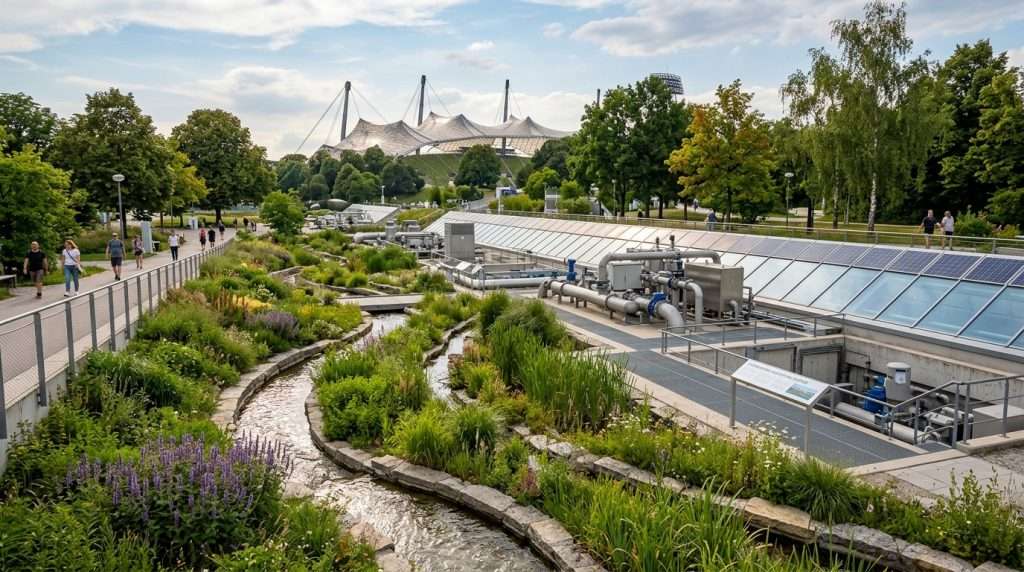
Most fans walking to their seats never see the hidden world beneath Olympic Plaza. The solar canopy gets attention, but the real engineering work happens underground. I spent an afternoon with the stadium’s water engineers, and they changed how I view stadium design.
Concrete vaults, pipes, and pumps beneath the plaza turn Berlin’s rainstorms into year-round cooling. No pump here runs on fossil fuel. The system wastes no water and works quietly out of sight.
Closed-Loop Reservoir Stormwater Harvesting Under Olympic Plaza
Picture a reservoir beneath the plaza, roughly the size of several city blocks. Rain from the Olympiapark district enters a closed loop reservoir stormwater harvesting system instead of Berlin’s sewers.
The vaults capture nearly all regional storm runoff before it reaches Berlin’s drainage network. They store reserves through dry spells, so the stadium has water during a rainless August.
- Captures virtually all runoff from the plaza and surrounding rooftops
- Holds enough reserve water to last through weeks without rainfall
- Reduces pressure on Berlin’s municipal stormwater system
- Feeds directly into the stadium’s cooling network without a treatment plant
Spree-Havel Hydrologic Cooling Loops Explained
Here’s where things get interesting. The reservoir connects with Berlin’s waterways through spree havel hydrologic cooling loops.
Pipes connect the plaza vaults with the Spree and Havel river systems. Cooler river water exchanges heat with the stadium’s closed loop. Think of it like the rivers lending their natural chill to the building, then taking back a little warmth without mixing water supplies.
This process is a closed exchange, not a drain. The stadium borrows coolness, returns it warmer, and the rivers absorb the small difference without noticeable downstream effects.
Zero-Emission Capillary Cooling for Fans and Field
Harvested and cooled water eventually reaches the fans and the field.
Thin capillary tubes run beneath the seating bowl and through the turf base. They carry cooled water near the air and ground, removing heat without refrigeration.
On a hot matchday, fans in the Ostkurve feel the difference first. The air near the seats stays several degrees cooler, while the pitch stays firm and green beneath direct sun.
The system captures rain, borrows river coolness, and quietly delivers relief throughout the bowl. Every drop does triple duty, without harming the planet.
5. The Crowd Becomes the Power Plant
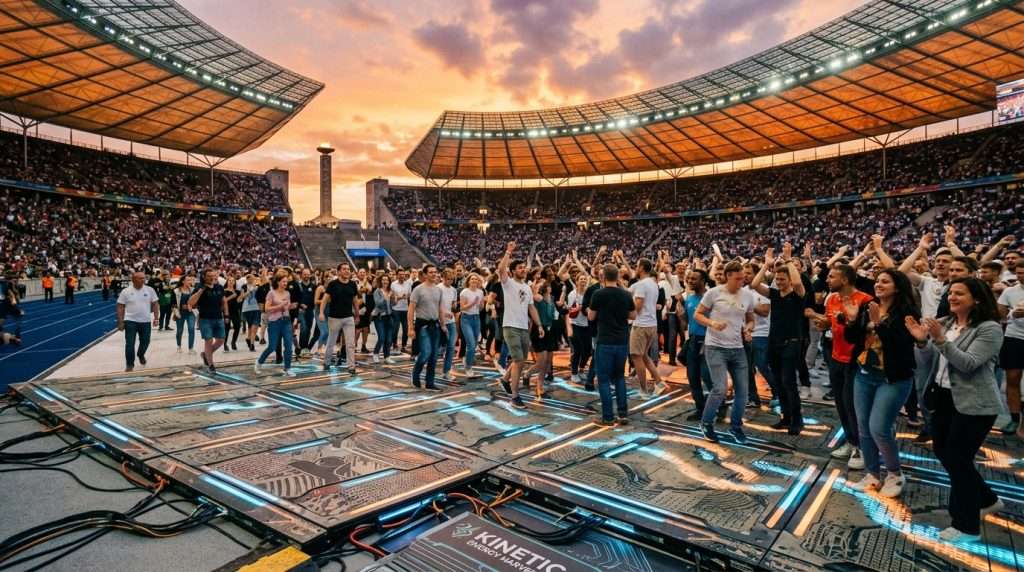
Of all the sustainability features in Olympiastadion Berlin’s 2050 vision, this one makes me smile most. The stadium holds 74,475 fans and turns them into part of its power supply.
Every stomp, jump, and roar during a Hertha BSC match serves a second purpose. The stadium captures that energy, converts it, and sends it to its microgrid.
It sounds like science fiction, but the engineering is refreshingly simple.
Stadium Kinetic Energy Crowd Harvesting at the Ostkurve
The Ostkurve has always been Olympiastadion Berlin’s loudest, rowdiest corner. Now, it is also the most productive.
Engineers built stadium kinetic energy crowd harvesting systems into the terrace structure. Each jump and stomp sends a small mechanical pulse through the concrete.
Sensors beneath the stands collect pulses from thousands of seats at once. During a packed match against rivals like Union Berlin, the energy builds quickly.
Nothing changes the matchday experience. Fans still sing, jump, and celebrate as before.
Piezoelectric Floor Plates Feeding the Microgrid
The main technology sits inside the floor plates. Piezoelectric materials create a small electrical charge when compressed or bent.
Thousands of plates under busy areas can produce useful power. The Ostkurve provides a steady trickle during peak crowd moments.
That electricity does not disappear. It flows into the stadium’s microgrid, alongside power from the solar roof and hydrologic cooling loops.
Here is how the stadium’s energy systems work together:
| Energy System | Location | Capture Method | Primary Use |
|---|---|---|---|
| PTFE Solar Membrane | Roof canopy | Photovoltaic cells in membrane | Lighting and general power |
| Piezoelectric Floor Plates | Ostkurve terraces | Pressure-based crystal deformation | Microgrid supplement |
| Hydrologic Cooling Loop | Spree-Havel waterways | Water temperature exchange | Concourse and pitch cooling |
| Stormwater Reservoir | Olympic Plaza | Closed-loop rainwater capture | Irrigation and cooling supply |
Together, the floor plates cannot power the whole stadium. They form one layer in a system where each part fills a different gap.
Hertha BSC’s Net-Zero Stadium Ambitions
None of these systems stands alone. They support Hertha BSC’s net-zero stadium ambitions, or the hertha bsc net zero stadium plan.
The club presents its home as proof that old stadiums can become greener without being demolished. Often, the smartest choice is adding new technology to a structure nearly a century old.
“A 1936 stadium shouldn’t be judged by when it was built, but by how far it can still go.”
That idea guides every system discussed here, from breathable stone coatings to piezoelectric plates beneath the Ostkurve. Hertha BSC is choosing reinvention over a flashy new build.
Watching crowd energy power lights above the fans makes the stadium’s future feel exciting. Berlin redefines monumental arena longevity, one footstep at a time.
Conclusion
After tracing every layer of this project, I saw history and innovation sharing one roof. The limestone walls that witnessed the 1936 Games still stand. They now shelter solar membranes, hidden water loops, and floors that turn footsteps into electricity.
This is the real story behind Olympiastadion Berlin future 2050. It does not replace the past with something shinier. Instead, it gives an old structure new habits while preserving its iconic bones.
Hertha BSC’s goal gives the hertha bsc net zero stadium vision a clear purpose. This is not a design concept waiting in a planning office. It is a club, city, and engineering team working toward a date on the calendar.
Berlin keeps proving that old monuments do not have to fade into postcards. They can host crowds, keep working, and cut emissions at the same time.
Next time you pass a stadium or landmark in your city, look twice. Ask what it could become if someone gave it the same second chance.


Leave A Comment