
I’ve spent years chasing dirt roads and coastlines, not concrete bowls.
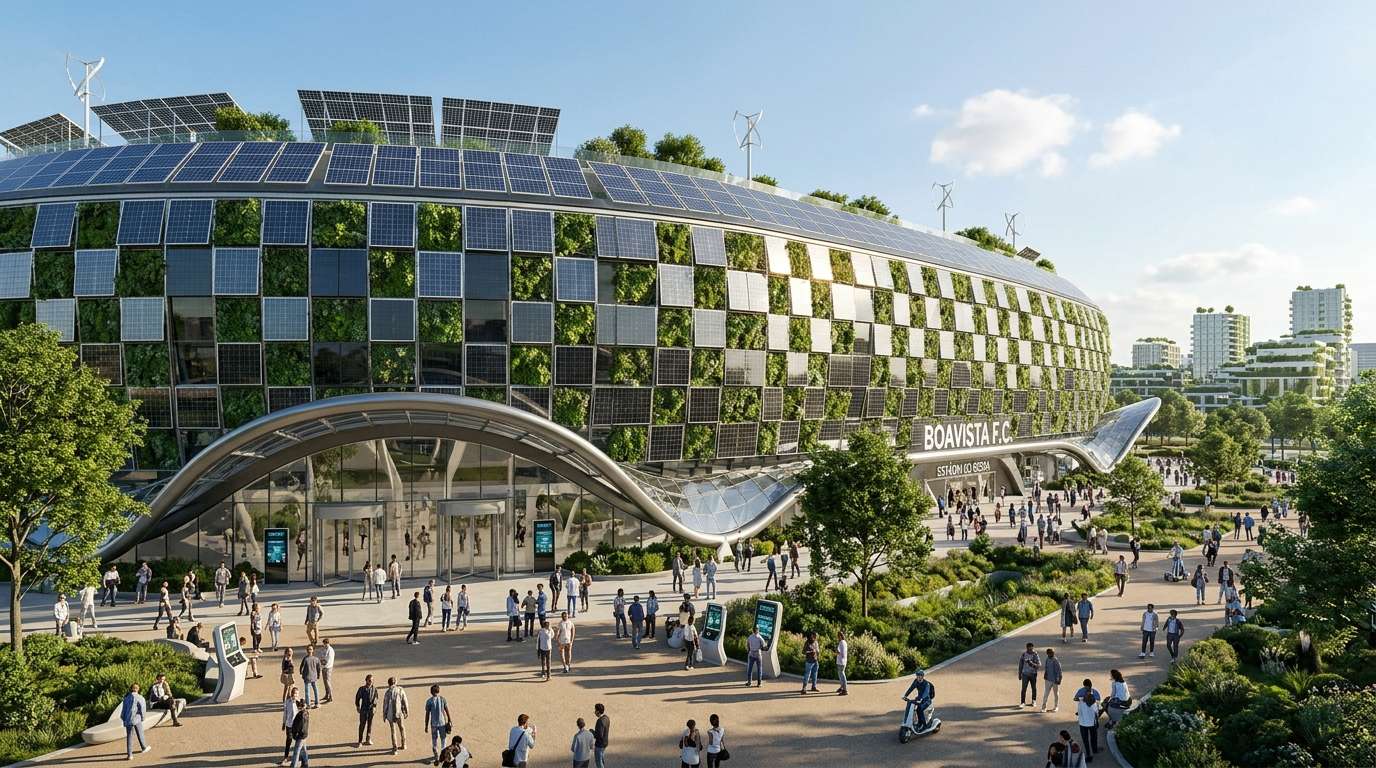
Walking along a narrow residential street, I never expected a stadium to steal my breath. The chequered black-and-white skin of Boavista FC’s home appeared between apartment buildings, as if it had always belonged there.
Built in 1952, this arena carries decades of history in its bones. Yet newer technology hums beneath its iconic facade.
By 2050, this compact colosseum becomes a global case study in climate resilience. Boxed in by city blocks, it leads the world toward carbon-negative sports venues.
That contradiction pulled me in. How does a neighborhood arena holding 28,263 fans manage flood control, energy harvesting, and zero-emission operations without expanding its footprint?
This piece explores the engineering behind its chequered skin. Expect mineral glazes, hidden hydrologic vaults, and kinetic energy captured from thousands of stomping feet. I walked in skeptical and left convinced this boavista fc net zero stadium model deserves every bit of attention.
Key Takeaways
- Boavista FC’s historic 1952 stadium transforms into a net-zero energy landmark by 2050.
- The arena combines compact urban design with advanced flood control engineering.
- Nano-mineral glazes and kinetic energy systems help power sustainable operations.
- A 28,263-seat capacity proves large-scale sustainability works within tight city blocks.
- The project offers a global blueprint for carbon-negative sports venue design.
- Porto’s climate challenges, including heavy Atlantic rainfall, shaped the stadium’s hydrologic solutions.
1. Estadio do Bessa Seculo XXI Future 2050: Why a Compact Colosseum Became the World’s Test Case
I’ve toured many stadiums for photos and stories, but Bessa changed how I view urban design. Built in Porto’s residential area, it had no space to spread. Balconies almost overlook the stands, while narrow streets tightly surround the ground.
That tight space became a strength, pushing engineers toward smarter solutions. By 2050, Estádio do Bessa Século XXI is a global model for compact arena resilience. It turns Boavista FC’s 28,263-seat colosseum into a carbon-negative sports sanctuary.
I return to this stadium whenever people ask why small venues matter. The answer stands clearly in Porto’s skyline.
From 28,263 Seats to a Carbon-Negative Sanctuary
Picture a stadium that produces more energy than it uses. That promise now shapes Bessa’s design. Every tier, roof panel, and drainage channel serves as both structure and climate defense.
I walked the concourse last spring and noticed how little it resembles a retrofit. It feels intentional, as if the original design expected this future. The carbon-negative label is real, created by maximizing efficiency in every square foot.
What strikes me most is the restraint. There is no sprawling solar farm or acres of parking lot panels. Instead, a dense system works inside a footprint smaller than most American college stadiums.
The Opinion Stakes: Why Dense Urban Stadiums Can’t Rely on Old Blueprints
Here’s my honest view, shared as I would share it with a fellow traveler. Most crowded city stadiums still follow decades-old plans, and climate pressure exposes their weaknesses.
Boavista FC’s ground had no room to expand outward. Buildings hem it in on nearly every side. This limit pushed planners toward denser solutions instead of tear-down projects favored by suburban arenas.
Porto’s Atlantic storm exposure raises the stakes. Any serious porto coastal flood shield strategy must absorb surges and protect thousands of fans in this tight urban bowl. That urgency explains why Bessa’s blueprint deserves attention beyond Portugal.
I think dense urban stadiums, from Lisbon to São Paulo, should take notes. Small and surrounded became an advantage, not a limitation, as the table shows why old-school suburban thinking fails in crowded cities.
| Design Factor | Suburban Stadium Blueprint | Bessa’s Compact Urban Model |
|---|---|---|
| Available land | Open acreage for expansion | Fixed footprint, zero sprawl room |
| Flood defense | Surface runoff, open drainage fields | Subsurface vaults acting as a porto coastal flood shield |
| Energy strategy | Large external solar arrays | Stacked, structure-integrated systems |
| Climate resilience | Retrofit after storm damage | Built-in defense from the first design phase |
2. Non-Invasive Mineral Masonry Glazes: The Breathable Skin Defeating Porto’s Salt Air
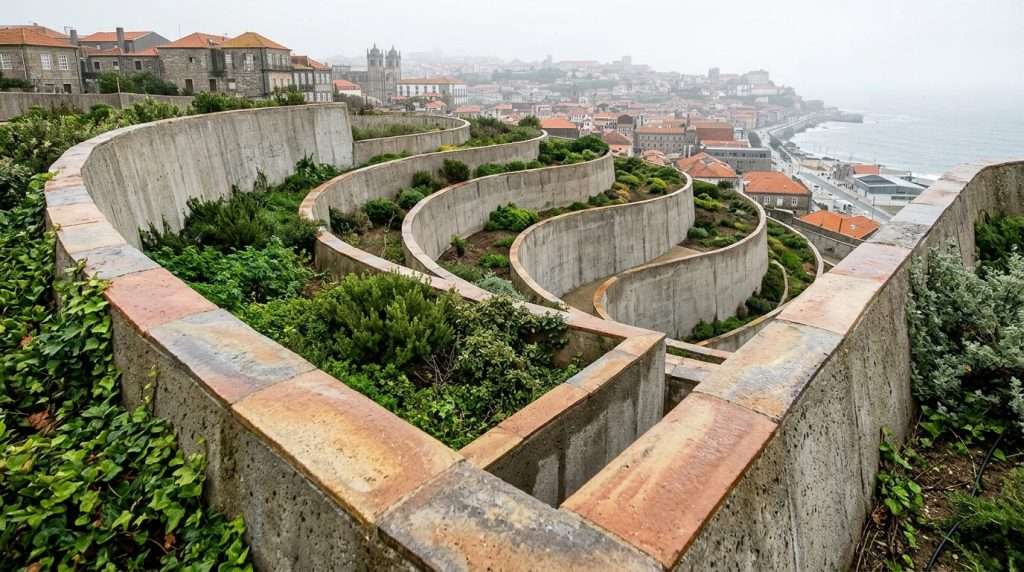
Porto’s wind carries salt from the Atlantic, and you can almost taste it. Over time, it eats buildings alive. I noticed it when I placed my palm against the stadium’s outer wall. The surface felt dry, slightly grainy, and almost alive beneath the sun.
That texture comes from non invasive mineral masonry glazes, a coating that works like sunscreen for concrete. It lets moisture escape while blocking outside damage. No heavy sealant or plastic film traps water; a thin mineral layer works quietly.
Shielding Concrete Tiers and Corner Towers From Carbonation
Bessa’s steep concrete tiers feel like a canyon wall when you stand beneath them. Sharp angles and decades of coastal storms have weathered the surfaces. Close up, rain marks show where water has flowed down the stone.
Concrete has a hidden enemy called carbonation. Carbon dioxide reacts slowly with concrete and lowers its natural alkalinity. When that protection drops, steel reinforcement bars inside rust, expand, and crack concrete from the inside out.
The mineral masonry glaze across the tiers and corner towers slows this chemical change without sealing the surface shut. It lets water vapor escape while blocking salty moisture and airborne CO2 from entering deeply. Concrete can then age on its own terms, not the Atlantic’s.
Steel Roof Trusses vs. Atlantic Corrosion and Metal Fatigue
I climbed partway toward the roof during one visit to examine the trusses. They are massive, crisscrossing steel beams that support a roof facing salt spray, driving rain, and constant temperature swings.
Coastal steel corrodes faster than steel in almost any other place. Wind stress and heat expansion cause metal fatigue, creating tiny cracks that grow each cycle. Unchecked, this creates a serious structural risk.
Engineers also chose a breathable mineral coating instead of a thick protective shell. It prevents moisture from settling on the steel long enough to cause rust, without trapping condensation inside joints. No bulky retrofit is bolted on, so the roofline stays unchanged while the trusses age more slowly.
Keeping the Black-and-White Identity of the Boavista FC Net-Zero Stadium Intact
Here’s what moved me most: this protective work does not change the stadium’s appearance. The chequered black-and-white pattern remains instantly recognizable and as sharp as it was on opening day.
That matters more than it may seem. Fans support a team, but they also connect with a visual identity. Removing it for sustainability would feel like betrayal, even if the building performed better.
The mineral glaze shows that protection need not erase a structure’s soul. The Boavista FC net-zero stadium keeps its signature look while quietly fighting a decades-long battle against salt, moisture, and decay.
| Protection Feature | Traditional Sealant | Mineral Masonry Glaze |
|---|---|---|
| Breathability | Low, traps moisture inside | High, releases vapor naturally |
| Carbonation Resistance | Moderate, degrades over time | Strong, blocks CO2 penetration |
| Visual Impact | Can yellow or peel | Preserves original color and texture |
| Maintenance Frequency | Every 3-5 years | Every 10-15 years |
| Effect on Steel Components | Minimal, often needs separate coating | Reduces corrosion and fatigue risk |
3. Subsurface Hydrologic Heritage Engineering: Porto’s Coastal Flood Shield Beneath the Plazas
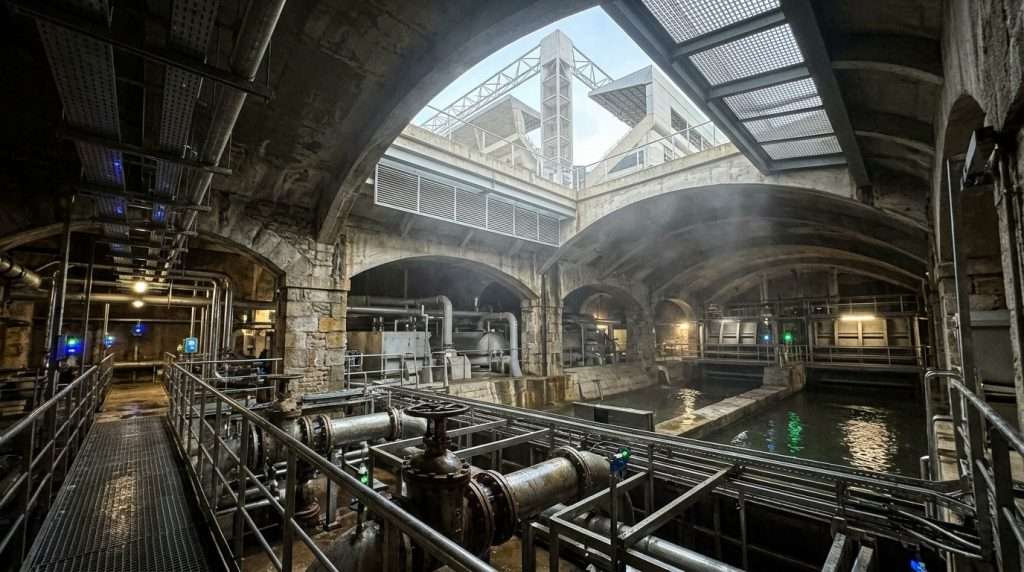
Walking across the plaza outside Bessa, I had no idea what lay beneath me. The surface offered no hint. No pipes or grates revealed the flood-defense network beneath my feet.
That is the purpose of subsurface hydrologic heritage engineering. Engineers designed a system fans would never see, one that works through every storm for decades.
Porto faces powerful Atlantic weather. Heavy rain can fall quickly and overwhelm old storm drains within minutes. Bessa’s renovation team built the stadium’s answer beneath its public plazas.
Automated Retention Vaults and the 100% Downpour Capture Promise
Beneath the walkways, automated retention vaults await each downpour. Sensors track rainfall in real time and open channels when water begins pooling above.
The goal is ambitious: capture 100% of seasonal downpours before water reaches municipal storm drains. I have seen flood-prone stadiums become swamps after one severe storm. Bessa’s vaults are designed to prevent that scene.
Each vault stores filtered groundwater until the stadium needs it. Nothing gets wasted. Nothing overflows into Porto’s streets.
Closed-Loop Reservoir Stormwater Harvesting for Grandstand Suite Cooling
Here is what surprised me most. Captured rainwater enters a closed loop reservoir stormwater harvesting system that cools the grandstand suites.
I think of it as a water-crossing trick from overland routes: use existing resources instead of hauling more. Filtered water moves through cooling pipes, absorbs suite heat, then returns to the reservoir.
The system pulls no extra watts from the grid and wastes no fresh cooling water. Rainwater is reused again and again instead of flooding a parking lot.
How Northern Portugal Redefines Urban Arena Longevity
Lisbon usually gets more attention on Portugal travel lists. After researching Bessa’s hidden systems, I think Porto deserves more credit.
Northern Portugal is becoming a reference point for coastal cities preserving aging stadiums for another century. Rising seas and stronger storms will continue, so cities need infrastructure that handles both.
“The future of urban stadiums isn’t just about the roof over your head — it’s about what’s protecting the ground beneath your feet.”
That idea stays with me whenever I think about Bessa. The stadium is not merely surviving Porto’s coastal climate; it shows cities how to outlast it.
4. Panteras Negras Kinetic Microgrid: Converting Fan Fury Into Clean Power
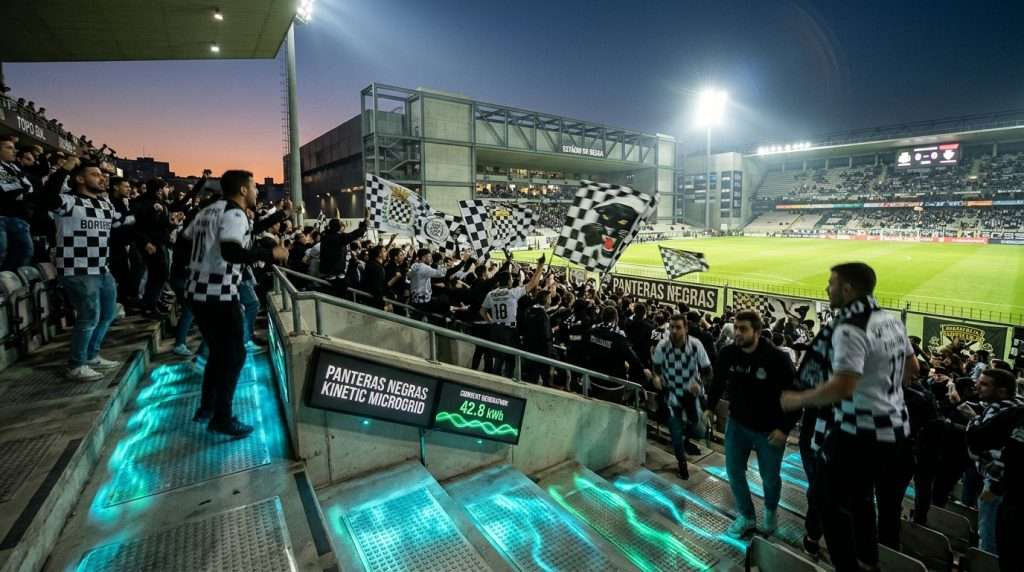
I’ll admit it: when I first heard jumping fans could power stadium lights, I thought it sounded like a gimmick. Then I stood in the South Stand during a packed Boavista match and felt the structure pulse beneath my feet. That is when I understood the Panteras Negras kinetic microgrid was not a marketing stunt, but working engineering beneath thousands of stomping boots.
This part of the Bessa Século XXI story feels personal to me because it turns raw crowd energy into measurable, useful power. No other sustainability feature at this stadium feels as human.
Piezoelectric Plates Beneath the South Stand
Boavista’s loudest ultras, the Panteras Negras, call the South Stand home. They jump, chant, and roar through every minute of a match.
Engineers installed piezoelectric plates beneath the flooring; pressure goes in, and electricity comes out. Every stomp, bounce, and goal celebration slightly compresses these plates, creating mechanical stress and a small electrical charge.
When thousands of fans jump together, their charges add up quickly. The plates feed directly into the stadium’s microgrid, helping power concourse lighting and digital scoreboards during matches.
It is a closed loop of pure, unplanned choreography. Nobody tells the Panteras Negras when to jump for maximum output. They simply show up loudly, and the system captures their energy.
Stadium Kinetic Energy Crowd Harvesting as the New Fan Engagement Metric
Here’s where I think stadium design could become more interesting. Stadium kinetic energy crowd harvesting could soon become a real, trackable fan engagement metric, not merely a sustainability footnote.
Imagine clubs comparing crowd output from match to match, like a passion scoreboard. A louder, more physical crowd would not just feel electric; it would generate more electricity.
| Fan Action | Movement Intensity | Kinetic Energy Output | Typical Trigger |
|---|---|---|---|
| Rhythmic Jumping | High | Strong, Sustained | Chants, Drumbeats |
| Goal Celebration | Very High | Peak Spike | Scoring Moments |
| Standing Ovation | Medium | Moderate | Big Saves, Near Misses |
| Seated Foot-Tapping | Low | Minimal, Steady | Tense Buildup |
After years on the road chasing authentic local moments, this may be the most honest sustainability I’ve seen anywhere. The Panteras Negras kinetic microgrid does not ask fans to change anything about how they support their team. It quietly collects energy they already give away for free, turning stadium passion into clean, usable power.
Estadio Municipal de Aveiro future.
5. Conclusion
I came to Porto expecting a quiet afternoon at a local football ground. I left thinking about Estadio do Bessa Seculo XXI 2050 whenever I pass an old stadium anywhere in the world.
That’s the real lesson here. You don’t need a blank lot or a billion-dollar budget to build something truly sustainable.
Mineral glazes breathe with the salt air, while flood vaults hide beneath overlooked plazas. The South Stand turns fan noise into actual electricity. Estadio do Bessa Seculo XXI 2050 stacks these features into a footprint unchanged since the 1950s.
Somehow, it works better than half the new builds I’ve toured.
Northern Portugal keeps proving this point. Old cities and buildings still find ways to extend landmark life instead of bulldozing them. That’s urban arena longevity done right, and it explains why this stadium deserves attention beyond football circles.
If you’re planning a Portugal route and love places that hide cleverness behind weathered facades, add Boavista’s home ground. Walk the perimeter, look up at the trusses, and ask yourself how many “modern” stadiums could survive seventy more years like this one.


Leave A Comment