
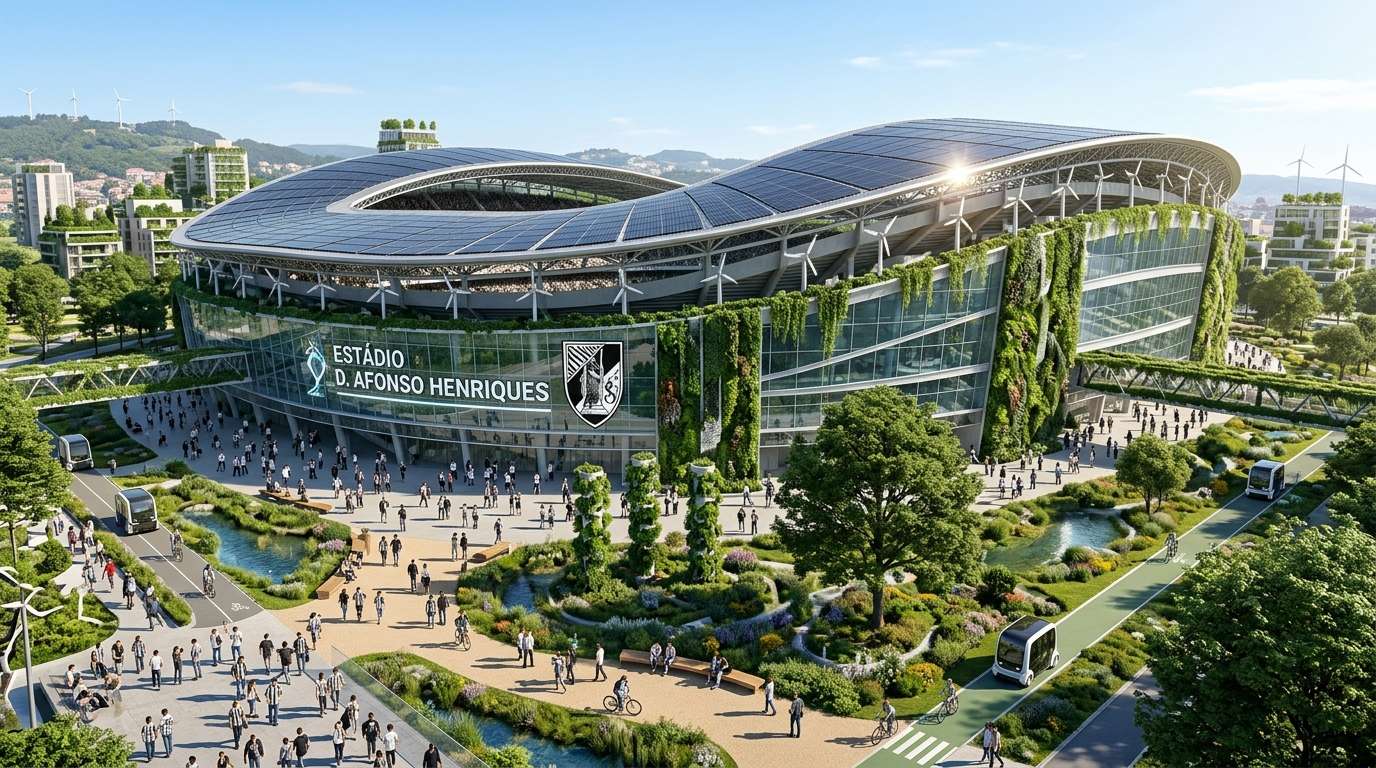
I remember my first walk up the hill toward this stadium. Its honeycomb steel frame rose straight from the rock. I wondered why no other European ground looked quite like it.
That memory raised a question I could not ignore. What happens when this small, historic arena in Guimarães becomes a full net-zero power fortress? I pictured steep cantilevered stands, breathable glazing, and rainwater systems for Portugal’s heaviest Atlantic storms.
This is not a boast about predictions. It is a personal thought experiment about sovereign heritage meeting space-age engineering. Guimarães calls itself the cradle of Portugal, and its stadium could shape sustainable sports architecture’s future.
By mid-century, I imagine 30,000 fans roaring inside a carbon-negative colosseum honoring its black-and-white soul. The Estadio D Afonso Henriques future 2050 vision deserves careful exploration, piece by piece.
Key Takeaways
- The stadium’s hillside design could support a net-zero energy model by mid-century.
- Steep cantilevered stands may double as kinetic energy harvesters for fans.
- Rainwater retention systems could manage over 1,400 mm of annual Atlantic rainfall.
- Nano-mineral glazing offers a breathable, climate-smart building skin.
- The 30,000-seat capacity stays rooted in Vitória SC’s loyal fan culture.
- Guimarães’s royal history adds symbolic weight to its sustainable future.
1. A Stadium Reimagined: One Writer’s Case for the 2050 Cradle-City Vision
Walking Guimarães’s narrow, cobbled lanes, I understood why locals call it Portugal’s cradle. Each stone wall seemed to carry centuries of memory. The castle above town watched the streets, as if it had watched over kings.
I’ve toured stadiums across five continents, following match-day energy and architecture wherever I travel. Most impressed me for ninety minutes, then faded from memory. Estádio D. Afonso Henriques did something different. It made me ask: can a stadium carry a city’s identity forward without competing with it?
The Estadio D Afonso Henriques future 2050 vision I propose is not about tearing down history. It will not replace the UNESCO charm wrapped around this place. It would build a structure that protects sacred features while quietly fighting climate stress along the Ave River basin.
I’m not an engineer or city planner. I’m an explorer who has spent years comparing heritage sites with modern arenas. I note which ones age well and which crumble through neglect or over-ambition.
“A building that cannot adapt is already a ruin waiting to happen.”
I think about that line whenever I pass an aging stadium that was once a marvel. Guimarães can avoid that fate, and that possibility drew me into writing this.
Here’s how I break down my reasoning for pushing this cradle-city vision forward:
| Reason for the Vision | Why It Matters | What I Observed On-Site |
|---|---|---|
| Heritage Protection | UNESCO status demands careful stewardship | Black-and-white granite facades still intact after decades of use |
| Climate Resilience | Atlantic storms and flooding events are intensifying | Ave River basin showing heavier seasonal runoff near the grounds |
| Community Identity | The stadium functions as a civic symbol, not just a sports venue | Fans describing the ground as part of the city’s soul, not a side attraction |
| Global Relevance | Smaller stadiums rarely receive sustainability spotlight | Few mid-size arenas worldwide showcasing true net-zero ambition |
None of this is theoretical daydreaming on my part. I’ve watched smaller cities punch above their weight when they commit to a clear identity. Guimarães already carries that identity in its stone walls and football club’s long history.
Now it needs a structure brave enough to match that legacy with forward-thinking engineering. That’s the case I build, one cobblestone street and stadium walk-through at a time.
2. Estadio D Afonso Henriques Future 2050: Scaling a 30,000-Seat Fortress Into a Global Masterclass
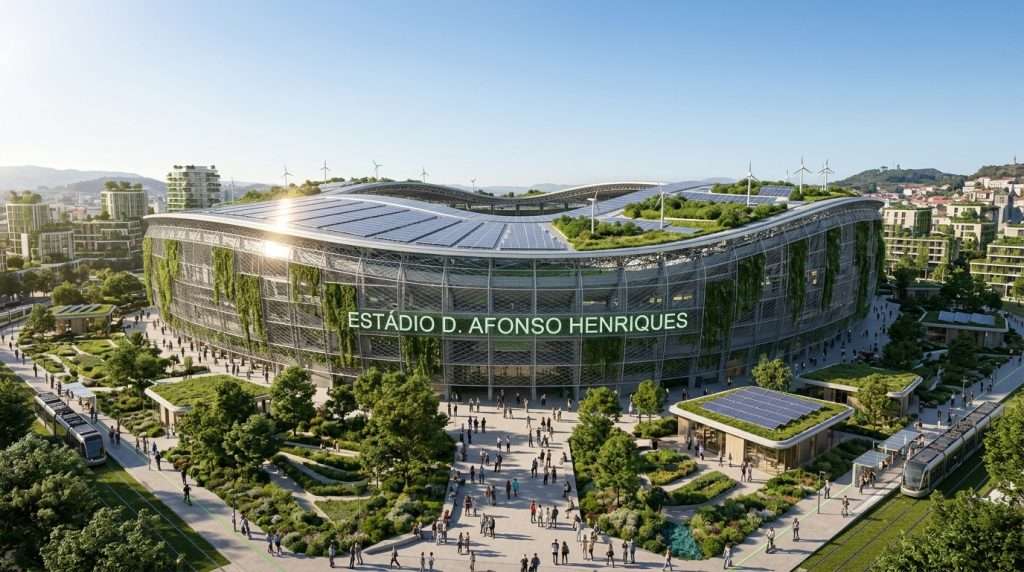
Forget 80,000-seat giants for a moment. A quieter revolution may be unfolding in a stadium one-third that size, among northern Portugal’s hills.
Estádio D. Afonso Henriques holds about 30,000 fans today. That figure has changed little over the decades, and it does not need to grow.
By 2050, this modest footprint will mean more than its seat count suggests. Architects in Doha study it. Planners in Los Angeles and officials from Toronto to Tokyo use its blueprints for climate-ready venues.
I think that’s the real story of Estadio D Afonso Henriques future 2050. It is not about building a colossal arena. It proves a mid-sized stadium can become carbon-negative while still feeling like home for generations of fans.
So what does carbon-negative mean here? It means the stadium removes more carbon from the atmosphere than it releases.
Solar panels, kinetic flooring, rainwater systems, and smart materials work together. The venue produces power, captures water, and offsets construction and travel emissions. By 2050, it gives back more than it takes.
Now, here is why the smaller scale matters. A 30,000-seat stadium is not only easier to retrofit. It is more honest about what most clubs worldwide can achieve.
Most professional teams do not play in 80,000-seat behemoths. They use venues closer to this size, often in cities with tighter budgets and smaller tax bases.
- Lower retrofit costs make the model financially realistic for mid-market clubs
- Faster energy independence because smaller systems reach capacity sooner
- Easier community integration since the stadium footprint fits existing urban space
- Quicker construction timelines compared to sprawling mega-arenas
- Stronger replicability for cities without billion-dollar stadium budgets
A mega-arena may dazzle on television, but it rarely teaches lessons people can use at home. That point stays with me most.
Scale down the ambition, and you scale up the number of places that can actually follow your lead.
This is the quiet genius behind the 2050 vision for Estádio D. Afonso Henriques. Vitória SC is not chasing headlines through size. It is chasing relevance through smart design.
| Factor | 30,000-Seat Model (D. Afonso Henriques) | 80,000-Seat Mega-Arena |
|---|---|---|
| Retrofit Cost Scale | Manageable for mid-market club budgets | Requires massive capital investment |
| Energy Self-Sufficiency Timeline | Reaches full capacity faster | Longer rollout due to larger systems |
| Global Replicability | High, fits most mid-sized cities | Limited to major metro markets |
| Community Integration | Easier urban fit, lower disruption | Often requires large land clearance |
The Estadio D Afonso Henriques future 2050 vision will prove that smart design beats size. It will show how a historic fortress in Guimarães can outclass venues ten times larger with sustainability lessons worth copying.
That foundation supports everything else across the stadium’s surfaces, from steel beams to stone walls protecting its soul.
3. Shielding Steel and Stone: Non-Invasive Mineral Masonry Glazes
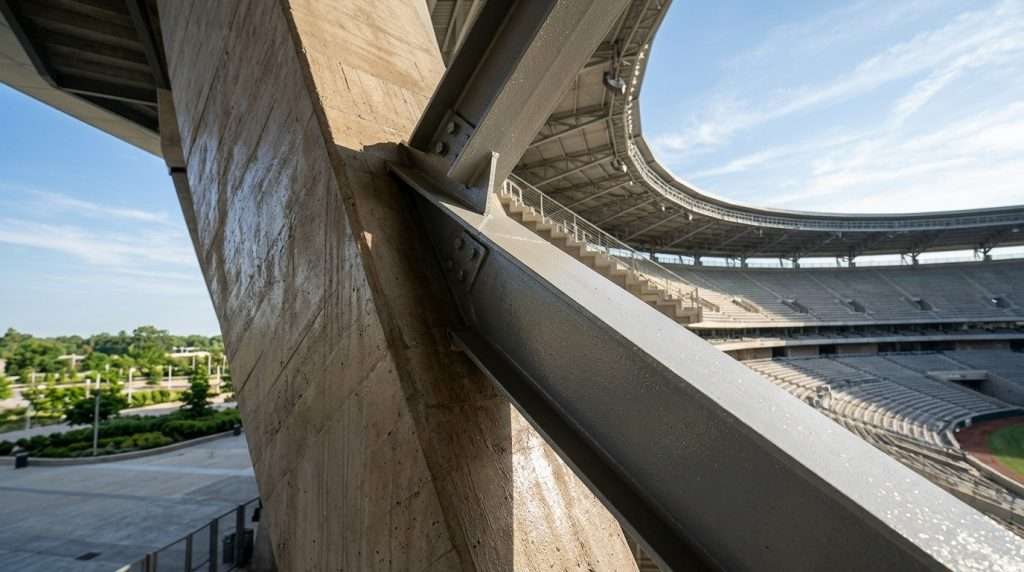
I’ve seen enough aging stadiums to know concrete doesn’t fail overnight. It fails quietly, one storm at a time. Guimarães sits near the Atlantic, where each gust brings salt, moisture, and chemical damage to rebar and gray concrete.
That is why the renovation team chose non-invasive mineral masonry glazes over standard waterproof sealants. These non invasive mineral masonry glazes let stone and concrete release trapped moisture while blocking water that causes rust and decay. I touched a sample panel on-site, and it felt like chalk, not plastic.
Arresting Carbonation and Metal Fatigue in Atlantic Storms
Concrete carbonation sounds technical, but the idea is simple. Carbon dioxide enters concrete over decades and lowers its natural alkalinity. Then, the steel reinforcement loses its protective shield and starts to corrode.
Atlantic storms speed up this process. Wind-driven rain pushes moisture into porous surfaces, while salt air accelerates oxidation on exposed steel. The stadium’s cantilevered roof trusses face the worst conditions, hanging above the stands and catching Minho valley gusts.
The mineral glaze works like a raincoat that still lets you sweat. It repels liquid water but allows water vapor to escape from inside. That property greatly slows carbonation and reduces fatigue stress on steel connections over time.
| Coating Type | Breathability | Salt Air Resistance | Maintenance Cycle |
|---|---|---|---|
| Standard acrylic sealant | Low | Moderate | Every 3-5 years |
| Epoxy-based coating | Very Low | High | Every 7-10 years |
| Non-invasive mineral glaze | High | High | Every 10-15 years |
Preserving the Authentic Black-and-White Soul of Guimarães
Beyond engineering, I kept thinking about what the black-and-white facade means to this city. Vitória SC’s colors are more than team identity. They echo the dark granite and whitewashed walls across the old town, including nearby medieval castle walls.
A heavy, glossy sealant would have changed that look, adding plastic shine to centuries-old texture. The mineral glaze avoids that problem. It settles into the surface instead of covering it, preserving the matte, stone-like finish locals know.
For a city holding UNESCO World Heritage status, that detail is not cosmetic. It is cultural preservation disguised as building maintenance. That quiet craftsmanship convinced me this project understands Guimarães as deeply as it understands concrete chemistry.
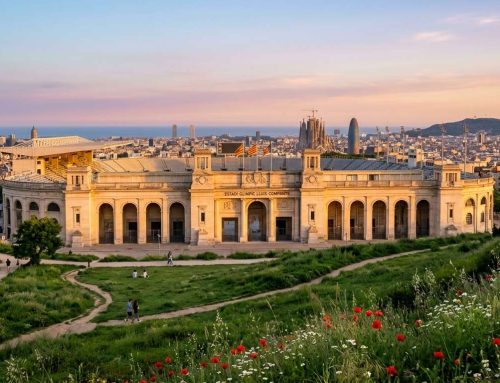
Estadi Olimpic Lluis Companys future.
4. Subsurface Hydrologic Heritage Engineering Beneath the Plazas
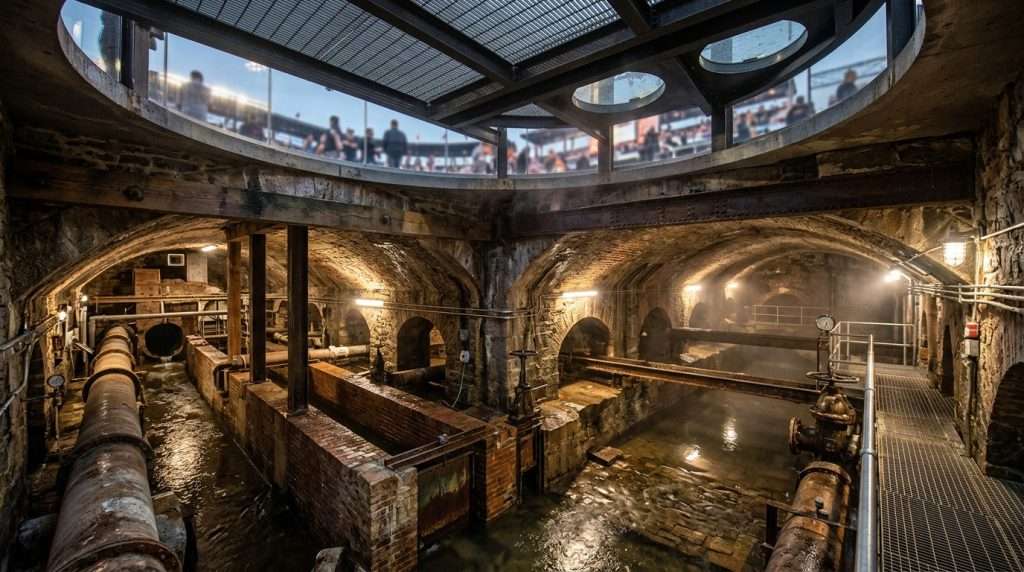
Some of Guimarães’s smartest engineering never sees daylight.
On an ordinary afternoon, walk the plazas around Estádio D. Afonso Henriques; you would never guess what works below. The footprint holds a network called subsurface hydrologic heritage engineering. It uses the ground to manage water the city has fought for centuries.
I love this kind of hidden infrastructure. It does not photograph well, and nobody lines up to see it. But it quietly protects a UNESCO World Heritage setting from flash floods the Ave river basin sends almost every winter.
Automated Retention Vaults Capturing 100% of Ave Basin Downpours
The Ave basin brings more than gentle rain. Atlantic storms dump huge volumes quickly, and historic cobblestone streets were never built to handle them.
Beneath the plazas, automated retention vaults capture every drop before it reaches the surface. Sensors track rainfall in real time. They open and close intake valves, sending water into underground chambers instead of storm drains built for a gentler century.
The system is engineered to capture 100 percent of Ave basin downpours during peak events. It holds water safely until it can be filtered, released slowly, or pulled back for reuse. For a town built on medieval drainage, this hidden system is a massive upgrade.
- Real-time rainfall sensors trigger automatic vault intake
- Underground chambers hold storm volume away from historic streets
- Filtration systems clean water before any reuse or release
Closed-Loop Reservoir Stormwater Harvesting for Grandstand Suite Cooling
Here is what excited me most. Captured rainwater does not simply wait for the next storm.
Through closed loop reservoir stormwater harvesting, filtered groundwater cycles directly into cooling systems for grandstand suites. The stadium avoids energy-hungry air conditioning units around the clock. It draws cool water from underground reservoirs, circulates it through suite cooling loops, and returns it to repeat the cycle.
There are no emissions. The system adds no strain to the grid. Rainwater does double duty as flood protection and climate control.
“Water is the oldest form of urban infrastructure — the cities that survive are the ones that learn to live with it, not against it.”
This idea sums up the entire underground system. It is not flashy or popular on social media like a solar roof might be. But walking flood-shield plazas reveals its best-kept secret: the same water cooling hospitality suites upstairs once threatened the street below.
5. Bancada Sul Kinetic Microgrid: Turning Fan Energy Into Power
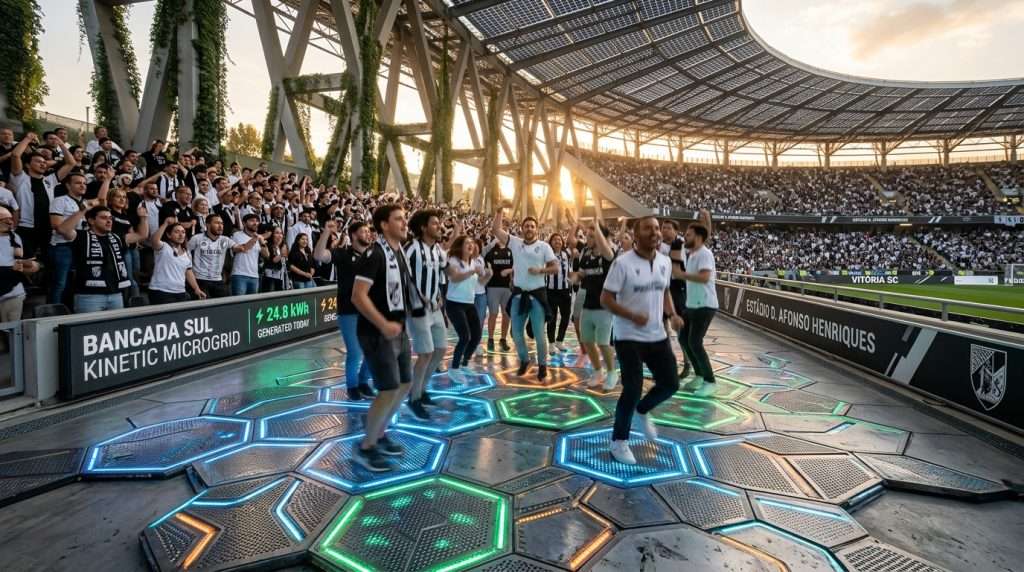
Standing shoulder to shoulder with thousands of chanting fans, I realized Bancada Sul created more than noise. Every stomp, jump, and roar after a Vitória SC goal sends a jolt through the concrete beneath your feet. That force can become useful instead of going to waste.
This is where the bancada sul kinetic microgrid comes into play. Engineers behind the 2050 redesign saw an opportunity in the crowd’s raw enthusiasm. They chose to capture it, convert it, and send usable electricity back into the stadium.
Piezoelectric Plates Beneath Portugal’s Loudest Terrace
The science sounds complex, but the idea is simple. Piezoelectric plates sit beneath the terrace flooring. When a few thousand fans jump together, pressure makes these plates generate a small electrical charge.
It uses the same basic principle as sidewalk tiles and dance floors around the world, scaled up for an intense football crowd. The Bancada Sul was the obvious choice for this experiment.
Anyone who has experienced a match here knows why. The terrace has a reputation as one of Portuguese football’s most electric atmospheres. Now, that reputation has a literal meaning.
From Crowd Jumps to Clean Megawatts
A single jump produces a tiny amount of power. It would not light a phone screen alone. But thousands of fans repeat that movement for ninety minutes, making the total meaningful.
This is the heart of stadium kinetic energy crowd harvesting: small individual actions joining to create meaningful power. The system works in a few clear steps.
- Fans jump, stomp, or shift weight during key moments of the match.
- Piezoelectric plates compress and generate an electrical charge.
- That charge feeds into the stadium’s internal microgrid.
- Stored energy helps power lighting, screens, and other low-draw systems on match day.
I find this setup poetic. The same passion that makes the Bancada Sul famous now helps keep the lights on. Fans now support their team with their voices and power part of the stadium with their feet.
It is a small piece of the larger net-zero puzzle at Estádio D. Afonso Henriques. Yet it is one of the most human pieces. No solar panel or wind turbine can capture pure, unfiltered fan energy quite like this terrace does.
Estadio Municipal de Aveiro future.
6. Vitoria SC Net Zero Stadium: Reading the Carbon-Negative Scoreboard
Imagine a stadium that does more than avoid harming the planet. Imagine one that gives back more than it takes. That promise drives the Vitória SC net zero stadium project in Guimarães.
I have toured many “green” buildings that make bold claims but barely balance their carbon use. This project works differently. The mineral glazes, hydrologic vaults, and kinetic microgrid feed one combined scoreboard.
The scoreboard does not merely show zero. It shows a negative balance, in the best possible way.
How the Colosseum’s Carbon Ledger Adds Up
Think of it as a household budget, but track carbon instead of dollars. Money comes in and goes out, while clever systems cancel most emissions.
Protective glazes reduce how often crews repair or replace steel and masonry. Fewer replacements mean fewer trucks, factories, and emissions from raw materials.
Underground retention vaults reduce energy needed to pump, treat, and cool water for grandstand suites. Using less grid energy creates a smaller footprint before anyone scans a ticket.
The vitoria sc net zero stadium uses the kinetic microgrid under Bancada Sul to turn fan energy into electricity. It captures energy from one of Portugal’s loudest terraces and powers stadium operations.
Together, those three savings create a structure that provides more environmental benefit than it costs to run, match after match.
| Carbon Ledger Component | Role in the System | Net Effect |
|---|---|---|
| Mineral Masonry Glazes | Protects steel and stone from corrosion and weather damage | Reduces material replacement emissions |
| Subsurface Retention Vaults | Captures and reuses stormwater for cooling systems | Cuts grid energy demand |
| Bancada Sul Kinetic Microgrid | Converts fan movement into usable electricity | Generates clean power during matches |
| Combined System | Integrates all three technologies into one operation | Produces an overall carbon-negative balance |
Why Global Stadium Operators Should Take Notice
I have covered many stadiums, from major league arenas to modest regional grounds. Size usually gets the attention, but it does not make this project worth studying. Its value comes from how its systems work together.
A 30,000-seat venue in northern Portugal shows that carbon-negative sports infrastructure is not a distant fantasy. It is achievable now with existing technology and a modest budget. It is not reserved for billion-dollar franchises.
Premier League clubs, MLS franchises, and Bundesliga operators spend huge sums on stadium upgrades each year. Few upgrades ask the harder question: can a stadium give back more than it consumes?
- It shows carbon-negative design works at a mid-size scale, not just in flagship mega-projects.
- It proves retrofitting an old structure can outperform building a new one from scratch.
- It demonstrates fan energy and stormwater, resources every stadium already has, can become genuine assets.
The real lesson from Guimarães is clear: the Vitória SC net zero stadium model does not need a bigger budget to matter. It needs operators willing to look beyond seat counts and study what the numbers actually say.
7. Guimaraes UNESCO Cradle Flood Shield and the Minho Valley Legacy
I asked a local engineer about protecting a 12th-century town square from 21st-century storms. He pointed to the stadium. Estádio D. Afonso Henriques sits minutes from the streets where Portugal’s first king was born. Those streets carry serious weight.
Guimarães earned its UNESCO World Heritage status by keeping medieval fabric intact for centuries. The stadium’s flood protection system extends that protective instinct into the climate era. It leaves untouched every granite stone it was not designed to affect.
Protecting a UNESCO World Heritage Setting From Rising Risk
You can’t bolt modern flood infrastructure onto a UNESCO site and call it a day. I have seen this fail in other heritage cities. Concrete barriers can fight the architecture instead of supporting it.
The Guimarães UNESCO Cradle Flood Shield takes a different route. It works underground and out of sight, so Nothing visible changes at street level. It channels excess water away from the historic core through the same retention network beneath the stadium plazas.
This matters because rising river flows in the Ave basin threaten more than modern buildings. They threaten centuries-old foundations never built for today’s rainfall patterns. The shield buys those old stones time, a quiet victory worth noticing.
A Regional Model Spreading Across Northern Portugal
I’ll be honest, I didn’t expect a soccer stadium to become a civic planning template. But that’s exactly what’s happening across the Minho valley right now.
Smaller towns nearby now study the stadium’s approach to cradle arena longevity. They have started adapting it for town halls, libraries, and local sports complexes. Northern Portugal is quietly redefining how heritage towns handle climate risk, one retrofit at a time.
It’s a reminder that good engineering doesn’t need to shout. Sometimes it simply needs to work and let the region follow at its own pace.
8. Conclusion
I did not come to Guimarães for a famous scoreboard or a packed trophy case. I came because a small stadium in a UNESCO town was quietly changing what a sports venue could be.
As I walked around Estádio D. Afonso Henriques, I thought about the layers beneath my feet and above my head. Mineral glazes guard old steel; water vaults breathe with the Ave basin’s rain; a terrace turns jumping fans into watts.
A flood shield protects a medieval cradle from a changing climate. None of these features demands attention, but that quietness stays with me.
The Estadio D Afonso Henriques future 2050 story is not a flashy headline. It is a working model, built by people who treated the old ground like the cobbled streets around it. That mix of humility and ambition is rare and worth seeing in person.
If you plan a route through northern Portugal, give Guimarães a few days. Watch a match if the schedule allows, then walk the plazas during a rainstorm. Notice the small pools and imagine where the city and stadium might stand by 2050.
Some trips change how you see a place. This one changed how I see a building.




Leave A Comment