
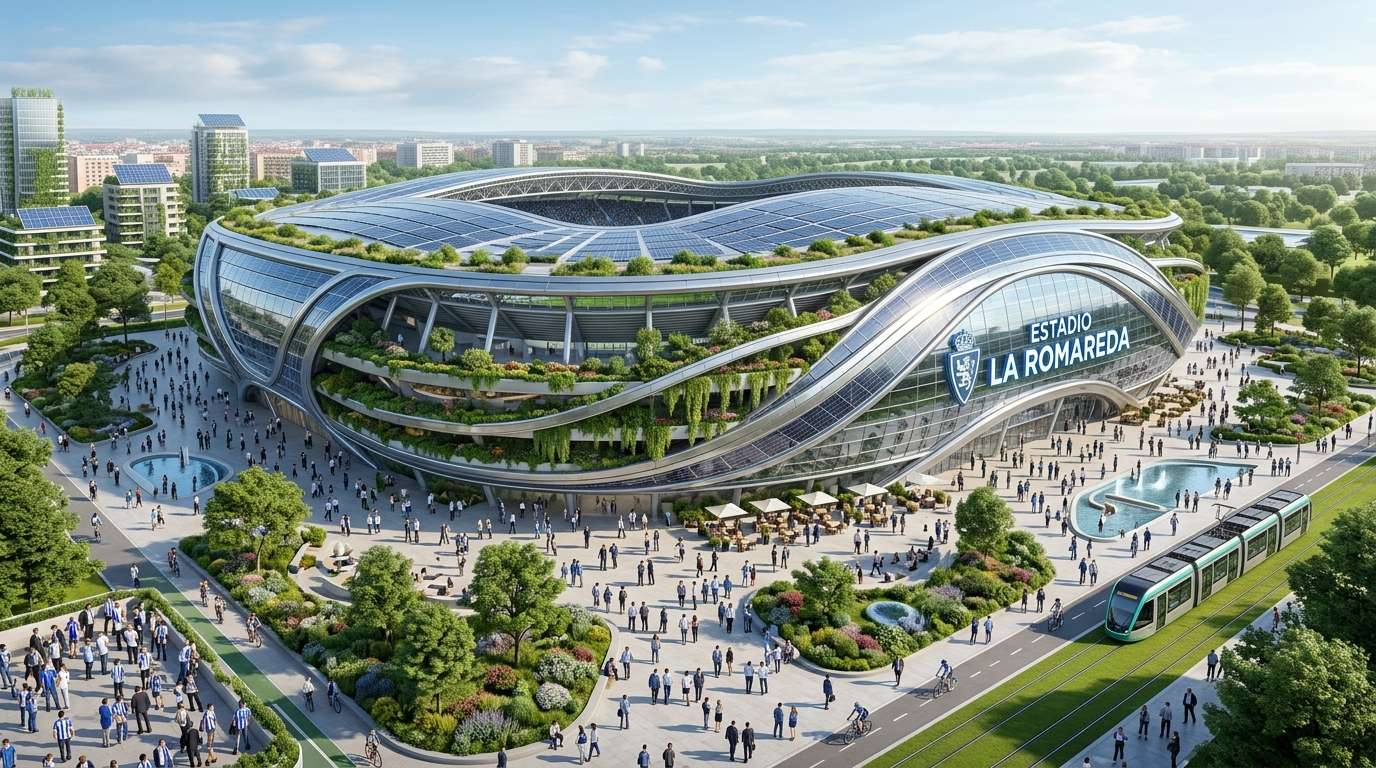
I have chased stadium stories across continents, but this one stopped me in my tracks. Picture a football ground that uses Spain’s harsh winds and heat instead of fighting them. It feeds off both.
The La Romareda future 2050 vision is taking shape in Zaragoza. The original stadium opened on September 8, 1957, with room for 33,608 fans. It endured decades of fierce Cierzo gusts and bone-dry summers.
It also hosted 1982 World Cup matches and Olympic football a decade later.
Crews began tearing down the old bowl on July 8, 2024. On May 25, 2025, Real Zaragoza beat Deportivo de La Coruña 1-0. It was the last match ever played there.
Now, architects at IDOM, led by César Azcárate, are raising something entirely different. A 43,110-seat colosseum is rising to turn brutal wind and heat into clean power and water. Full operation is planned for August 31, 2027, and the venue may host 2030 FIFA World Cup matches.
This is where I dig into how that transformation actually works.
Key Takeaways
- The original Zaragoza stadium opened in 1957 with a capacity of 33,608 and hosted both the 1982 World Cup and 1992 Olympics.
- Demolition started July 8, 2024, and the final match took place May 25, 2025.
- Architecture firm IDOM, led by César Azcárate, designed the new 43,110-seat arena.
- The rebuilt stadium is scheduled for full operation by August 31, 2027.
- The venue is positioned as a possible host site for the 2030 FIFA World Cup.
- By 2050, the stadium’s engineering aims to convert harsh Cierzo winds and extreme heat into renewable energy and water resources.
- The project reflects a broader shift toward climate-responsive sports architecture built for extreme regional conditions.
1. My Take: Why La Romareda Future 2050 Signals a Turning Point for Stadium Design
A sustainable stadium makes claims. A truly engineered stadium can face the climate crisis. La Romareda’s 2050 plan belongs to the second group.
I have toured many “green” arenas and can spot marketing gloss. This project feels different. By 2050, La Romareda will expand Real Zaragoza’s 43,000-seat bowl into a carbon-negative sports colosseum.
It will withstand Zaragoza’s brutal Cierzo winds and summer heat spikes.
From Local Pride to Global Benchmark
The stadium began modestly. Ayuntamiento de Zaragoza built it in 1957, and Real Zaragoza has run it ever since.
It hosted 1982 FIFA World Cup matches and 1992 Summer Olympics football, putting Aragon on the world sports map. That history matters, because this ground has always punched above its weight.
Architecture firm IDOM is rebuilding it in three stages: Phase 1A, Phase 1B, and Phase 2. The firm handles design, engineering, and construction oversight. After completion, capacity will reach about 43,110 to 43,114 seats.
Real Zaragoza Net Zero Stadium: A Bold Bet on Climate-Resilient Architecture
For a stadium, net zero has a clear meaning. The building produces as much clean energy as it uses while resisting wind damage and water stress.
IDOM stated its ambition clearly:
“Nueva Romareda is designed to be a benchmark for sustainability.”
I believe the claim holds up. The Real Zaragoza net zero stadium project pairs climate-resilient materials with renewable energy systems. The ground becomes a lab for cities facing hotter, windier futures.
2. Engineering Against the Cierzo: The Wind-Shielded Envelope of Nueva Romareda
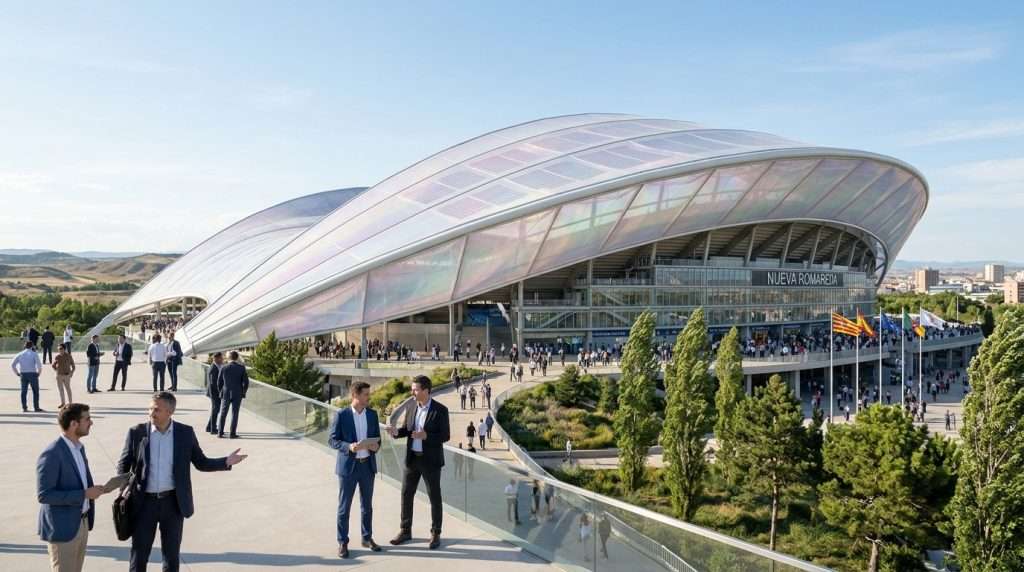
Most stadiums get built despite the weather. La Romareda got built because of it.
The Ebro Valley is known for vineyards, tapas bars, and strong wind. Locals call it the Cierzo. It howls for days, carries dust, and can make temperatures drop quickly.
IDOM’s team responded to the Cierzo directly. Instead of using thicker concrete, they studied the wind through Zaragoza and shaped the building around it.
“The stadium volume is eroded into concave forms facing north and south, and convex forms facing east and west toward Plaza Eduardo Ibarra and Paseo de Isabel la Católica.”
That design choice changes how the building performs during storms. It is not brute force; aerodynamics does the hard work.
The Aerodynamic Undulating Roof and PTFE Membrane Solar Roof Technology
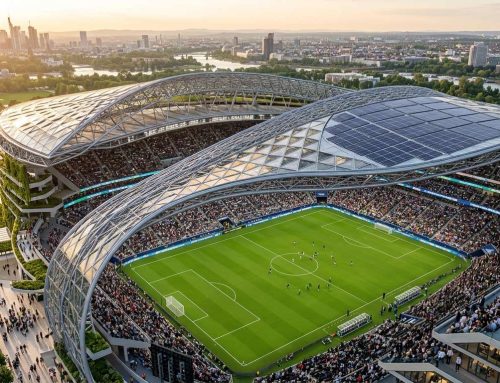
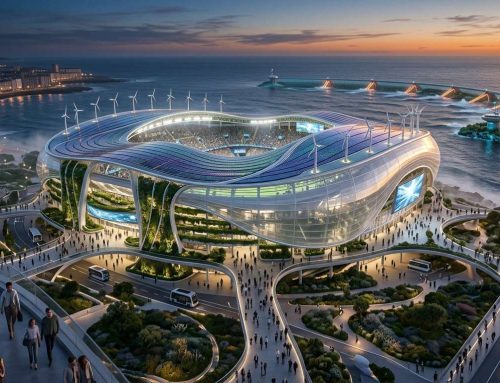
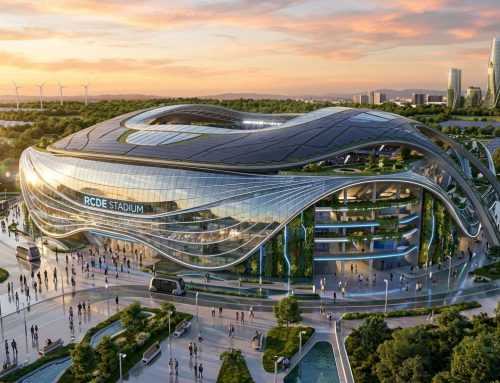
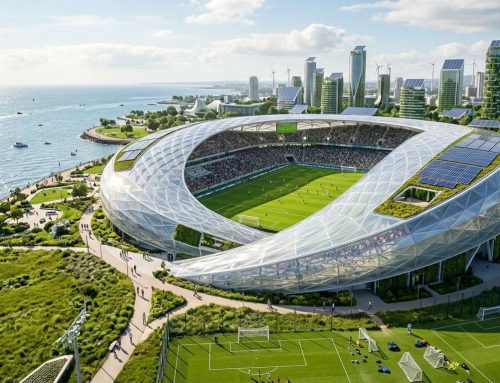
The roof tells the same story. This lightweight, undulating canopy covers 100% of the seating bowl and reaches the stadium’s edge, creating one continuous 360-degree concourse.
The roof is more than shelter. It uses PTFE membrane solar roof technology, a flexible, weather-resistant fabric carrying solar capacity across its surface. Fans get shade from the harsh Aragon sun and shelter from Cierzo gusts, while the stadium generates clean power above them.
It is a two-for-one solution that many stadiums never attempt. Most roofs block weather, but this one also produces power.
Nano-Mineral Glazes: Shielding Concrete Tiers from Dust Scour and Carbonation
Concrete faces two major threats in Zaragoza: wind-driven dust and summer heat above 42°C. Over time, dust scours surfaces, while carbonation weakens concrete from within.
To fight these threats, workers coat the structural tiers with nano-mineral glazes. These breathable coatings release moisture while blocking particles and chemical reactions that cause decay.
It is not a flashy fix. Few people will photograph a glaze coating for Instagram. Yet this quiet engineering can keep a stadium sharp for fifty years.
Nueva Romareda Preservation: Balancing Heritage with High-Tech Armor
I kept asking one question: how can new materials protect the stadium without erasing La Romareda’s original sense of home?
That is what Nueva Romareda preservation means. By day, the façade looks calm and familiar; at night, a double-skin lighting effect makes it vibrant. This subtle design keeps the stadium rooted in local identity, not like a spaceship in Aragon.
I did not expect concrete coatings and wind tunnels to lead to a heritage discussion. But this project seeks balance: future-proof materials surround a stadium that still feels unmistakably Zaragoza.
3. Beneath Plaza Eduardo Ibarra: Subsurface Hydrologic Heritage Engineering for a Thirsty City
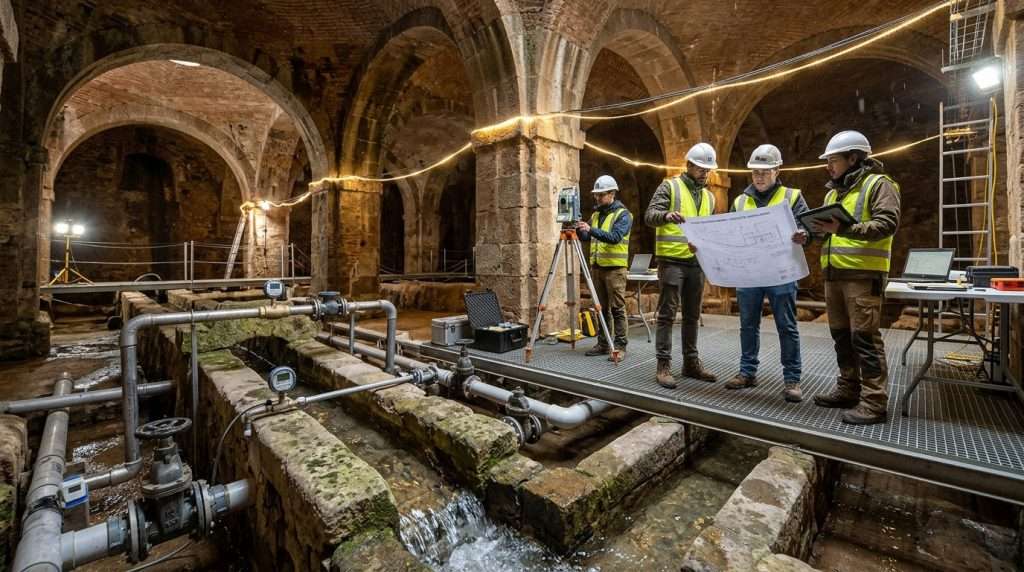
Some of La Romareda’s smartest engineering stays hidden underground. Beside its convex eastern façade, Plaza Eduardo Ibarra looks like an ordinary square. Below it, a hidden system handles Zaragoza’s old problem: violent storms that flood streets within minutes.
Automated Retention Vaults and Closed Loop Reservoir Stormwater Harvesting
Here, subsurface hydrologic heritage engineering helps protect the city. Automated retention vaults beneath the plaza capture flash downpours from the Huerva basin before they reach nearby streets. Sensors open valves before storms arrive, clearing space for sudden rain surges.
After collection, filters clean the water. Pumps then send it through a closed loop reservoir stormwater harvesting system to the stadium’s cooling equipment. Grandstand suites stay comfortable during Zaragoza’s hot summers without using fossil fuel.
Turning Huerva Basin Flash Floods into Zero-Emission Cooling
I like how this system turns a liability into an asset. Huerva basin flash floods once troubled planners and soaked residents’ sidewalks. Now, the same runoff provides renewable cooling for thousands of fans on match day.
The plaza’s redesign also strengthens ties between the stadium and Parque Grande José Antonio Labordeta. New vegetation links the park, plaza, and stadium in one shared green corridor. This small detail makes the area feel like a neighborhood, not a venue surrounded by concrete.
A Model for Flood-Prone Cities Beyond Zaragoza
This idea matters to me because I have watched flooding disrupt cities from coastal Asia to the Gulf Coast. It is not only a Zaragoza fix. Cities with aging stormwater systems could adapt this blueprint for their own streets.
| City | Flood Risk Driver | Current Stormwater Challenge | Potential Adaptation from La Romareda Model |
|---|---|---|---|
| Zaragoza, Spain | Huerva basin flash downpours | Outdated drainage near dense urban plazas | Underground retention vaults feeding closed-loop cooling |
| Valencia, Spain | Mediterranean cold-drop storms | River overflow into historic districts | Filtered groundwater reuse for public building cooling |
| Houston, USA | Hurricane-driven rainfall surges | Limited subsurface storage capacity | Automated vault networks under sports and civic plazas |
| Miami, USA | Sea-level rise and tidal flooding | Saltwater intrusion into drainage systems | Closed-loop harvesting to offset HVAC energy demand |
Projects like this appear more often in global international construction projects coverage. Cities are racing to build infrastructure that solves old problems while cutting emissions. La Romareda places that lesson inside a football stadium, showing that smart ideas can start underground.
4. Gol Sur Kinetic Microgrid: Harvesting Fan Energy at La Romareda
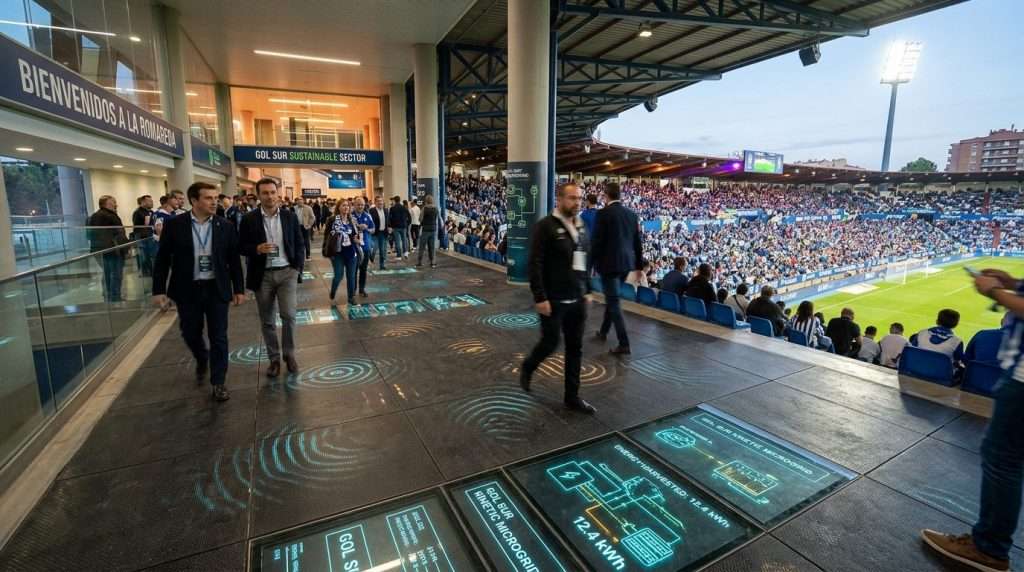
Of everything happening inside Nueva Romareda, one idea stopped me mid-scroll when I first read about it. Fans could help power the stadium by jumping, stomping, and celebrating goals. That promise drives the Gol Sur kinetic microgrid, perhaps this project’s most playful engineering.
IDOM built the bowl close to the pitch after multiple geometric design iterations. The final shape aims to intensify the matchday atmosphere. Closer seats make crowds louder and more physical, turning that intensity into fuel, not only noise.
Stadium Kinetic Energy Crowd Harvesting Explained
Here’s the simple version. Every time a crowd jumps, its weight hits the ground with real force. Stadium kinetic energy crowd harvesting captures that force instead of letting it disappear into concrete.
Special flooring materials called piezoelectric plates turn pressure into a small electrical charge. One stomp alone produces little. Thousands of fans celebrating a last-minute goal can make the numbers rise quickly.
This is not science fiction. Similar piezoelectric flooring already powers train station lighting and dance floors worldwide. La Romareda scales the idea up to full stadium size.
Under-Floor Piezoelectric Plates Across Concourses and Terraces
The plan places plates under floors across the Gol Sur terraces and exterior concourses. These areas see the heaviest foot traffic and celebration energy. Each rush toward the rail during a goal adds a small contribution to the grid.
The stadium’s layout gives this system plenty to work with. Premium seating, VIP boxes, a presidential box, and a Pitch Club overlook the players’ tunnel. Together, they bring extra people and energy to high-traffic zones on matchday.
Concourse areas stay busy from halftime rushes through the final walk out after the whistle. Plates across these zones, not only the terraces, keep the microgrid collecting power throughout the match.
- Terrace plates capture celebration jumps and chants in the loudest sections
- Concourse plates gather steady foot traffic before kickoff and at halftime
- VIP and Pitch Club zones add a consistent, lower-intensity energy flow
Why the Gol Sur Kinetic Microgrid Could Reshape Fan Engagement Everywhere
I’ve sat in plenty of loud away ends over the years, and I thought that energy vanished into the night. The Gol Sur kinetic microgrid challenges that assumption.
Clubs could market fan behavior as part of their sustainability story. “Jump for clean power” sounds silly until you realize it’s technically true.
Other stadiums are watching projects like this one closely. If La Romareda proves the idea works at scale, kinetic flooring could reach fan zones beyond Zaragoza. Those sites could include college football venues and arenas across the United States.
5. Conclusion: La Romareda as the Blueprint for Carbon-Negative Stadiums Worldwide
After reviewing the project, I reach the same conclusion: this is more than a renovation. It proves stadiums can fight climate change instead of ignoring it.
The wind-shielded roof, hidden water vaults under Plaza Eduardo Ibarra, and fan-powered microgrid beneath Gol Sur solve real Zaragoza problems. Together, they show what La Romareda future 2050 means: a stadium built to last through weather extremes.
Recognition is already arriving. The project reached the shortlist for the 2026 World Stadiums & Arenas Awards. It also earned recognition in the BREEAM ES Awards 2025 for New Construction. These honors show the architecture world is watching closely.
Zaragoza is redefining modern arena longevity through every project detail. Crews target full operation by the 2027–28 season. There are whispers that Nueva Romareda could host matches during the 2030 FIFA World Cup.
I will watch this project closely. If La Romareda future 2050 fulfills its promise, cities worldwide will study this blueprint for decades. I cannot wait to see it finished.
Estadi Olimpic Lluis Companys future.


Leave A Comment