
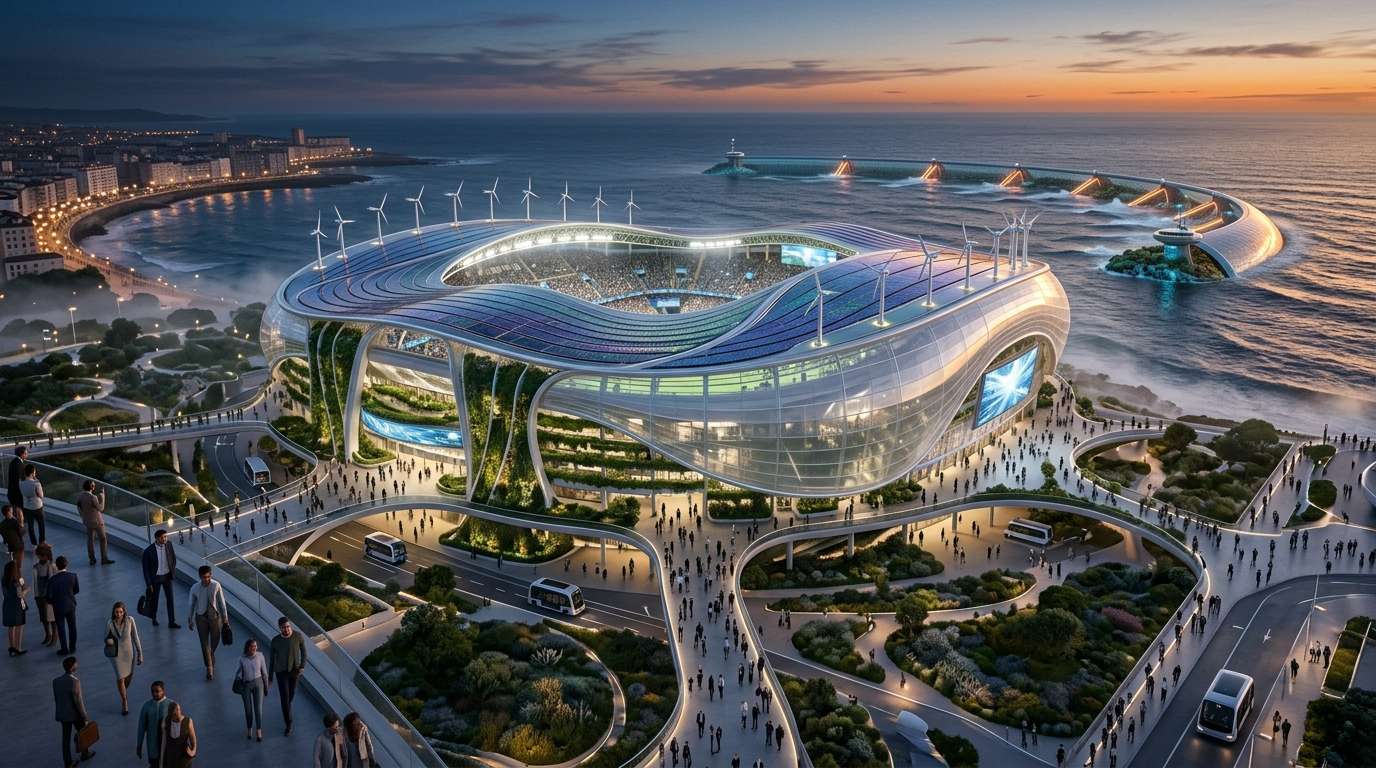
I love the Paseo Marítimo in A Coruña, where Atlantic wind hits sideways and Riazor stands rise past sand. Each visit makes me wonder how salty air and crashing surf punish that concrete and glass.
That question sparked this thought experiment. What if, by 2050, this beachfront ground not only survived the ocean’s assault but also drew power from it?
The Estadio Riazor future 2050 vision is not science fiction. I am mapping a grounded future using real engineering trends reshaping stadiums worldwide, with some imagination.
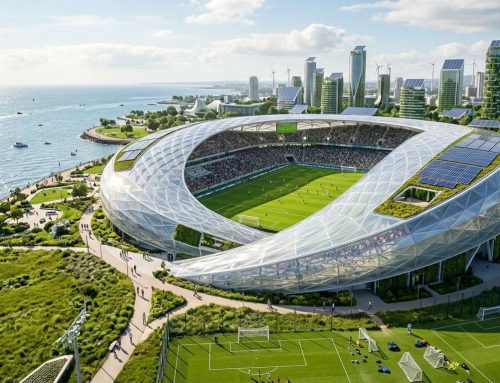
Picture Deportivo de La Coruña’s 32,490-seat home as a carbon-negative colosseum that turns gale-force winds and crowd energy into usable power.
This piece explores that vision through real physics and coastal engineering. I will guide you through it like a new destination. Curious? Let’s dive in.
Key Takeaways
- Estadio Riazor could evolve into a net-zero, carbon-negative venue by 2050 through advanced coastal engineering.
- The stadium’s design may harness Atlantic wind gusts and ocean surf as renewable energy sources.
- Fan movement and crowd energy inside the 32,490-seat ground could contribute to the power grid.
- Nano-fluoropolymer glazing and curved polycarbonate materials offer both durability and energy efficiency.
- Hydrologic retention systems tied to Orzán Bay could manage stormwater and coastal flooding risks.
- This vision reflects real-world stadium innovation trends, not distant science fiction.
1. Reimagining Riazor: A 2050 Vision for Coastal Stadium Resilience
Salt air slowly eats through things. I began wondering what quiet decay means for a stadium as old as Riazor.
I’ve walked through seaside towns where rust creeps up railings and paint peels from storefronts within a few years. The same erosion affects concrete, steel, and glass, but most people never consider its scale.
Estadio Riazor sits near the water in A Coruña, a city shaped by Atlantic winds since opening in the 1940s. Storm surge, chloride-heavy air, and relentless gales put constant pressure on a structure that has become part of the city’s identity.
That pressure made me think beyond small fixes. What would it take to build a stadium that survives the ocean and works with it? That question drives the Estadio Riazor future 2050 vision explored in this article.
I’m not the only one asking these questions. Cities around the world already test climate adaptation strategies for landmark venues:
- Athens is factoring climate change risk directly into conservation plans for the historic Panathenaic Stadium.
- Nicosia’s new stadium project folds in solar panels and rainwater collection from the start, rather than retrofitting later.
- Coastal arenas across Europe are rethinking facade materials to handle rising humidity and salt exposure.
These examples share one idea: resilience works best when designers build it in, not add it after storm damage. That’s the mindset I want to apply to Riazor.
Galicia offers a perfect proving ground for this idea. The region faces some of Western Europe’s harshest marine weather, yet holds engineering knowledge built through centuries of coastal life.
Picture a 32,490-seat stadium that makes storm resistance a design feature, not a maintenance headache. Picture facades resisting salt spray, flood systems capturing seawater, and energy systems powered by crowd noise and ocean wind. Ocean wind once threatened the structure.
That’s the vision I’ll explore in this piece. Each section builds on the last, from the stadium’s facade and flood defenses to its power grid and roofing. By the end, I hope you’ll see Estadio Riazor as a football ground and working blueprint for coastal stadiums everywhere.
2. Estadio Riazor Future 2050: From Local Icon to Global Net-Zero Benchmark
A mid-size stadium like Riazor is taking a bold path: it aims to become carbon-negative, not merely carbon-neutral. Many climate-ready stadiums chase attention with 60,000-seat designs and matching budgets. Riazor rejects that plan.
I have covered similar stories before: small border crossings carrying huge traffic and modest towns exceeding expectations. This Estadio Riazor future 2050 vision follows that pattern.
People searching for Estadio Riazor future 2050 expect a flashy project. Instead, they find a 32,490-seat home designed to return more energy than it uses.
Scaling a 32,490-Seat Legacy into a Carbon-Negative Colosseum
Carbon-negative means the stadium removes more emissions than it produces during a full season of matches. For this venue, that target is realistic, not a marketing slogan.
Engineers reach this goal by combining small gains instead of relying on one major fix. Solar roofing, kinetic flooring, and seawater cooling each cut part of the carbon load.
- Rooftop solar membranes generating clean power year-round
- Kinetic energy capture from thousands of moving fans
- Seawater-based geothermal cooling replacing traditional air conditioning
These additions do not change the stadium’s footprint or seat count. Riazor remains Riazor, quietly carbon-negative beneath the surface.
Why Galicia Became the Testing Ground for Coastal Arena Longevity
Galicia has harsh weather. Atlantic gales strike hard, annual rainfall ranks among Spain’s highest, and salt air corrodes nearly everything.
That harsh climate proved useful. Engineers needed a real stress test, not a lab simulation, and A Coruña’s coast provided one.
Historic stadiums elsewhere face similar climate pressure. The Hellenic Olympic Committee is reviewing Athens’s Panathenaic Stadium for heat and heavy rain damage to its ancient marble. Nicosia’s new UEFA Category 4 stadium chose another path, including solar panels and rainwater collection in its original design.
| Stadium | Climate Challenge | Resilience Response |
|---|---|---|
| Estadio Riazor (A Coruña) | Salt spray, Atlantic gales, heavy rainfall | Nano-mineral facade glazes, flood vaults, carbon-negative target |
| Panathenaic Stadium (Athens) | Extreme heat, sudden heavy rainfall | Hellenic Olympic Committee marble conservation study |
| New Nicosia Stadium (Cyprus) | Intense solar exposure, water scarcity | Integrated solar panels and rainwater collection systems |
Riazor’s redesign asks the question Athens and Nicosia face in their climates: can a stadium outlast the weather that shaped it? Galicia redefines coastal arena longevity: granite, salt wind, and genuine Atlantic stubbornness prove the answer can be yes.
3. Shielding the Facade: Nano-Mineral Glazes Against Atlantic Salt and Gales
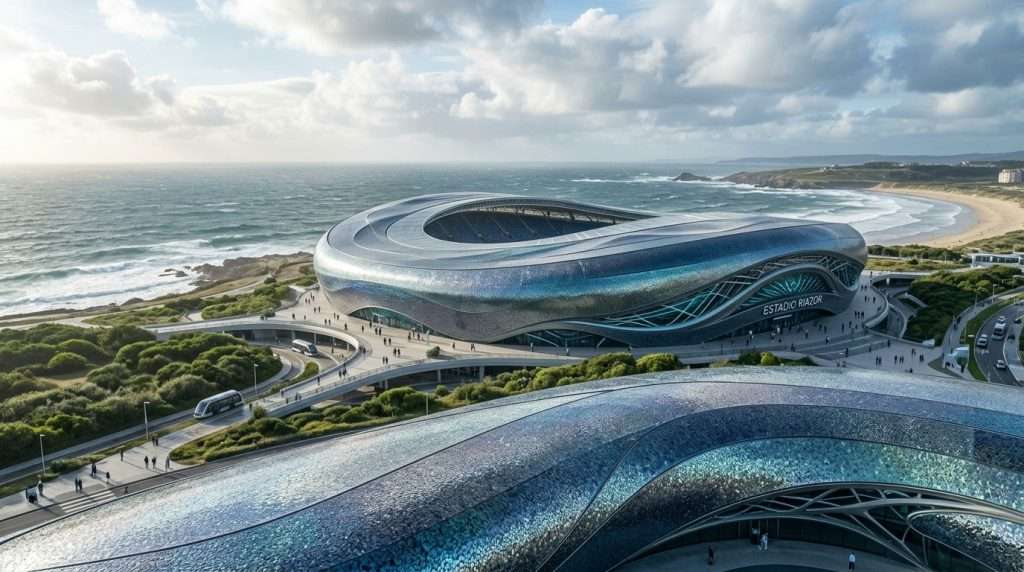
I’ve photographed many coastal structures, but few face conditions like A Coruña’s shoreline. Each gust carries fine salt that wears down paint, metal, and plastic. For Estadio Riazor future 2050 plans, the goal is surviving storms while preserving the stadium’s famous beachside look.
Engineers tackled this problem with nano-mineral glazes. These ultra-thin layers bond with surfaces at the molecular level. They protect curved panels, steel trusses, and signature finishes, each needing a different approach.
Protecting Curved Blue Polycarbonate Panels from Polymer Fatigue
The curved blue panels are among my favorite Riazor details. I remember walking from Playa de Riazor and watching them catch light like glass waves.
Polycarbonate has one weakness. Years of UV exposure break down its molecular chains, causing polymer fatigue. The panels turn yellow, become brittle, and eventually crack.
Salt spray speeds up this decay. Microscopic crystals settle into surface flaws and worsen the breakdown. Nano-mineral glazes slow this damage by forming a breathable barrier that blocks UV rays and keeps salt from bonding to the surface. Treated panels keep their color and flexibility longer, extending the facade’s life.
Arresting Chloride Corrosion in Marine Steel Trusses
I once drove a salt-beaten van along coastal roads and watched rust spread through its frame. Ocean steel faces the same battle without strong protection.
Sea spray carries chloride ions through steel’s natural oxide layer. They trigger rust that weakens load-bearing trusses from within. Corrosion often starts under paint, hidden until cracks or bulges appear.
Any serious Estadio Riazor future 2050 structural plan must address this threat. Layered nano-mineral primers bond with steel and block chloride at the molecular level. They also protect joints and welds where moisture collects.
| Facade Zone | Primary Threat | Protective Solution | Expected Lifespan Gain |
|---|---|---|---|
| Blue Polycarbonate Panels | UV-driven polymer fatigue and salt pitting | Breathable nano-mineral UV glaze | 15-20 years added service life |
| Marine Steel Trusses | Chloride-induced internal corrosion | Layered nano-mineral primer sealant | 25-30 years added structural integrity |
| Exterior Decorative Finishes | Trapped moisture and salt staining | Vapor-permeable mineral coating | 10-15 years between major repaints |
Preserving Authentic A Coruña Finishes Through Breathable Coatings
This part matters most to me. Riazor’s exterior finishes reflect the city’s character. Its blue shade and weathered textures feel unique to this place.
Sealing a coastal building too tightly can cause serious problems. Trapped moisture under non-breathable paint leads to blisters, peeling, and mold. Nobody wants that on such an iconic stadium.
Breathable nano-mineral coatings let vapor escape while blocking liquid water and salt. The surface stays dry and stable, with longer gaps between maintenance cycles. A similar idea shaped Real Betis’s €70 million redevelopment of Estadio Benito Villamarín. Architects added 13 horizontal stripes to its durable facade, reflecting the club’s identity.
Protection and personality don’t have to compete. Riazor’s coastal retrofit follows that lesson. It keeps A Coruña’s beachfront landmark looking familiar for generations.
Estadio Municipal de Aveiro future
4. Riazor Coastal Flood Shield: Subsurface Hydrologic Heritage Engineering
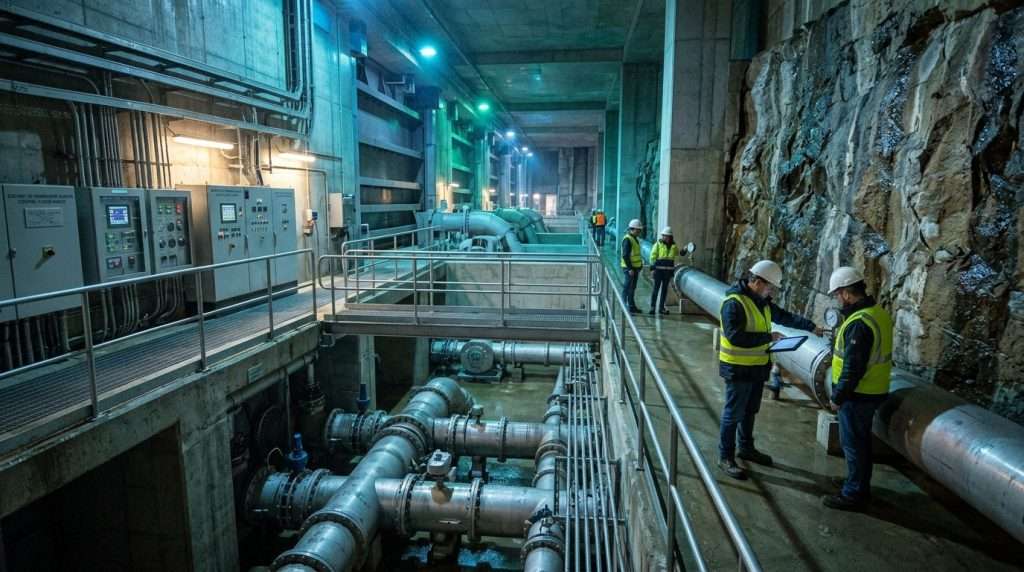
There’s a strange kind of magic in watching a stadium turn its biggest vulnerability into its smartest engineering trick. Beneath Riazor’s beachfront concourses, that transformation becomes real.
I’ve stood on the Paseo Marítimo during a winter swell and felt spray hit my face from thirty feet away. That same ocean, once a threat, powers a riazor coastal flood shield built on subsurface hydrologic heritage engineering.
This isn’t about taller seawalls or ugly barriers. It respects the stadium’s historic footprint and hides smart water infrastructure underground, unnoticed until a storm hits.
Automated Subterranean Retention Vaults Beneath Beachfront Concourses
Picture concrete vaults buried beneath the concourses, invisible to fans arriving for a match. These automated chambers open during storm surges, swallowing seawater before it threatens the pitch or lower stands.
The system targets 100% capture of coastal storm surges, a bold number but not an impossible one. Nicosia’s new stadium already collects rainwater for pitch irrigation, proving cities can treat water as a resource, not a liability.
Estadio Benito Villamarín offers another clue. Its redevelopment includes an underground car park, part of a broader push toward building below ground instead of only upward. Riazor’s vaults follow that logic, applying it to flood control instead of parking.
The best flood defenses are often invisible, working underground long before the water ever becomes a problem.
Closed-Loop Reservoir Stormwater Harvesting Explained
Once seawater enters the vaults, it doesn’t just sit there. Closed loop reservoir stormwater harvesting moves it through filtration, cleaning it step by step until it’s usable again.
Breaking this into stages makes the concept easier to understand:
| Stage | Process | Outcome |
|---|---|---|
| Intake | Storm surge enters subterranean vaults | Surge pressure relieved instantly |
| Filtration | Sediment and salt particles removed | Clean water ready for reuse |
| Storage | Water held in closed-loop reservoirs | Steady supply for cooling systems |
| Cycling | Treated water redirected to geothermal loop | Zero waste, continuous reuse |
Nothing gets dumped back into the ocean untreated. Nothing gets wasted either. That’s the point of a closed loop system: it keeps working after the storm passes.
Turning Captured Seawater into Zero-Emission Geothermal Cooling
Here’s the payoff, and honestly my favorite part of this entire concept. Filtered seawater does not sit in storage tanks collecting dust. It feeds directly into geothermal cooling loops that chill the grandstand suites.
There are no fossil fuels or emissions. Seawater, temperature exchange, and smart plumbing do the heavy lifting.
This approach mirrors what venues like Villamarín are already proving: going underground solves multiple problems at once. Riazor’s version adds climate resilience and cooling efficiency to the same subterranean footprint, making every cubic foot of buried concrete work overtime.
5. Kinetic Power and the Fondo Pavillón Microgrid Revolution

Nothing matches the chest-rattling bounce of Fondo Pavillón when Deportivo scores. By 2050, that bounce will do more than celebrate—it will power the stadium. I once thought the jumping and chanting simply vanished into the night air. Riazor’s engineers had other plans.
That raw fan energy, the kind that makes your ribs vibrate, became the base for one of the stadium’s smartest upgrades. The system uses something simple: stadium kinetic energy crowd harvesting.
Stadium Kinetic Energy Crowd Harvesting Under the Stands
Here’s the easy version. Pressure goes in, electricity comes out. No engineering degree required.
Special plates sit beneath floors in busy zones. Each jump, stomp, and excited surge presses them down. That pressure makes a tiny charge; thousands of fans create usable power.
It is a small idea with a surprisingly big payoff. More crowd passion means more power for the stadium.
Piezoelectric Plates Beneath Paseo Marítimo and the Terraces
The placement is not random. Engineers put piezoelectric plates where foot traffic and crowd movement hit hardest.
Across the vocal Fondo Pavillón and Paseo Marítimo, under-floor piezoelectric plates turn fan jumps into clean microgrid power. The terraces get the same treatment because fans stand, stomp, and sway for ninety straight minutes.
Before kickoff, you would never guess the Paseo Marítimo ground collects energy from every step. That is the beauty of it. The system works without asking fans to change how they cheer.
- Plates are embedded flush with the walkway, so there’s zero trip hazard.
- Terrace installations handle repeated, rhythmic pressure from jumping fans.
- Energy collected feeds directly into the stadium’s broader power network.
Powering Grandstand Suites with Fan-Generated Electricity
All that captured energy needs a destination. The fondo pavillon kinetic microgrid channels fan-generated power into the grandstand suites, helping run lighting, charging stations, and small appliances during matches.
It is a genuinely poetic setup. The loudest section in the house lights the room next door. Fans jumping for Deportivo are helping keep part of their stadium running.
This kind of stadium kinetic energy crowd harvesting will not replace solar panels or wind turbines soon. But it adds personal self-sufficiency, built from the crowd’s passion instead of outside infrastructure.
Riazor’s microgrid shows that sustainability does not always need massive machinery. Sometimes it needs fans who refuse to sit still.
6. Beyond Walls: PTFE Membrane Solar Roofing and the Net-Zero Equation
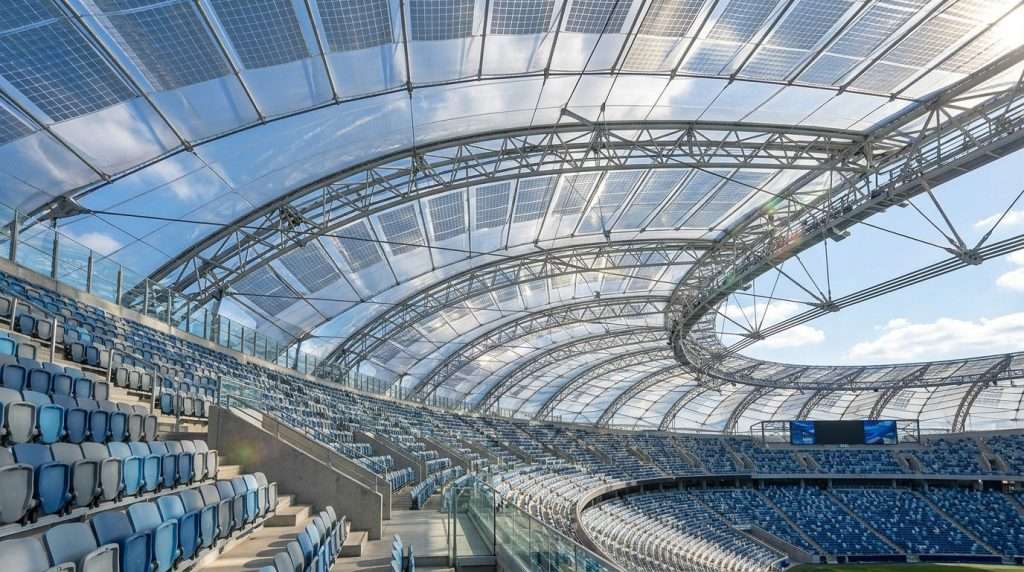
The final puzzle piece in this coastal engineering story sits thirty meters above the pitch, not beneath it. Every system I’ve described protects Riazor from the ground up: facade coatings, flood vaults, and kinetic floors. But a stadium still needs power, so PTFE membrane solar roof technology finishes the job.
I like to view it as gear for a long overland trip. You want something light, tough, and able to do several jobs. A roof that only blocks rain wastes potential. A roof that blocks rain and makes electricity? That’s an upgrade worth the investment.
How PTFE Membrane Solar Roof Technology Complements the Facade
PTFE, short for polytetrafluoroethylene, is the same tough, non-stick material found on camp skillets, stretched into massive architectural sheets. It resists UV rays, cleans itself in rain, and weighs far less than glass or steel roofing.
Adding thin-film solar cells to the membrane makes the roof a quiet generator that still weatherproofs the bowl. It does not compete with the nano-mineral glazed facade below; it works alongside it. The roof carries its own load without stressing the curved blue polycarbonate panels or steel trusses underneath.
This full-coverage approach is not new to football. Estadio Benito Villamarín in Seville fully roofed its seating bowl during modernization, improving fan comfort and protecting infrastructure year-round. Riazor’s version takes that idea and makes the roof earn its keep energetically.
Calculating Deportivo La Coruña’s Path to a Net-Zero Stadium
Here’s where the math gets interesting. No single system gets you to zero. Together, they move toward a real Deportivo La Coruña net-zero stadium outcome, not merely a press-release phrase.
| System | Primary Function | Estimated Share of Net-Zero Target |
|---|---|---|
| PTFE Solar Membrane Roof | Rooftop electricity generation | ~40% |
| Closed-Loop Geothermal Cooling | Reduced HVAC energy draw | ~20% |
| Piezoelectric Terraces & Fondo Pavillón Microgrid | Crowd-powered electricity | ~15% |
| Nano-Mineral Facade Coatings | Lower maintenance energy demand | ~10% |
| Grid-Tied Renewable Offset | Covers remaining balance | ~15% |
Stack these numbers together, and the stadium can generate more than it consumes on most match days. Its 32,490 seats provide crowd energy, while sunlight adds power. That is the carbon-negative colosseum concept in practice, not theory.
Lessons for Other Ocean-Facing Arenas Worldwide
Not every ambitious stadium project finishes as planned. At Estadio de Gran Canaria’s, the modernization budget rose from €114 million to €174 million after steel and concrete prices spiked. In Saudi Arabia, NEOM Stadium was planned as a futuristic coastal icon, but development stopped entirely.
By contrast, Coventry Building Society Arena has followed a steady, multi-year investment programme instead of rushing one massive overhaul. Villamarín’s gradual, full-bowl roofing followed a similar patient path.
The lesson for any ocean-facing arena is simple: resilience is not a weekend project. It needs phased funding, realistic timelines, and patience as the engineering matures. Rushed ambition breaks budgets, while steady ambition builds legacies.
7. Conclusion
At Riazor, you feel the Atlantic before seeing it. Salt wind and the breakwater’s constant roar reveal this place’s true character. Nothing here changes that character; it imagines engineering working with the ocean instead of fighting it each season.
Estadio Riazor future 2050 is not an architect’s or city planner’s blueprint. It connects one traveler’s Galician coast experiences with stadium technology’s direction. Projects documented through international stadium construction show similar patterns, including solar integration and climate-adaptive planning, so this vision isn’t imaginary.
What excites me most is Galicia redefining coastal arena longevity through resilience, not size or spectacle. A stadium that captures rain, harvests wind-driven energy, and resists salt corrosion does more than survive the coast. It learns from the coast.
No one knows exactly what Riazor will look like in 2050. But this Galician coastline, with fierce storms and fiercer fans, deserves a future that respects its land.
That lesson guides me on every overland route: protect authentic places, and they keep giving back long after we’re gone.











Leave A Comment