
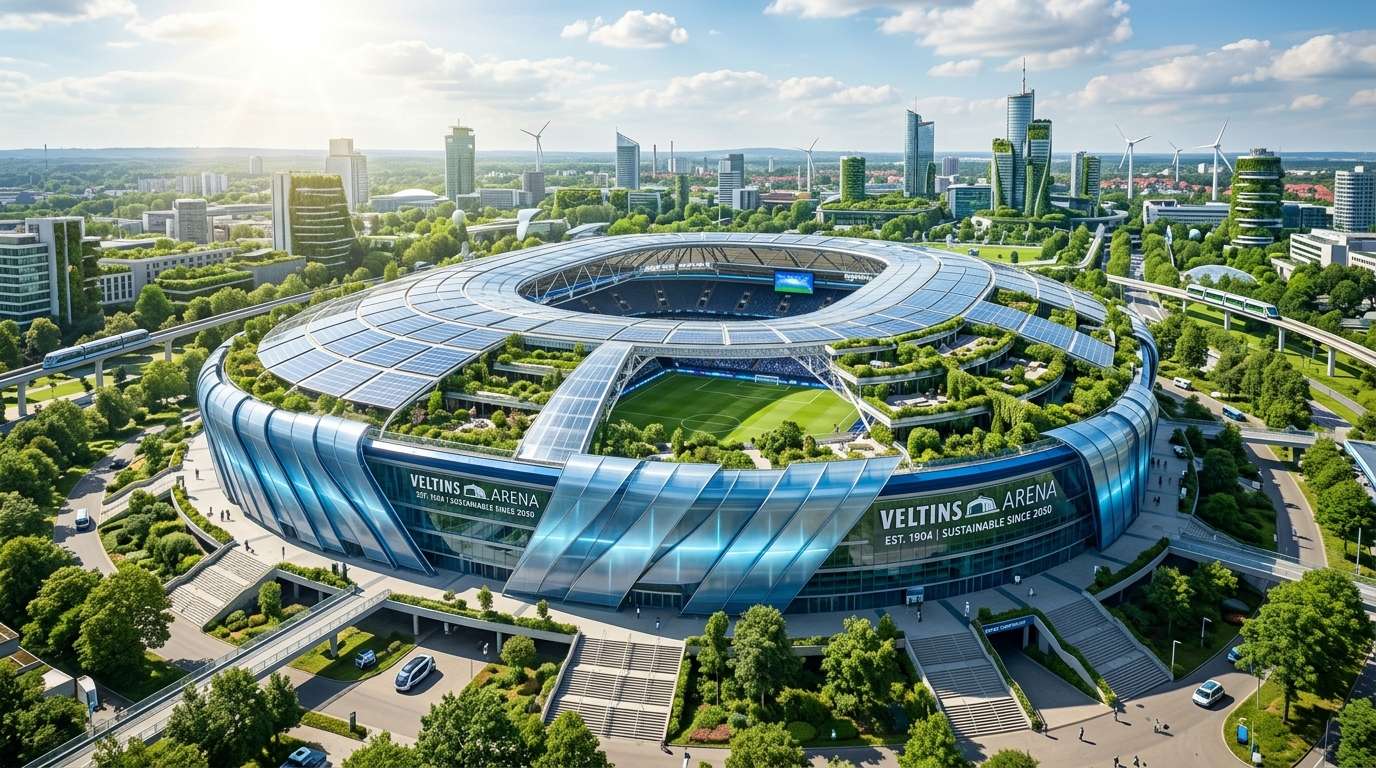
I remember standing outside Gelsenkirchen’s royal blue fortress, feeling I had reached a pilgrimage site, not a soccer stadium.
This former mining town turned its working-class grit into football devotion, and Schalke 04 became its heartbeat. That feeling stuck with me long after I left.
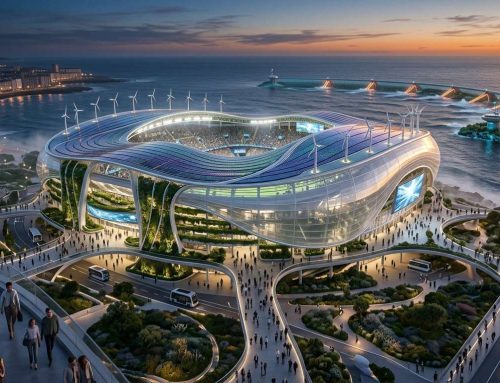
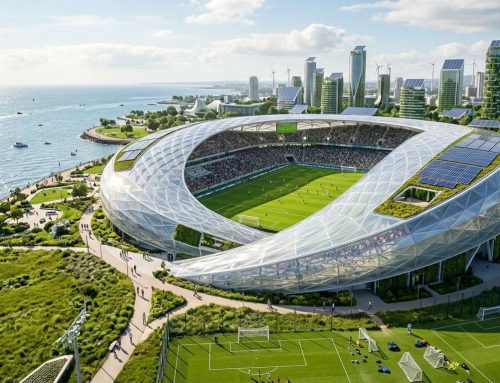
Now imagine the Veltins Arena future 2050: the same ground powers itself instead of using the grid. By mid-century, it becomes a global masterclass in mechanical modernization, scaling Schalke 04’s 62,271-seat home into a carbon-negative sports colosseum.
I am not describing fresh paint or upgraded seating. I mean a self-sustaining machine inside a football ground, built from retractable roofing, kinetic flooring, and crowd-powered energy systems.
Over the next few sections, I will explain five engineering marvels shaping the Veltins Arena future 2050. They include the roof, pitch, water systems, crowd noise, and the stadium’s lasting legacy.
Key Takeaways
- This iconic stadium is reimagined as a carbon-negative colosseum while still serving Schalke 04’s 62,271 fans.
- Gelsenkirchen’s industrial, working-class roots shape the stadium’s identity and its sustainability mission.
- Five core innovations drive the transformation: roofing, pitch design, water systems, crowd energy, and long-term legacy.
- Retractable roofing and kinetic flooring are engineered to generate usable power from everyday match-day activity.
- Crowd movement and sound are converted into measurable energy contributions through specialized harvesting tech.
- The project offers a practical blueprint for aging stadiums worldwide seeking true energy self-sufficiency.
1. Veltins Arena Future 2050: A Global Masterclass in the Schalke 04 Net-Zero Stadium
Keeping a 62,271-seat stadium standing feels almost rebellious, rather than bulldozing it for something newer. That is what Schalke 04 chose: it turned its storied home into a Schalke 04 net-zero stadium.
I believe the best sustainability stories improve what already exists instead of starting from scratch. Veltins-Arena, reborn as Arena auf Schalke 2050, is that story in concrete and steel.
A 62,271-Seat Icon Reimagined as Arena auf Schalke 2050
Walk through the gates today, and you still recognize its bones. The seating bowl holds the same 62,271 fans, who roar at Bundesliga matches or sing at sold-out concerts.
The changes sit below the surface. Engineers kept the original 2001 steel frame, then wrapped it with new membrane systems, better insulation, and smarter airflow controls.
I see it as a classic car with an electric engine swap. The shell stays familiar, but its working parts receive a complete overhaul.
That approach makes Arena auf Schalke 2050 more than a renovated venue. It becomes a working blueprint showing how aging stadiums can reach net-zero goals without losing their soul.
| Feature | Veltins-Arena (2001) | Arena auf Schalke 2050 |
|---|---|---|
| Capacity | 62,271 seats | 62,271 seats, unchanged |
| Roof System | Standard retractable panels | Teflon-coated solar-harvesting roof |
| Energy Status | Grid-dependent | Carbon-negative, self-sustaining |
| Pitch Design | Fixed natural turf | Mag-lev retractable kinetic pitch |
| Core Structure | Original 2001 steel frame | Retrofitted original frame, reinforced |
Why Gelsenkirchen Redefines Arena Longevity
Gelsenkirchen is not flashy. It is a working-class town in the Ruhr region, shaped by coal and steel rather than glass towers.
That history matters. Schalke 04 built its identity on grit and loyalty, so a new net-zero stadium would feel out of place.
Retrofitting an existing arena sends a different message than replacing it. Sustainability does not require starting over; it means respecting what exists and making it better.
I find this approach more honest than most “green stadium” announcements I have read elsewhere. Gelsenkirchen redefines arena longevity by showing that old infrastructure can meet modern climate goals without losing its character.
Other cities weighing demolition against renewal now have a working example to study. Sometimes the boldest move is not building new; it is making old things last.
2. PTFE Membrane Solar Roof Technology: Teflon-Coated Retractable Roof Meets Bio-Photovoltaic Power
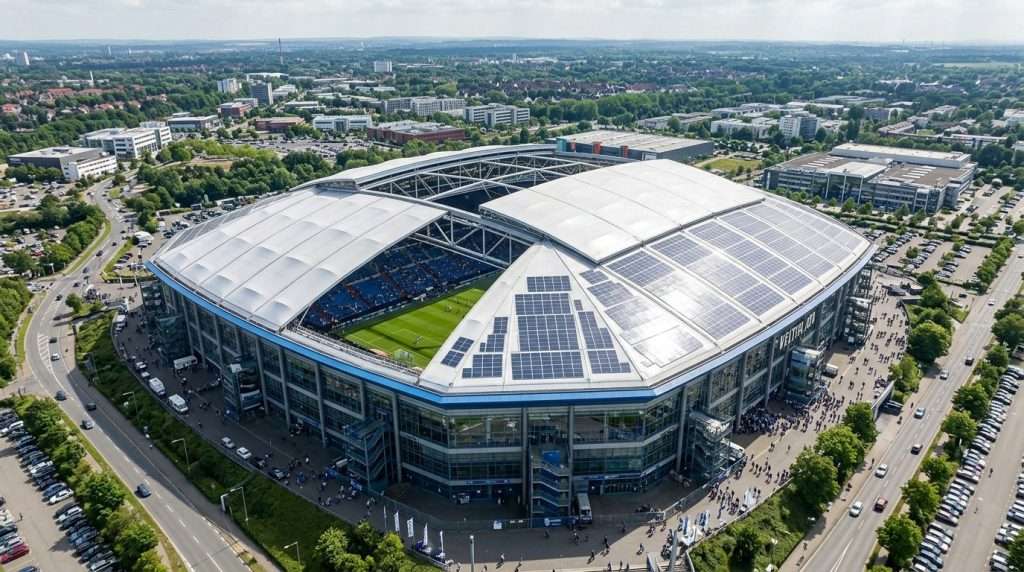
I’ve pitched enough tents in rough weather to know a good rainfly. This roof reminded me of one, only stadium-sized. Veltins-Arena’s 2050 roof uses that idea: a tough, weatherproof membrane keeps the space below dry and warm. It also makes electricity, so PTFE membrane solar roof technology becomes a quiet power station.
Teflon-Coated Retractable Roof: Engineering an Airtight, Insulated Bowl
PTFE means polytetrafluoroethylene, but most people call it Teflon. It resembles a frying pan’s nonstick coating, but woven into flexible fabric strong enough for a stadium bowl.
The roof panels slide along steel tracks high above the stands. When storms arrive, or organizers need climate control for a concert, the panels close and lock into one dome. This seal quickly creates an airtight, insulated space.
A freezing January match in Gelsenkirchen feels unlike a sweaty August show. That contrast is exactly what this roof solves. The insulated membrane holds heat during winter games and blocks it during summer events, keeping fans comfortable under any sky.
Translucent Bio-Photovoltaic Membranes: Solar Harvest Without Sacrificing Light
This PTFE membrane solar roof technology uses the same Teflon-coated fabric. Translucent bio-photovoltaic membranes use thin solar cells that pass soft light while collecting the sun’s energy.
Across its Teflon-coated retractable roof, translucent bio-photovoltaic membranes generate clean solar power during closed-roof arena events. They also insulate the indoor bowl.
Sunlight filters onto the pitch in gentle, diffused patterns while the roof feeds electricity into the stadium grid. It sounds like science fiction, but similar bio-photovoltaic materials are already being tested today in greenhouses and building facades, but not at this scale.
This dual-purpose roof might be the smartest single piece of the entire 2050 vision, since it solves weather protection and power generation with one surface instead of two separate systems competing for space and budget.
Here is how this membrane compares with conventional stadium roofs used for decades:
| Feature | Traditional Stadium Roof | PTFE Membrane Solar Roof |
|---|---|---|
| Material Weight | Heavy steel and glass panels | Lightweight, flexible coated fabric |
| Light Transmission | Opaque, blocks natural light | Translucent, keeps pitch bright |
| Energy Function | None, passive structure only | Generates solar power while closed |
| Climate Control | Fixed panels, limited sealing | Airtight, insulated, fully retractable |
3. Retractable Pitch Kinetic Regeneration: The 11,000-Tonne Slide-Out Pitch’s Mag-Lev Power Play
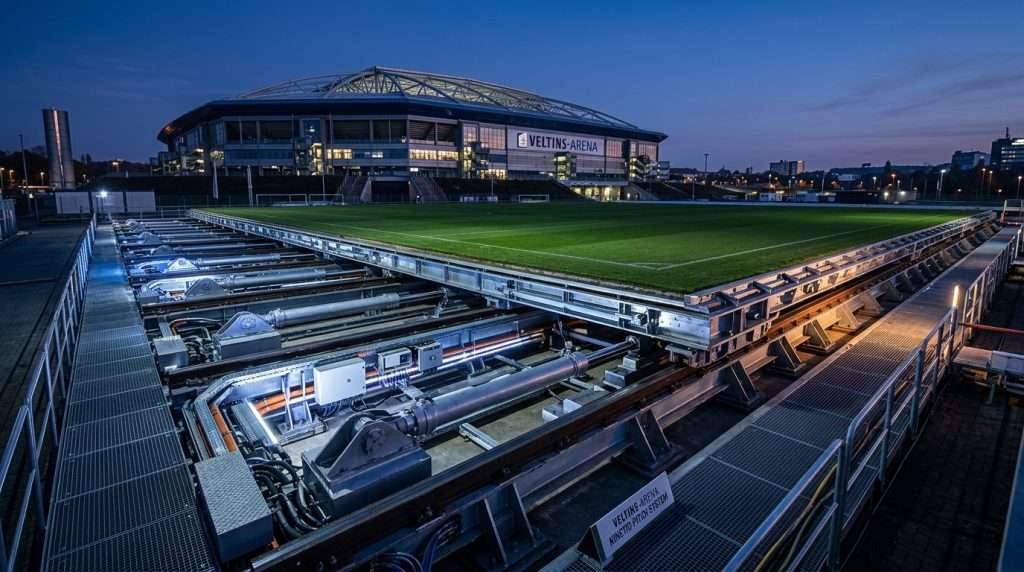
During my research into this stadium’s 2050 vision, the retractable pitch stood out most. The 11,000-tonne slab of turf and steel glides from Veltins-Arena on rails. This party trick echoes the real-world stadium that Schalke fans already recognize today.
In the 2050 version, this is more than mechanical spectacle. It uses retractable pitch kinetic regeneration to turn routine maintenance into power for the whole building.
Magnetic-Levitation Induction Tracks: From Tray Movement to Regenerative Electricity
Here’s the simple version. Instead of wheels, the pitch tray floats on magnetic-levitation tracks built into the foundation. Magnets guide the tray along a path, like high-speed mag-lev trains.
That floating motion does not waste energy. Induction coils along the track capture movement and convert it into regenerative electricity, like a hybrid car recovering energy while braking.
Groundskeepers have moved pitch trays for decades to protect grass from shade and poor airflow. Adding induction technology makes that old practice clever.
When the pitch moves outside for sunlight or clears the field for a concert, the stadium’s microgrid receives a small power boost. Across a packed match calendar, those boosts add up quickly.
An Opinion on Kinetic Pitch Engineering: Why This Changes Stadium Economics
I’ll be honest: this feature changed how I view stadium design. Most sustainability upgrades require large upfront costs and save money slowly over many years. Kinetic pitch engineering flips that script because everyday use helps the system earn its keep.
Think about what that means on the ground:
- Every pitch slide generates electricity instead of consuming it.
- Routine maintenance becomes a revenue event rather than a cost center.
- Stadiums can host more non-match events without worrying about turf damage or energy waste.
Once other clubs and stadium operators see kinetic pitch movement paying for itself, retrofitting becomes a clear financial decision. It is no longer just a nice environmental gesture.
I’ve visited enough aging stadiums to know how expensive pitch upkeep becomes. Watching that expense turn into retractable pitch kinetic regeneration feels like seeing an old problem solve itself.
4. Subsurface Hydrologic Heritage Engineering Meets Stadium Kinetic Energy Crowd Harvesting
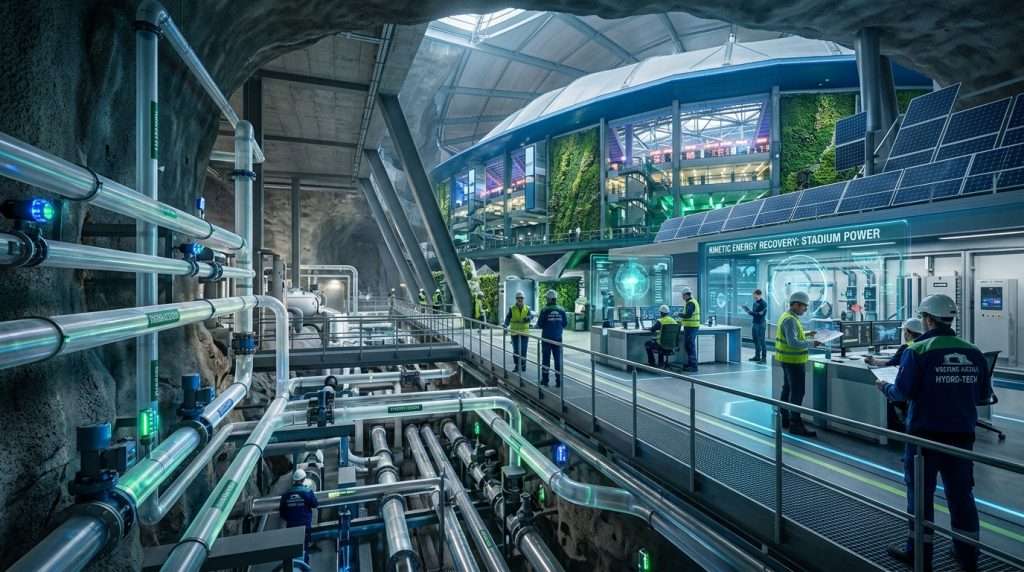
Part of this stadium’s story stays hidden because it happens several feet below the grass.
I learned what sits beneath Veltins-Arena’s southern pitch apron and the Nordkurve terraces. It felt like a living organism that drinks rain, breathes cool air, and uses crowd energy. That’s subsurface hydrologic heritage engineering at work, one of this 2050 redesign’s quietest and smartest features.
Subterranean Hydrologic Vaults: Closed Loop Reservoir Stormwater Harvesting from the Emscher Basin
Beneath the southern outdoor pitch apron, engineers built several underground vaults. They capture every drop of rain from the Emscher basin catchment area.
This is not a random design choice. Gelsenkirchen has a long, complex relationship with water. The Emscher River once served as an open industrial sewer during the Ruhr’s coal and steel era.
Decades of renaturation work turned the waterway into a symbol of ecological recovery. The stadium uses closed loop reservoir stormwater harvesting at essentially 100% efficiency. Water gets filtered, stored, and prepared for reuse inside the stadium’s systems.
Zero-Emission Closed-Loop Cooling: Filtered Water Keeps the Bowl Comfortable
After filtration, harvested rainwater moves through a closed-loop cooling network. This network controls temperatures across the entire indoor bowl.
Think of it like a well-run, off-grid campsite. Nothing goes to waste, and resources get reused before release. The same idea works here on a massive architectural scale.
Cool air moves through packed stands during matchdays, powered by this internal water cycle. No outside water is drained, and mechanical cooling creates no related emissions. The system recycles rainfall already delivered by the Emscher basin.
This system solves a real comfort problem for 62,000 fans without wasting energy. Climate control becomes almost self-sustaining instead of remaining a major energy drain.
Nordkurve Piezoelectric Plates: Converting Fan Chants into Microgrid Power
Now comes my favorite part because it brings fans directly into the energy equation.
Engineers installed piezoelectric plates beneath the Nordkurve’s standing terraces. Schalke’s supporters are famously loud, stomping, jumping, and chanting for ninety minutes. Every movement creates a small amount of mechanical pressure.
The plates convert that pressure into electricity for the stadium’s microgrid. This is stadium kinetic energy crowd harvesting in its purest form. Fans help power the energy transition with every chorus and chant.
It is a small detail with a powerful emotional effect. Passion becomes electricity, and noise becomes power. This engineering makes the stadium feel alive, not merely efficient.
| System Component | Location | Primary Function | Energy or Resource Output |
|---|---|---|---|
| Subterranean Hydrologic Vaults | Southern pitch apron | Stormwater capture from Emscher basin | 100% rainfall retention, closed-loop reserve |
| Filtered Cooling Network | Indoor bowl structure | Zero-emission climate control | Continuous recycled water flow |
| Piezoelectric Terrace Plates | Nordkurve standing section | Converts fan movement into electricity | Direct feed into stadium microgrid |
5. Conclusion
After exploring these five systems, I keep returning to one idea. The roof, pitch, water vaults, and piezoelectric terraces do not work alone. They work because someone chose to update a 1973 stadium footprint instead of erasing it.
That is the real story behind Veltins Arena future 2050. It is not science fiction added to an old bowl. It uses technology tested in labs and smaller venues, joined through patience and sound engineering.
Gelsenkirchen redefines arena longevity: renovation can beat demolition for the planet and Nordkurve fans who have sung for decades.
I did not expect a football stadium to change how I view sustainable architecture. Stormwater, crowd noise, and sunlight can all become power sources inside one building. Old grounds in England and aging US arenas have the same usable bones, if owners look closer.
I will keep watching Schalke 04, not only on match days, but also for its lessons. Its home ground teaches the rest of us to build smarter instead of building new. That lesson travels beyond Gelsenkirchen.


Leave A Comment