
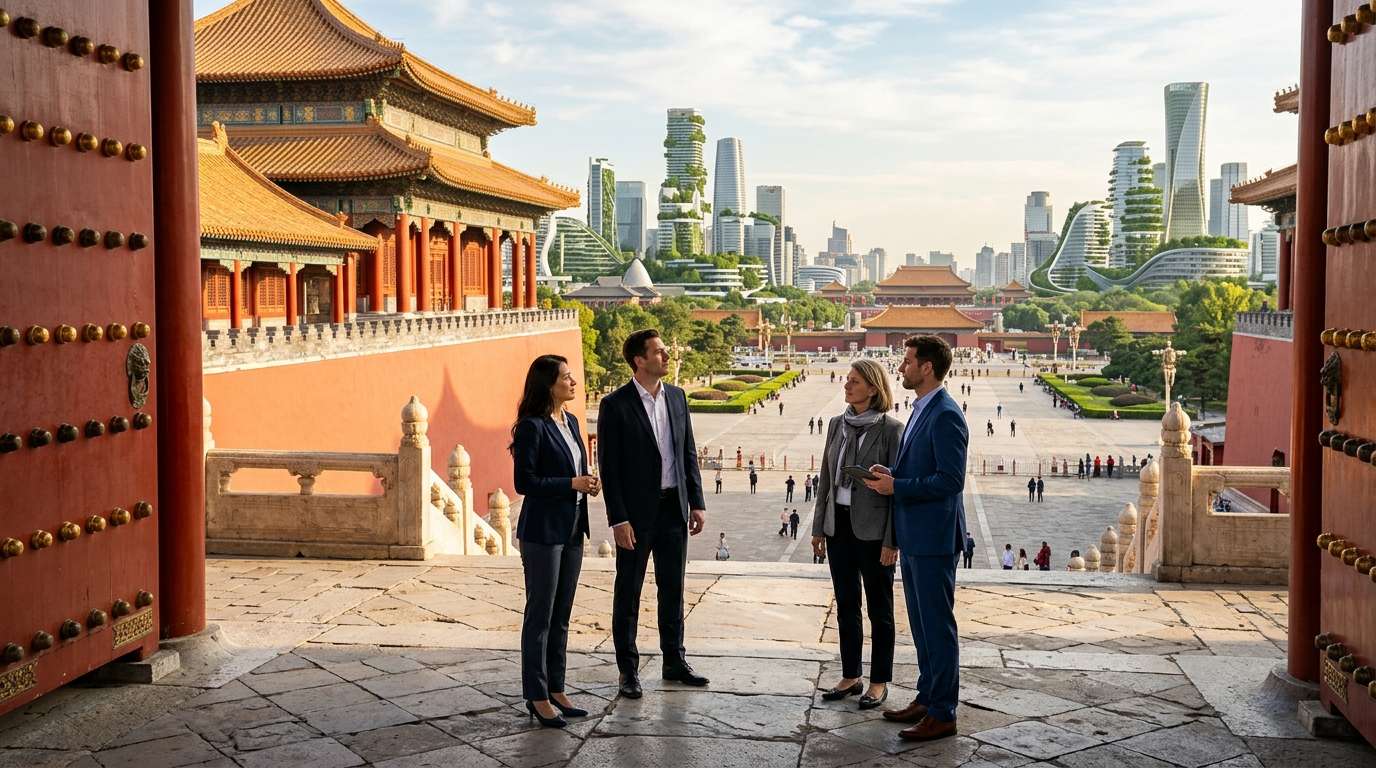
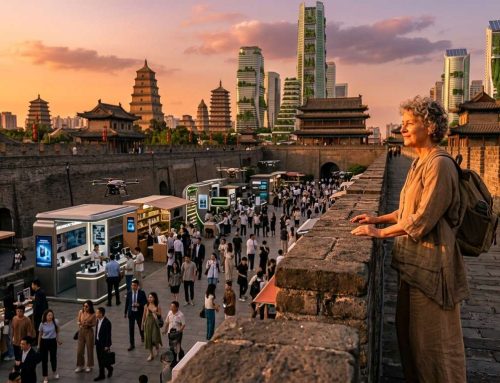
I stood at the Forbidden City gate and tried to picture the same ground in 2050, with Gobi dust in the air, 600-year-old glazed roofs overhead, and the steel Bird’s Nest far to the north. How could a city turn dust, stone, steel and millions of footsteps into a net-zero place? The Beijing Central Axis future 2050 is a vision, and that is what pulled me in.
The axis joins imperial palaces and Olympic sites in one line. I am an overland traveler and photographer, and I love routes that link places on foot. Here I follow what the axis is, where planners point it, how stone and water could be protected, and how to walk it.
Every 2050 idea here is labeled as a vision. Every date and number is real.
Key Takeaways
- The axis is a 7.8 kilometer line through old Beijing and a World Heritage site since 2024.
- The road to 2050 runs through the 2035 conservation plan.
- Dust, freeze-thaw cycles, flaking stone and rust are the main threats to the monuments.
- Breathable glazes, water vaults and footstep pavers are visions, not built projects.
- China’s national pledge is carbon neutrality before 2060.
- You can walk the whole axis in three unhurried days, north to south.
What the Beijing Central Axis Is and Why It Won World Heritage Status
The Beijing Central Axis is the 7.8 kilometer spine of old Beijing, a line of palaces, temples, gates, towers and old road remains running from the Bell Tower to Yongdingmen Gate. In Chinese it is 北京中轴线 (Zhongzhouxian). UNESCO inscribed it on the World Heritage List on July 27, 2024, as China’s 59th World Heritage Site.
The full inscription name is A Building Ensemble Exhibiting the Ideal Order of the Chinese Capital. The Xinhua report on the listing says the axis was set in the 13th century and took its final form in the 16th. The property covers 589 hectares, with a buffer zone of 4,542 hectares.
The layout follows the Kaogongji, an ancient Chinese text, the Book of Diverse Crafts, that describes how an ideal capital city should be laid out. The axis began under the Yuan Dynasty (1271-1368), grew under the Ming (1368-1644) and was improved under the Qing (1636-1912). The Forbidden City was already listed in 1987.
| Section | Key sites | Character |
|---|---|---|
| Northern | Bell and Drum Towers, Wanning Bridge | Busy shopping streets |
| Northern-central | Forbidden City with glazed roof tiles | The highest-ranking buildings |
| Southern-central | Tiananmen Square complex | Wide and flat |
| Southern | Zhengyangmen to Yongdingmen | Commercial quarter and sacrificial area |
The axis is not a perfectly straight north-south line. It leans slightly off true north, so trust your eyes more than a ruler.
The listing names 15 components. They include imperial palaces and gardens, sacrificial buildings, city-management facilities, ceremonial and public buildings, and road remains. Some of the axis is simply a street you can walk down.
Beijing Central Axis Future 2050: Where the Plan Points
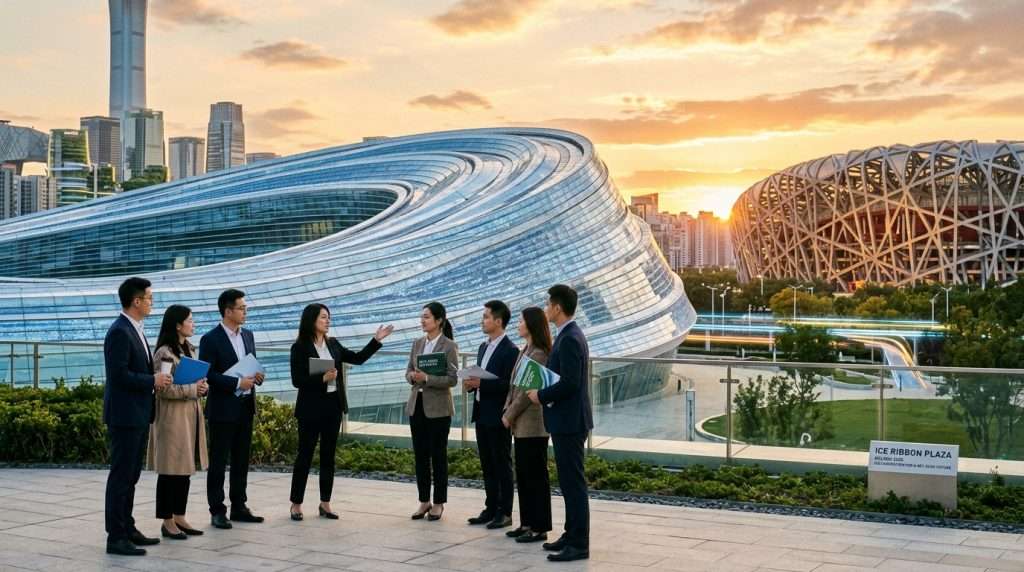
The road to 2050 runs through 2035. China’s modernization goals run to mid-century, and the end of the 2022-2035 Conservation and Management Plan is the stepping stone. The Beijing Central Axis future 2050 has no schedule of its own, so I read 2050 images as aims, not deadlines.
Protection rests on the 2021 Regulations on the Conservation of Beijing Historical and Cultural City. Nineteen institutions share management of the property. More than 100 renovation projects have been carried out on the axis since preparation began in 2011.
| Year | Event | Why it matters |
|---|---|---|
| 2008 | Olympic opening | 29 fireworks footprints traced the axis toward the Bird’s Nest |
| 2021 | Regulations | Gave legal weight to city-wide protection |
| 2022 | Ice Ribbon and archives | Beijing became the first city to host both Summer and Winter Olympics |
| 2024 | Inscription | Reference point for the planning |
| 2035 | End of conservation plan | Stepping stone to 2050 |
The axis stretches north through the Olympic Park and, in common planning talk, south toward Daxing International Airport. The China National Archives of Publications and Culture opened in July 2022 on the northward axis. Shouhuang Palace in Jingshan Park reopened in 2018 after a four-year restoration.
Digital twins and monitoring are the direction. A real example today is a Tencent WeChat mini-programme that lets visitors learn the history through games and virtual tours, and report hazards at heritage sites. The best preview of the plan is what is open now: reopened palaces and the new northern landmarks.
How Could Gobi Dust and Freeze-Thaw Stress Be Kept Off Palace Stone and Steel?
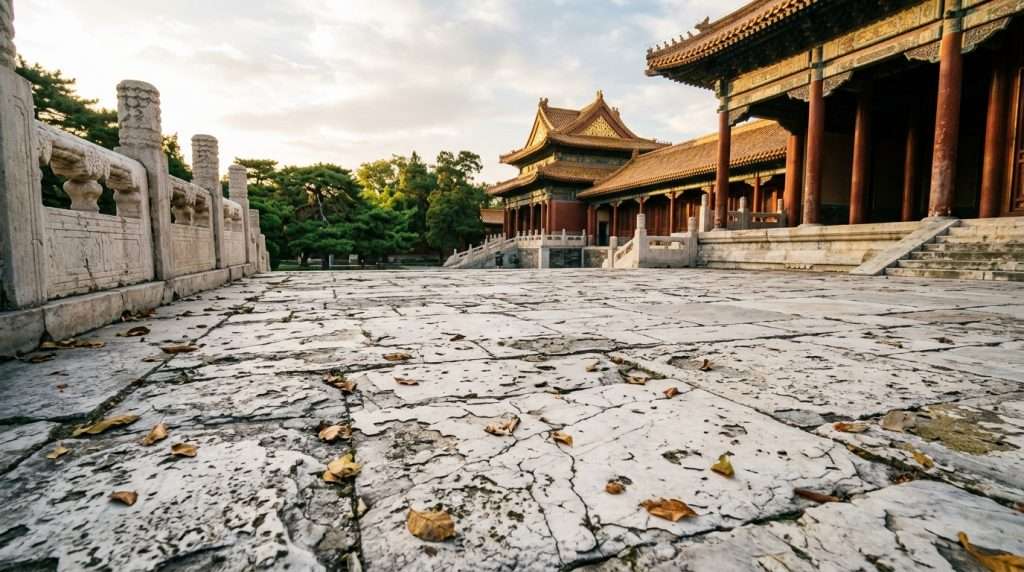
The vision is a breathable, nano-mineral glaze that slows flaking and rust without sealing the surface. A study assessed climate risks across 3,619 immovable cultural heritage sites in Beijing. High-risk areas concentrate in central urban districts and western mountains, so the axis sits right in the danger zone.
Mean risk under the high-emission scenario SSP5-8.5 was about 41.5% higher than under SSP2-4.5. Four threats stand out:
- Dust blown in from the Gobi
- Freeze-thaw cycles that open tiny cracks
- Stone spalling, the flaking of the surface
- Metal oxidation, or rust
Why Roof Tiles and Marble Terraces Crack Over Time
The Forbidden City has yellow glazed roof tiles and marble terraces. Water seeps into tiny pores, freezes in winter and expands. Repeat that for centuries and the surface flakes.
The Bell Tower, Drum Tower and Forbidden City were preserved as developed in the Ming and Qing dynasties. That age is part of their value.
What Wears Down the Bird’s Nest Steel Lattice
The Bird’s Nest is a steel lattice, so its enemy is rust. Dust holds moisture against metal, and oxidation creeps in at joints. Steel ages differently from stone, but both need a gentle shield.
Breathable Mineral Glazes That Keep the Old Patina
As a vision for 2050, breathable nano-mineral glazes would slow flaking and alloy rust. Nothing like this is installed or tested on the axis today. Sealing stone too tightly traps moisture, so breathability is the real test, and the old patina is part of the value.
A photographer’s tip: weathered edges on tiles and marble deserve a close-up now, since they tell the story the glaze aims to keep.
Can Rainwater and Footsteps Help Power a Carbon-Neutral Axis?
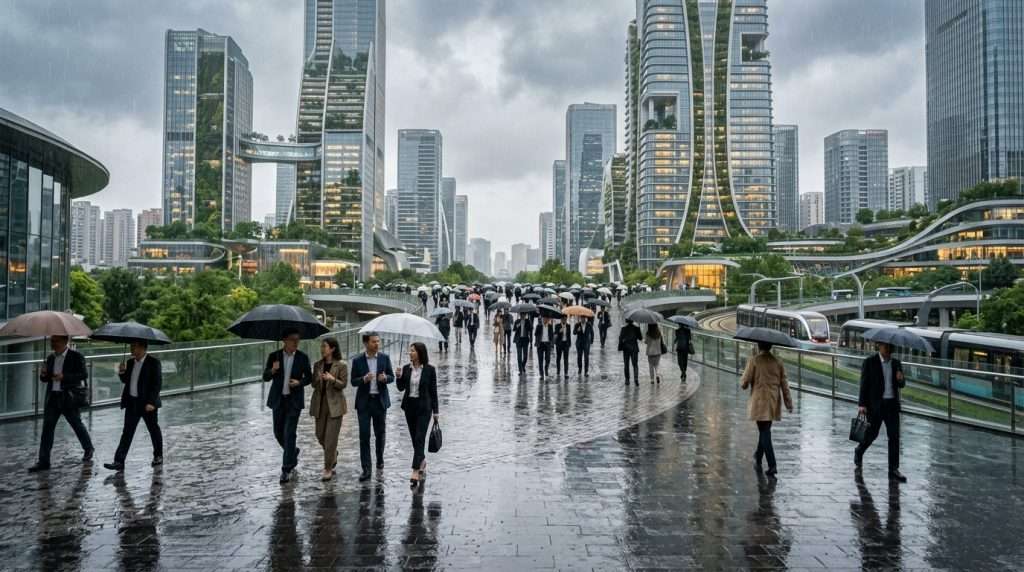
They could help, but only as small parts of a bigger clean-energy plan. Picture a July downpour on a stone plaza: water sheets across the paving and runs off. China has pledged to peak carbon dioxide emissions before 2030 and reach carbon neutrality before 2060, and the vision aims for the axis to get there by 2050.
The vision places retention vaults beneath the imperial moat and the Olympic Green esplanades. They would catch flash floods, filter the water and cool buildings through quiet capillary loops. Footsteps give modest power, so clean grid power carries the load.
These are the four pieces of the vision:
- Retention vaults: catch and filter monsoon rain
- Cooling loops: use captured water to cool palace halls and stadium facilities
- Piezo pavers: turn footsteps on stone plazas into small amounts of power
- Microgrid: share that power locally
Capturing 100% of the rain is a design goal, not a result. None of these pieces exists on the axis yet. The strongest proof of a vision like this is a pilot plaza with published results.
How to Walk the Axis on Foot in Three Days
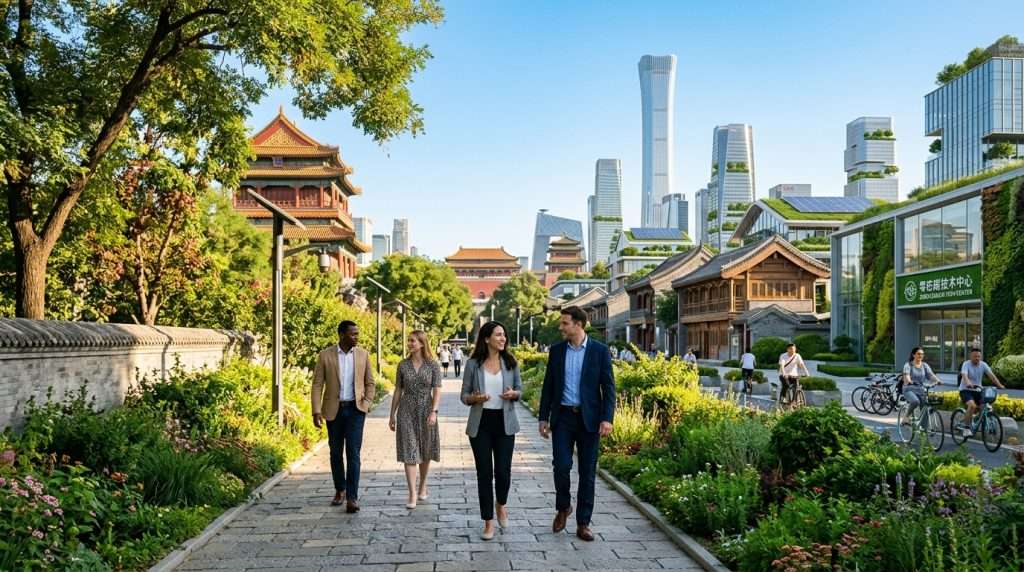
Three unhurried days is enough to walk the axis from north to south. A map of the Beijing Central Axis is easiest read as a straight line, with the Bell Tower at the top and Yongdingmen Gate at the bottom. Tickets for big sites are normally reserved ahead.
Day One in the North: Towers, Jingshan and the Forbidden City
Start at the Bell and Drum Towers. The Bell Tower reopened in January 2022 after a year-long refurbishment. Then climb Jingshan hill, built from soil dug for the Forbidden City moat.
Finish in the Forbidden City, with over 980 buildings that housed 24 emperors in the Ming and Qing dynasties. It usually closes one day a week, so check before planning day one.
Day Two in the Middle: Tiananmen and the Ceremonial Heart
Walk through Tiananmen Square and its gate. Then visit the Imperial Ancestral Temple and the Altar of Land and Grain. The ground is flat and open, so it is an easy day on the feet.
Day Three in the South: Temple of Heaven and Yongdingmen Gate
Pass through Zhengyang Gate, then visit the Temple of Heaven and the Altar of the God of Agriculture. End at Yongdingmen Gate. Its tower was demolished in 1957 and rebuilt in 2004.
- Reserve Forbidden City tickets ahead
- Bring your passport
- Expect closure days at big sites
- Start early for the best photography light
Plan each day around one closure check, because a shut gate can cost you half a day on a line this long.
Yongdingmen at golden hour closes the north-to-south line with a frame worth waiting for.
Conclusion
What stayed with me most was how ordinary the axis feels underfoot. It is a living line where old stone meets modern goals, and people still shop, jog and chat along it.
The 2050 ideas are worth watching, but the real thing is open to walk now. Sketch a three-day route this week, starting from the Bell Tower. Pick one landmark from the route and plan your first photo there.





Leave A Comment