
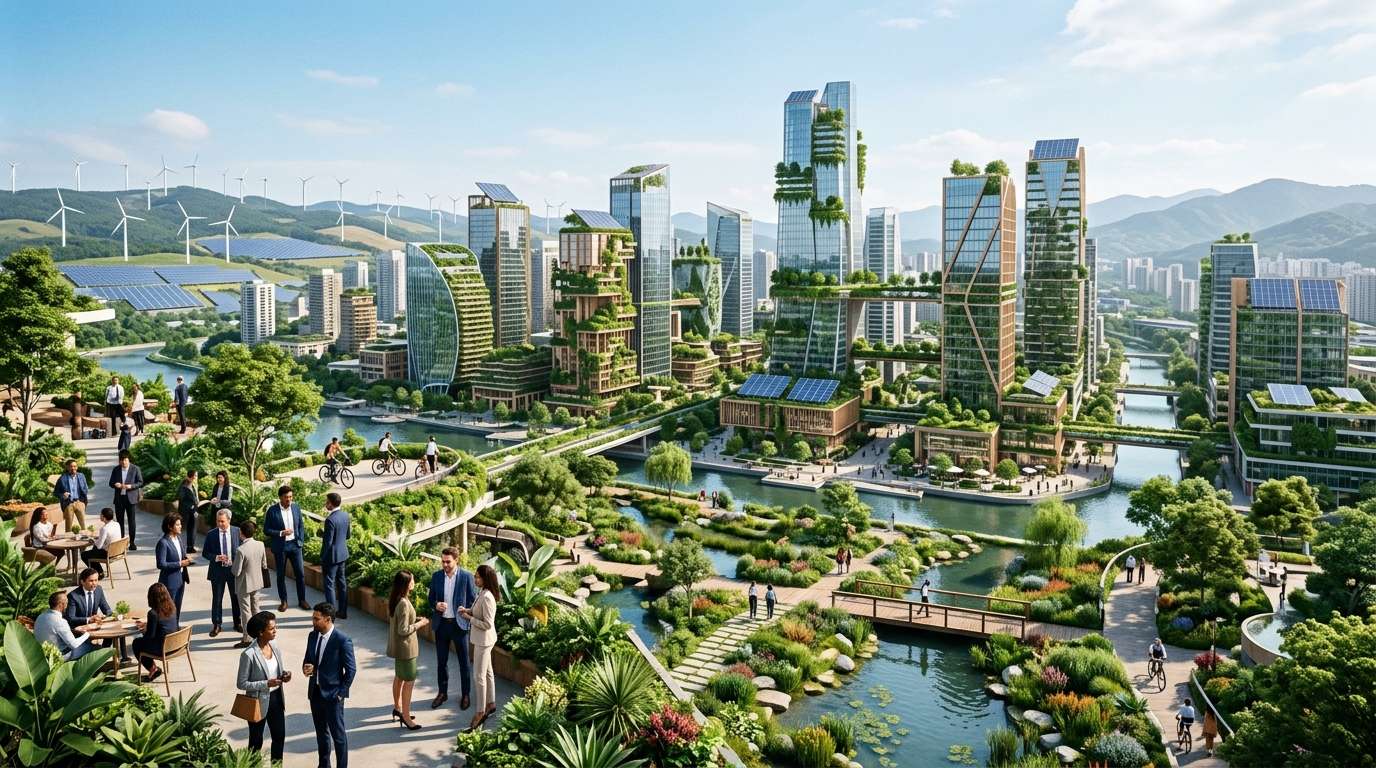
Years ago, I first walked through this city’s old lanes. Steam rose from teahouse cups, while hot pot smoke drifted past wooden shutters. Nearby, pandas dozed beyond town.
Back then, I never imagined this same place would become one of the world’s most studied models of urban resilience. The Chengdu future 2050 vision draws on two thousand years of irrigation wisdom beneath its streets. It guides the city toward operating on little more than water, sunlight, and clever design.
I call it an Abundance Engine: a city designed to produce more than it consumes. Ancient canals, breathable building coatings, underground water vaults, and kinetic sidewalks work together like organs in one living system.
What strikes me most is that none of this feels forced. Heritage and technology sit side by side in the Chengdu future 2050 vision, woven into daily routines.
In the pages ahead, I will explain each piece of this puzzle. This account shows how a city rooted in deep history is rewriting urban life for decades ahead.
Key Takeaways
- Chengdu blends 2,200-year-old irrigation heritage with modern net-zero urban design.
- Breathable nano-mineral coatings protect historic timber and brick architecture.
- Underground hydrologic vaults help manage monsoon humidity and store water.
- Kinetic walkways along the Tianfu Greenway capture energy from foot traffic.
- The city aims to become a fully autonomous, carbon-neutral biome by mid-century.
- Ancient engineering principles still guide today’s sustainability solutions.
Chengdu Future 2050: A Blueprint for Ecological Metropolis Resilience
Numbers rarely keep me awake, but urban growth figures for 2050 did. According to IPCC AR6 Chapter 6, roughly 2.5 billion more people will crowd into cities over the next few decades. Up to 90% of that growth will occur in Asia and Africa, often where mistakes carry serious costs.
After walking Chengdu’s old town, I noticed century-old courtyards beside glass towers and considered cities’ green-cover losses. The IPCC notes that removing green infrastructure can raise local temperatures by as much as 2°C through the urban heat island effect. This can turn humid basin cities like Chengdu into pressure cookers during summer monsoon season.
Chengdu chose another path, treating its 2,200-year-old hydraulic heritage as a living system, not a relic. Planners folded canals, retention vaults, and courtyard lanes into that system. By 2050, I call it an autonomous, carbon-neutral garden biome, a city breathing with its waterways instead of fighting them.
What struck me most was how this supports a wider shift in climate thinking. The IPCC now describes nature-based solutions as mainstream adaptation tools, not experimental side projects.
“Nature-based solutions are increasingly recognized as mainstream approaches to urban climate adaptation, with considerable room for broader application across diverse urban contexts.”
Chengdu’s model supports that claim with clear results. Planners connected social, ecological, and physical infrastructure into one system, and that integration matters. Research shows cities linking these layers build far greater adaptive capacity than those adding green projects to old systems later.
I think Chengdu future 2050 projections reveal the real lesson: resilience is not about choosing between heritage and innovation. It means weaving them into one self-sustaining fabric.
| Planning Approach | Conventional Urban Growth Model | Chengdu’s Ecological Resilience Blueprint |
|---|---|---|
| Population Growth Response | Expands outward, paving over green land | Scales existing hydraulic and garden systems inward |
| Flood Management | Reactive storm drains and concrete channels | Autonomous retention vaults capturing monsoon flow |
| Heat Mitigation | Minimal green cover, heat island intensifies | Garden corridors reduce local warming naturally |
| Energy Model | Centralized, carbon-heavy grid | Distributed, carbon-neutral infrastructure |
| Heritage Treatment | Often demolished for new development | Preserved and integrated into functioning systems |
This comparison clarified the stakes for me. Chengdu future 2050 is not a slogan in a planning document. It is a working framework other cities can study, adapt, and apply before their populations double down on the same climate risks.
Two Millennia of Flow: Scaling Dujiangyan’s Hydraulic Heritage into a Living System
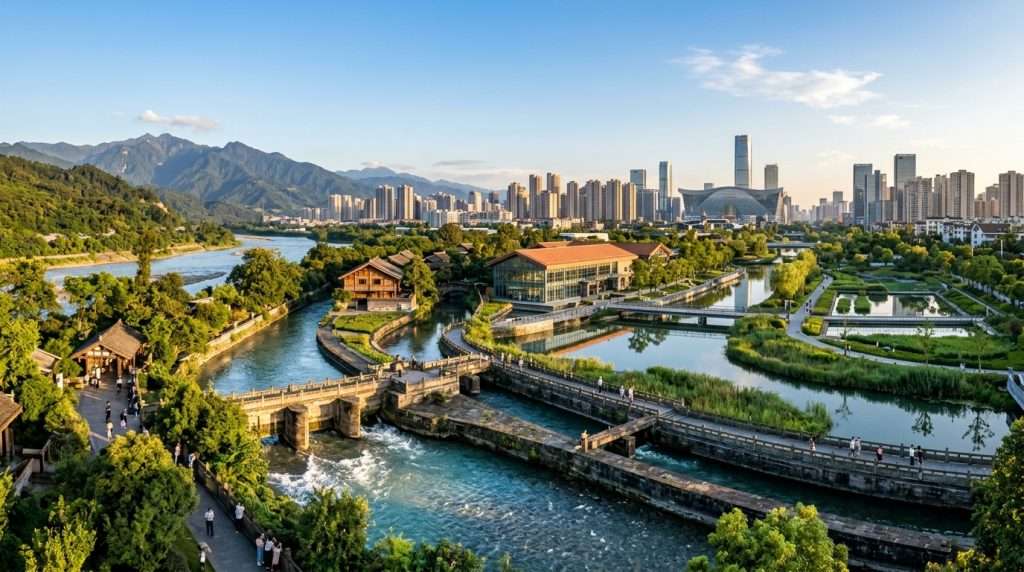
Outside Chengdu, a river still manages itself without dams or pumps, using gravity as it did twenty-two centuries ago. I spent an afternoon tracing Dujiangyan’s stone channels, and it changed my view of modern engineering. This living system is not a relic behind glass.
The Dujiangyan irrigation system still waters crops across the Chengdu Plain, as it did under the Qin Dynasty. That lasting success shaped Chengdu’s 2050 water network more than imported dams or heavy concrete fixes. Planners studied the local system built by Li Bing and his son around 256 BCE.
Dujiangyan Irrigation Preservation as the Engineering Blueprint
Dujiangyan irrigation preservation in Chengdu’s 2050 plan means more than protecting a historic site. Engineers treated the ancient structure as an active teacher and studied its three core parts. Together, they guide water without a wall blocking the river.
- Fish Mouth Levee: splits the Min River into two channels using nothing but current and terrain.
- Flying Sand Weir: lets excess floodwater and sediment spill out naturally during high-flow season.
- Bottleneck Channel: narrows the flow into farmland, controlling volume through geometry rather than gates.
Those three pieces work together without electricity, pumps, or moving parts. That simplicity is the whole point. Chengdu’s planners saw that physics-based systems rarely break down or need unavailable replacement parts.
The preservation effort served two goals. Conservators restored the stonework and canal linings, protecting this UNESCO-recognized site from erosion and heavy tourist traffic. Hydrology teams mapped every slope and flow rate, translating its 2,200-year-old logic into sensor networks across the modern city.
From Ancient Canals to Autonomous Subterranean Retention Vaults
Chengdu did not simply copy old stone channels into new concrete ones. Engineers took Dujiangyan’s gravity-based separation logic underground and expanded it with technology Li Bing never imagined.
Autonomous subterranean retention vaults now sit beneath several Chengdu districts. They mirror the same three-way split: a main intake, an overflow route, and a narrowed delivery channel. However, sensors and AI adjust flow in real time instead of using fixed stone shapes.
During storms, the system reads rainfall data and redirects water, as the Flying Sand Weir released floodwater through design alone.
| Ancient Dujiangyan Element | Modern 2050 Equivalent | Shared Function |
|---|---|---|
| Fish Mouth Levee | AI-controlled intake splitters | Divides water flow using the land’s natural grade |
| Flying Sand Weir | Automated overflow release vaults | Discharges excess water during flood surges |
| Bottleneck Channel | Narrowed subterranean delivery tunnels | Regulates volume without mechanical gates |
| Manual seasonal maintenance | Sensor-driven predictive monitoring | Keeps the system clear and functional year-round |
This approach reflects a lesson from climate resilience research. Good infrastructure depends not only on strong materials, but also on the thinking behind it.
“Infrastructure resilience is not an inherent property of materials alone; it emerges from how systems are planned, designed, and maintained over time.”
That captures Dujiangyan irrigation preservation in one line. Li Bing built more than a dam alternative; he created a planning philosophy that lasted twenty-two centuries. Chengdu’s engineers wisely borrowed it instead of starting over.
Watching water split as it has for thousands of years, I wondered whether future tech was old wisdom buried deeper.
Guarding the Past: Non-Invasive Mineral Masonry Glazes in Historic Preservation
Basin humidity in Chengdu does not just make shirts stick; it slowly harms brick, timber, and stone without protection. I saw this in old lanes near Kuanzhai Alley, where centuries-old walls still resist a climate that harms most materials.
The secret was non-invasive mineral masonry glazes, which protect historic surfaces without changing their look or feel. These breathable nano-mineral glazes work with natural materials instead of sealing them shut, and that difference matters.
“The best preservation technology doesn’t fight time, it works with it, letting materials breathe and age the way nature intended.”
Architecture showcases worldwide increasingly favor biomimetic, material-science-driven solutions. Chengdu’s preservation teams have clearly followed this approach.
Shielding Qing-Era Grey-Brick Walls from Basin Humidity
Qing-era grey brick has a special charm. It looks soft and slightly chalky, then ages beautifully when healthy.
Moisture trapped inside brick causes spalling, the flaking and crumbling seen on untreated walls. Non invasive mineral masonry glazes form a microscopic, breathable barrier on the surface.
Water vapor still escapes from inside the wall. Liquid water cannot get back in, so this one-way action keeps brick dry without sealing it like plastic.
I’ve seen restored walls near Wenshu Monastery that still show their original grey tone. They show no dark water stains after a Chengdu rainy season.
The glaze does not disguise the brick’s history. It simply gives the brick room to keep breathing.
Nanmu Timber Shrines and the Science of Breathable Coatings
Chinese woodworkers consider Nanmu timber one of the finest, most fragrant woods available. Shrines made from it can last centuries with proper care.
Basin humidity invites fungal growth and slow rot when wood cannot dry between rains. Breathable coatings made from nano-mineral compounds let moisture escape instead of trapping it under a hard, glossy finish.
The coating resists surface water while allowing the wood’s natural pores to work normally. This balance is the whole point: protection without suffocation.
Breathing wood stays structurally sound much longer than tightly sealed wood. It also keeps the warm, aged color that makes old shrines feel truly old.
Anshun Bridge Pavilions: Preserving Patina Without Sacrificing Authenticity
Anshun Bridge crosses the Jin River, and its pavilions have weathered into soft greens and grays. No one can fake this patina with paint.
Engineers had to strengthen the stone and timber without erasing decades of natural weathering. Mineral glazes offered a practical solution.
Applied thinly, the coating stays invisible and slows moisture-driven decay. It adds no shine and does not change the color.
At dusk, I watched light hit weathered stone and could not see the protective layer. That quiet success lets mineral masonry glazes disappear into what they protect.
| Treatment Type | Breathability | Patina Preservation | Typical Lifespan |
|---|---|---|---|
| Cement-based sealant | Low | Poor, often discolors surface | 5-10 years before cracking |
| Acrylic waterproof coating | Very low | Moderate, adds visible sheen | 8-12 years |
| Non-invasive mineral masonry glaze | High | Excellent, surface stays visually unchanged | 20-30 years |
| Untreated surface (baseline) | High | Degrades quickly under humidity exposure | Rapid decay in basin climate |
Preservation in 2050 is not about freezing history in time. It helps old brick, wood, and stone age gracefully through breathable layers.
Subsurface Hydrologic Heritage Engineering Beneath the Jin River
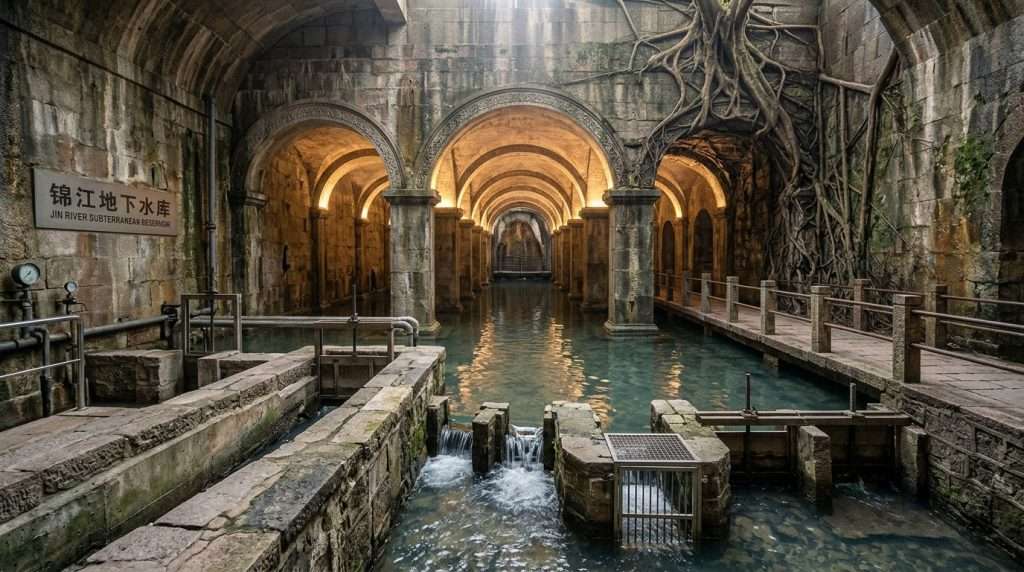
Chengdu’s most impressive flood defense system is almost invisible.
I learned this while standing on a footbridge over the Jin River. The water looked calm, and I could not see what lay beneath me.
Engineers built a network below that follows Dujiangyan’s logic. This is called subsurface hydrologic heritage engineering, turning ancient water wisdom into modern flood protection.
The IPCC’s Sixth Assessment Report makes a clear point about cities like Chengdu.
Climate change will keep raising flood risk, expanding the amount of exposed urban land, and increasing the damage that follows — and the adaptation measures that work best are the ones woven together, not grey infrastructure standing alone.
Chengdu seems to have followed that advice long before the report existed.
Automated Retention Vaults and 100% Monsoon Capture
Beneath the Jin River and under the Tianfu Greenway sits a grid of automated retention vaults. Sensors track rainfall in real time. During monsoon storms, the vaults open and swallow runoff before it reaches street level.
Chengdu’s planners claim something close to 100% monsoon capture. That sounds bold, but this city has managed floodwater since the third century BC. Dujiangyan never used brute concrete.
It split, slowed, and redirected river flow using the terrain. These vaults follow the same approach underground, using algorithms instead of stone weirs.
Walking the greenway, you would never guess this system exists. That is the point. Good flood infrastructure disappears.
Closed-Loop Reservoir Stormwater Harvesting for Zero-Emission Cooling
Here’s what genuinely surprised me. Captured water does not simply wait underground for the next storm.
Filtered water enters a closed loop reservoir stormwater harvesting system that cools entire cultural districts. Teahouses, museums, and performance halls across central Chengdu use recycled groundwater instead of power-hungry air-conditioning units.
There is no extra electricity or emissions. Rainwater does double duty, first preventing floods, then cooling buildings tied to the city’s identity.
The table below compares this system with a standard municipal stormwater setup:
| Feature | Standard Stormwater System | Chengdu’s Closed-Loop System |
|---|---|---|
| Monsoon capture rate | 50-70% typical | Near 100% |
| Water reuse | Minimal or none | Filtered into cooling loops |
| Energy demand | Grid-dependent pumps | Zero-emission cycling |
| Heritage integration | Rarely considered | Built on Dujiangyan principles |
I return to this idea whenever I explore a city built on old water channels. The smartest infrastructure does not fight the landscape. It listens to what already exists, then quietly builds upon it.
Tianfu Greenway Net Zero: Building a Carbon-Neutral Garden Corridor
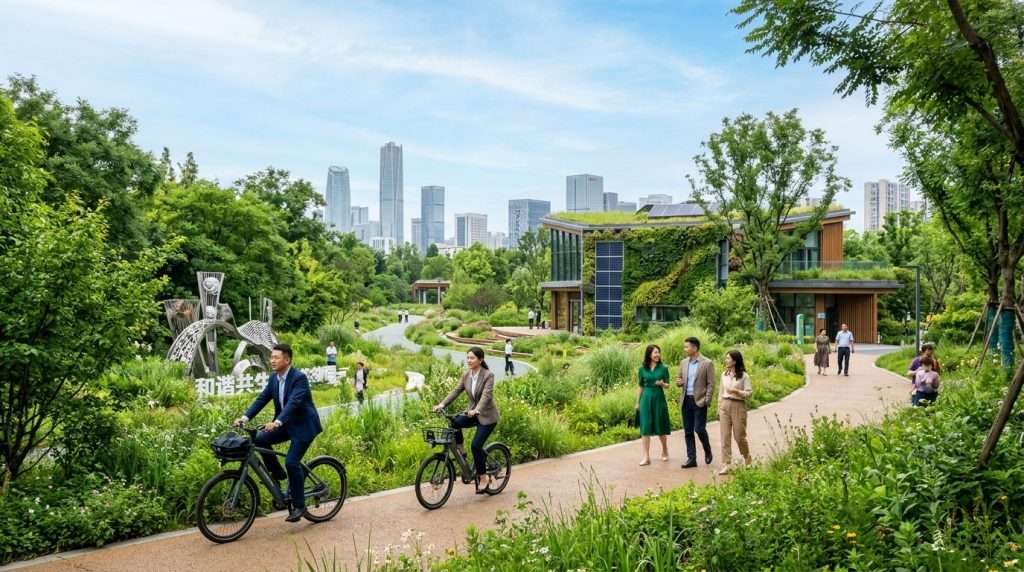
I’ve run greenways on four continents, but this carbon-neutral corridor still surprised me. Tianfu Greenway crosses Chengdu like a green ribbon, with hidden technology beneath its paths. This is tianfu greenway net zero thinking in action: stormwater capture, renewable power, and carbon offsetting support daily recreation.
Critics often cite net-zero towers with solar glass and green roofs as proof buildings can balance energy use. Chengdu applies that idea across a whole landscape, not just one structure. One roof captures rainwater; this corridor does so across kilometers of parks, pathways, and stadiums.
Stadium Porous Asphalt Stormwater Drainage Integration
Chengdu’s monsoon season brings intense rain in short bursts, quickly overwhelming traditional sewers. Engineers addressed this problem beneath stadiums along the greenway. Crews installed stadium porous asphalt stormwater drainage layers, letting water sink through instead of pooling.
During a sudden downpour, I watched standing water vanish near one stadium within minutes. Crushed stone and filtration fabric beneath the asphalt remove pollutants before water reaches basins or the aquifer. That step sends less dirty runoff to the Jin River and eases pressure on the city’s aging drainage grid.
“Nature-based solutions, including urban greening and sustainable water management, are already supporting climate adaptation in cities worldwide.”
| Feature | Traditional Asphalt | Stadium Porous Asphalt System | Environmental Outcome |
|---|---|---|---|
| Water absorption | Minimal; water pools on surface | High; water drains through instantly | Reduced surface flooding |
| Runoff pollution | Carries oils and debris directly into drains | Filtered through stone and fabric layers | Cleaner water reaching the Jin River |
| Monsoon flood risk | High during heavy rainfall | Significantly reduced | Lower sewer system strain |
| Surface heat retention | Traps and radiates heat | Allows airflow, cooler surface | Lower urban heat island effect |
Greenway Pathways as Distributed Renewable Infrastructure
Stormwater control is only half the story. The paths also generate power as people use them. Under-floor piezoelectric pavers, also used beneath Kuanzhai Alley’s cultural district, line sections, turning footsteps and bike tires into electric bursts.
No single paver makes much energy. Across kilometers of daily foot traffic from joggers, cyclists, and commuters, that output becomes a genuine distributed microgrid. Small solar canopies at rest stations and compact wind elements near open plazas power lights and chargers off-grid.
- Piezoelectric pavers capturing kinetic energy from pedestrians and cyclists
- Solar canopies powering rest stops and charging stations
- Porous surfaces reducing both flooding and urban heat
- Localized generation reducing dependence on the city’s central grid
At dusk, I watched solar lamps flicker on without a wire leading to a power plant. It made the IPCC’s nature-based solutions concept real beneath my running shoes. This greenway is more than scenery; it acts as a power plant, sewer system, and carbon sink at once.
Kuanzhai Alley Kinetic Microgrid: Turning Footsteps into Power
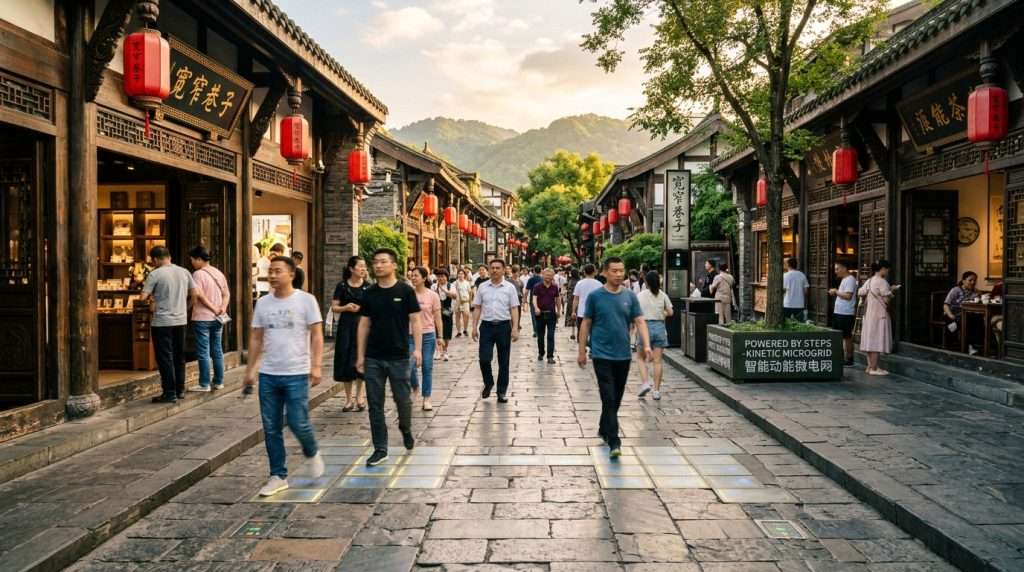
On my first evening in Kuanzhai Alley, I never imagined its flagstones could become a power source. I dodged street vendors, snapped photos of old courtyard doors, and enjoyed the alley’s quiet, timeless pace.
By 2050, the same historic walkway runs on a Kuanzhai Alley kinetic microgrid built beneath its stones. Tourists, shopkeepers, and locals create usable electricity with every step. The idea sounds strange, but it works beautifully.
Under-Floor Piezoelectric Pavers Explained
Piezoelectric materials create a small electrical charge when pressure touches them. Each step produces a tiny burst of energy. Thousands of steps each day create real power.
Engineers placed these pavers beneath the alley’s original flagstones without disturbing the historic surface. Nothing looks different. You cannot see or feel the technology beneath your feet, and visitors still love the stones’ worn texture.
Each paver links to a small underground grid that collects and stores its charge. The energy then flows into batteries that power nearby fixtures. The system works quietly, hidden in plain sight and without fanfare.
Powering Cultural Districts Without Emissions
Combined foot traffic from one of Chengdu’s busiest pedestrian zones becomes a measurable, reliable energy source. Each step makes little energy, but a district’s total becomes significant.
This approach resembles what I’ve seen in net-zero student housing and tower projects. Rooftop solar panels there produce enough power for a building’s daily operations. Piezoelectric pavers use the same idea, but on a smaller scale in pedestrian spaces, not rooftops.
The results power several everyday essentials across the district:
- Paper lanterns strung above the alley at night
- Shop signage and small retail lighting
- Public benches and rest areas with charging ports
- Information kiosks for visitors
The system creates no emissions or noise and does not disrupt the alley’s charm. Footsteps support both a historic stroll and clean energy. That’s the kind of quiet innovation that makes exploring these streets feel even more rewarding.
What strikes me most is how invisible the system is. Travelers walk through Kuanzhai Alley as generations have, unaware they support a working microgrid. This blend of old-world atmosphere and modern engineering makes Chengdu’s approach compelling.
The Garden City Redefined: Chengdu’s Autonomous Urban Biome
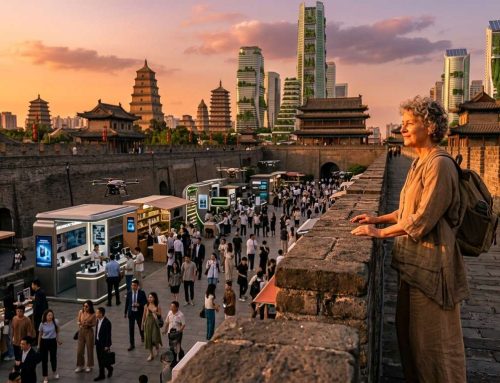
After I passed the retention vaults, touched breathable wall coatings, and felt kinetic pavers flex, something clicked. Chengdu is not placing technology on top of history. It is growing one living system where old lanes and new engineering share the same breath.
That is what Chengdu future 2050 looks like up close. It is not a city divided between heritage and innovation. Both sides strengthen each other.
The phrase “garden city” appears often here. I once pictured parks and tree-lined boulevards. Now I see it another way.
A real garden city in this century must manage its water, generate power, and recycle materials. It must work like a biome, not merely a group of attractive buildings.
Weaving Heritage Lanes into a Self-Sustaining Ecosystem
In Kuanzhai Alley and old courtyard neighborhoods, you will find no velvet ropes or “do not touch” signs. The lanes still smell like jasmine tea and sizzling street food. Yet nearby systems now work together.
- Grey-brick courtyard walls stay dry through breathable mineral coatings instead of plastic sealants.
- Footsteps on old stone paths help power nearby lantern lighting through piezoelectric pavers.
- Rainwater that once flooded alleyways drains into underground vaults instead of the street.
- Nearby greenway corridors feed renewable energy back into the historic district’s grid.
This technology does not replace the area’s character. If anything, it protects that character. The teahouse owners I spoke with barely notice it now; it works quietly in the background, as a well-built home should.
What Net-Zero Longevity Means for a 2050 Megacity
Dujiangyan has moved water for more than two thousand years without a major redesign. That seems to be the standard Chengdu is setting again. Net-zero longevity means infrastructure built to outlive several generations, not just a decade or two.
The IPCC AR6 report supports this idea. It says integrated development planning can improve city adaptation to long-term stress. This works best when innovation and investment connect social, ecological, and physical systems.
“Integrated development planning that connects innovation and investment across social, ecological, and physical infrastructure can significantly increase the adaptive capacity of urban settlements.”
That is exactly what I saw across Chengdu’s streets. The city is not relying on one solution. It combines water systems, energy systems, and heritage preservation to face climate stress through 2050 and beyond.
| Aspect | Conventional City Infrastructure | Chengdu’s Autonomous Biome Model |
|---|---|---|
| Design Lifespan | 20-50 years before major overhaul | Centuries, modeled after Dujiangyan |
| Water Management | Centralized pipes and drainage | Distributed vaults and reservoir reuse |
| Energy Approach | Grid-dependent, fossil-reliant | Kinetic and solar microgrids, carbon-neutral |
| Heritage Role | Preserved separately, often static | Actively integrated into living systems |
In an old alley, I watched a lantern light from footsteps. I realized this was more than city planning; it was a long-term promise. Chengdu future 2050 is practical work that helps the city stand and grow for generations.
Lessons for Global Cities: Replicating Chengdu’s Water-Woven Model
Whenever I visit a flooded city, I ask the same question: why hasn’t it studied Chengdu?
I’ve stood on levees in New Orleans and watched canals overflow in Jakarta. I’ve photographed sandbag walls in small towns along the Mississippi. I wonder why more planners do not look east.
Part of the answer is geopolitical. For decades, Western engineering firms assumed they held a permanent technological edge. That assumption is now cracking.
“While China hasn’t yet taken an overall innovation lead, it has pulled ahead in certain advanced industry areas, with Chinese firms likely to equal or surpass Western counterparts within a decade in many fields.”
That shift matters here. Chengdu’s planners did not simply copy old irrigation methods from Dujiangyan.
They paired ancient hydraulic wisdom with cutting-edge sensor networks, autonomous vaults, and renewable infrastructure. Most Western cities have not even piloted these systems.
So what can a flood-prone city borrow from this playbook? Quite a lot, honestly.
Engineering Takeaways for Flood-Prone Metropolises
I’m not an engineer, but I’ve learned the basics from engineers during my travels. Chengdu offers principles that suit almost any waterlogged city, regardless of budget or geography.
- Subterranean retention vaults that store monsoon runoff instead of dumping it straight into rivers
- Porous surfaces on roads, sidewalks, and stadium perimeters that let water soak through rather than pool
- Closed-loop reservoir systems that recycle captured stormwater for cooling instead of drawing fresh municipal supply
- Distributed microgrids that generate power from foot traffic or solar canopies along greenways
None require demolishing a city and rebuilding it. That is the part I find most hopeful. Chengdu added new technology to existing infrastructure instead of bulldozing it.
Balancing Heritage Conservation with Climate Technology
Here’s where things get harder, and I want to be honest. Not every city has Chengdu’s political will, funding, and centuries-old engineering foundation.
Its chapter on cities and settlements states a stubborn reality: urban adaptation gaps exist in every region of the world. Governance capacity, financing shortfalls, and legacy infrastructure all slow progress.
Many cities lack innovative funding mechanisms or integrated planning tools. These tools can connect flood control with cultural preservation.
I’ve seen this in smaller towns, where volunteers protect a single historic district. The city budget cannot cover both flood defense and preservation. Chengdu’s model works partly because it treats both goals as one project, not two competing priorities.
That may be the biggest lesson for American cities facing similar risks. Heritage and climate resilience do not have to compete for the same dollar. When planners design both together from day one, they protect the past and people living there now.
Conclusion
At the Jin River, I watch water move through channels designed two thousand years ago and refined for this century. Chengdu future 2050 improves what works instead of replacing it. It means listening more closely.
The grey-brick walls still breathe. The alleyways still hum with life, powered differently now. Dujiangyan’s engineers knew water should flow, not fight; modern cities are relearning it, and Chengdu built its future around it.
Chengdu redefines garden city longevity by showing that old wisdom and new technology can work together. A city can protect its temples while capturing every drop of monsoon rain. It can keep teahouses full of chatter while powering them with footsteps.
I began this research expecting robots and glass towers. Instead, I left thinking about bamboo groves, canal gates, and quiet courtyards doing more work than smart sensors. That is Chengdu future 2050: a city moving forward by looking back.
If you ever plan a trip through Sichuan, put Chengdu on your list. Walk the greenways and sit by the water. You will feel a city that learned how to last.







Leave A Comment