
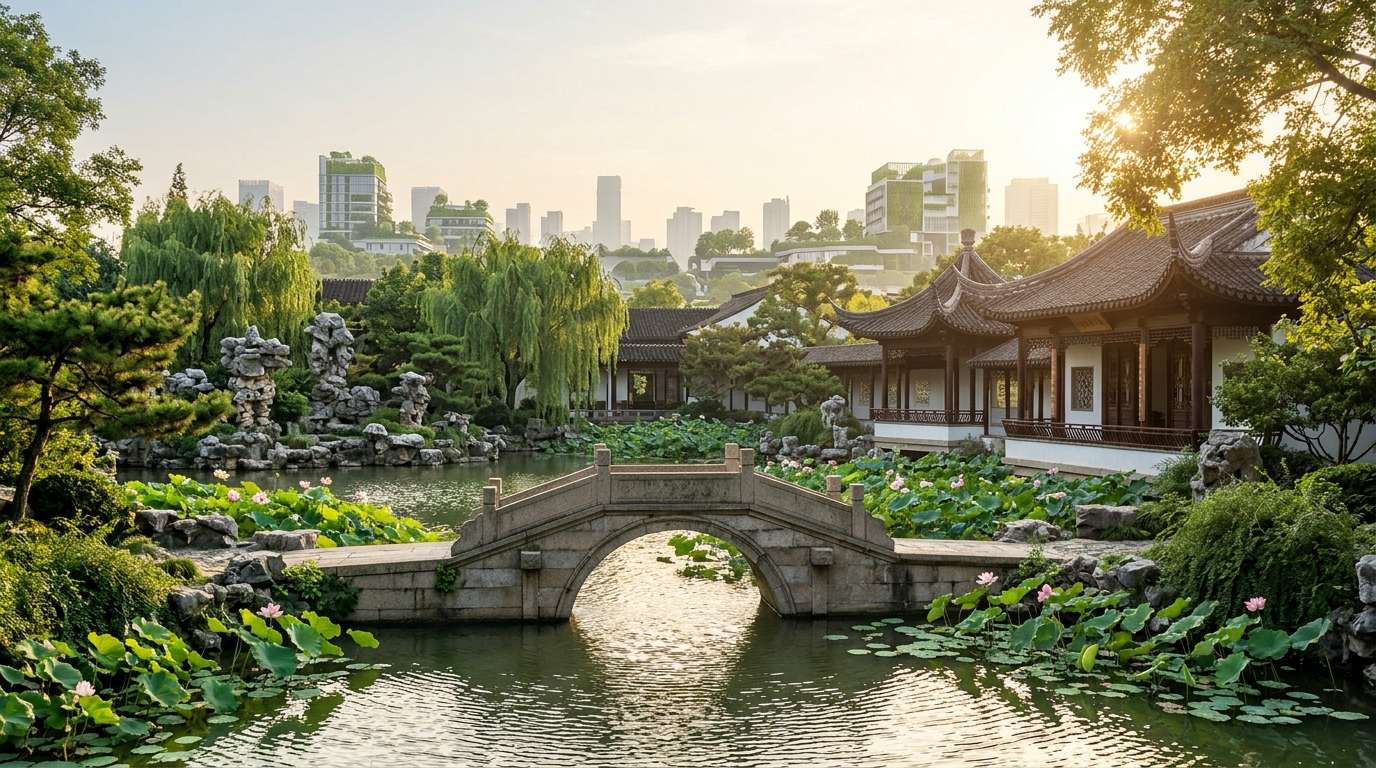
I got lost for hours reading about Suzhou’s canal network, and I mean that in the best way.
Grey-tiled rooftops line quiet waterways. The classical gardens of Suzhou show how UNESCO preservation protects scholar gardens behind white plaster walls. Walking these streets feels like stepping into a painted scroll.
What happens when this classical water town becomes a testing ground for climate policy? That question kept me awake at night.
China has spent three decades building institutional capacity for this transformation. The CCICED’s thirty-year policy review traces how “ecological civilization” moved from slogan to blueprint. It shaped Five-Year Plans aimed at green urbanization.
Picture this water town decades from now: carbon-neutral, and partly powered by footsteps on Pingjiang Road. Breathable mineral coatings cool centuries-old stone. Scholar garden design logic meets serious civil engineering.
This piece combines a travel dispatch with a speculative sketch. I will guide you through my findings, one canal bridge at a time.
Key Takeaways
- UNESCO-listed scholar gardens could function as a living laboratory for large-scale, carbon-neutral urban design.
- Three decades of policy groundwork from bodies like CCICED have set the stage for this kind of green transformation.
- “Ecological civilization” principles link traditional garden craftsmanship with modern climate engineering techniques.
- Speculative innovations explored include nano-mineral stone coatings, hidden hydrologic vaults, and footstep-powered microgrids.
- This historic water town may serve as a working model for canal towns facing similar climate pressures worldwide.
- China’s carbon intensity per unit of GDP dropped 45.8% versus 2005 levels, beating national 2020 targets ahead of schedule.
Suzhou Ancient City Future 2050: A Canal Civilization Reimagined
Walking through Suzhou in 2050 feels less like visiting a museum and more like entering a 2,500-year-old organism. I crossed a humpbacked stone bridge on Pingjiang Road and watched a wooden boat glide silently below. Its wake rippled past timber teahouses standing since the Ming Dynasty, matching old photographs I had studied.
The stones under my boots had breathable coatings that let them age naturally while resisting monsoon rain. The canal water smelled slightly mineral and cool; a hidden closed-loop system filtered and recirculated it. None of this announced itself: The city hides its engineering the way a garden hides its irrigation lines.
Suzhou’s 2050 vision extends classical scholar-garden logic across the metropolis. These places use water, shade, and careful balance instead of fighting nature. They borrowed from nature, channeled it, and lived alongside it; this philosophy now guides the city’s power grid, stormwater system, and climate control.
“A garden is not a conquest of nature, it is a conversation with it.”
I think that line explains Suzhou better than any engineering report. The famous classical gardens of Suzhou earned UNESCO preservation status because they captured a worldview, not merely a style. Scaled up, that worldview keeps the ancient city carbon-neutral today.
Here’s a quick snapshot of how old garden principles became citywide systems:
| Garden Principle | Classical Application | 2050 City-Scale Function |
|---|---|---|
| Borrowed scenery (jiejing) | Framing distant views through windows and doorways | Smart glass and sensor networks framing natural light while cutting energy use |
| Water as circulation | Ponds and canals connecting garden courtyards | Closed-loop canal network cooling buildings and recharging groundwater |
| Rockery as structure | Taihu stones shaping walking paths and vistas | Porous stone masonry managing stormwater across the old city |
| Courtyard microclimates | Shade and airflow cooling pavilions naturally | District-wide passive cooling reducing citywide power demand |
Standing there, I realized UNESCO preservation and net-zero engineering are not competing goals in Suzhou. They are one goal measured at different scales. The gardens taught the city to breathe before anyone used the word sustainability.
Everything ahead—stone coatings, stormwater vaults, and kinetic pavers—grew from lessons developed in a few acres of classical garden centuries ago. Suzhou is not importing the future; it is listening to its canals at last.
Non-Invasive Mineral Masonry Glazes Safeguarding Ming-Dynasty Stonework
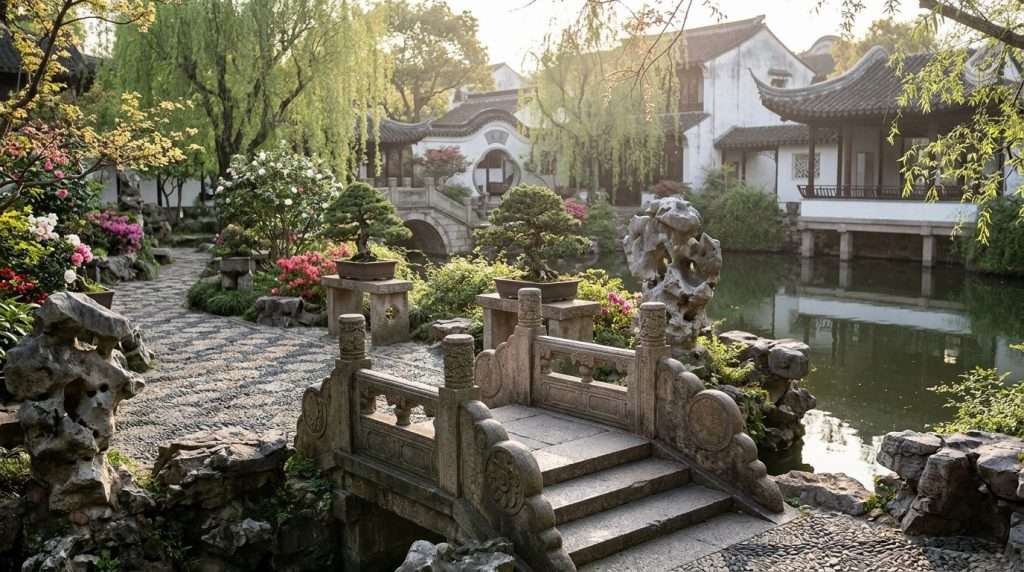
No one tells you how fast moss can cover a 600-year-old stone. I watched it happen beside a Suzhou canal wall near Pingjiang Road.
A jagged Taihu rockery was green at its base, and its surface softened like wet chalk.
The Yangtze Delta is hard on old stone. For months, humidity soaks porous rock and timber, feeding moss and cracking surfaces that survived the Ming dynasty.
For centuries, caretakers scrubbed and sealed these surfaces. Heavy sealants trap moisture inside stone, making cracks worse over time. Suzhou’s 2050 restoration teams needed a smarter way to protect stone without smothering it.
That’s where non-invasive mineral masonry glazes come in. These non invasive mineral masonry glazes shield stone from water damage while letting it breathe.
Breathable Nano-Mineral Formulas and Moss Rot Prevention
The glaze uses ultra-fine mineral particles, mostly silicate-based, that bond directly with stone without forming a solid, plastic-like film. Think of it as a raincoat with tiny vents, not a sealed plastic bag.
Water vapor trapped inside old masonry needs an escape route. These breathable nano-mineral formulas let moisture escape through microscopic pores. Stone then avoids saturation, which keeps moss spores from settling.
This approach is not entirely new. Silicate mineral paints have protected breathable masonry for over a century. German conservation brand Keim uses similar paints on historic European facades. Suzhou’s engineers scaled that chemistry to nanoparticles for finer, more precise coverage.
Stone doesn’t fail because of water contact alone. It fails when water gets trapped and has nowhere to escape, freezing, expanding, and cracking the structure from within.
Once applied, the non-invasive mineral masonry glaze hardens into stone’s natural pore structure instead of sitting on top. It leaves no flaking, peeling, or visible coating line decades later.
Preserving Authentic Patinas Across Taihu Rockeries, Grey-Tiled Pavilions, and Timber Corridors
Suzhou’s gardens use many materials. Jagged Taihu rockeries, smooth grey roof tiles, and dark timber corridors age differently. Each needed a slightly different glaze application to look untouched.
The goal was never shine or a restoration gloss. It was to preserve the soft, monochrome patina that draws collectors and photographers worldwide.
| Surface Type | Primary Risk | Glaze Function | Preserved Appearance |
|---|---|---|---|
| Taihu Rockery Stone | Deep pitting traps water, speeding erosion | Penetrates crevices, allows vapor release | Natural jagged texture, no gloss |
| Grey Roof Tiles | Surface flaking from freeze-thaw cycles | Bonds into tile pores, blocks water intrusion | Matte grey tone, unchanged silhouette |
| Timber Corridor Beams | Moisture-driven rot and fungal growth | Breathable sealant layer over wood grain | Original wood color and grain visible |
| Stone Bridge Arches | Constant canal spray weakening joints | Reinforces mineral bonds at contact points | Weathered stone look, structurally sound |
Walking across Pingjiang Road today, you would never guess the stones underfoot have an invisible, breathable shield. That is exactly the point.
Suzhou’s conservators are not trying to make the city look new. They use non-invasive mineral masonry glazes to let it look its age and last another six hundred years.
Subsurface Hydrologic Heritage Engineering Beneath Pingjiang Road and Jinji Lake
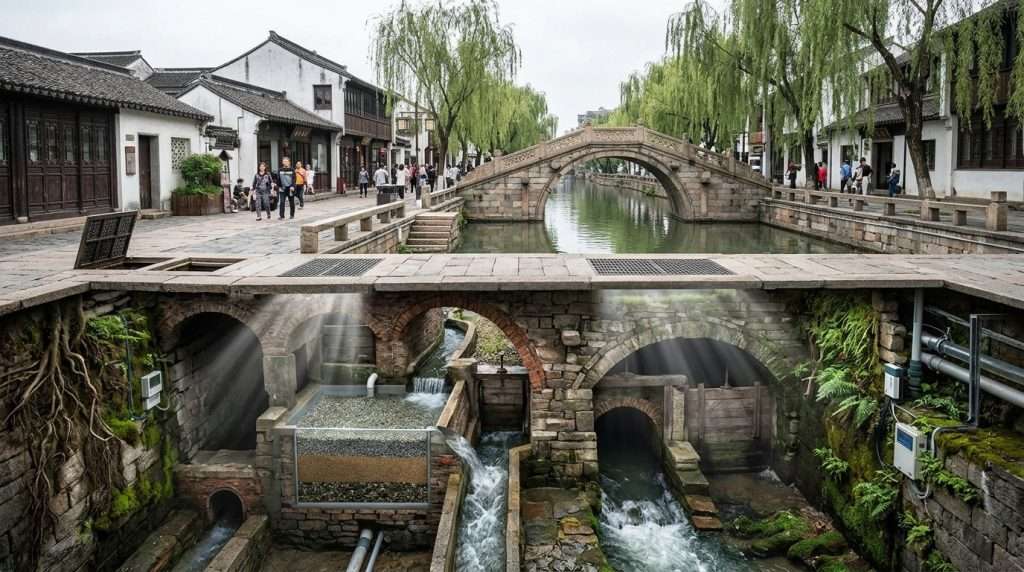
I never expected Suzhou’s 2050 vision to impress me most through something I could not see.
Everything that keeps this canal city working without harming history happens underground. After a sudden summer downpour, I asked local engineers why Pingjiang Road stayed dry. They explained subsurface hydrologic heritage engineering, a complex term for smart water management beneath centuries-old stone.
The idea is simple. Protect the canals and buildings. Keep the infrastructure hidden.
Automated Retention Vaults Capturing 100% of Monsoon Deluges
Automated retention vaults sit beneath Pingjiang Road and Jinji Lake. These chambers activate when sensors detect rising water during monsoon season.
I found this detail fascinating: the vaults can capture 100% of seasonal monsoon deluges. That bold claim makes sense for a city built around waterways. Suzhou’s canal grid was not designed for today’s climate extremes, so engineers went below the surface.
After capture, the water gets filtered and redirected into closed-loop cooling systems. These systems serve nearby garden pavilions and museum halls. Nothing goes to waste, and ancient stone streets stay dry.
“The best heritage infrastructure is the kind visitors never notice.”
Stadium Porous Asphalt Stormwater Drainage Adapted for Historic Canal Streets
One comparison stayed with me. Pingjiang Road’s surface technology borrows from stadium porous asphalt stormwater drainage, used in modern sports arenas.
Water drains through the surface instead of pooling on ancient cobblestones. The design sends rain into the collection system without eroding historic materials or disrupting foot traffic.
I walked these streets during heavy rain and barely saw a puddle. That is the whole point.
| System Feature | Traditional Drainage | Suzhou’s Adapted System |
|---|---|---|
| Surface material | Solid stone, prone to pooling | Porous asphalt layer over heritage stone |
| Water capture rate | Partial, relies on surface runoff | Up to 100% via retention vaults |
| Visual impact on heritage streetscape | Minimal change needed | Invisible, preserves original appearance |
| End use of collected water | Discharged or wasted | Filtered into closed-loop cooling systems |
Closed-Loop Reservoir Stormwater Harvesting for Zero-Emission Cooling

Watching monsoon runoff become coolant for a 500-year-old garden pavilion feels quietly brilliant. I stood beside one of Suzhou’s reservoir outlets and saw water enter a building’s climate system. The water was not going to waste.
This is closed loop reservoir stormwater harvesting at work. Instead of sitting idle or being pumped away, captured rain moves through sealed cooling loops. No fossil fuel burns, no emissions escape, and the water keeps circulating.
From Filtered Canal Water to Climate Control in Garden Pavilions and Museum Halls
I break the process into simple stages because the engineering becomes clear when you follow the flow:
- Canal water gets filtered through sediment traps and mineral layers, removing debris before it enters the loop.
- Filtered water flows into underground pipes that run beneath garden pavilions and museum buildings.
- Heat exchangers pull warmth from indoor air and transfer it into the circulating water.
- Cooled air returns to the room while the warmed water cycles back for re-filtering and reuse.
The result is almost invisible. Visitors walk through cool, dry rooms without hearing an air conditioner hum. Museum curators get stable humidity that protects silk scrolls, lacquered furniture, and centuries-old paintings from warping or mold.
I have visited historic cities where bulky window units were bolted onto ancient facades. Suzhou avoids that entirely. Cooling stays underground and hidden, allowing the architecture to breathe as intended.
The Humble Administrator’s Garden Net-Zero Benchmark
If you want to see the system proven, visit the Humble Administrator’s Garden. It is Suzhou’s most celebrated classical garden and a net-zero testing ground for this approach.
Engineers chose this site for its mix of pavilions, water features, and foot traffic. If the closed-loop system could keep the garden comfortable and protect its structures, it could scale across the ancient city.
I walked through the garden on a humid afternoon. Temperature dropped when I entered a covered hall. There were no vents or visible machines, only filtered canal water working quietly beneath my feet.
What strikes me most is the restraint. Suzhou built no flashy showcase; it tested a working benchmark where tourists and scholars already gather. It lets comfort, not spectacle, show the results: practical, unassuming, and genuinely effective.
Pingjiang Road Kinetic Microgrid: Power From a Million Footsteps

Walking along Pingjiang Road one evening, I never guessed my footsteps carried me toward the next lantern-lit bridge. Beneath worn stone slabs, my weight quietly fed power into the Pingjiang Road kinetic microgrid.
It’s a strange thought. You see no wires or solar panels glinting in the sun. Old stone has absorbed footsteps for centuries; now, it serves a new purpose.
That contrast makes this part of Suzhou’s 2050 vision especially compelling. The technology stays hidden. You feel no change underfoot, yet the system works step after step, bridge after bridge.
Piezoelectric Pavers Across Towpaths and Stone Bridges
The science is simpler than it sounds. Piezoelectric pavers use pressure-sensitive materials beneath the surface. When a foot presses down, even briefly, the material flexes and releases a small electrical charge.
Thousands of pedestrians cross Pingjiang Road’s towpaths and stone bridges every day. Their steps add up quickly. Engineers placed these pavers in busy areas, including bridge crossings, canal-side walkways, and narrow lanes.
No special shoes are required. Walkers need no special awareness. The pavers convert ordinary movement into usable electricity for nearby streetlights, sensors, and small public amenities.
Decentralized Energy for a Living UNESCO Streetscape
The bigger picture now comes into focus. Rather than using one massive power plant outside the city, Suzhou’s ancient quarter draws power from thousands of tiny sources. These sources are woven into daily life through the Pingjiang Road kinetic microgrid.
| Feature | Traditional Power Grid | Pingjiang Road Kinetic Microgrid |
|---|---|---|
| Energy Source | Single large plant, often fossil-fuel based | Thousands of footstep-activated pavers |
| Infrastructure Impact | Large-scale, visible equipment | Hidden beneath historic stone paths |
| Resilience | Vulnerable to single-point failure | Distributed, continues functioning if one node fails |
Pingjiang Road is not a museum piece sealed behind glass. It is a living UNESCO streetscape, filled with foot traffic, market stalls, and daily commutes. Turning that movement into clean power suits a heritage site that refuses to sit still.
I keep returning to this idea when I think about Suzhou’s future. A city can generate energy simply by staying alive with people walking through it. No grand gesture is needed, just thousands of ordinary steps quietly becoming something extraordinary.
Conclusion
Looking back at Suzhou’s path toward 2050, one point stands out. The goal is not to turn this 2,500-year-old water town into a sterile tech showcase. It is to protect what makes Suzhou special while quietly fixing threats facing historic canal cities everywhere.
Moisture damage, flooding, energy waste, and brutal summer heat threaten historic water towns worldwide. These problems are not unique to one Chinese city. Suzhou is worth watching because it treats preservation and innovation as one project, not opposing forces.
This vision is not pure speculation: China’s environmental policy groundwork has grown for three decades through bodies like CCICED. That groundwork has steadily supported integrated ecological management, giving this 2050 vision real footing. It feels less like science fiction and more like the next chapter in a long-running story.
I’ll keep watching Suzhou as it moves forward. Its gardens, stone bridges, and quiet canals are not relics frozen in place. They are gaining new tools to survive another thousand years.
If old-world charm and smart problem-solving draw you, add Suzhou to your travel list. This ancient city is quietly redefining what water-town longevity can mean for the rest of the world. See it in person before others catch on.
















Leave A Comment